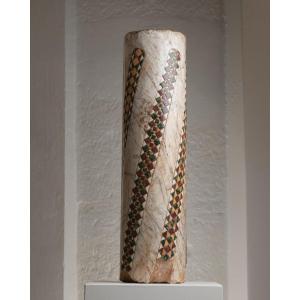
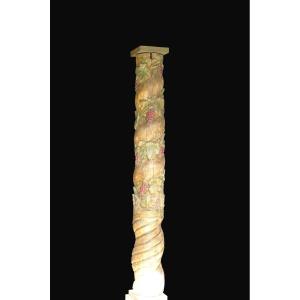
Twisted Marble Column – Italy – 14th Century
This twisted column in white marble, adorned with a Verde di Prato marble band and four-lobed relief motifs, stands as a refined example of Italian architectural sculpture. Dating from the 14th century, it most likely originated from a cloister or church portal in Tuscany, a region where Verde di Prato, a local stone, was historically quarried and used for centuries in numerous monuments. The creation of a helical shaft decorated with spirals, framed by two parallel lateral bands, creates a subtle interplay of light and shadow that captures the light and makes the material vibrate, revealing the purity of the marble and the depth of the green. The four-lobed motifs punctuate the surface, adding a refined geometric dimension. The two-tone decoration, combining the white of the marble with the green of the Verde di Prato, is characteristic of the Tuscan Romanesque style, found in many cities such as Pisa, Pistoia, Lucca, and Florence. This chromatic and material combination not only visually rhythmically structures the sacred spaces but also situates the column within an aesthetic and symbolic tradition deeply rooted in local religious architecture. The twist, by introducing an upward movement, symbolizes the soul's ascent towards the divine. Before the 13th century, architectural columns primarily served a structural and decorative function. Our column belongs to the Italian Gothic tradition, where artists adapted the classical heritage to new aesthetic and spiritual demands, and ornamentation took on a more pronounced symbolic and spiritual meaning. Comparable examples can be found in the cloister of the Basilica of Saint Paul Outside the Walls in Rome, where the spiraling shafts rhythmically structure the space and complement the sacred light, lending the stone a sense of movement. The twist, framed by the lateral fillets, guides the eye and organizes the surface, while the four-lobed motifs punctuate the spiral with elegance, creating a balance between dynamism and rigor. Thus, this twisted column, through the delicacy of its motifs, the harmony of its materials, and the simplicity of its profile, embodies a rare equilibrium between architecture, decoration, and religious symbolism. It bears witness to the Italian sculptural art of the late Middle Ages and retains all the evocative power of an art where white marble and Verde di Prato, enlivened by light, become visible supports of faith and instruments of spiritual contemplation.
12 000 €
Period: Before 16th century
Style: Renaissance, Louis 13th
Condition: Excellent condition
Material: Marble
Width: 20 cm
Height: 48 cm
Reference (ID): 1673190
Availability: In stock
Print