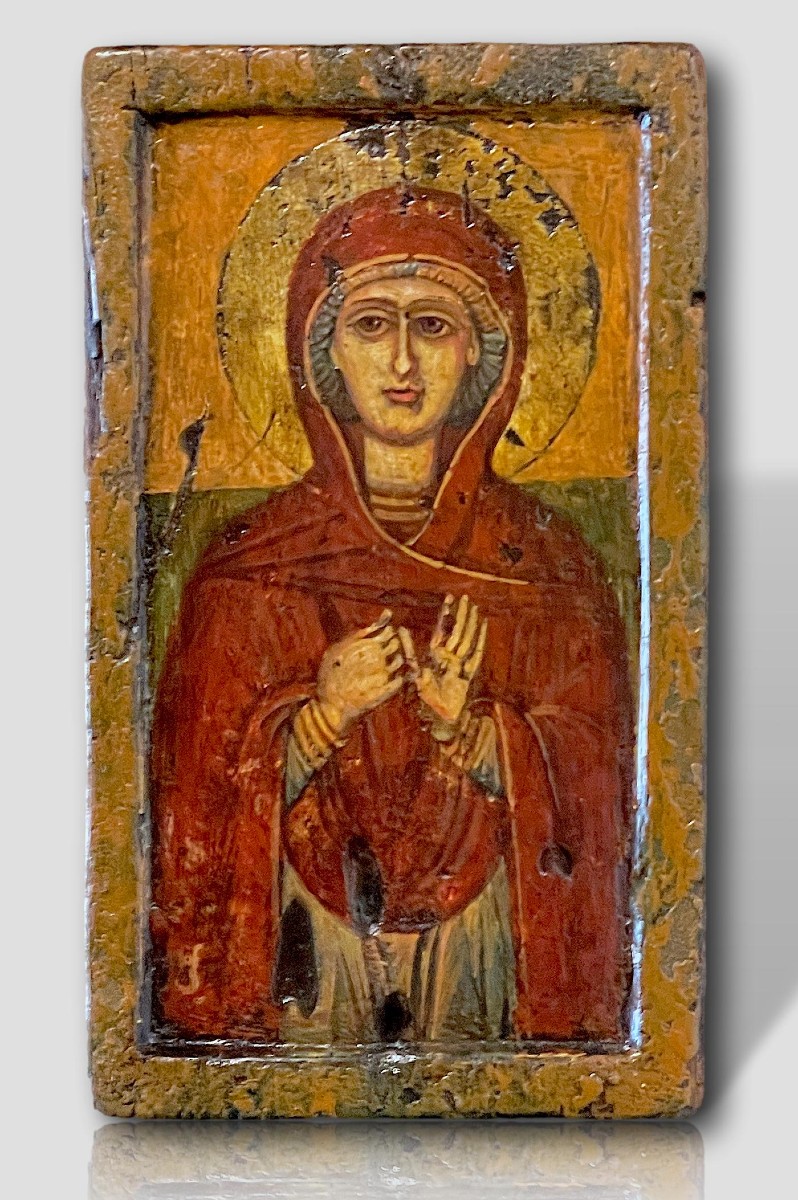
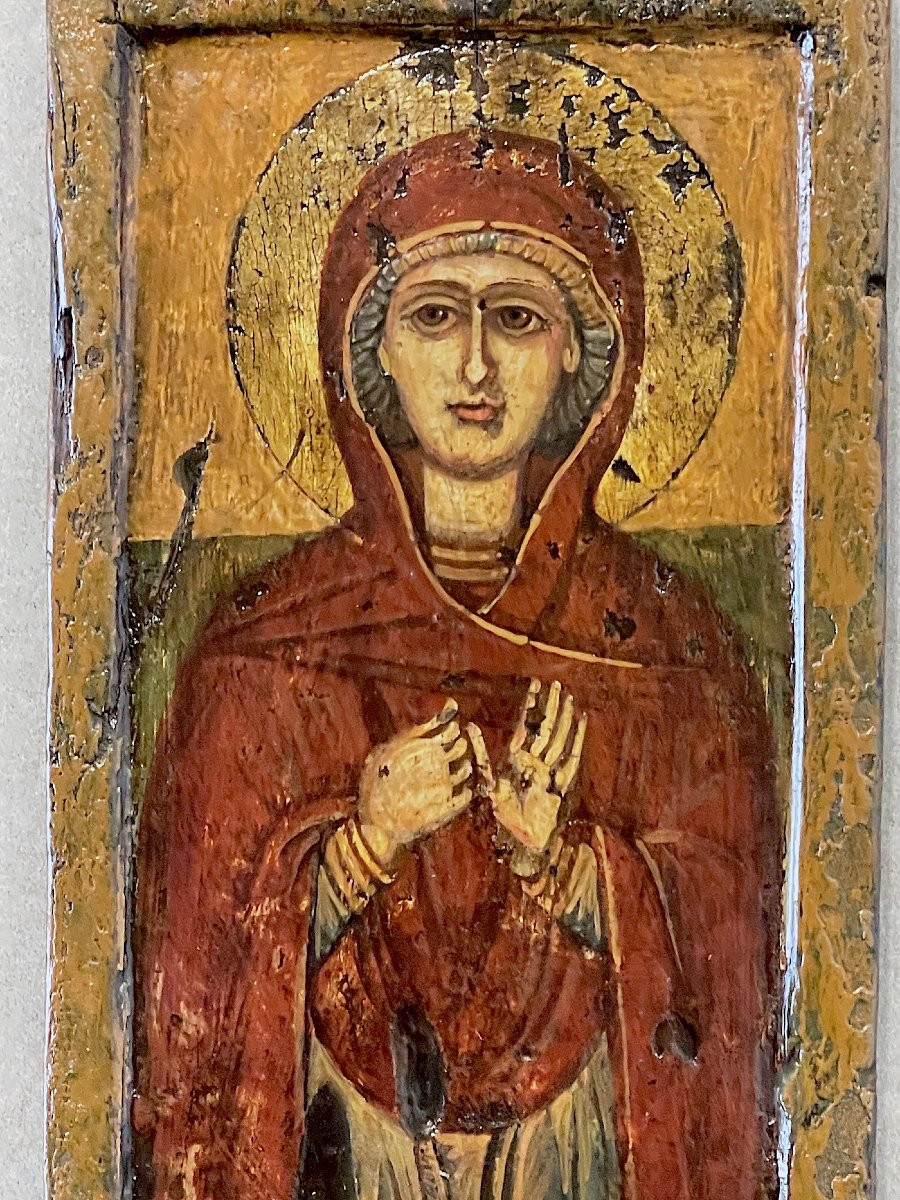


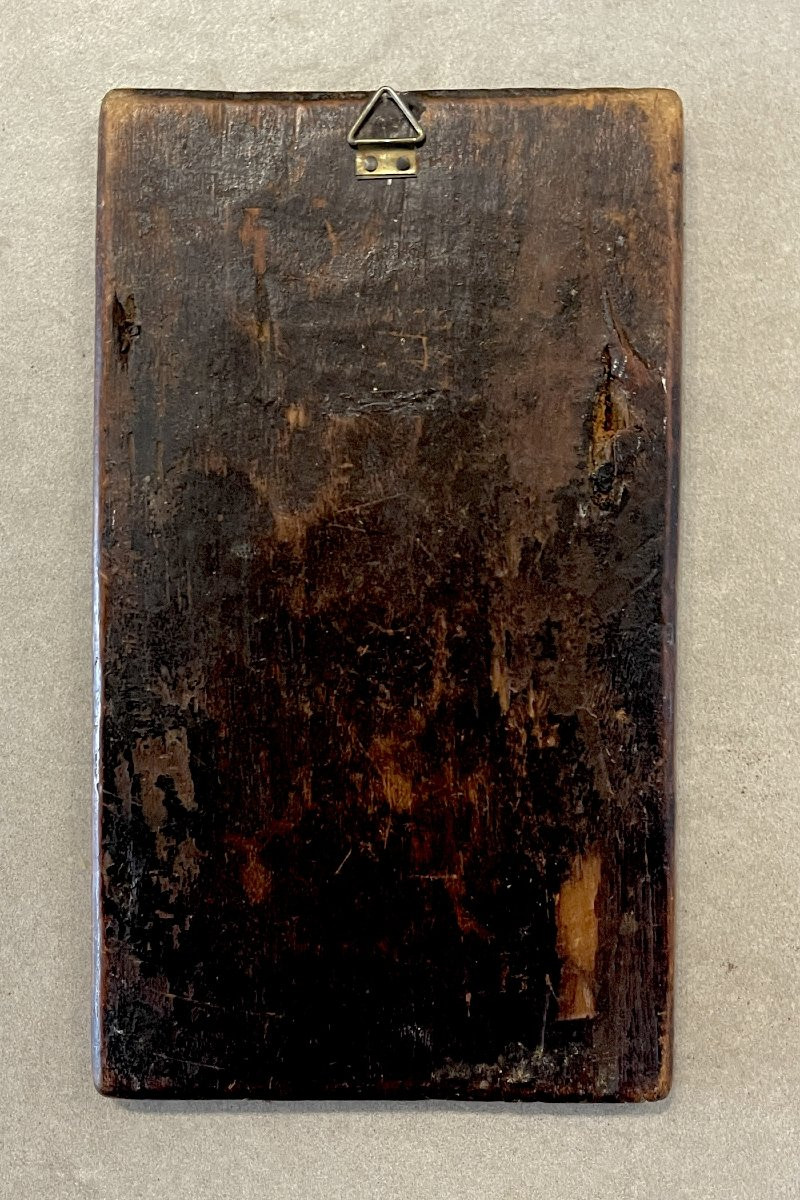


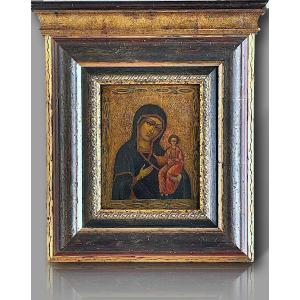
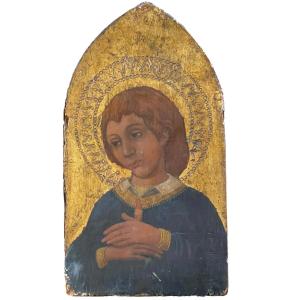
This refined early icon depicts a haloed Holy Woman, shown half-length in an attitude of interior prayer and contemplative stillness, her hands gently crossed upon her chest in the traditional gesture of silent intercession.
The image embodies the essence of late Byzantine spirituality, where restraint of movement and intensity of gaze replace narrative action.
Painted in egg tempera on a wooden panel, the icon retains its original levkas preparation and a recessed integral frame carved from the same board (Kovcheg), a feature characteristic of Orthodox icon production between the late 15th and mid-16th centuries.
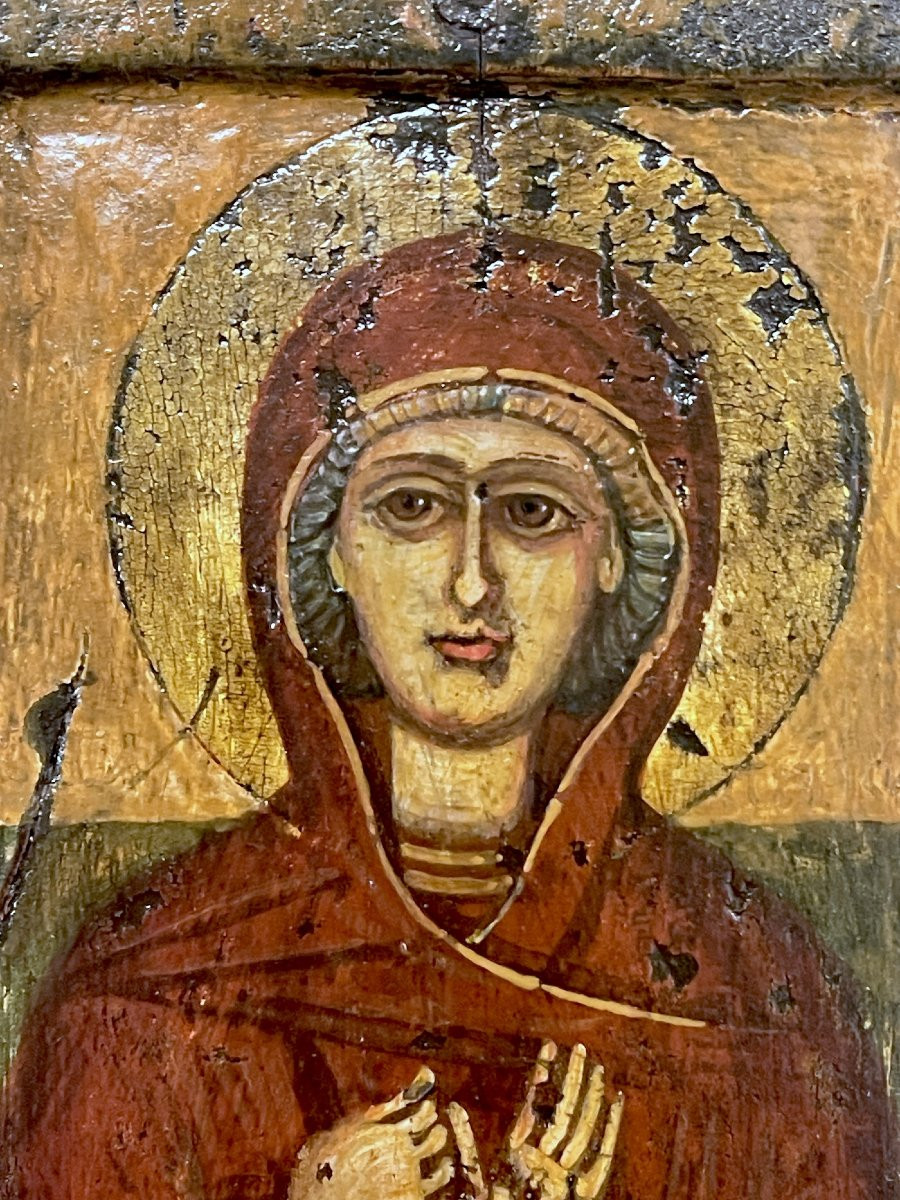
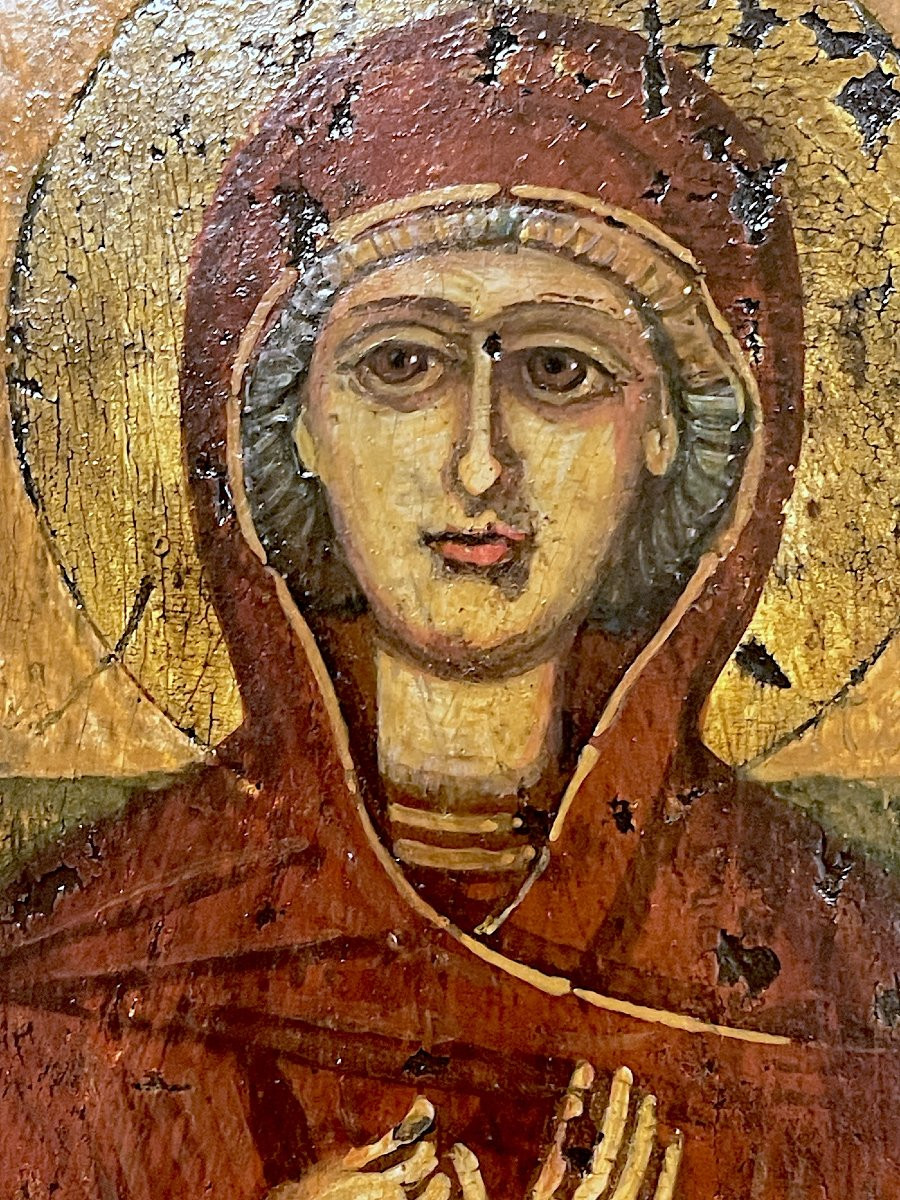
Stylistic and Iconographic AnalysisThe elongated oval face, marked by a serene hieratic expression, is framed by a deep purple mantle covering a veil in muted blue-green tones, delicately nuanced.
The flesh tones are subtly modeled through fine highlights and translucent layers combining golden ochres, red earths, and lead white, creating a warm and luminous presence.
The almond-shaped eyes, slender elongated nose, and controlled stylization of forms reflect the late Palaiologan tradition, transmitted and renewed by Cretan workshops under Venetian influence.
The circular halo, finely incised into the gilded background, reinforces the sacred character of the figure and situates her beyond earthly temporality.
The gold ground, symbol of uncreated light, expresses according to Orthodox theology the Saint’s participation in divine radiance, echoing the doctrine of the Transfiguration.
Technique and MaterialsThe iconographer employed egg tempera applied over a white gesso ground, using traditional natural pigments, including:
yellow ochre and earth pigments,
cinnabar and red earths for the drapery,
malachite for the green hues,
lead white for highlights and flesh modeling.
The composition is strictly frontal, the figure filling the pictorial field, in accordance with Byzantine canons intended to establish a direct spiritual encounter between image and beholder.
Historical Context and Devotional UseIcons of this type were widely disseminated throughout the late Byzantine world, and later within Slavic and Balkan territories, serving private or monastic devotion.
Smaller formats such as this example (22 × 13 cm) were particularly suited for domestic prayer, sometimes incorporated into portable diptychs or triptychs.
The Saint depicted—possibly Saint Anne, Saint Mary Magdalene, or Saint Thecla—embodies the virtues of faithfulness, compassion, and interior prayer, intentionally rendered without specific attributes in keeping with an austere iconographic tradition.
Attribution and Artistic QualityThe clarity of drawing, harmonious chromatic balance, and restrained expressiveness closely relate this icon to the Cretan workshops active in Candia (modern Heraklion), whose models circulated widely, from Venice to the Balkans.
The work reveals the hand of an experienced workshop, likely that of a monk-painter trained within the Orthodox tradition, where canonical rigor is balanced by refined pictorial sensitivity.
The particularly expressive treatment of the eyes and hands, combined with the purity of color planes, lends this icon a quietly radiant and deeply contemplative presence.
School: Cretan / Italo-Byzantine
Date: 16th century (circa 1500–1550)
Medium: Egg tempera on panel, gold ground
Dimensions: 22 × 13 cm
Condition: Overall good condition; minor wear, small losses, and a homogeneous aged patina consistent with age and devotional use
#ByzantineIcon #EarlyIcon #CretanArt #OrthodoxIcon
#EggTempera #ReligiousArt #AntiqueArt #ByzantineArt
#ChristianIconography #SacredArt #16thCenturyIcon
#ArteCollection #Proantic #OrthodoxHeritage
All artworks are professionally packed by MBE (Mail Boxes Etc.) – Narbonne, ensuring secure, museum-standard packaging suitable for fragile and historic works of art.
Shipping is handled by UPS, FedEx, or GLS, with full tracking and worldwide delivery.
For purchases exceeding €4,000, a comprehensive ad valorem insurance policy is systematically arranged through Trans-Pass, guaranteeing full coverage throughout the entire transport process.













 Le Magazine de PROANTIC
 TRÉSORS Magazine
 Rivista Artiquariato