Jacques Callot (Nancy, 1592–1635)
Entrance of the Duke of Lorraine – Court Festival in Nancy
Engraving on laid paper
Dimensions: 7.3 × 11.3 cm
Dating: 17th century (after 1627)
The engraving is related to the ducal celebrations held in Nancy in 1627, organized on the occasion of the ceremonial entrance of the Duke of Lorraine, allegorically represented as the Sun. The print belongs to a series of four engravings conceived by Jacques Callot to preserve the memory of the court festivities and the ephemeral structures created for the event.
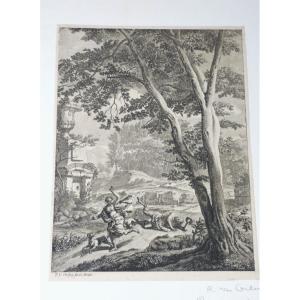
The scene depicts a theatrical structure conceived as an artificial garden, developed on several levels, with terraces, balustrades and ornamental vases. At the center stands a fountain supported by a satyr, a decorative and allegorical element typical of Baroque festive apparatuses, alluding to natural and instinctive forces placed in the service of celebratory order. Around the structure move allegorical and satirical figures, engaged in symbolic actions that enhance the spectacular and allusive character of the composition, without referring to a specific mythological episode.
The composition reflects Jacques Callot’s taste for the grotesque and the bizarre, with minute figures and ephemeral constructions rendered as theatrical machines charged with irony and ambiguity, in which ceremonial order is crossed by a subtle and slightly unsettling tension, characteristic of his vision of court festivities.
The engraving is connected to the preparatory drawings preserved at the Musée Condé in Chantilly, belonging to the same series, as well as to impressions now held in French public collections, confirming the circulation and importance of this cycle.
The print is impressed on laid paper made on a hand mould, showing very closely spaced vertical laid lines and regular, well-spaced horizontal chain lines, clearly visible in transmitted light. The structure of the paper is a significant element for dating: the consistent spacing of the chain lines and the fineness of the laid lines correspond to French and Lorraine paper production of the early 17th century, distinct from both contemporary Italian papers and later productions. The rag-based pulp, fine grain, and naturally developed patina are consistent with an early impression, compatible with a 17th-century printing.














 Le Magazine de PROANTIC
 TRÉSORS Magazine
 Rivista Artiquariato