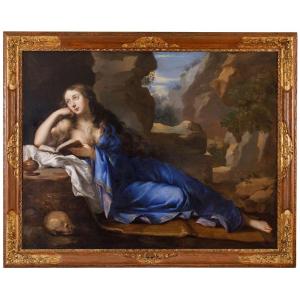



Flemish School, Circa 1650–1670, Landscape With The Penitent Magdalene
Artist: école Flamande, Vers 1650–1670
FLEMISH SCHOOL, c. 1650–1670
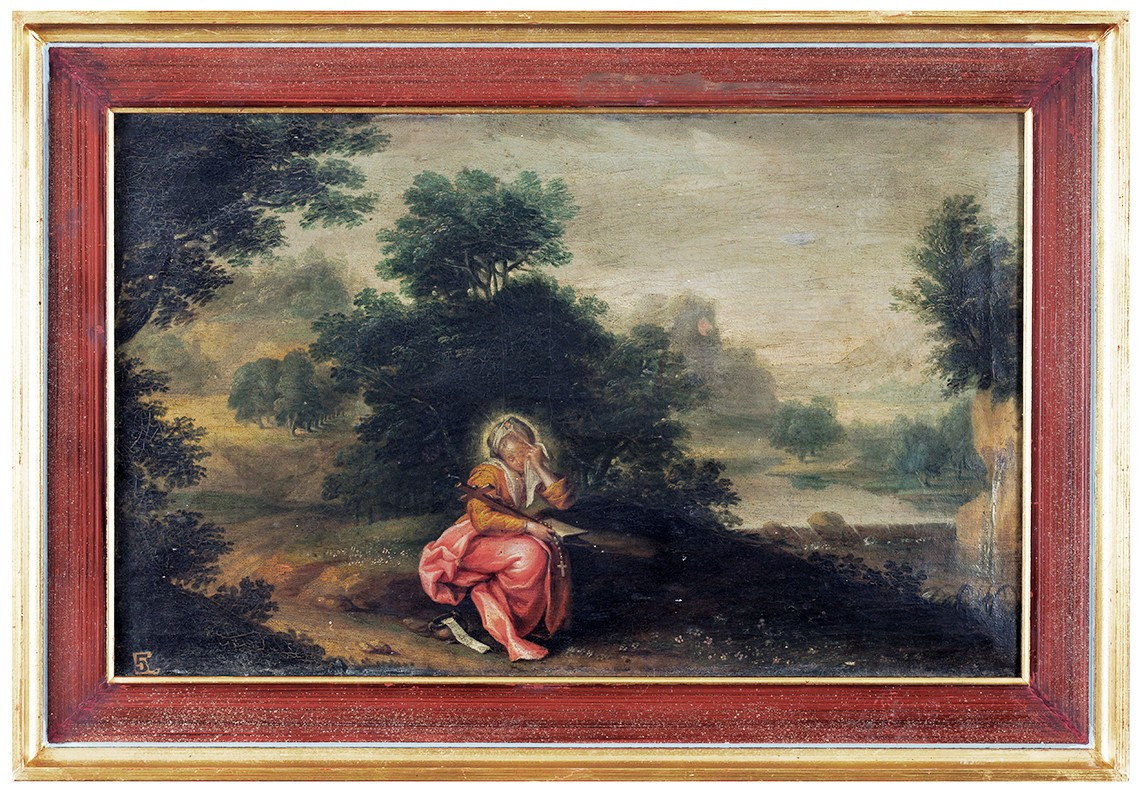
LANDSCAPE WITH THE PENITENT MAGDALENE
Oil on canvas, laid down on panel
31 × 49 cm / 12.2 × 19.3 in
with frame: 40 × 58 cm / 15.7 × 22.8 in
PROVENANCE: European private collection.
Flemish landscape painting of the mid-seventeenth century underwent a marked shift: the densely populated, meticulously detailed idiom inherited from Jan Brueghel the Elder and Abraham Govaerts gradually gave way to a more restrained and lyrical mode cultivated by the so-called “minor masters,” among them Pieter van Avont and painters working in the tradition of Jasper van der Lanen. Their landscapes are characterised by broader, freer perspectives, a reduced accumulation of ornamental detail and a more unified, often subtly monochromatic tonal structure that lends the compositions a distinctly poetic atmosphere. This evolution, already visible by the 1650s, defined a quieter, more introspective phase of the Antwerp school.
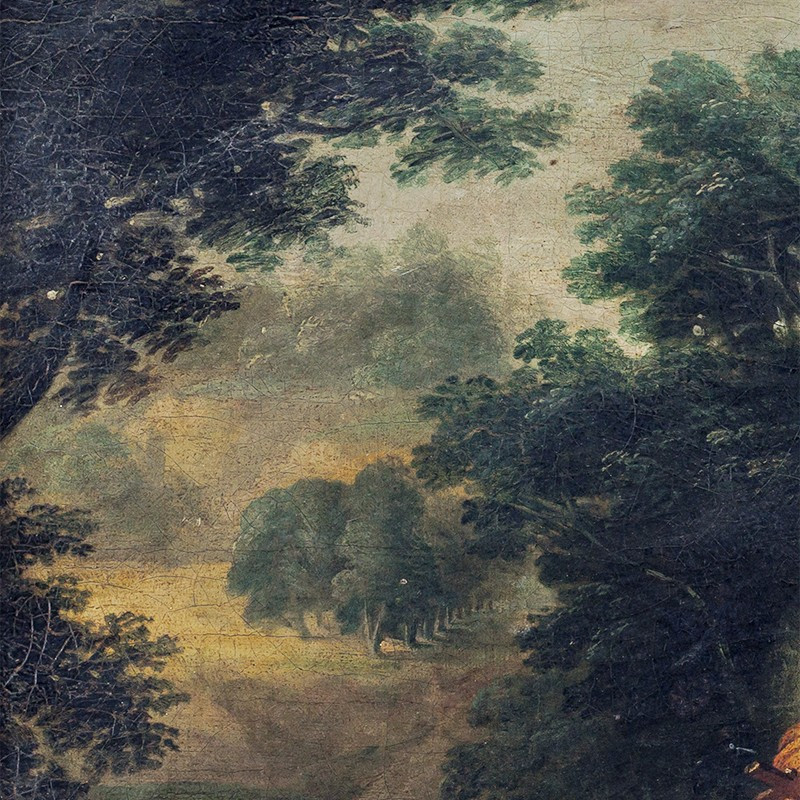
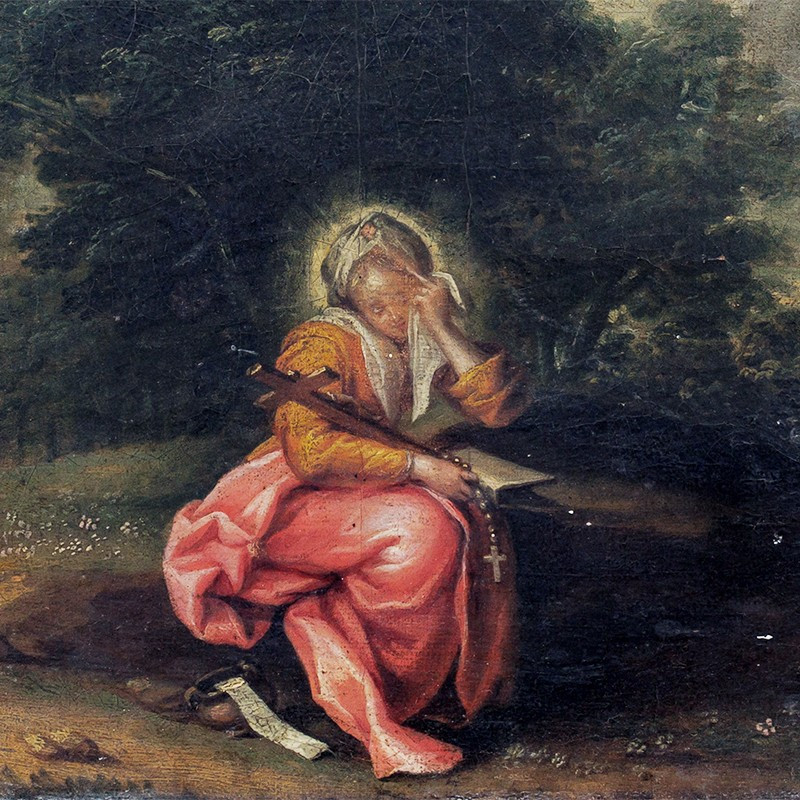
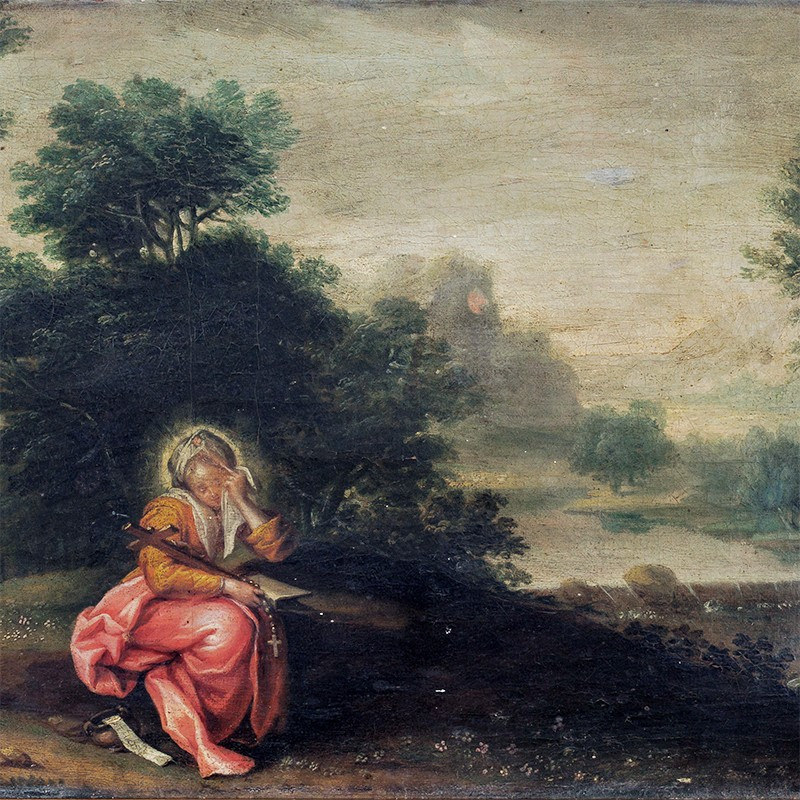
The present painting exemplifies this development with unusual clarity. The figure of Mary Magdalene functions primarily as staffage, harmoniously integrated into the setting rather than dominating it. The artist’s real preoccupation lies in the construction of an unfolding spatial continuum: the viewer’s eye moves from the rocky outcrop and downward rush of the waterfall on the right—establishing the compositional axis—to the receding open distance on the left, where forms soften into atmospheric light. This sense of spatial breathing, combined with modulated transitions of green, ochre and muted blue, aligns the work with the tonal landscape aesthetic that defined Antwerp production around the middle decades of the century.
The small waterfall introduces an additional layer of meaning. In Flemish devotional landscapes of this period, running water often served as a quiet emblem of transience, subtly reinforcing the contemplative presence of the Penitent Magdalene. Without resorting to overt symbolism, the painter allows natural motifs—a broken tree trunk, the rushing stream, the fading horizon—to echo the moral undertones of penitence and vanitas. The result is a landscape both atmospheric and introspective, rooted in the mid-seventeenth-century Flemish tonal tradition yet sensitively attuned to its devotional subject.
LANDSCAPE WITH THE PENITENT MAGDALENE
Oil on canvas, laid down on panel
31 × 49 cm / 12.2 × 19.3 in
with frame: 40 × 58 cm / 15.7 × 22.8 in
PROVENANCE: European private collection.
Flemish landscape painting of the mid-seventeenth century underwent a marked shift: the densely populated, meticulously detailed idiom inherited from Jan Brueghel the Elder and Abraham Govaerts gradually gave way to a more restrained and lyrical mode cultivated by the so-called “minor masters,” among them Pieter van Avont and painters working in the tradition of Jasper van der Lanen. Their landscapes are characterised by broader, freer perspectives, a reduced accumulation of ornamental detail and a more unified, often subtly monochromatic tonal structure that lends the compositions a distinctly poetic atmosphere. This evolution, already visible by the 1650s, defined a quieter, more introspective phase of the Antwerp school.
The present painting exemplifies this development with unusual clarity. The figure of Mary Magdalene functions primarily as staffage, harmoniously integrated into the setting rather than dominating it. The artist’s real preoccupation lies in the construction of an unfolding spatial continuum: the viewer’s eye moves from the rocky outcrop and downward rush of the waterfall on the right—establishing the compositional axis—to the receding open distance on the left, where forms soften into atmospheric light. This sense of spatial breathing, combined with modulated transitions of green, ochre and muted blue, aligns the work with the tonal landscape aesthetic that defined Antwerp production around the middle decades of the century.
The small waterfall introduces an additional layer of meaning. In Flemish devotional landscapes of this period, running water often served as a quiet emblem of transience, subtly reinforcing the contemplative presence of the Penitent Magdalene. Without resorting to overt symbolism, the painter allows natural motifs—a broken tree trunk, the rushing stream, the fading horizon—to echo the moral undertones of penitence and vanitas. The result is a landscape both atmospheric and introspective, rooted in the mid-seventeenth-century Flemish tonal tradition yet sensitively attuned to its devotional subject.
1 700 €
Period: 17th century
Style: Renaissance, Louis 13th
Condition: Good condition
Material: Oil painting
Length: 49 cm
Height: 31 cm
Reference (ID): 1670556
Availability: In stock
Print