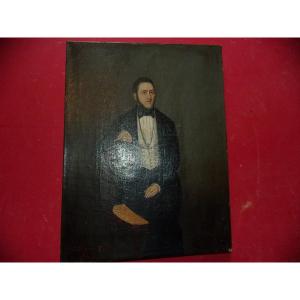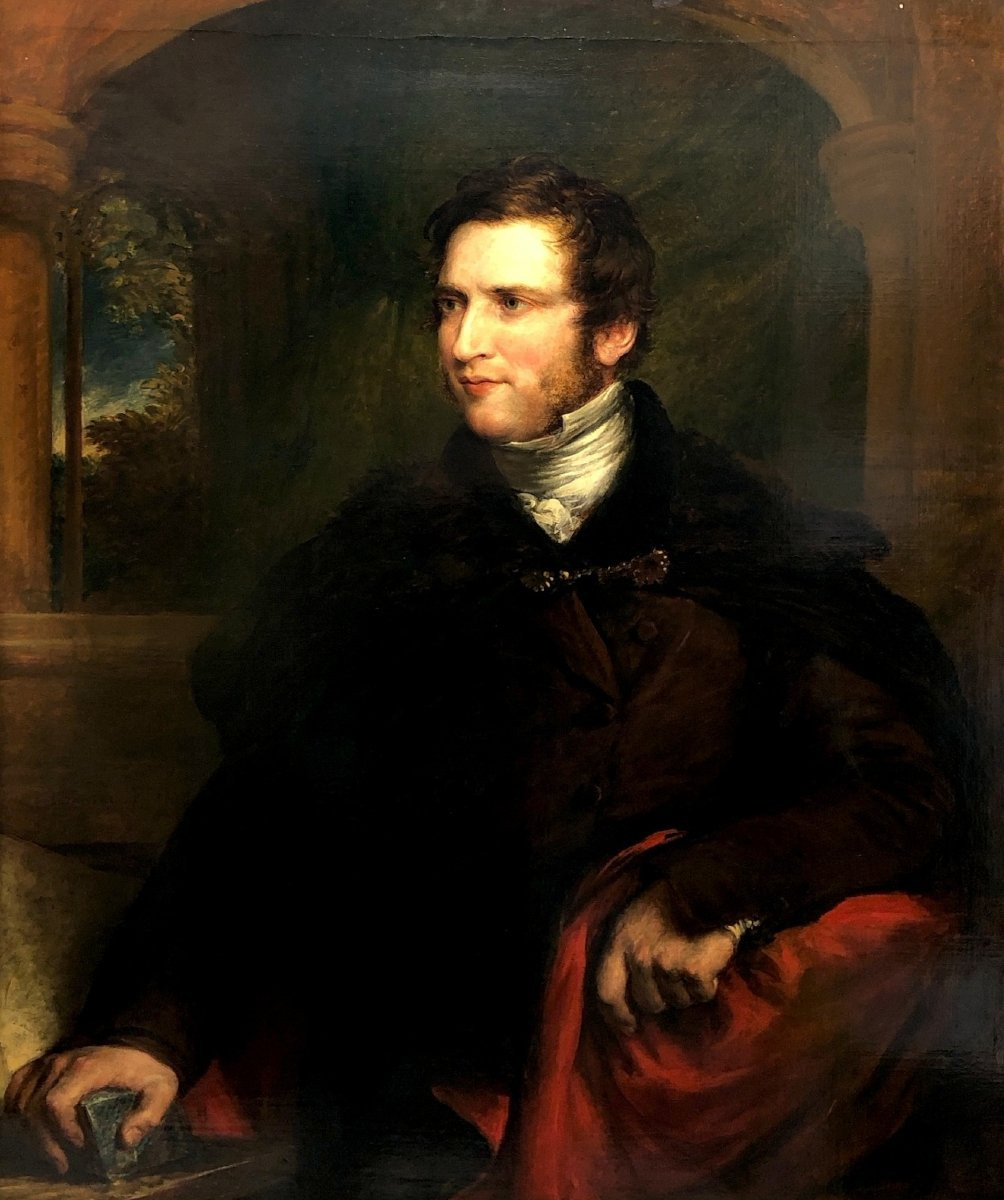


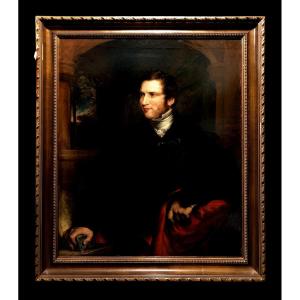


John Linnell (1792-1882) - Portrait Of The Architect Decimus Burton
- Oil on canvas. Signed and dated. Inscription "Section 1? J Arch / W Palace". - This impeccable account, executed with precision in 1830, depicts the eminent architect Decimus Burton during his three years (it includes a contemporary pastel account of the architect elaborated by Thomas Lawrence) and has become an aesthetic key to the King's story as Prince Regent. The pictorial power of the work maintains the canons of the modified English text, following the patterns established by figures such as Thomas Lawrence and Martin Archer Shee. Without embargo, the work seeks to have a new resonance to celebrate a professional journal specific to Burton: the completion of the Houses of Parliament in the monumental event of the Palace of Westminster. In direct relation to his profession, the artist anecdotally aggregated shadowy Gothic ruins of Romantic taste, a contrast that reflects the fascination of the era with the medieval past before Burton's Neoclassical passion. Linnell's magnificent technique is amplified by the quality of this work, one of the large-format collaborators produced by the artist, who normally limits his output to small-format paintings. This portrait must be formally linked to another painting in the Mateu Collection, also a portrait of a horseman, sold in 2020 at Ansorena in Madrid for €8,000. Decimus Burton (London, 1800–1881) was one of the most prolific and influential architects in the United Kingdom during the Regency and Victorian periods. Born into a family of builders, his career unfolded at an extraordinarily early age, demonstrating a masterful command of the pure Neoclassical style. Burton is primarily known for his contribution to the creation of elegant and functional urban landscapes, carrying out his work in London, where he designed the iconic Hyde Park Gate and the Pantheon on Regent Street. He was the principal architect of major estate and landscape projects such as Regent's Park and Kew Gardens. Furthermore, his design work for numerous public and residential buildings included his involvement in the interior of the Palace of Westminster (such as the Houses of Parliament). His ability to combine monumental scale with refined detail has cemented him as a key figure in defining the aesthetic of 19th-century British architecture. John Linnell (1792–1882) was a versatile philanthropist, retiree, and English farmer, considered a naturalist and rival of the painter John Constable. Born in Bloomsbury, his artistic training began tentatively, selling childhood souvenirs and studying with figures such as Benjamin West and John Varley, before entering the Royal Academy in 1805, where he won medals in drawing, model making, and sculpture. Throughout his career, Linnell initially championed miniatures and large-format narratives by figures like Thomas Carlyle, and devoted himself extensively to acquisitions, publishing transcriptions of frescoes by Miguel Angel and works from Buckingham Palace. Much of his own output is notable for his friend and patron, the visionary William Blake, who created the two greatest works of his life: the designs for the Inventions of the Book of Job and the illustrations for Dante. Once he had moved beyond historical and religious themes where landscape was important, Linnell is primarily remembered for his pure landscape paintings, capturing typical English scenes with an impressive amateur or artist's touch. His subject is distinguished by a rich and brilliant color, full of a verdadero poetic feeling. An admirer of Northern European Renaissance art, particularly Alberto Durero, he was also a central figure in Blake's circle, introducing him to the painter Samuel Palmer and other members of "The Ancients." In 1850, thanks to the large sums he received from his four friends, he acquired a property in Redhill, Surrey, where he lived until his death, devoting himself to landscape painting and the study of the Bible in its original language. - Dimensions of the image without frame: 81 x 104 cm / 99 x 122 cm with exclusive marking.
8 500 €
Period: 19th century
Style: Other Style
Condition: Excellent condition
Material: Oil painting
Reference (ID): 1670257
Availability: In stock
Print