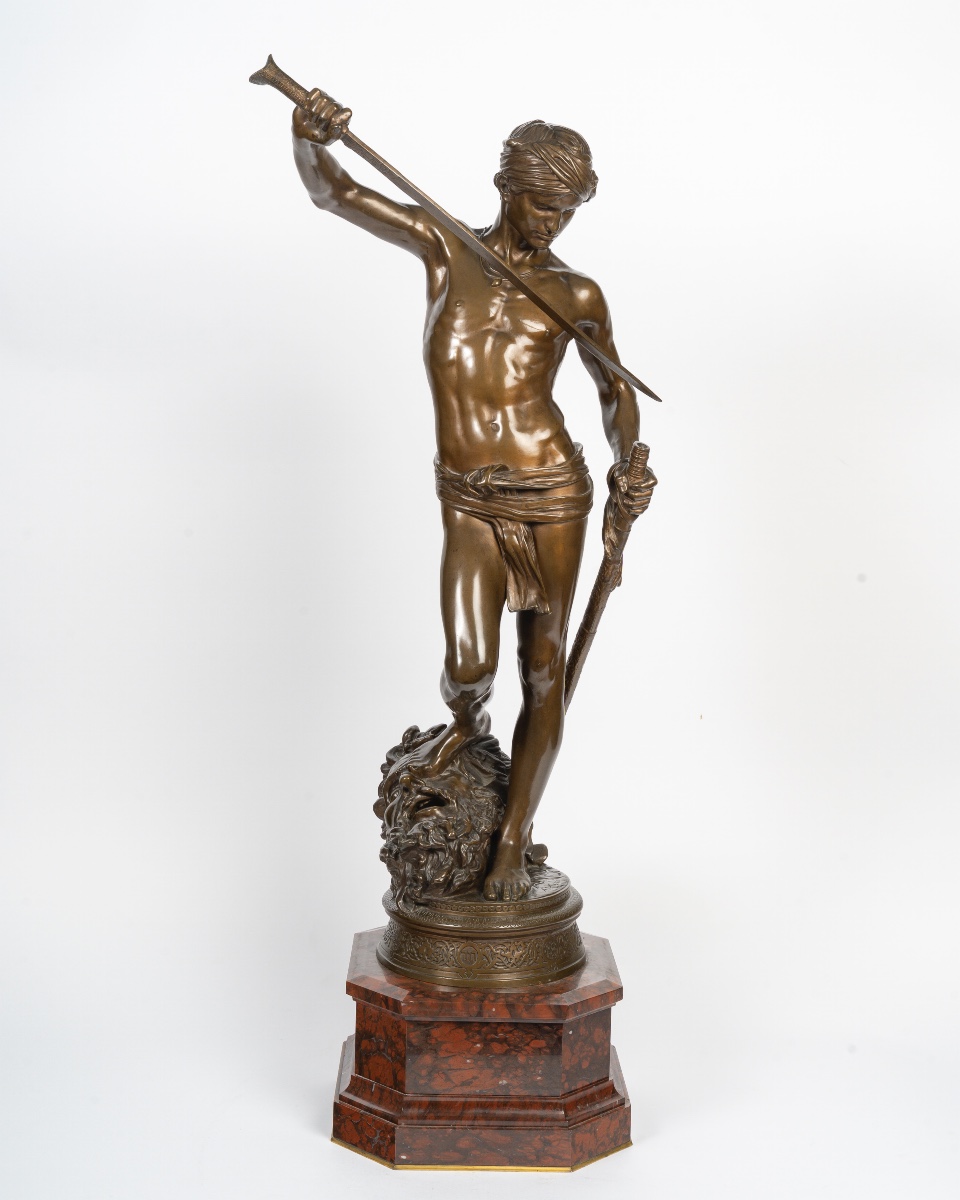
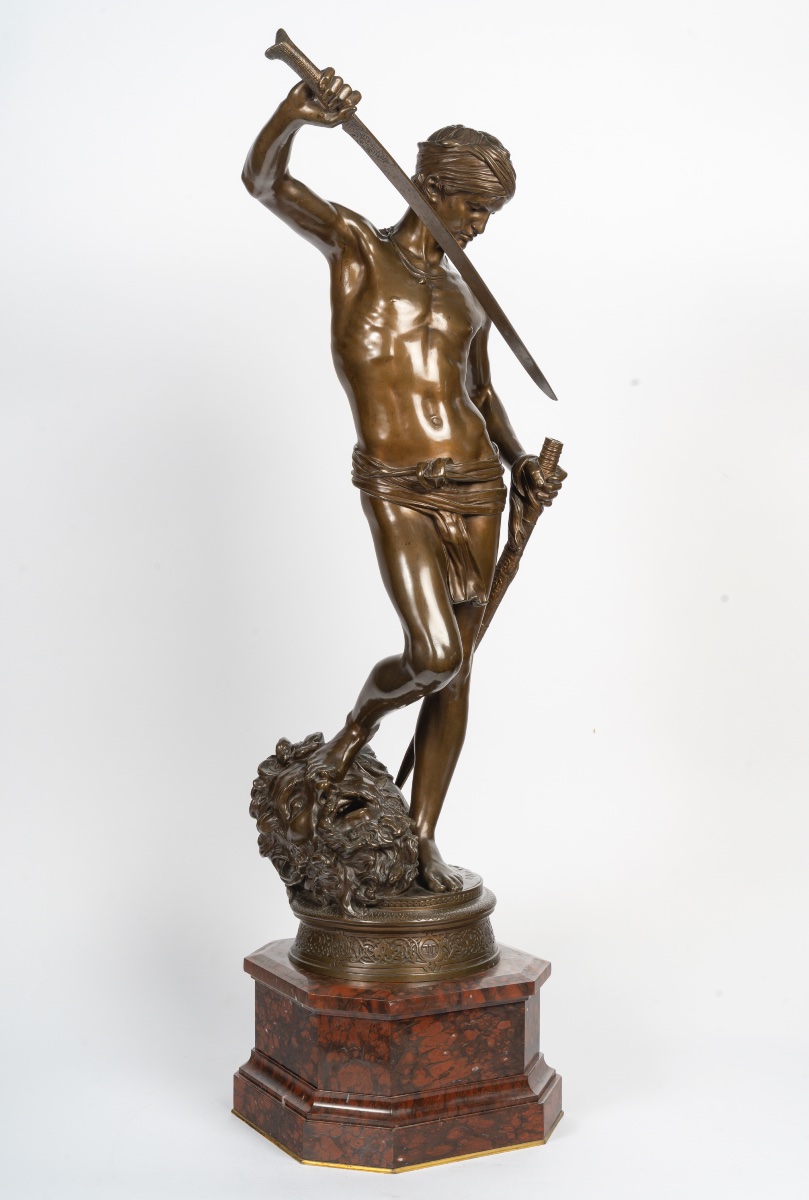
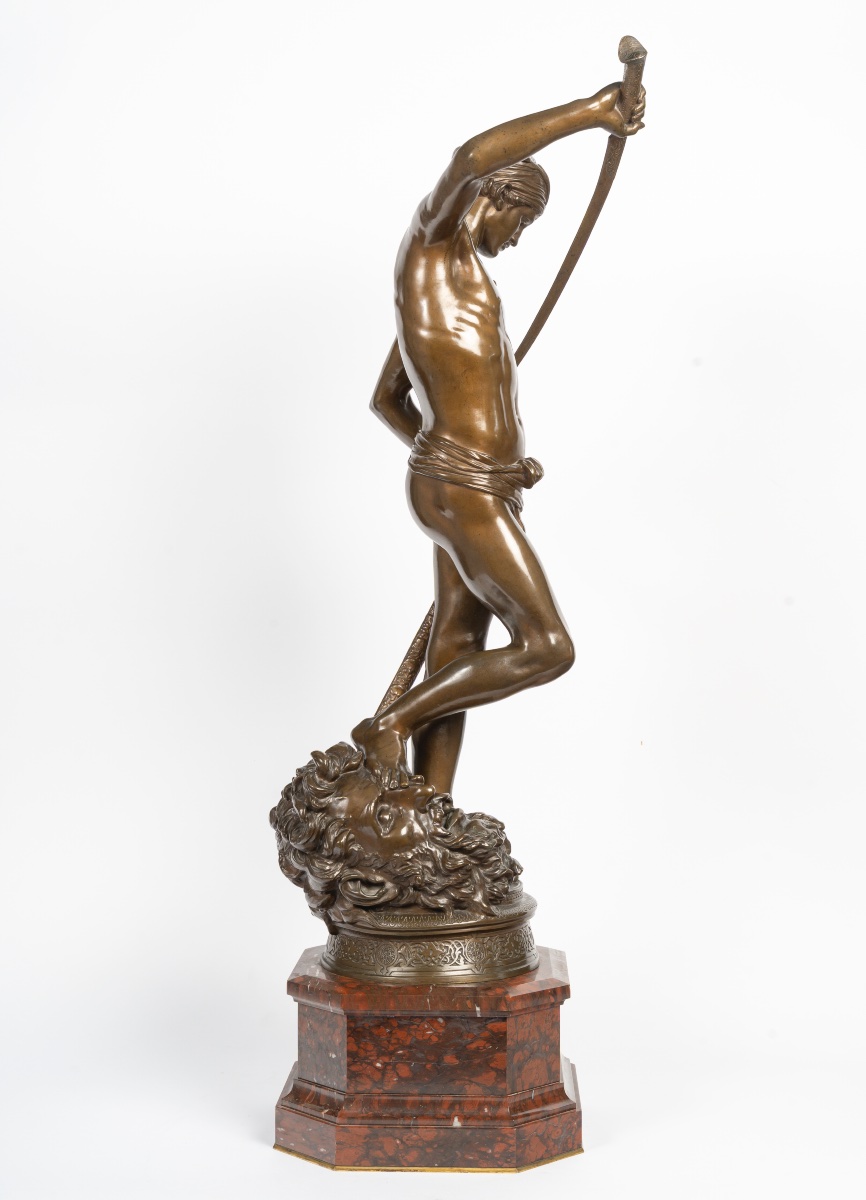

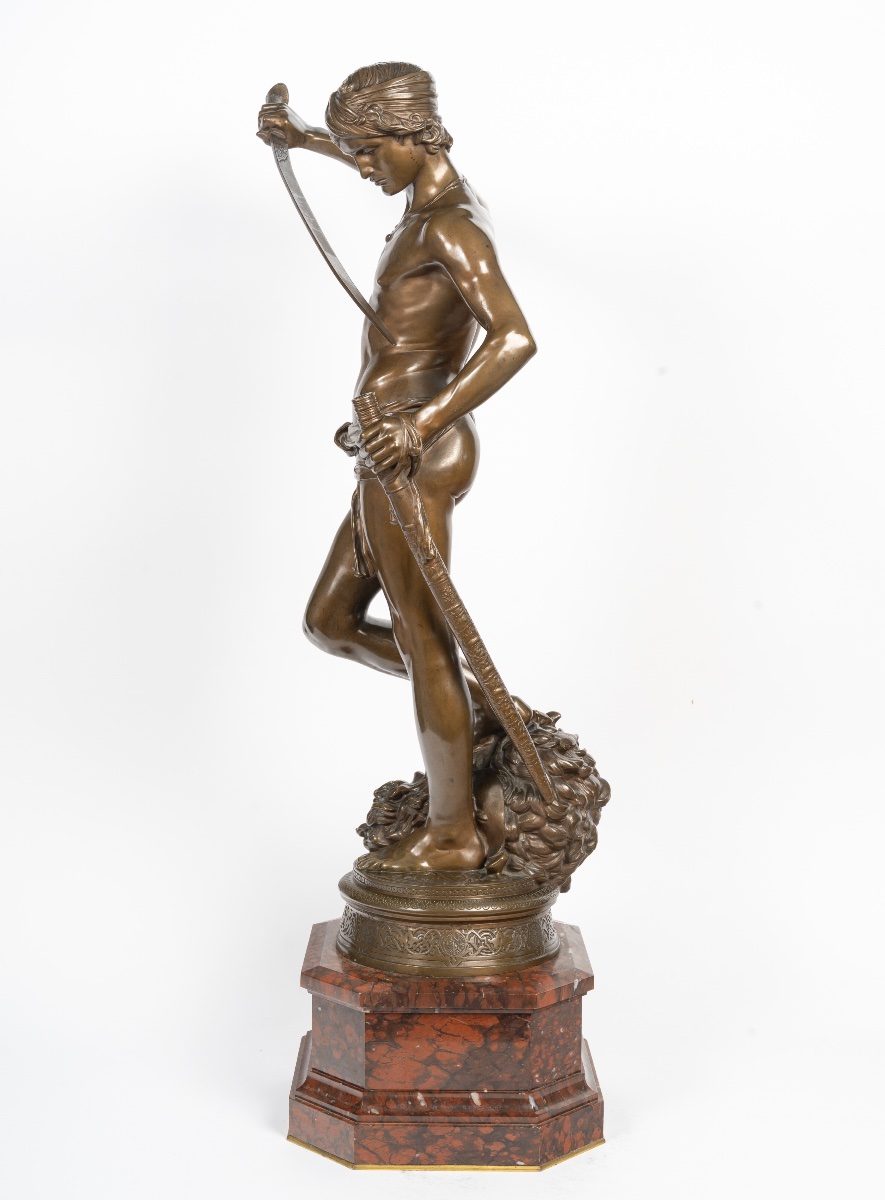
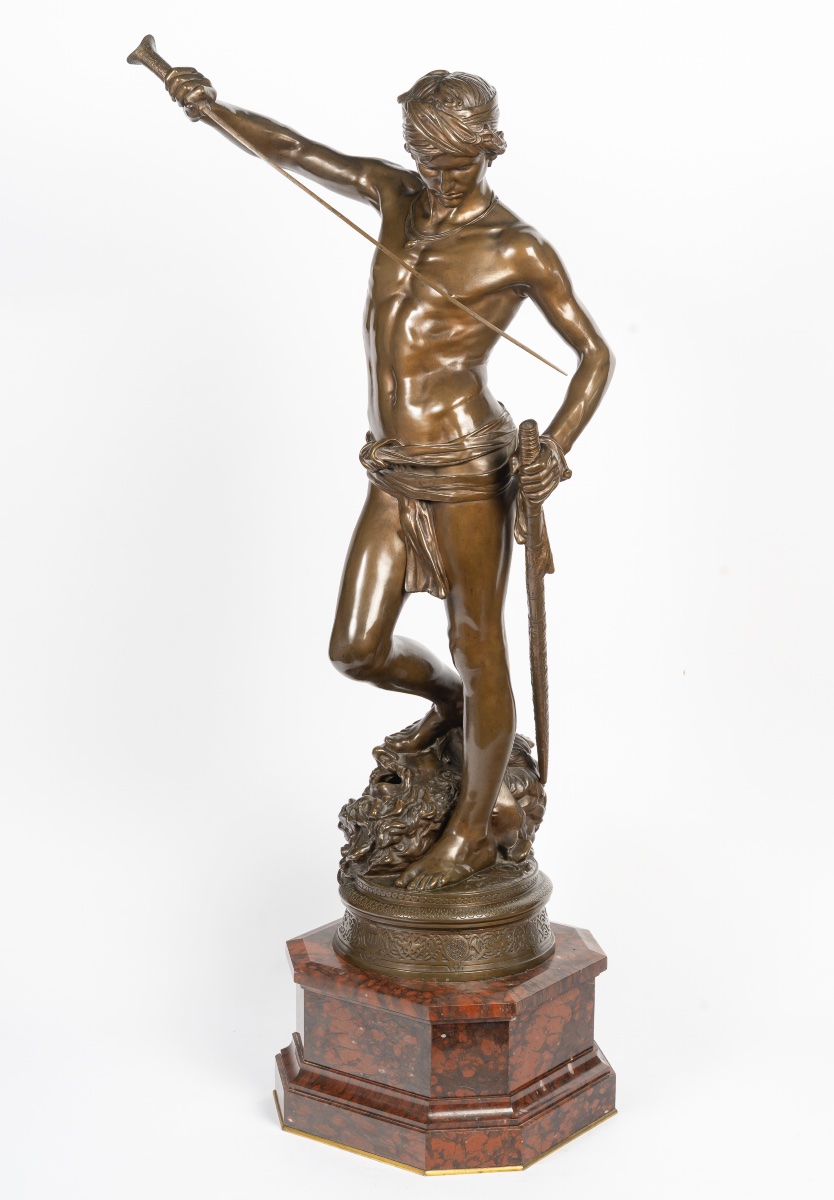
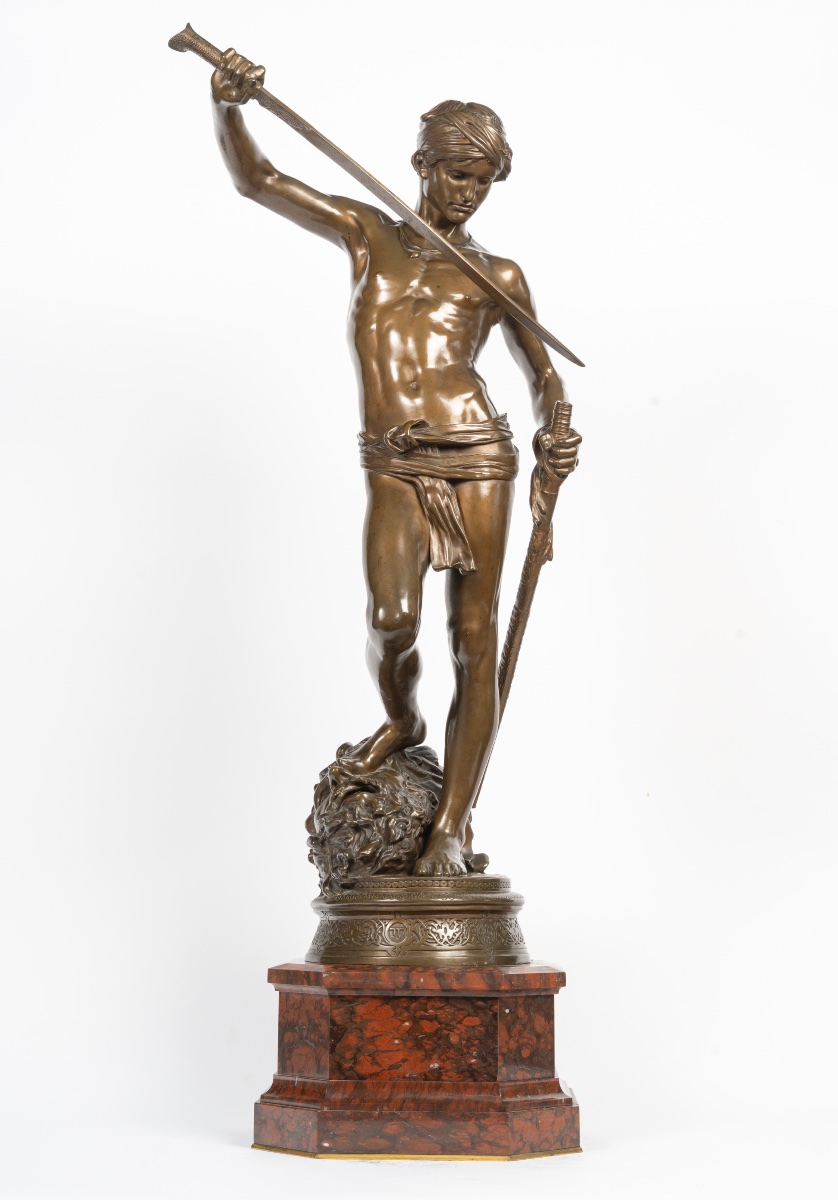
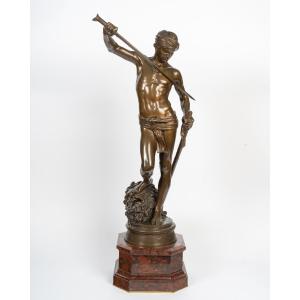


"Antonin Mercié (1845-1916) David, Victor Over Goliath"
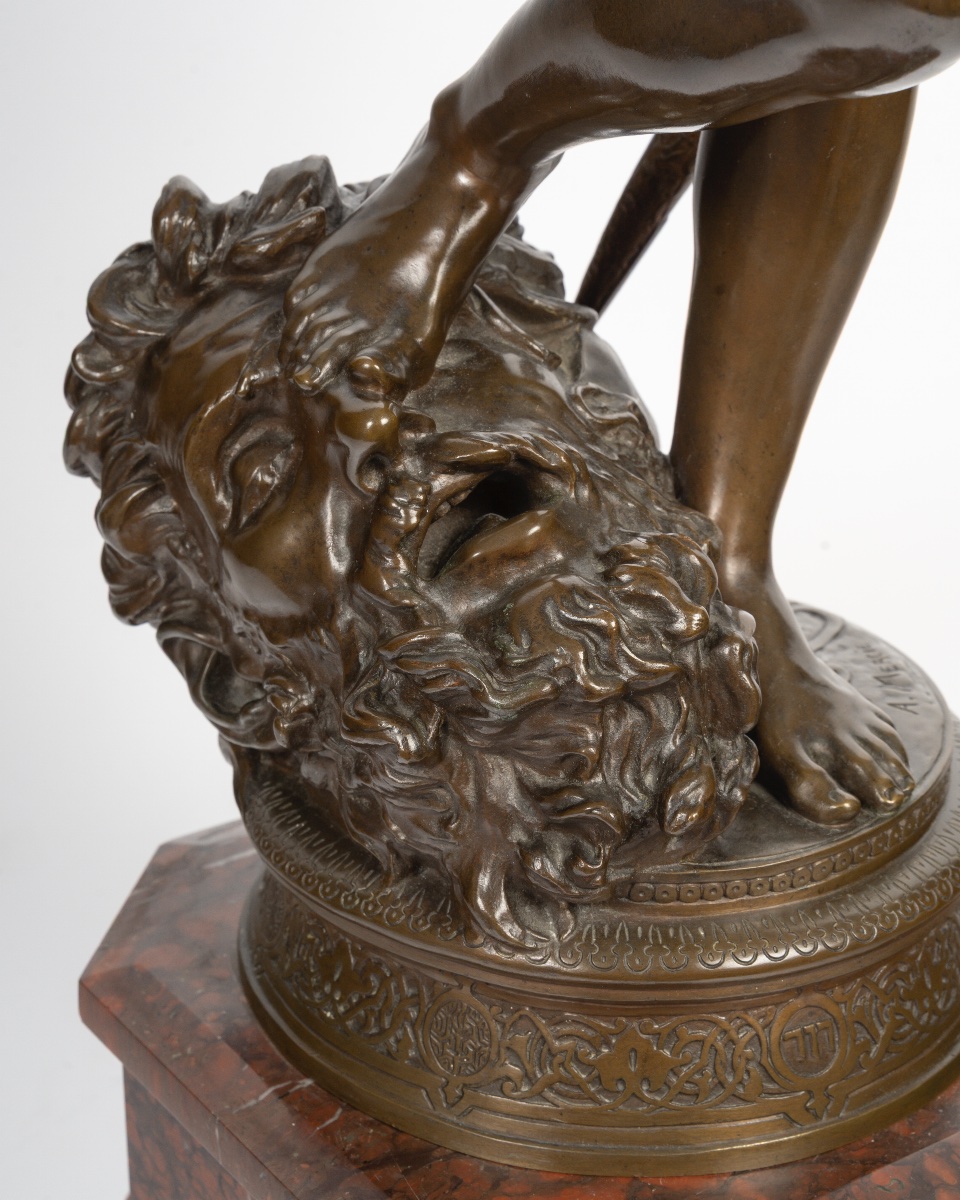
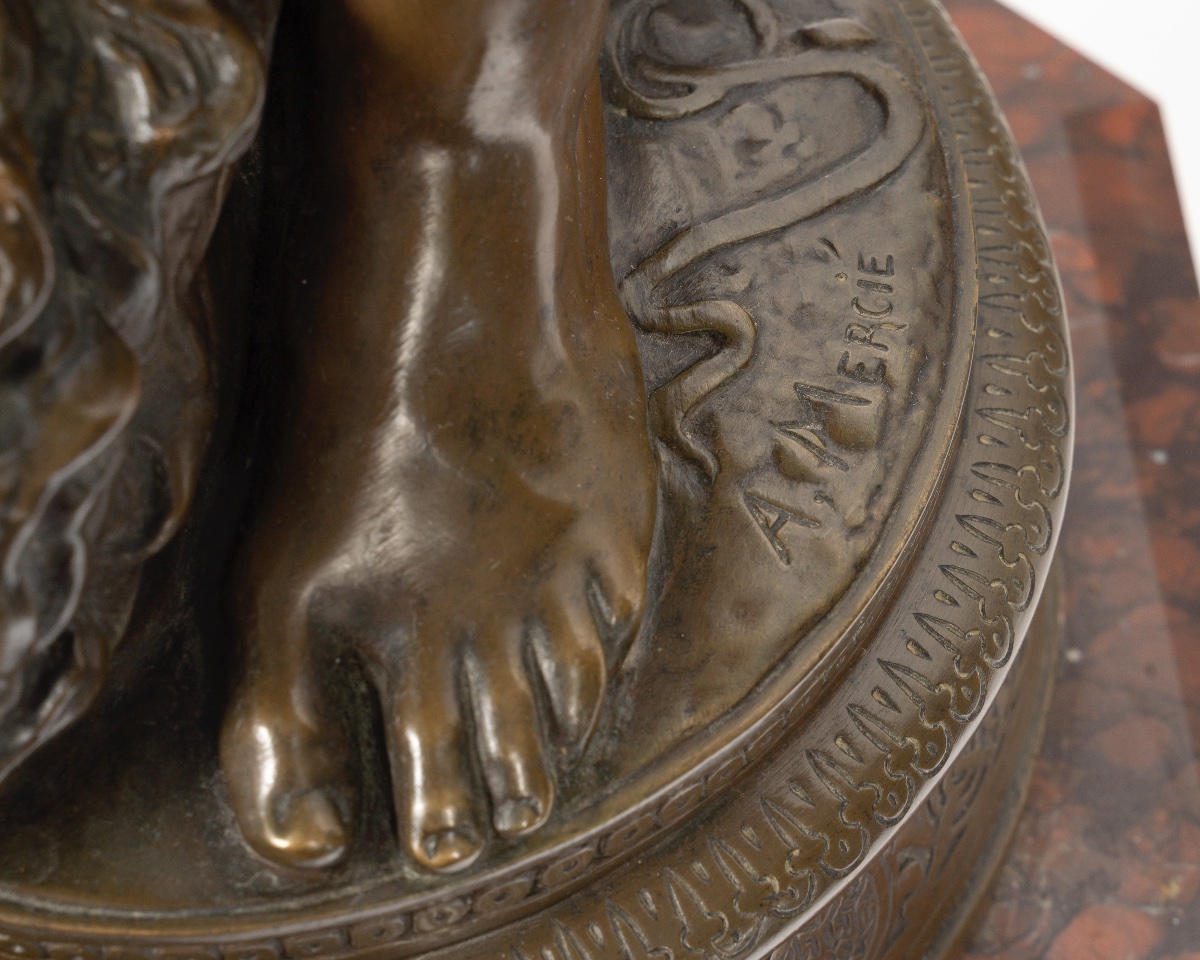
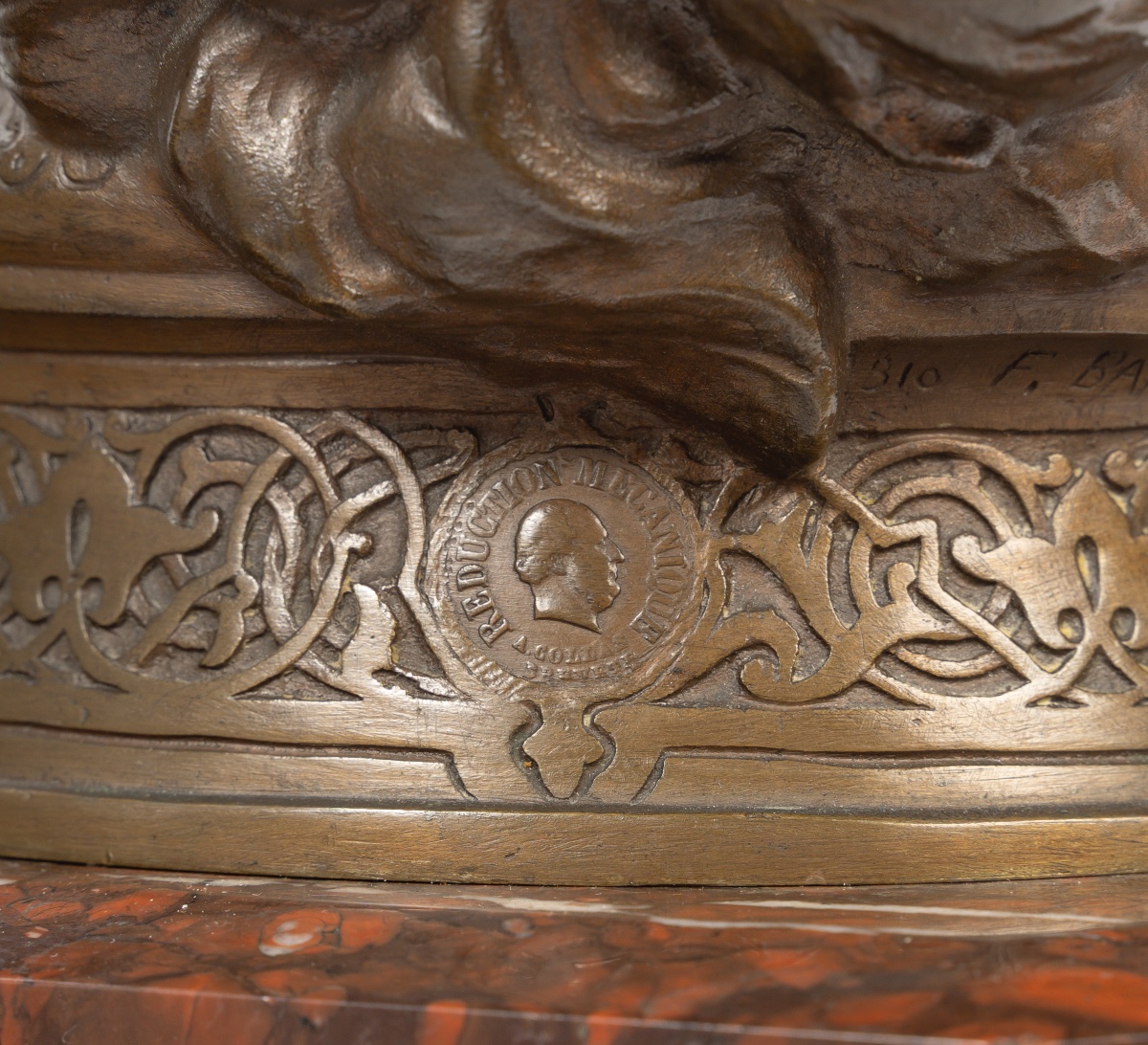
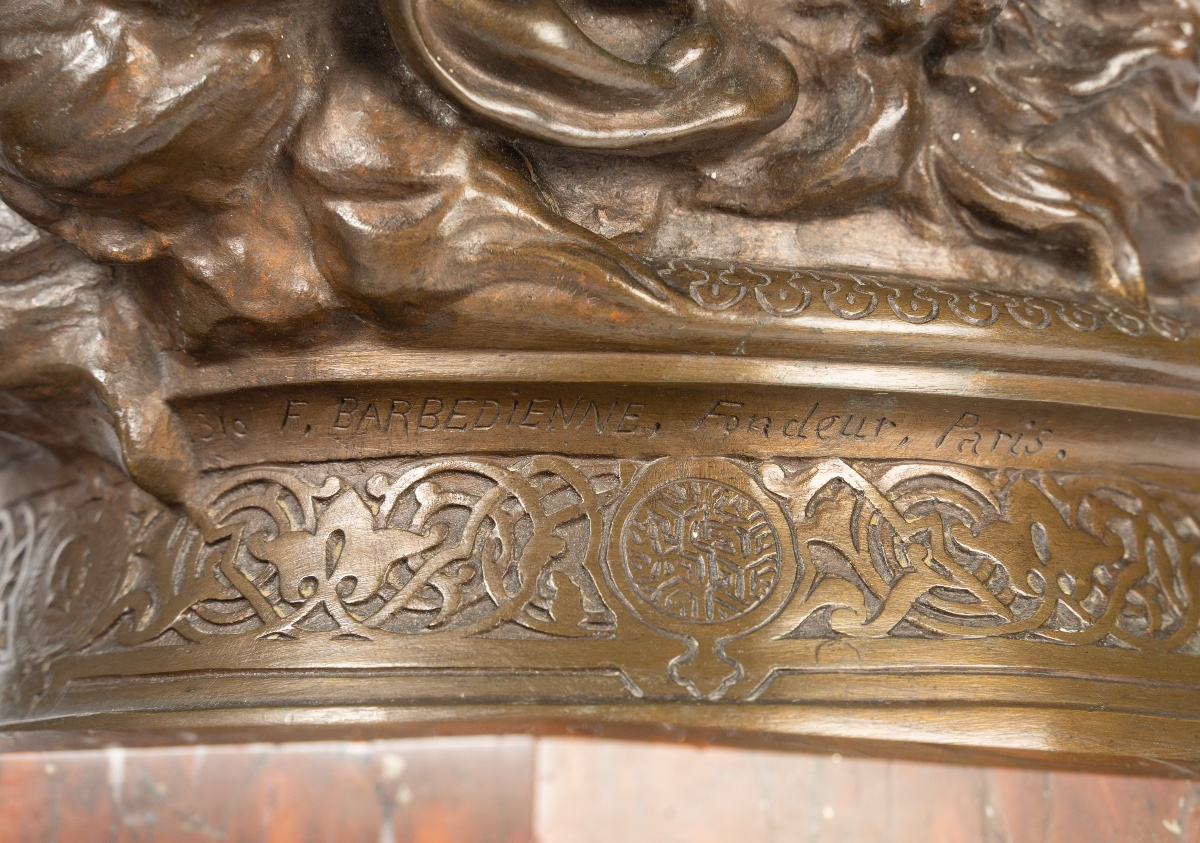
Bronze with a medal patina, signed "A. Mercié."Foundry mark: Ferdinand Barbedienne and stamp: "Reduction Mécanique COLLAS."
Circa 1890
Dimensions with base:
Height 87 cm
Width 25 cm
Depth 25 cm
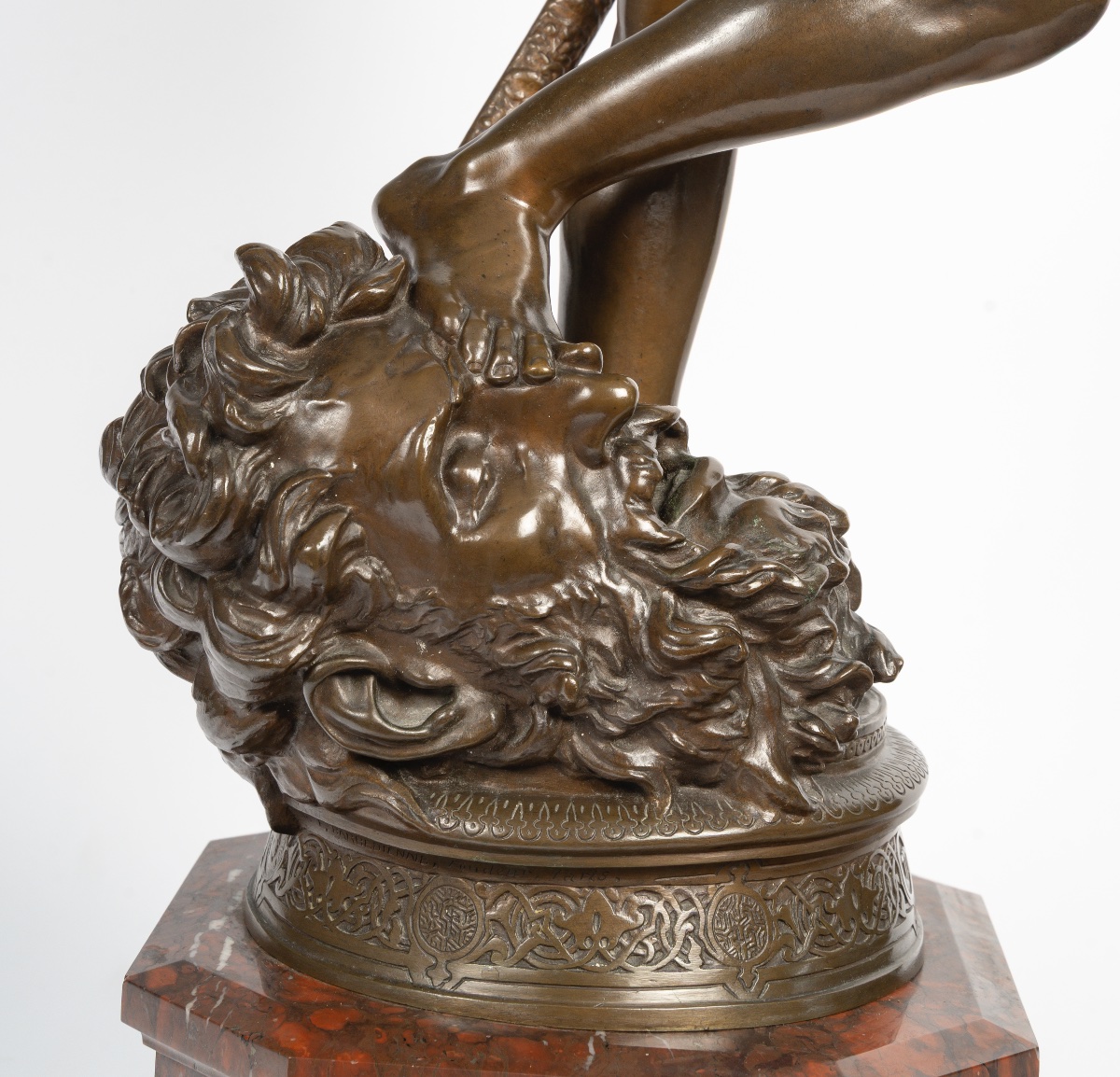
A beautiful sculpture depicting David after his victory over Goliath, an emblematic theme of the 19th century. Antonin Mercié, one of the most talented French sculptors of his generation, has created a figure of powerful realism and neoclassical elegance. The young David is shown standing in a victorious yet serene pose, his sword still held in his hand. The body is rendered with great anatomical finesse, showcasing Mercié's precise and energetic style. Goliath's head rests at the hero's feet, recalling biblical drama.
This work is one of Antonin Mercié's best-known compositions and is frequently featured in exhibitions of late 19th-century French sculpture. It perfectly illustrates the artist's mastery of the balance between strength, movement, and classical idealization.
Biography of Antonin Mercié (1845-1916)
French sculptor and painter, considered one of the major figures of late 19th-century academic sculpture.
He was born in Toulouse in 1845. Gifted in drawing and sculpture from a very young age, he entered the École des Beaux-Arts in Paris, where he studied under Alexandre Falguière and François Jouffroy. In 1868, he won the prestigious Prix de Rome, which allowed him to reside at the Villa Medici. It was during this period that he created the first models for several of his most famous works. Mercié became famous at a very young age thanks to two major sculptures. In 1872, he exhibited David Victorious over Goliath, which was a resounding success at the Salon. In 1874, he presented Gloria Victis, a work commemorating the Franco-Prussian War of 1870, which became one of the most iconic French sculptures of the century. Both compositions were produced in various sizes and widely distributed, notably by the Barbedienne foundry.
Throughout his career, Mercié received numerous public commissions. He created statues and monuments for Paris, Bordeaux, and other major cities. He was also appointed professor at the École des Beaux-Arts and was elected to the Académie des Beaux-Arts in 1891. Alongside his work as a sculptor, he also practiced painting, albeit more discreetly.
His style is characterized by a perfect mastery of anatomy, a classical elegance inherited from the academic tradition, and a dramatic flair that reflects the great historical and heroic themes of his time.
Antonin Mercié died in Paris in 1916. His works are now held in numerous museums, including the Musée d’Orsay, the Petit Palais, the Musée des Augustins in Toulouse, and several international collections.
Biography of the Ferdinand Barbedienne Foundry
The Barbedienne firm was a renowned 19th-century foundry that quickly gained a great reputation for its editions of statues and objets d’art. A bronze workshop, the company nevertheless collaborated with other craftspeople and associated its name with a wide variety of works, particularly in furniture. Present at all the World's Fairs of its time, the Barbedienne firm was regularly honored with awards, notably at the 1855 Universal Exhibition where it received the Grand Medal of Honor.
Bibliography
Pierre Kjellberg, 19th-Century Bronzes. Dictionary of Sculptors, Paris, Les Éditions de l'Amateur, 1989, pp. 37-38;
Bernard Metman, Small Sculpture in the 19th Century. Les Éditeurs, Archives de l’Art français, 1989, vol. XXX, pp. 184, 195.












 Le Magazine de PROANTIC
 TRÉSORS Magazine
 Rivista Artiquariato