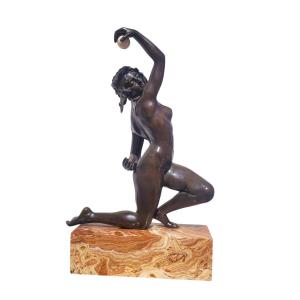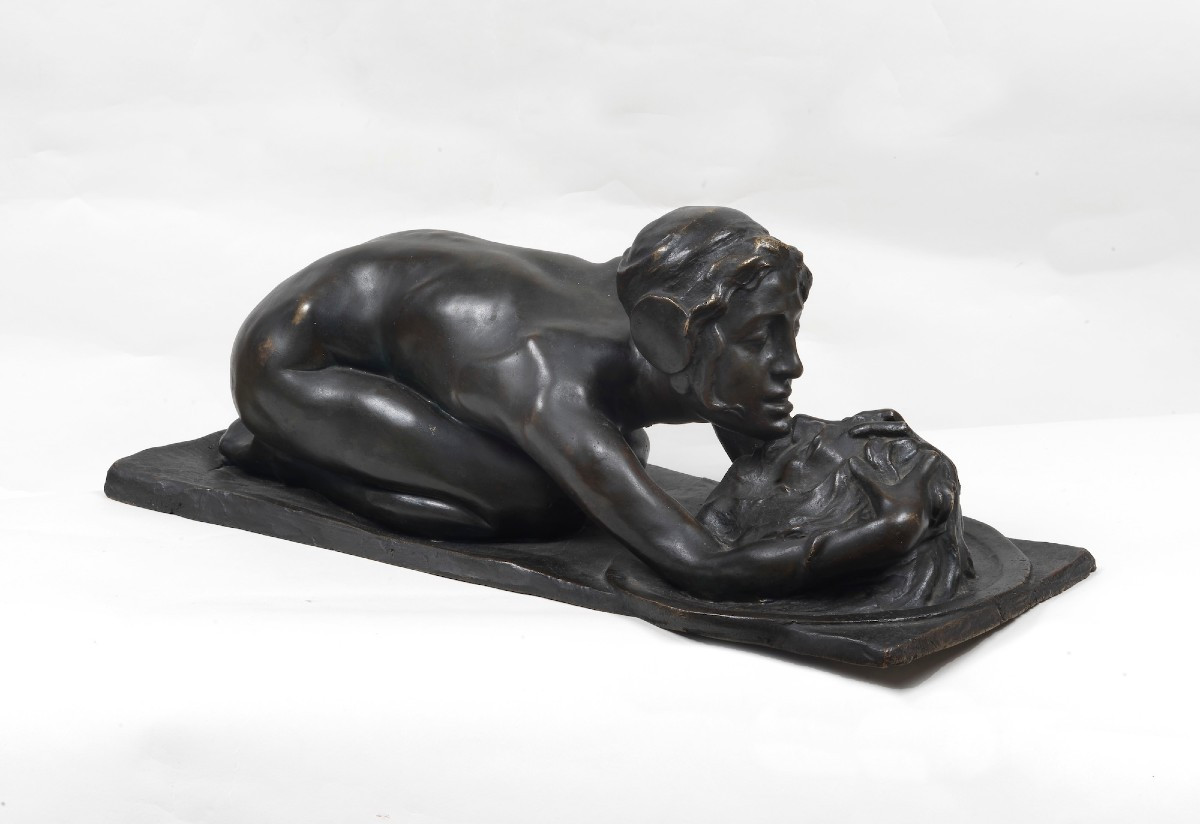
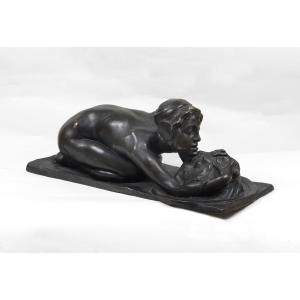
Carlo De Veroli - Salomè
Carlo De Veroli, born in Carrara in 1890 and trained at the local academy, began his career in Carlo Nicoli's studio and then in Rome alongside his uncle Arturo Dazzi during work on the Altare della Patria. After the First World War, he moved permanently to Naples, where he frequented Vincenzo Gemito's artistic circle and participated in the first national exhibitions. In the 1920s, he embraced the trends of the Return to Order, presenting works with mythological subjects and portraits in Naples and at the Venice Biennale, developing a style that blended archaic solemnity and modern softness inspired by the most ancient Greek statuary. In the following decade, he developed a primitive but fluid plastic language, evident in works such as Dopo il bagno (After the Bath), and continued to exhibit in important exhibitions in Naples, Venice, Rome and Florence. At the end of the 1930s, his research became more rigid, moving towards more severe and monumental forms, increasingly approaching the Korai model. During this period, he received numerous public commissions, including statues for the Stadio dei Marmi, and obtained the chair of sculpture in Naples, which he lost shortly afterwards due to racial laws. He died in 1938 in the same city, at the age of only forty-nine.
Period: 20th century
Style: Art Deco
Condition: Good condition
Material: Bronze
Width: 50
Height: 18
Depth: 19
Reference (ID): 1662744
Availability: In stock