

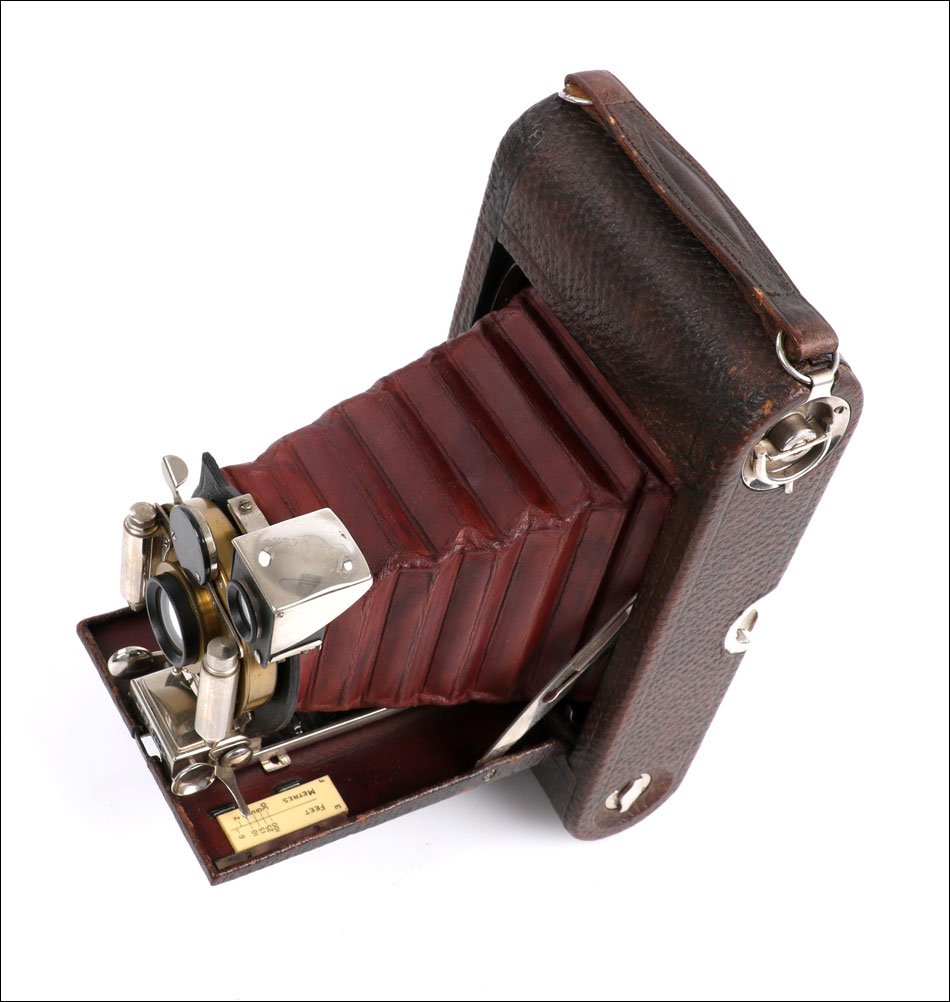

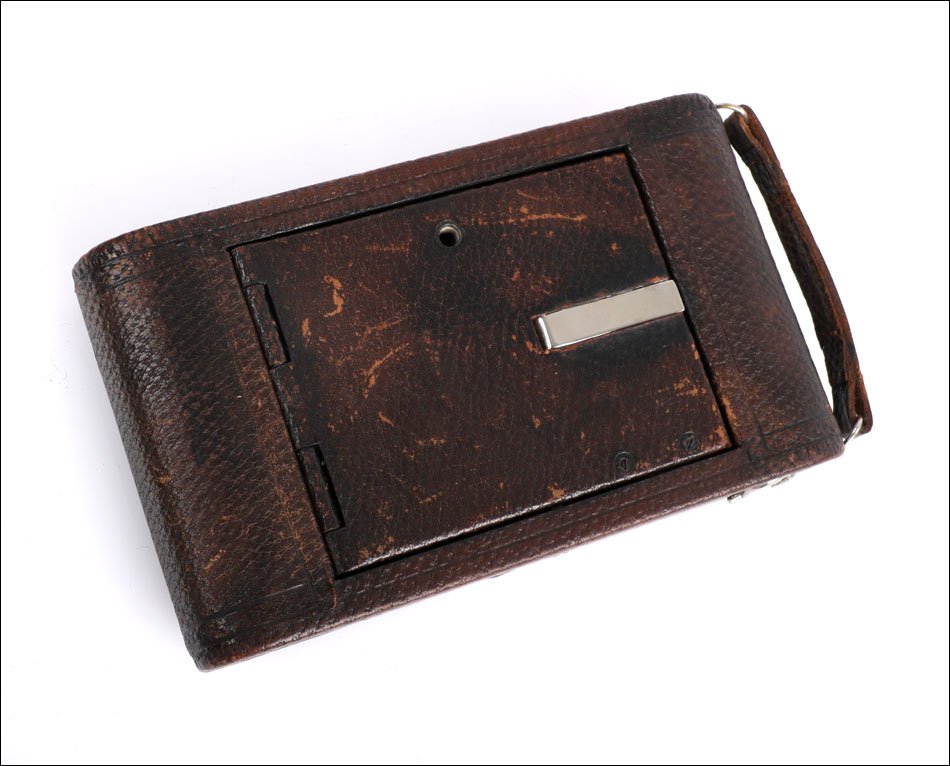
"Antique Kodak Folding Pocket No.3 C-2 Camera. Usa 1900-1910"
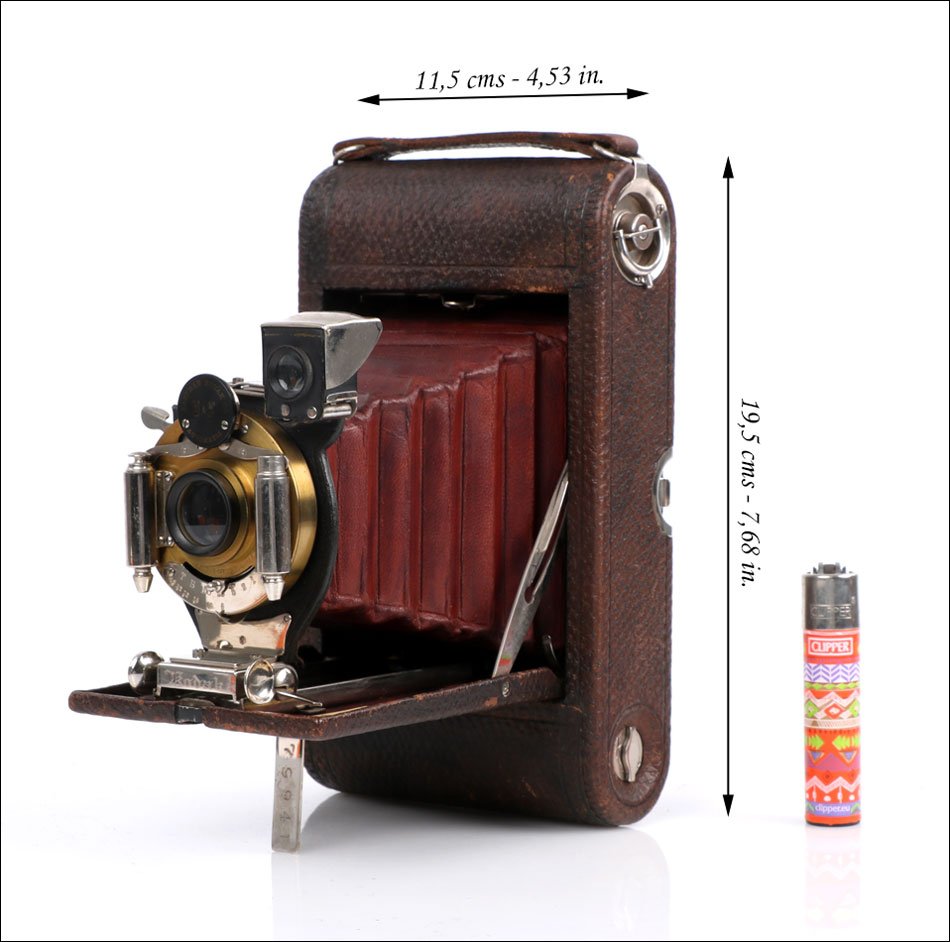
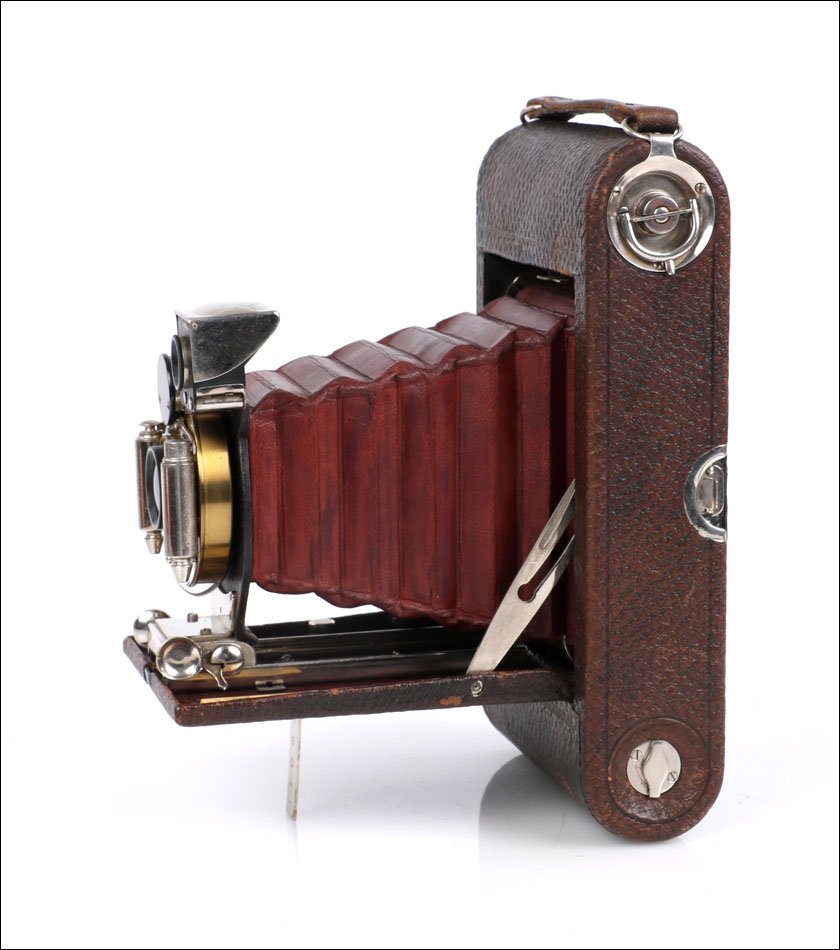
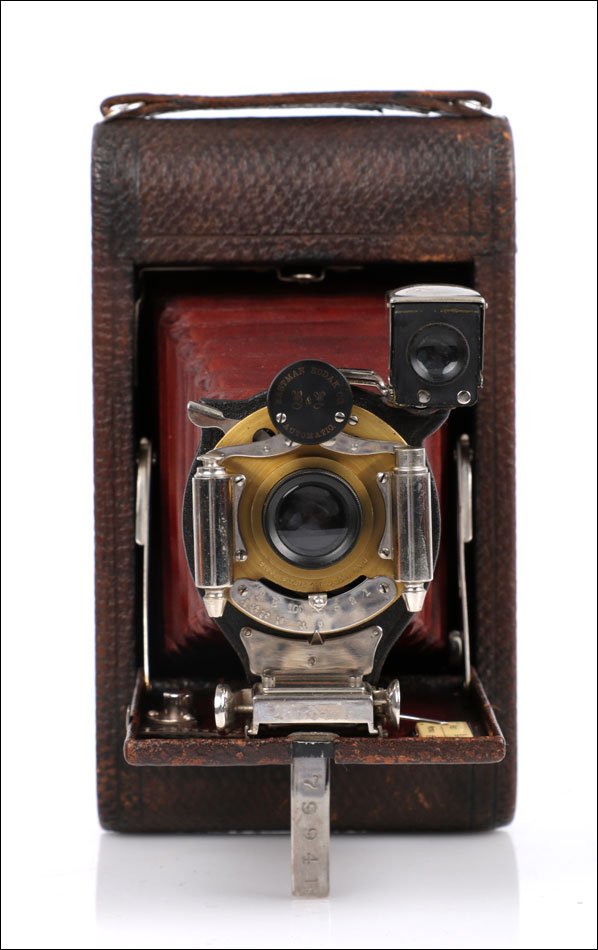
This magnificent Kodak Folding Pocket No. 3 Model C-2, manufactured between 1900 and 1910, belongs to one of the most interesting series of early bellows cameras produced in Rochester by Eastman Kodak Co. The piece presented here immediately stands out for its compact presence, its beautiful red bellows and the elegant case covered in textured brown leather, elements that evoke the refined aesthetic of portable photography at the beginning of the twentieth century. It is a camera designed for 118 mm roll film, intended for users who sought a robust, reliable device capable of producing large-format negatives within a body that was surprisingly manageable for its time. The specimen is preserved intact. The construction combines a firm and well-adjusted metal frame with an exterior covering in grained leather that effectively protects the interior and gives it a very attractive historic character. The front opening system unfolds smoothly and allows the red bellows, one of the most distinctive elements of the model, to extend its structure with perfectly symmetrical geometry. These bellows maintain remarkable flexibility and, most importantly, remain fully light-tight, without leaks, something especially valued in cameras more than a century old.
The metal fittings show their original finish, with a clean shine and no appreciable corrosion, while the front flap, the top handle and the rear section maintain their structural integrity with only the logical signs of use consistent with their age.
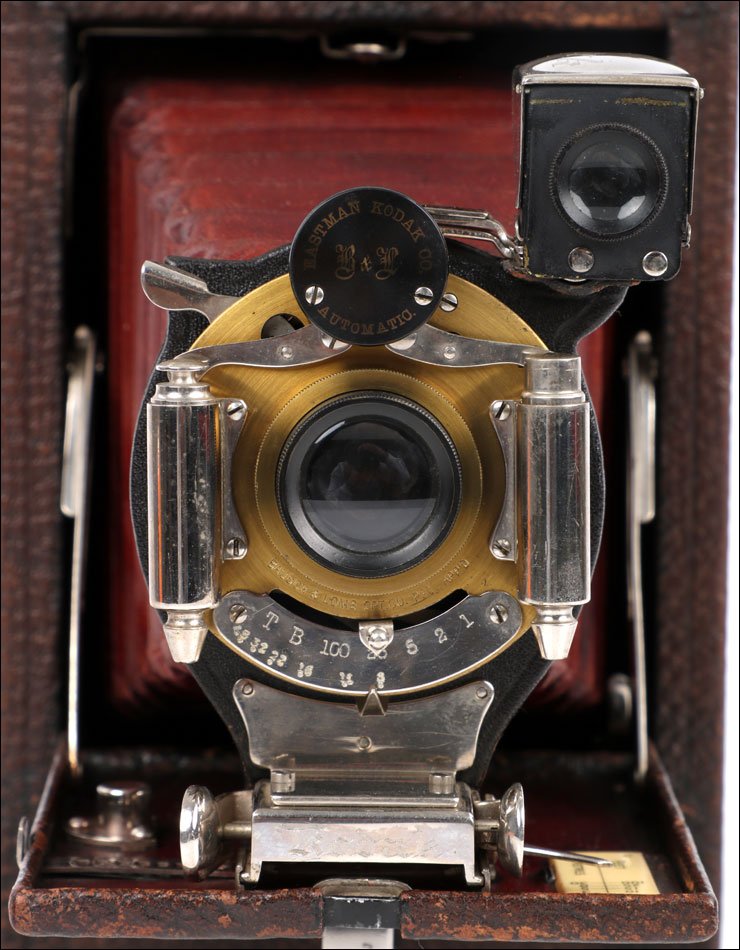
The optical assembly consists of a lens mounted on an Eastman Kodak automatic shutter, clearly visible in the front inscriptions. The shutter works precisely and responds correctly in its T and B modes, as well as in the marked speeds. The lens presents clean glass, without haze or fungus, still allowing surprisingly sharp image formation.
The side folding finder maintains its alignment and operates smoothly, showing a degree of preservation not often seen in cameras of this series.
The inner cover preserves the original inscriptions with the patent dates —from 1885 to 1898, and the Eastman Kodak Co. mark, which is particularly valuable for the authenticity of the piece and places it closer to the year 1900 than to 1910.
The internal system for 118 mm film remains complete, with rollers, guides and chambers in excellent condition, ready to receive roll film if one wishes to use it in functional mode. Although the signs of use on the exterior leather of the back are visible, they do not affect the integrity of the piece at all and add a slightly melancholic charm that emphasises its century-old character.
Due to its rarity, since this C-2 model is difficult to find on the market, and its exceptional preservation, the camera is a splendid opportunity for any lover of photographic history. It would be a spectacular piece in a collector’s display cabinet or in the decoration of a studio or room dedicated to visual art. It offers presence, historical coherence and admirable mechanical quality for its age, becoming an object with its own soul that conveys the beauty of authenticity.
This camera brings together design, history and authenticity. A piece like this, in such good working condition, rarely appears again and is an acquisition that connects the collector with the very origin of portable photography. Its historical and aesthetic appeal invites you to enjoy it every day. It is a camera that moves you, that inspires you and that can become the focal point of any collection. And moreover, its working condition enhances its value even further. Acquire it without hesitation: this Kodak, rare and well preserved, is one of those opportunities that quickly escape.
Measurements: 19,5 × 11,5 cm (7,68 × 4,53 in).
History of Kodak Folding Pocket No. 3
The Kodak Folding Pocket series represented one of the most important steps in the evolution of portable photography at the beginning of the twentieth century. Eastman Kodak Co., founded by George Eastman in 1888 in Rochester, revolutionised photography by introducing cameras that anyone could use without needing deep knowledge. Their early models used roll film, an invention that transformed photographic practice by replacing fragile glass plates.
Within this context, the Folding Pocket line was fundamental: it combined the portability of early roll-film with the image quality of a large negative, which made it especially popular among travellers, advanced amateurs and documentary photographers.
The Kodak Folding Pocket No. 3 used 118-type film, introduced by the company itself to obtain large negatives suitable for prints of excellent quality. The series had several variants, among them the Model C-2, produced approximately between 1900 and 1910, which introduced improvements in the shutter, a more refined front, and a more precise focusing system.
These cameras were part of a generation designed at a time when Kodak sought to offer sophisticated yet portable devices, able to compete with European bellows cameras that had dominated the market since the late nineteenth century. The manufacture of these models coincided with a period of global expansion for Kodak, which already had facilities in the United States, Europe and Canada. The firm constantly refined its roll film and produced cameras aimed at different market segments. The Model C-2 was part of this phase of continuous innovation, where advances such as more reliable automatic shutters, compact folding viewfinders and increasingly precise internal film-advance mechanisms were consolidated.
Today, more than a century later, the Kodak Folding Pocket No. 3 C-2 is considered a historically relevant camera, especially appreciated by collectors due to its short production and its mechanical complexity compared to other contemporary and more common models. Its presence on the current market is limited, which gives it clear added value as a piece for specialised collections. We are professional antique dealers. To see more photos of this item, Please click on this link:
https://www.antiguedades.es/en/antique-cameras/5365-antique-kodak-folding-pocket-no3-mod-c-2-camera-usa-1900-1910.html









 Le Magazine de PROANTIC
 TRÉSORS Magazine
 Rivista Artiquariato