Daubigny Karl Sunset By The Sea Oil On Canvas Signed Date And Dedicated Certificateauthenticity
Artist: Daubigny Karl ( 1846 / 1886 )
DAUBIGNY Karl (1846–1886)
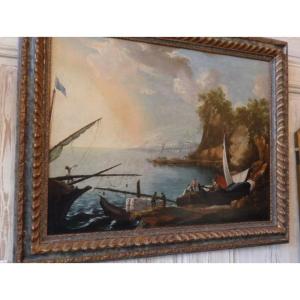
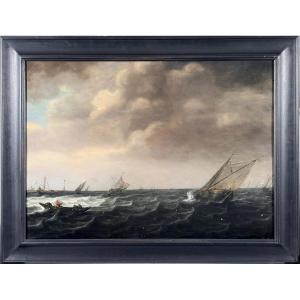
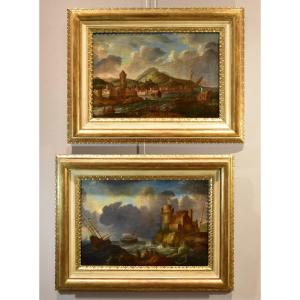
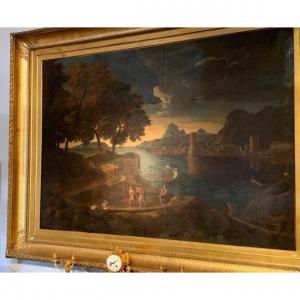
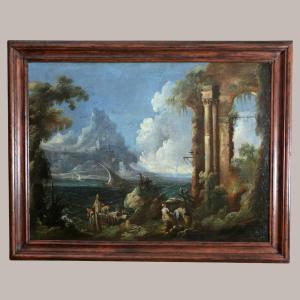
Sunset by the Sea.
Oil on canvas, signed, dated 1880, and dedicated to his friend lower left.
19,56 x 31,49 in
Certificate of authenticity.
Landscape painter Karl Daubigny took drawing lessons from his father Charles François Daubigny at the Académie Suisse. His taste for painting developed at a prodigious rate, no doubt thanks to the influence of the artistic milieu in which he grew up. He regularly accompanied his father on excursions with his painter friends such as Corot, Daumier, and Steinheil.
Karl Daubigny made his debut at the Salon des Artistes Français at a very young age in 1863 with two paintings, “Le Sentier” and “L'Ile de Vaux.” The following year, he attracted attention at the Salon with “Pré des Graves,” a work of extraordinary truth and power for an 18-year-old. He won his first award in 1865 with “Chemin creux” (Hollow Way). Every year, Karl continued to amaze the Salon with his light-filled works and remarkable talent as a colorist. Until 1867, he painted the same subjects as his father, but in order to avoid being compared to him, he began to paint rustic scenes and seascapes in which the figures became the main focus of the painting.
He left for Brittany to recharge his batteries and returned with studies of rocks and low tides that would give rise to the painting “Les vanneuses de Kérity” (The Rye Threshers of Kérity), which was awarded a medal at the 1868 Salon. In 1874, he submitted “La Ferme Saint-Siméon au Printemps, Environs d'Honfleur” (The Saint-Siméon Farm in Spring, Near Honfleur) and “La Route dans la Forêt de Fontainebleau” (The Road in the Forest of Fontainebleau) to the Salon, two paintings so remarkable that the jury awarded him another medal, which made him Hors Concours (out of competition) at the age of 29. The critics were enthusiastic, and the journalist Jules Antoine Castagnary wrote of “The Farm at Saint Siméon” that “there is more than light: there is freshness and a real scent of spring.”
In 1875, he presented a true masterpiece, “The Valley of Scie, near Dieppe.” With this painting, he broke away from his father's style, his palette became lighter, his touch became lighter, and air now flowed freely through his canvases. It was the painting of a moment, of an impression, abandoning the romantic vision of the 1830s, he created a more natural, brighter painting, less focused on effects and more concerned with values.
He inherited his father's love of the aquatic environment and also took up the theme of estuaries, with their lazy waters and shimmering reflections, their low houses on the shore, their tall sailing ships, and their low gray skies from which a shower escapes between two clear spells. We find a chromaticism of muted, solid colors, broken by the sun's rays, rendered in thick impasto with savory brushstrokes.
A modest artist, Karl Daubigny did not seek fame or even the recognition of his masters, and always kept himself apart from the struggles and competitions of the schools. He had no other desire than to deepen his art and pursued no other goal than the faithful interpretation of nature in all its splendor.
Museums:
Musée d'Orsay
Musée du Luxembourg
Musée d'Aix-France
Musée d'Amiens
Musée de Bayonne
Musée de Brest
Musée La Haye
Musée d'Honfleur
violondingres.fr
Sunset by the Sea.
Oil on canvas, signed, dated 1880, and dedicated to his friend lower left.
19,56 x 31,49 in
Certificate of authenticity.
Landscape painter Karl Daubigny took drawing lessons from his father Charles François Daubigny at the Académie Suisse. His taste for painting developed at a prodigious rate, no doubt thanks to the influence of the artistic milieu in which he grew up. He regularly accompanied his father on excursions with his painter friends such as Corot, Daumier, and Steinheil.
Karl Daubigny made his debut at the Salon des Artistes Français at a very young age in 1863 with two paintings, “Le Sentier” and “L'Ile de Vaux.” The following year, he attracted attention at the Salon with “Pré des Graves,” a work of extraordinary truth and power for an 18-year-old. He won his first award in 1865 with “Chemin creux” (Hollow Way). Every year, Karl continued to amaze the Salon with his light-filled works and remarkable talent as a colorist. Until 1867, he painted the same subjects as his father, but in order to avoid being compared to him, he began to paint rustic scenes and seascapes in which the figures became the main focus of the painting.
He left for Brittany to recharge his batteries and returned with studies of rocks and low tides that would give rise to the painting “Les vanneuses de Kérity” (The Rye Threshers of Kérity), which was awarded a medal at the 1868 Salon. In 1874, he submitted “La Ferme Saint-Siméon au Printemps, Environs d'Honfleur” (The Saint-Siméon Farm in Spring, Near Honfleur) and “La Route dans la Forêt de Fontainebleau” (The Road in the Forest of Fontainebleau) to the Salon, two paintings so remarkable that the jury awarded him another medal, which made him Hors Concours (out of competition) at the age of 29. The critics were enthusiastic, and the journalist Jules Antoine Castagnary wrote of “The Farm at Saint Siméon” that “there is more than light: there is freshness and a real scent of spring.”
In 1875, he presented a true masterpiece, “The Valley of Scie, near Dieppe.” With this painting, he broke away from his father's style, his palette became lighter, his touch became lighter, and air now flowed freely through his canvases. It was the painting of a moment, of an impression, abandoning the romantic vision of the 1830s, he created a more natural, brighter painting, less focused on effects and more concerned with values.
He inherited his father's love of the aquatic environment and also took up the theme of estuaries, with their lazy waters and shimmering reflections, their low houses on the shore, their tall sailing ships, and their low gray skies from which a shower escapes between two clear spells. We find a chromaticism of muted, solid colors, broken by the sun's rays, rendered in thick impasto with savory brushstrokes.
A modest artist, Karl Daubigny did not seek fame or even the recognition of his masters, and always kept himself apart from the struggles and competitions of the schools. He had no other desire than to deepen his art and pursued no other goal than the faithful interpretation of nature in all its splendor.
Museums:
Musée d'Orsay
Musée du Luxembourg
Musée d'Aix-France
Musée d'Amiens
Musée de Bayonne
Musée de Brest
Musée La Haye
Musée d'Honfleur
violondingres.fr
38 000 €
Period: 19th century
Style: Louis 14th, Regency
Condition: Re-canvas
Material: Oil painting
Width: 80 cm
Height: 49,7 cm
Reference (ID): 1653396
Availability: In stock
Print