

Circa 1950 / Studio Arax / Gregor Arax (1897–1975) / Vintage Silver Gelatin Print / Bodybuilder
Artist: Gregor Arax (1897–1975) / Gregor Djololian
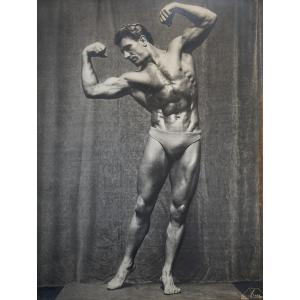
Gregor ARAX (Gregor Djololian, 1897–1975) André DRAPP, bodybuilder, Paris, circa 1950. Vintage baryta silver gelatin print, studio stamp on verso.
Image size 38 x 28 cm,
image size 61 x 55 cm with frame.
Taken in Gregor Arax's Parisian studio in the early 1950s, this portrait of bodybuilding champion André Drapp perfectly illustrates the photographer's singular aesthetic: that of a heroic body, sculpted by light and elevated to the status of a work of art. Under controlled side lighting, the pose is reminiscent of Greek statues, while simultaneously imbuing the model with an almost cinematic modernity. The print, made on vintage baryta paper, testifies to the care Arax took with the materiality of his images. This traditional silver halide process, coated with a thin layer of baryta (barium sulfate), gives blacks a depth and flesh tones a softness that the photographer favored to capture the sensuality and powerful form of his models. Arax often opted for semi-matte paper, whose slightly velvety surface softened the light and enhanced the sculptural dimension of the male body. Annotated on the back, stamp in the lower right corner and on the back (visible through a window in the frame). These prints, now rare, are precious witnesses to an era when art photography was breaking free from reportage to enter the realm of the artistic nude and the study portrait.
Gregor ARAX (Gregor Djololian, 1897–1975) Born in Trabzon (Ottoman Empire, now Turkey) in 1897, Gregor Djololian, known by his artist name Gregor Arax, was a photographer of Armenian origin who settled in Paris after the First World War. A survivor of the Armenian genocide, he settled in France in the 1920s and opened his own studio in Montparnasse, a neighborhood then frequented by many artists and intellectuals. Arax quickly gained recognition for his work on the male body, which he approached with a rigorous aesthetic and a sensitivity akin to sculpture. His photographs, most often shot in black and white on baryta paper, reveal an exceptional mastery of light and form. He photographed athletes, bodybuilders, and dancers, but also artists and anonymous models, in poses inspired by Antiquity and classical statuary. His work follows in the tradition of Herbert List, George Platt Lynes, and Raymond Voinquel, while asserting a singular aesthetic, both sensual and heroic. In postwar France, Gregor Arax contributed to redefining the representation of the male body in photography, poised between the Greek ideal and expressive modernity. He died in Paris in 1975, leaving behind an essential body of work in the history of 20th-century photography, at the crossroads of anatomical study, portraiture, and visual art.
Image size 38 x 28 cm,
image size 61 x 55 cm with frame.
Taken in Gregor Arax's Parisian studio in the early 1950s, this portrait of bodybuilding champion André Drapp perfectly illustrates the photographer's singular aesthetic: that of a heroic body, sculpted by light and elevated to the status of a work of art. Under controlled side lighting, the pose is reminiscent of Greek statues, while simultaneously imbuing the model with an almost cinematic modernity. The print, made on vintage baryta paper, testifies to the care Arax took with the materiality of his images. This traditional silver halide process, coated with a thin layer of baryta (barium sulfate), gives blacks a depth and flesh tones a softness that the photographer favored to capture the sensuality and powerful form of his models. Arax often opted for semi-matte paper, whose slightly velvety surface softened the light and enhanced the sculptural dimension of the male body. Annotated on the back, stamp in the lower right corner and on the back (visible through a window in the frame). These prints, now rare, are precious witnesses to an era when art photography was breaking free from reportage to enter the realm of the artistic nude and the study portrait.
Gregor ARAX (Gregor Djololian, 1897–1975) Born in Trabzon (Ottoman Empire, now Turkey) in 1897, Gregor Djololian, known by his artist name Gregor Arax, was a photographer of Armenian origin who settled in Paris after the First World War. A survivor of the Armenian genocide, he settled in France in the 1920s and opened his own studio in Montparnasse, a neighborhood then frequented by many artists and intellectuals. Arax quickly gained recognition for his work on the male body, which he approached with a rigorous aesthetic and a sensitivity akin to sculpture. His photographs, most often shot in black and white on baryta paper, reveal an exceptional mastery of light and form. He photographed athletes, bodybuilders, and dancers, but also artists and anonymous models, in poses inspired by Antiquity and classical statuary. His work follows in the tradition of Herbert List, George Platt Lynes, and Raymond Voinquel, while asserting a singular aesthetic, both sensual and heroic. In postwar France, Gregor Arax contributed to redefining the representation of the male body in photography, poised between the Greek ideal and expressive modernity. He died in Paris in 1975, leaving behind an essential body of work in the history of 20th-century photography, at the crossroads of anatomical study, portraiture, and visual art.
580 €
Period: 20th century
Style: Other Style
Condition: Perfect condition
Material: Paper
Reference (ID): 1649203
Availability: In stock
Print