THIS OBJECT WAS SOLD
Adam And Eve In The Garden Of Eden – Circle Of Abraham Bloemaert (1564/66 – 1651)


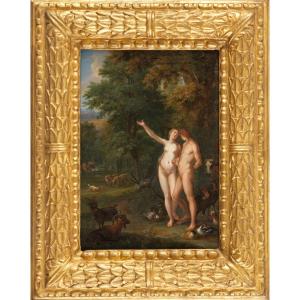


Oil on panel – 17th-century Dutch School, circle of Abraham Bloemaert.
In the heart of a bountiful natural setting teeming with animals, Adam and Eve stand before the fruitful Tree of Knowledge. Their naked bodies are not displayed provocatively, but rendered with a gentleness that evokes original innocence. What is striking is the grace of their slender figures, a legacy of elegant Mannerism, and above all, the tender gesture that unites them: their intertwined fingers assure them that nothing can separate them. The captured moment is not merely the temptation preceding the Fall, but a moment of silent complicity that unites two beings in the harmony of the world. Thus, the biblical narrative becomes a scene of human intimacy.
Our composition derives from a drawing of Adam and Eve by Abraham Bloemaert, considered the founder of the Utrecht School. This drawing, now in the Städel Museum in Frankfurt, shows subtle differences in the positions of Adam's left arm and right leg. But it is undoubtedly the source for our painting. However, neither the foliage nor the animals could have been painted by his hand; Bloemaert's style of depicting nature is quite different from that seen in our Paradise scene, suggesting that only a student or a member of his workshop was responsible. And within Bloemaert's immediate circle, within his workshop itself, we find a specialist in this genre: Jan Baptist Weenix (1621–1659), who taught his art to his son Jan (1642–1719) and his nephew Melchior d'Hondecoeter (1636–1695), all three of whom painted nature as it is. Thus, we can affirm that our painter—from the Utrecht school and in the Weenix lineage—composed this delicate painting after having access to Bloemaert's marvelous drawing and making it his own.
This precious painting bridges two generations of painters from the Utrecht school and unites in a single composition two successive artistic movements: Bloemaert's Mannerism coexists with the Baroque style of the Weenix.
We have chosen to present this paradisiacal scene in a sturdy carved and gilded wooden frame decorated with bundles of laurel leaves.
Dimensions: 42.5 x 29.5 cm - 62 x 50 cm with frame.
Biography:
Abraham Bloemaert (Gorinchem 1564/66 - Utrecht 27.01.1651) received his initial artistic training from his father, Cornelis, a sculptor and architect. He then studied painting under artists who would leave no mark on history or his own artistic output. Then, between 1581 and 1583, he lived and painted in Paris. Finally, he settled permanently in Utrecht, where he was appointed dean of the Guild of Saint Luke in 1618. Bloemaert was a complete artist; he painted, drew, and engraved historical and allegorical subjects, as well as landscapes in which nature was sublime. He was a major painter of his time. In the 1620s, his pupils Gerrit van Honthorst and Hendrik Terbrugghen returned from Italy, bringing Caravaggism with them. Drawn in by the general enthusiasm, Abraham Bloemaert followed this new artistic path for a time but quickly returned to the elegant classical style that characterizes his work. His influence, beyond his pupils Jan Both and Jan Baptist Weenix, is perceptible in the works of many contemporaries and followers.
Bibliography:
- ROETHLISBERGER Marcel Georges, Abraham Bloemaert and his sons, Aetas Aurea, Vol. Xi London), 1997
- ROETHLISBERGERMarcel Georges, METZLER Sally, Abraham Bloemaert (1566-1651) and his time,Museum of Fine Arts : St. Peters, 2001
- Ouvragecollectif, Masters of Light, Dutch painters in Utrecht during the Golden Age,Yale University Press (catalogue d’exposition au Fine Arts Museum de SanFrancisco, à la Walters Art Gallery de Baltimore; et à la National Gallery deLondres), 1997
- HELMUS M. Liesbeth, SEELIG Gero, The Bloemaert effect: Color and Composition in the Golden Age (exhibition catalog in Utrecht and Schwerin), Michael Imhof Verlag, 2011
- HAAK Bob, The Golden Age: Dutch painters of the Seventeenth Century, Thames & Hudson Ltd, 1999
- Collective work edited by Léonie MARQUAILLE, New Perspectives on Abraham Bloemaert and his Workshop, Brepols, 2022
In the heart of a bountiful natural setting teeming with animals, Adam and Eve stand before the fruitful Tree of Knowledge. Their naked bodies are not displayed provocatively, but rendered with a gentleness that evokes original innocence. What is striking is the grace of their slender figures, a legacy of elegant Mannerism, and above all, the tender gesture that unites them: their intertwined fingers assure them that nothing can separate them. The captured moment is not merely the temptation preceding the Fall, but a moment of silent complicity that unites two beings in the harmony of the world. Thus, the biblical narrative becomes a scene of human intimacy.
Our composition derives from a drawing of Adam and Eve by Abraham Bloemaert, considered the founder of the Utrecht School. This drawing, now in the Städel Museum in Frankfurt, shows subtle differences in the positions of Adam's left arm and right leg. But it is undoubtedly the source for our painting. However, neither the foliage nor the animals could have been painted by his hand; Bloemaert's style of depicting nature is quite different from that seen in our Paradise scene, suggesting that only a student or a member of his workshop was responsible. And within Bloemaert's immediate circle, within his workshop itself, we find a specialist in this genre: Jan Baptist Weenix (1621–1659), who taught his art to his son Jan (1642–1719) and his nephew Melchior d'Hondecoeter (1636–1695), all three of whom painted nature as it is. Thus, we can affirm that our painter—from the Utrecht school and in the Weenix lineage—composed this delicate painting after having access to Bloemaert's marvelous drawing and making it his own.
This precious painting bridges two generations of painters from the Utrecht school and unites in a single composition two successive artistic movements: Bloemaert's Mannerism coexists with the Baroque style of the Weenix.
We have chosen to present this paradisiacal scene in a sturdy carved and gilded wooden frame decorated with bundles of laurel leaves.
Dimensions: 42.5 x 29.5 cm - 62 x 50 cm with frame.
Biography:
Abraham Bloemaert (Gorinchem 1564/66 - Utrecht 27.01.1651) received his initial artistic training from his father, Cornelis, a sculptor and architect. He then studied painting under artists who would leave no mark on history or his own artistic output. Then, between 1581 and 1583, he lived and painted in Paris. Finally, he settled permanently in Utrecht, where he was appointed dean of the Guild of Saint Luke in 1618. Bloemaert was a complete artist; he painted, drew, and engraved historical and allegorical subjects, as well as landscapes in which nature was sublime. He was a major painter of his time. In the 1620s, his pupils Gerrit van Honthorst and Hendrik Terbrugghen returned from Italy, bringing Caravaggism with them. Drawn in by the general enthusiasm, Abraham Bloemaert followed this new artistic path for a time but quickly returned to the elegant classical style that characterizes his work. His influence, beyond his pupils Jan Both and Jan Baptist Weenix, is perceptible in the works of many contemporaries and followers.
Bibliography:
- ROETHLISBERGER Marcel Georges, Abraham Bloemaert and his sons, Aetas Aurea, Vol. Xi London), 1997
- ROETHLISBERGERMarcel Georges, METZLER Sally, Abraham Bloemaert (1566-1651) and his time,Museum of Fine Arts : St. Peters, 2001
- Ouvragecollectif, Masters of Light, Dutch painters in Utrecht during the Golden Age,Yale University Press (catalogue d’exposition au Fine Arts Museum de SanFrancisco, à la Walters Art Gallery de Baltimore; et à la National Gallery deLondres), 1997
- HELMUS M. Liesbeth, SEELIG Gero, The Bloemaert effect: Color and Composition in the Golden Age (exhibition catalog in Utrecht and Schwerin), Michael Imhof Verlag, 2011
- HAAK Bob, The Golden Age: Dutch painters of the Seventeenth Century, Thames & Hudson Ltd, 1999
- Collective work edited by Léonie MARQUAILLE, New Perspectives on Abraham Bloemaert and his Workshop, Brepols, 2022
Explore similar pieces and discover your ideal find:
religious paintings