THIS OBJECT WAS SOLD
Christ “vivo” In Carved Ivory. Flanders, Late 17th Century

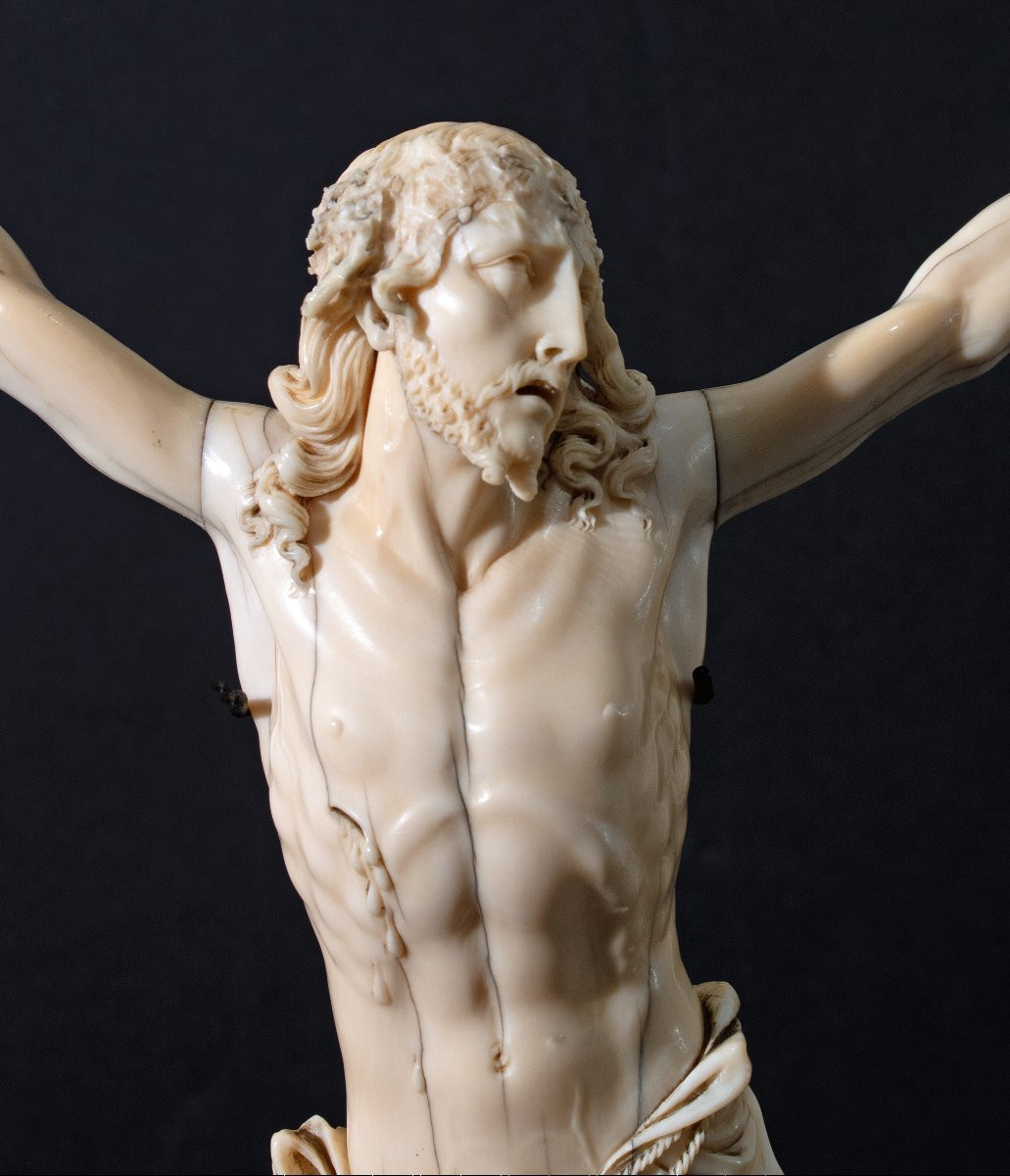


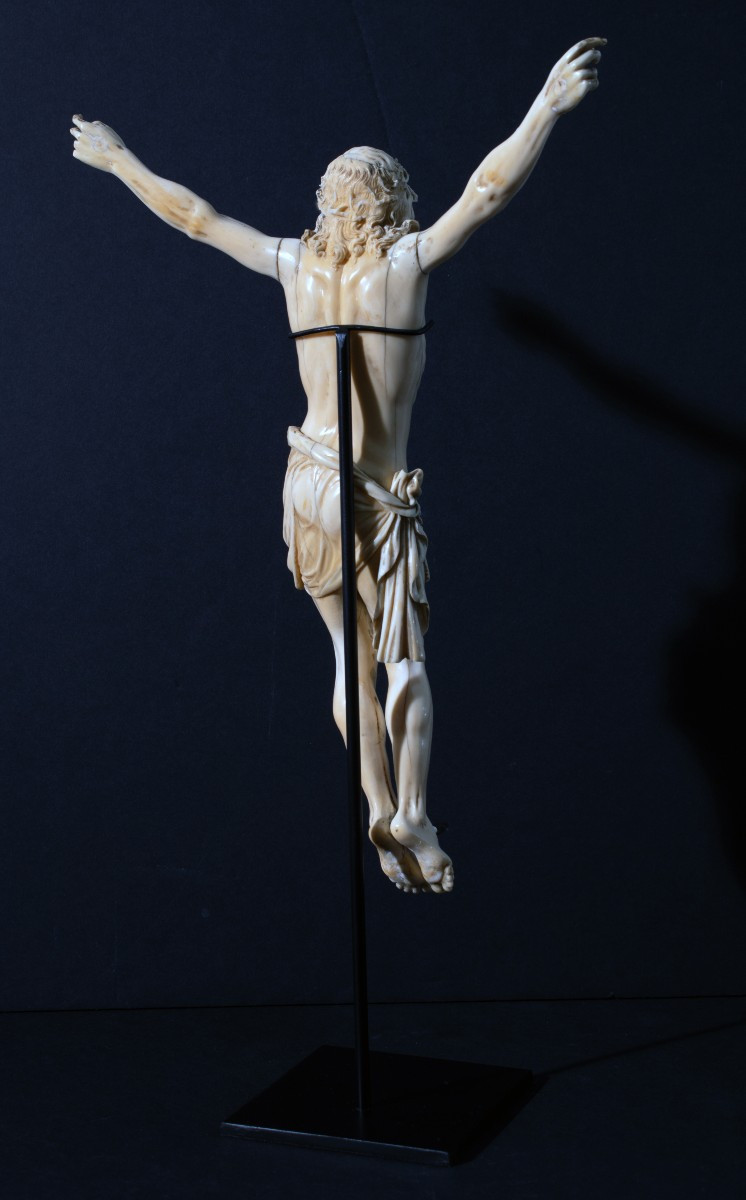


Ivory Sculpture of the Living Christ (Christus Vivo)Flanders,late 17th centuryThis finelycarved ivory sculpture of the living Christ (Christus vivo) is astriking example of Flemish devotional art from the late 17th century.
Executedin full round (ronde-bosse) with remarkable precision and anatomicalrealism, it reflects the stylistic influence of the Antwerp school,particularly the work of Mathieu van Beveren (1630, Antwerp –1691, Brussels), renowned for his expressive and dynamic religious figures.
The Christis depicted alive on the cross, his gaze lifted heavenward in a moment ofspiritual intensity. His mouth is slightly open, revealing the teeth—a rare anddramatic detail that enhances the realism of the scene.
The hair is parted atthe center and falls in soft, wavy locks over the shoulders. Subtle veins arevisible on the arms, underscoring the sculptor’s anatomical mastery.The perizonium istied with a delicate cord, exposing the right leg and cascading in elegantfolds to one side. The legs are parallel and gently bent, with the feet placedside by side in the traditional crucifixion pose.
The overall compositionconveys both suffering and transcendence, characteristic of Baroque religioussculpture.
Height (from feet to hands): 28 cm
Mount: simple blackened metal base
Condition: excellent, with no visible restorations
Origin: Flanders, circa 1680
Documentation: sold with invoice and certificate of authenticity
Executedin full round (ronde-bosse) with remarkable precision and anatomicalrealism, it reflects the stylistic influence of the Antwerp school,particularly the work of Mathieu van Beveren (1630, Antwerp –1691, Brussels), renowned for his expressive and dynamic religious figures.
The Christis depicted alive on the cross, his gaze lifted heavenward in a moment ofspiritual intensity. His mouth is slightly open, revealing the teeth—a rare anddramatic detail that enhances the realism of the scene.
The hair is parted atthe center and falls in soft, wavy locks over the shoulders. Subtle veins arevisible on the arms, underscoring the sculptor’s anatomical mastery.The perizonium istied with a delicate cord, exposing the right leg and cascading in elegantfolds to one side. The legs are parallel and gently bent, with the feet placedside by side in the traditional crucifixion pose.
The overall compositionconveys both suffering and transcendence, characteristic of Baroque religioussculpture.
Height (from feet to hands): 28 cm
Mount: simple blackened metal base
Condition: excellent, with no visible restorations
Origin: Flanders, circa 1680
Documentation: sold with invoice and certificate of authenticity
Explore similar pieces and discover your ideal find:
Other Sculptures