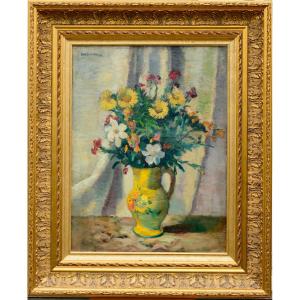

Bouquet With Yellow Vase. Ch. Kvapil
Artist: Charles Kvapil
Charles Kvapil is known for his sculptural nudes, but he also excelled in still lifes with intense tones.
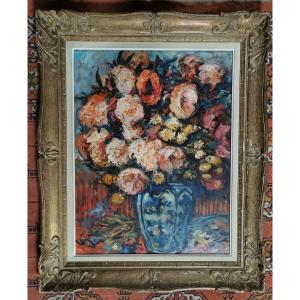
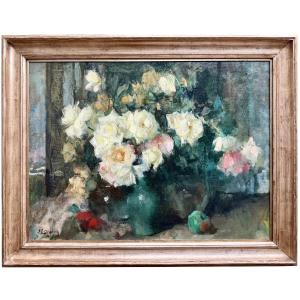
Here, he presents us with a bouquet of summer flowers in a luminous and vibrant yellow vase.
This painter's still lifes are particularly sought after in these shades of yellow.
Oil on canvas in perfect condition.
Beautiful modern gilt frame in perfect condition.
Dimensions: Canvas 46 x 61 cm;
Frame: 70 x 85 cm.
Charles Kvapil was a Belgian painter of the School of Paris, of Czechoslovakian origin, born on November 1, 1884, and died in Paris in 1957. He studied at the Royal Academy of Fine Arts in Antwerp. His first works were exhibited in 1908 at the Antwerp Salon. In 1911, he exhibited in Munich; these works showed a clear Cubist influence. In 1914, he exhibited again in Belgium, at the Brussels Triennial. He was mobilized during the First World War. After the armistice, he lived in Paris and set up his studio in Montmartre, in the Hameau des Artistes (Artists' Hamlet), where he died. He led a very impoverished existence, but he possessed an optimistic temperament and hoped to make it big; he had to work to survive and painted mainly in the evenings, especially during his early years in Paris. At the 1920 Salon des Indépendants, Kvapil revealed himself to the Parisian public. "In the wake of the legendary figures of Montparnasse, in their shadow, and bound by them to a relative discretion, stands Charles Kvapil. He frequented the Café du Parnasse and exhibited there with a small organized group, 'the Company of Professional Painters and Sculptors,' which emerged in 1921. In 1923, his works were hung at Marcel Bernheim's gallery, then at Dalpeyrat's gallery in Limoges, where he mainly showed landscapes." Subsequently, he participated in the Salon d'Automne; in 1941, he presented "The Phlox," and in 1944, "At the Window." In 1951, at the same Salon, he exhibited "Summer Pleasure" and "Afternoon Tea." During his lifetime, he exhibited in Paris, Munich, Brussels, Geneva, Italy, Stockholm, London, and New York. Today, his work is represented in numerous public and private collections, including the Musée d'Art Moderne in Paris, and museums in Le Havre, Libourne, Rouen, Saint-Étienne, Amsterdam, and Tunis. Charles Kvapil was influenced by Fauvism and a very restrained form of Cubism; Paul Cézanne and, to some extent, Matisse (as a colorist), also left their mark on his style. His paintings are original and modern. His nudes and bouquets of flowers are strong and powerful. His palette is rich in cobalt blue and warm colors. His technique is deliberate and powerful. His oil paintings are often of modest size, sometimes painted on panels, or on cardboard.
Here, he presents us with a bouquet of summer flowers in a luminous and vibrant yellow vase.
This painter's still lifes are particularly sought after in these shades of yellow.
Oil on canvas in perfect condition.
Beautiful modern gilt frame in perfect condition.
Dimensions: Canvas 46 x 61 cm;
Frame: 70 x 85 cm.
Charles Kvapil was a Belgian painter of the School of Paris, of Czechoslovakian origin, born on November 1, 1884, and died in Paris in 1957. He studied at the Royal Academy of Fine Arts in Antwerp. His first works were exhibited in 1908 at the Antwerp Salon. In 1911, he exhibited in Munich; these works showed a clear Cubist influence. In 1914, he exhibited again in Belgium, at the Brussels Triennial. He was mobilized during the First World War. After the armistice, he lived in Paris and set up his studio in Montmartre, in the Hameau des Artistes (Artists' Hamlet), where he died. He led a very impoverished existence, but he possessed an optimistic temperament and hoped to make it big; he had to work to survive and painted mainly in the evenings, especially during his early years in Paris. At the 1920 Salon des Indépendants, Kvapil revealed himself to the Parisian public. "In the wake of the legendary figures of Montparnasse, in their shadow, and bound by them to a relative discretion, stands Charles Kvapil. He frequented the Café du Parnasse and exhibited there with a small organized group, 'the Company of Professional Painters and Sculptors,' which emerged in 1921. In 1923, his works were hung at Marcel Bernheim's gallery, then at Dalpeyrat's gallery in Limoges, where he mainly showed landscapes." Subsequently, he participated in the Salon d'Automne; in 1941, he presented "The Phlox," and in 1944, "At the Window." In 1951, at the same Salon, he exhibited "Summer Pleasure" and "Afternoon Tea." During his lifetime, he exhibited in Paris, Munich, Brussels, Geneva, Italy, Stockholm, London, and New York. Today, his work is represented in numerous public and private collections, including the Musée d'Art Moderne in Paris, and museums in Le Havre, Libourne, Rouen, Saint-Étienne, Amsterdam, and Tunis. Charles Kvapil was influenced by Fauvism and a very restrained form of Cubism; Paul Cézanne and, to some extent, Matisse (as a colorist), also left their mark on his style. His paintings are original and modern. His nudes and bouquets of flowers are strong and powerful. His palette is rich in cobalt blue and warm colors. His technique is deliberate and powerful. His oil paintings are often of modest size, sometimes painted on panels, or on cardboard.
950 €
Period: 20th century
Style: Other Style
Condition: Perfect condition
Material: Oil painting
Length: toile 61 cadre 85
Width: toile 46 cadre 70
Reference (ID): 1647862
Availability: In stock
Print