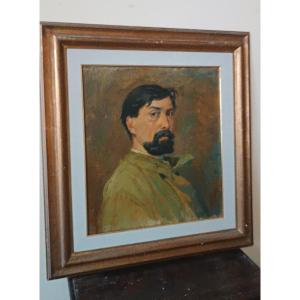
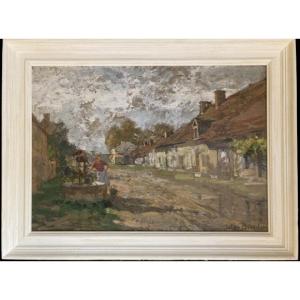
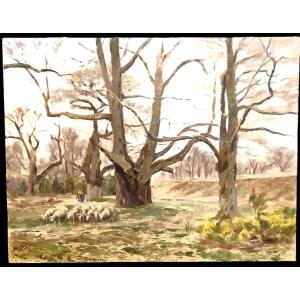
Peinture à l'Huile Ancienne Sur Toile Ettore Cumbo Borgia Fin 19ème Siècle (messine 1833- 1899)
Artist: Ettore Cumbo Borgia
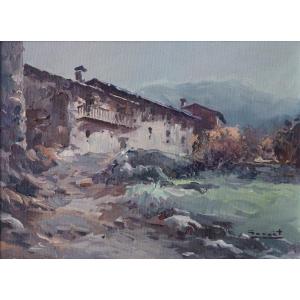
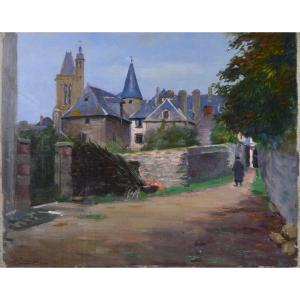
Rare oil painting on canvas depicting a sunset, Florentine Impressionist period - Author Ettore Cumbo Borgia (Messina 1833- Florence 1899) signed on the back of the frame - frame size 56 x 46 cm oil 30x20 CUMBO, Ettore Son of Diego and Alcmena Borgia, he was born in Messina in 1833. Roman by adoption - since childhood he lived in Rome with his mother (De Gubernatis) -, he studied with excellent results at the Sapienza college in Perugia and, having finished the course in 1850, showed an interest in mathematical disciplines, with particular attention to architecture and engineering. In 1857 he abandoned his engineering studies to devote himself to painting, choosing the landscape genre, in which he had as a teacher the Roman A. Castelli, an artist with an academic-romantic background with veristic accents and a landscape painter of reasonable success in those decades. A patriot since his adolescence, C. was unable to take part in the second war of independence (1859) due to the degenerative arthritis that had struck him a few years earlier. However, due to his intense conspiratorial activity against the papal government, he was exiled to Florence, where he settled permanently, practising his art with greater commitment as a painter. His contacts with the lively Florentine artistic environment seem to have been few and sporadic. We know that he became friends with S. Ussi, N. Barabino, V. Matteo Corcos (Accascina, 1939, p. 118), but his path appears to be completely detached from the theoretical debate and the new artistic trends of the post-unification years. From around 1870 C. published his paintings - Alpine subjects, seascapes, Florentine views, still lifes - establishing himself as a genre painter. He also took part in numerous exhibitions: the international one in London in 1874, the regional horticultural exhibitions in Palermo in 1886 and 1887 (obtaining recognition for his highly sought-after still life paintings) and the national one in Palermo in 1891-92 (silver medal for the painting depicting a Landscape on the Apennines, today in the collection of the Bank of Sicily). In 1893 he became a member of the Accademia di S. Luca, as an "academic of merit" (Rome, Arch. dell'Accademia di S. Luca. C. died in Florence on 16 January 1899. In 1910 a retrospective of his works was set up in Florence. A little-known artist, C. is a personality difficult to critically define both due to the scarce biographical information and the almost total dispersion of his works. Absent from Italian public collections, knowledge of his artistic production was entrusted above all to a good number of his paintings preserved in Florence, partly by his heirs (Corner of Florence, Corner of the Loggia del Pesce, Piazza del Mercato Vecchio, Stormy Sea, Ideal Landscape, Landscape) and partly in the Foligno house (Still Life, Landscape, Flowers, Small Seascape, Sky and Sea, Grapes, Roses, Large Landscape), mentioned by Accascina. (1936 and 1939), but today all dispersed. From the information reported by biographers it is also clear that many of C.'s paintings were already in English and German private collections by the end of the 19th century. His only remaining work in Sicily is the Landscape on the Apennines (oil on canvas, 103 x 164 cm; signed lower right) from the collections of the Bank of Sicily, awarded at the National Exhibition of Palermo in 1891-92 (see a lengthy description in Lo Forte Randi, 1892): a wide-ranging mountain landscape, characterised by a calligraphic realism and emphasis on the rocks in the foreground, enlivened by small touches of ochre, which stand out against a backdrop of livid and misty tones. In a Stormy Seascape, formerly belonging to the Modern Gallery of Florence, probably to be identified with the former Pisani Gallery, now untraceable and known only through a discarded Brogi photo, instead, one can notice the fluid, frayed brushstroke and the extreme finesse of execution. Far from the Sicilian painting schools (after all, C.'s "Sicilianness" is only a matter of age) and with only a few points of contact with the great Neapolitan landscape tradition, his calm and diligent style appears frozen in a conventional style, undoubtedly rich in decorative taste, which nevertheless met with the favor of the Italian and especially foreign lower middle class. Unfortunately, also missing are the small paintings depicting some corners of Florence, with an almost impressionistic flavor, and the Marine paintings brought closer by Accascina (1936) to the results of Ciardi and Mosè Bianchi, perhaps among Cumbo's best works. From the few surviving data, C. would seem to be configured in the role of a painter of landscapes and still lifes, a good draftsman and quality colorist.
470 €
Period: 19th century
Style: Other Style
Condition: Excellent condition
Material: Oil painting
Reference (ID): 1641293
Availability: In stock
Print