THIS OBJECT WAS SOLD
Sculpture – The Winner Of The Cockfight , Alexandre Falguière (1831-1900) – Bronze

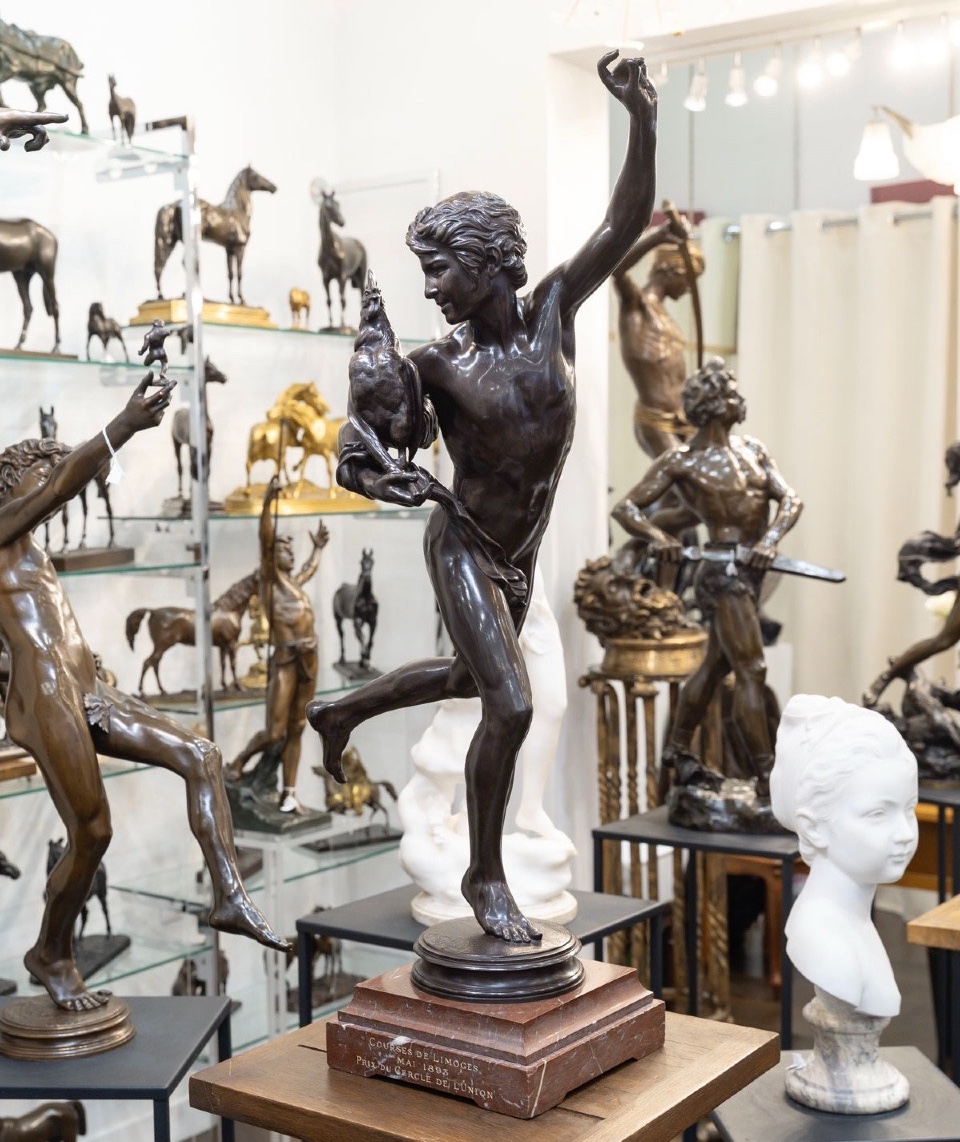


Important bronze proof , with brown patina , depicting a young man, jumping for joy , after the victory of his rooster in combat , by the sculptor Alexandre Falguiere (1831-1900) .
The sculpture shows the moment following the combat : the presentation of the "Winning Rooster" which brings the recognition and money of the bettors to the breeder of the animal .
The nudity of the boy's body indicates that the scene takes place in Antiquity .
His foot and his hand are suspended in the air , as if the boy were fixed in a victorious dance step .
The fighting cock , appears in the right arm of the young man , his gaze is fixed and his head straight , which shows his conquering temperament .
Bronze resting on a base in red griotte marble , bearing the words "COURSES DE LIMOGES, MAY 1893, PRIX DU CERCLE DE L'UNION" .
Signature of the sculptor "A.Falguière" in hollow , on the oval terrace , naturalist .
Circular stamp of the founder "Thiébaut Frères Fondeurs Paris" .
Old edition sculpture , period second part of the 19th century .
Very good state of conservation and patina .
Height : 87 cm
His results decided the municipality to award him a pension to allow him to complete his training in Paris.
Seeking to improve his income with a view to entering the School of Fine Arts in Paris , he was first hired in the then very prosperous company of the sculptor Albert-Ernest Carrier-Belleuse (1824-1887) , then worked with Jean-Louis Chenillion (1810-1875) .
Approaching the age limit for admission to the Fine-Arts in Paris , he finally decided in 1854 to enter .
Admitted to the Workshop of François Jouffroy , Alexandre Falguiere was the winner , with Leon Cugnot , of the first Rome Grand Prix for sculpture in 1859 with his bas-relief "Mézence wounded , preserved by the intrepidity of his son Lausus" .
He boarded at the Villa Medici in Rome from 1860 to 1864 , where in 1861 he met his fellow Toulouse resident Raymond Barthelemy (1833-1902) , a former student of Griffoul-Dorval like him .
In 1864 , he sent to the Artists' Fair , which is held every year in Paris , the fruit of his Italian work, the sculpture of "Winner in Cockfight". The success is immediate .
Emperor Napoleon III , purchased the original bronze sculpture .
She measures one meter seventy-four and is kept at the Orsay Museum .
The sale of these sculptures ensures Alexandre Falguiere a comfortable income , and places him in the position of a prominent artist .
Alexandre Falguiere was then part of a group of sculptors, with "Paul Dubois" , "Antonin Mercie" and "Alexandre Moulin" , who were nicknamed "The Florentins".
As in the city of Florence during the Renaissance , these sculptors draw their themes from Antiquity .
In 1882 , A.Falguiere was appointed professor at the School of Fine Arts in Paris, and elected member of the Academy of Fine Arts.
Falguiere's students included "Antonin Mercié" , "Laurent Marqueste" , "Gaston Schnegg" , "Camille Crenier" , "Achille Jacopin" , "Maurice Bouval" and "Jean-Marie Mengue" , the most famous of these being "Antoine Bourdelle".
Alexandre Falguiere was promoted to Commander of the Legion of Honor in 1889 .
In 1898 , A.Falguiere received the order for the Monument to Balzac , after the refusal of that of Auguste Rodin , by the Society of People of Letters , its sponsors .
The affair caused a scandal that the press called the "Second Dreyfus affair" because Emile Zola supported Auguste Rodin .
To prove that this episode in no way damaged their friendship , Falguiere created the bust of Rodin for the Salon of 1897 , and for his part Rodin sculpted a bust of Falguiere .
Alexandre Falguière died on April 19 , 1900 at his home at 68 , rue d'Assas .
He is buried in Paris at the Pere-Lachaise Cemetery .
The sculpture shows the moment following the combat : the presentation of the "Winning Rooster" which brings the recognition and money of the bettors to the breeder of the animal .
The nudity of the boy's body indicates that the scene takes place in Antiquity .
His foot and his hand are suspended in the air , as if the boy were fixed in a victorious dance step .
The fighting cock , appears in the right arm of the young man , his gaze is fixed and his head straight , which shows his conquering temperament .
Bronze resting on a base in red griotte marble , bearing the words "COURSES DE LIMOGES, MAY 1893, PRIX DU CERCLE DE L'UNION" .
Signature of the sculptor "A.Falguière" in hollow , on the oval terrace , naturalist .
Circular stamp of the founder "Thiébaut Frères Fondeurs Paris" .
Old edition sculpture , period second part of the 19th century .
Very good state of conservation and patina .
Height : 87 cm
Alexandre Falguiere (1831-1900)
Alexandre Falguiere , born September 7, 1831 in Toulouse , is a famous French sculptor and painter.
His results decided the municipality to award him a pension to allow him to complete his training in Paris.
Seeking to improve his income with a view to entering the School of Fine Arts in Paris , he was first hired in the then very prosperous company of the sculptor Albert-Ernest Carrier-Belleuse (1824-1887) , then worked with Jean-Louis Chenillion (1810-1875) .
Approaching the age limit for admission to the Fine-Arts in Paris , he finally decided in 1854 to enter .
Admitted to the Workshop of François Jouffroy , Alexandre Falguiere was the winner , with Leon Cugnot , of the first Rome Grand Prix for sculpture in 1859 with his bas-relief "Mézence wounded , preserved by the intrepidity of his son Lausus" .
He boarded at the Villa Medici in Rome from 1860 to 1864 , where in 1861 he met his fellow Toulouse resident Raymond Barthelemy (1833-1902) , a former student of Griffoul-Dorval like him .
In 1864 , he sent to the Artists' Fair , which is held every year in Paris , the fruit of his Italian work, the sculpture of "Winner in Cockfight". The success is immediate .
Emperor Napoleon III , purchased the original bronze sculpture .
She measures one meter seventy-four and is kept at the Orsay Museum .
The sale of these sculptures ensures Alexandre Falguiere a comfortable income , and places him in the position of a prominent artist .
Alexandre Falguiere was then part of a group of sculptors, with "Paul Dubois" , "Antonin Mercie" and "Alexandre Moulin" , who were nicknamed "The Florentins".
As in the city of Florence during the Renaissance , these sculptors draw their themes from Antiquity .
In 1882 , A.Falguiere was appointed professor at the School of Fine Arts in Paris, and elected member of the Academy of Fine Arts.
Falguiere's students included "Antonin Mercié" , "Laurent Marqueste" , "Gaston Schnegg" , "Camille Crenier" , "Achille Jacopin" , "Maurice Bouval" and "Jean-Marie Mengue" , the most famous of these being "Antoine Bourdelle".
Alexandre Falguiere was promoted to Commander of the Legion of Honor in 1889 .
In 1898 , A.Falguiere received the order for the Monument to Balzac , after the refusal of that of Auguste Rodin , by the Society of People of Letters , its sponsors .
The affair caused a scandal that the press called the "Second Dreyfus affair" because Emile Zola supported Auguste Rodin .
To prove that this episode in no way damaged their friendship , Falguiere created the bust of Rodin for the Salon of 1897 , and for his part Rodin sculpted a bust of Falguiere .
Alexandre Falguière died on April 19 , 1900 at his home at 68 , rue d'Assas .
He is buried in Paris at the Pere-Lachaise Cemetery .
Explore similar pieces and discover your ideal find:
bronze sculptures