


Front And Back: Georges Higuet, Portrait Of A Miner / Study After Houdon's écorché Figure, 1926
Artist: Georges Higuet (1892-1956)
Georges Higuet (Belgian, 1892-1956)
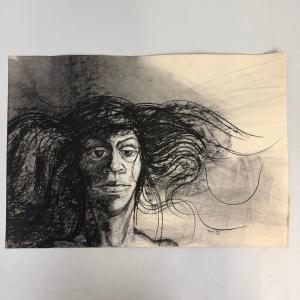
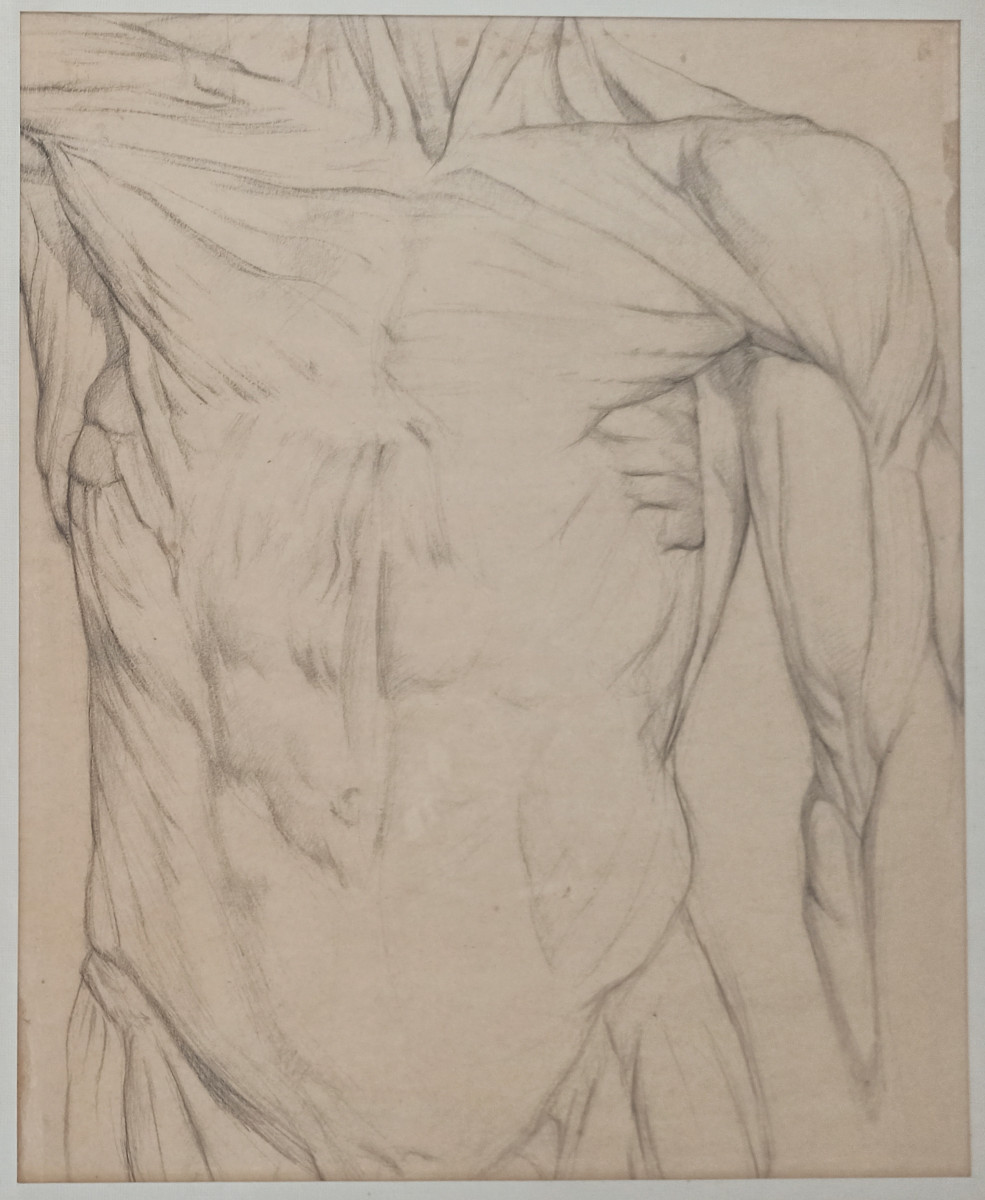
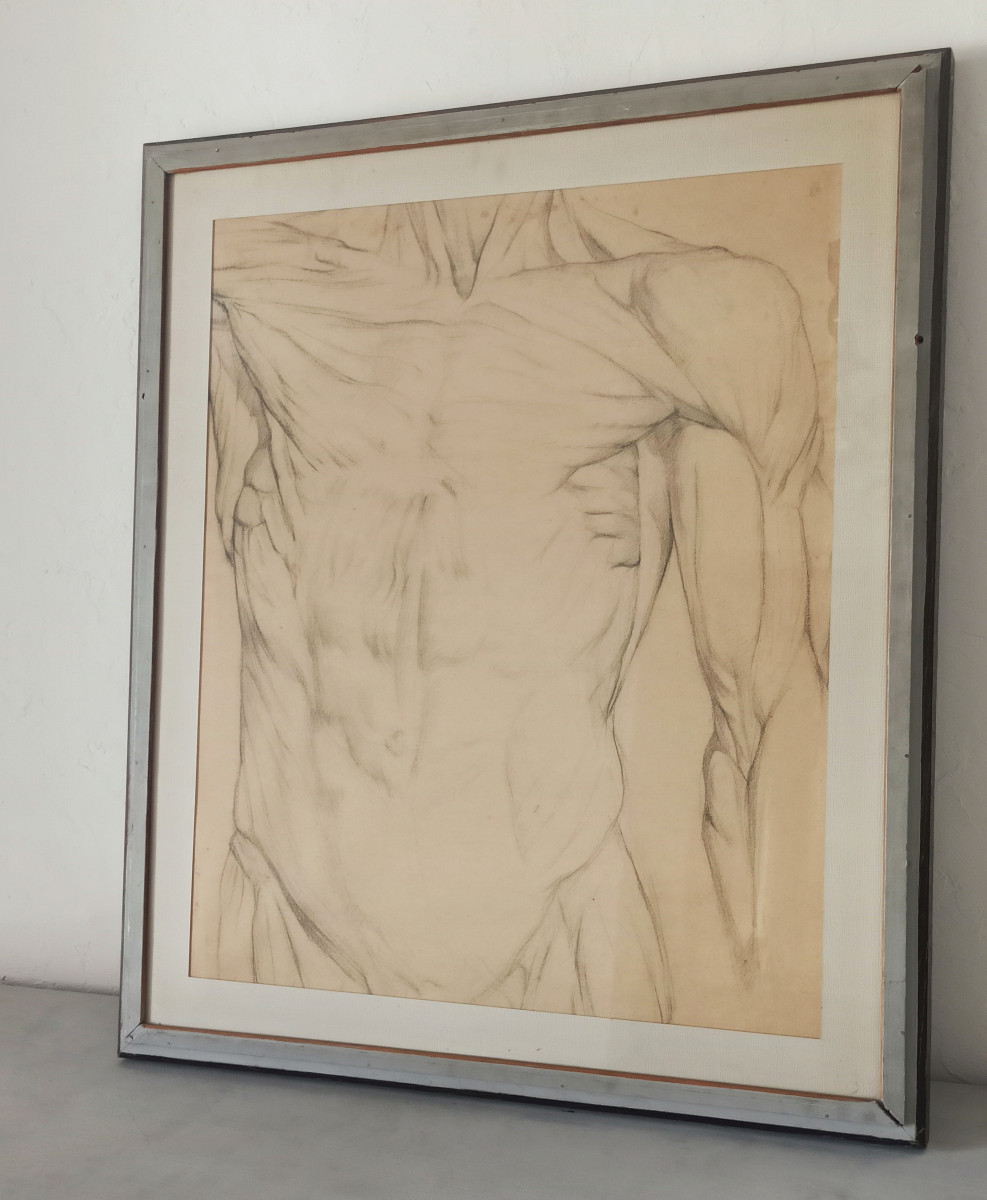
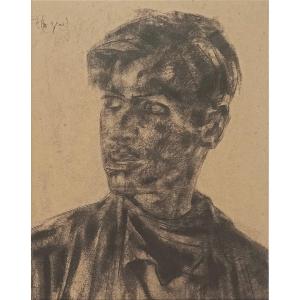
Portrait of a Miner / Study of an écorché, a man's torso (after Jean Antoine Houdon)
Charcoal on paper, double-sided drawing
55 x 45.5 cm
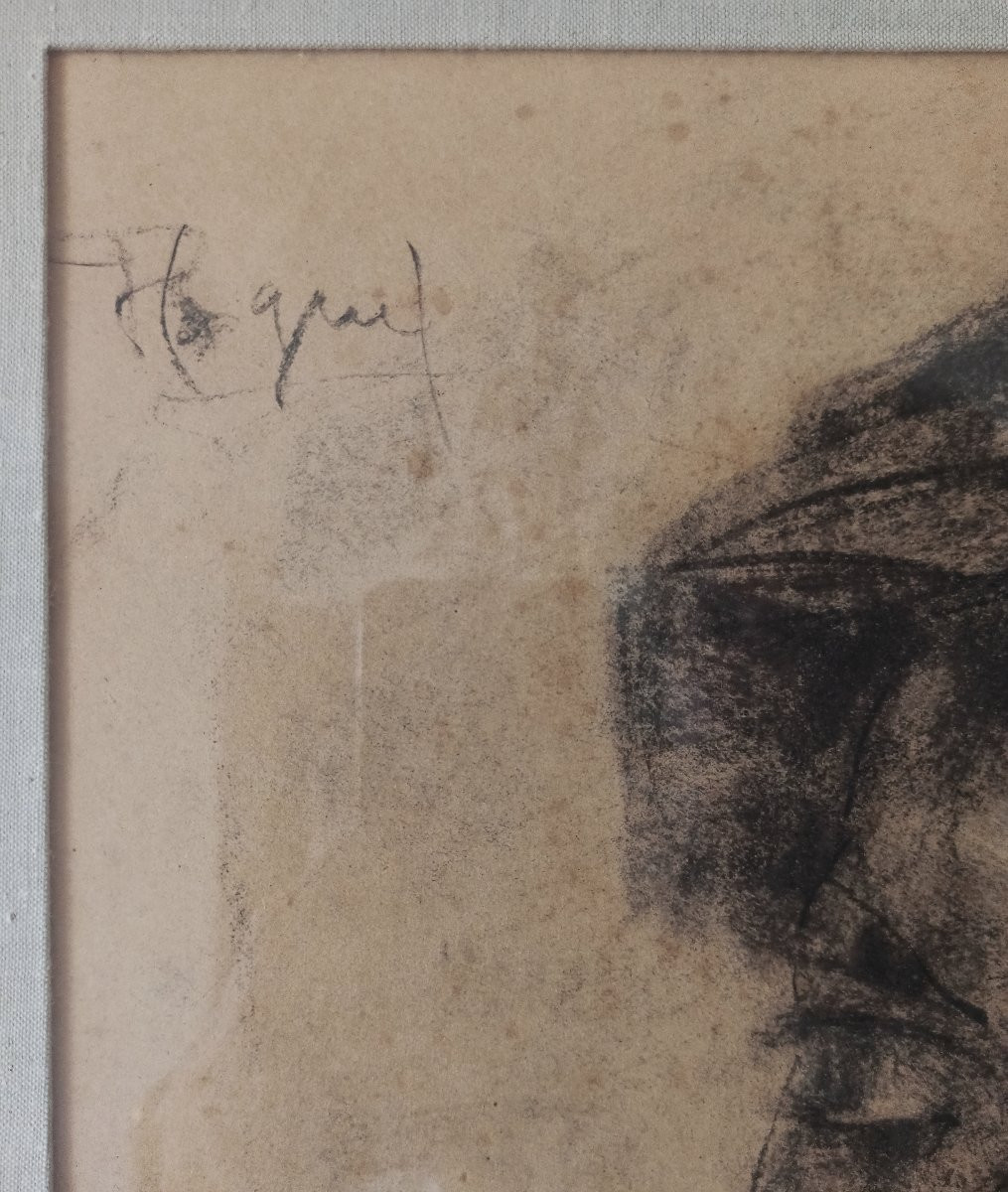
Signed top left, in charcoal: "Higuet"
Very good condition, some foxing
Framed, under double-sided glass
Dimensions with frame: 68.5 x 58.5 cm
* * *
Exhibition review from February 1936:
"Higuet's charcoal drawings are of a different kind of beauty. It is rare to achieve such sure effect with more sobriety. With a consummate knowledge of lighting, Higuet portrayed types of miners, pit boys, rollers, gypsies of surprising strength. A few essential features, a few charcoal rubbings, and a moving, tragic life emanates from the character. No anecdotes, no declamatory attitude, but a grandiose simplicity and, to put it bluntly, this profound humanity that touches you before you analyze its elements and by which one recognizes, without concern for schools or aesthetic palaver, a true and great artist's soul.
* * *
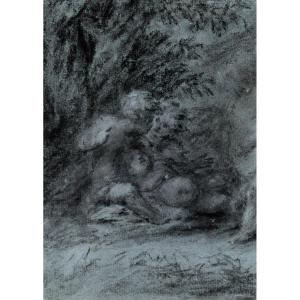
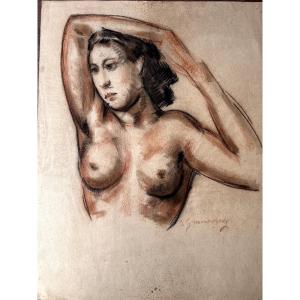
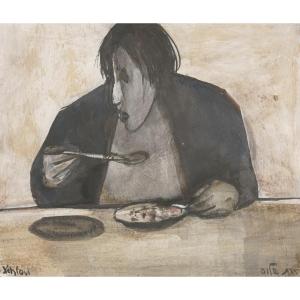
A remarkable sheet, used on both sides by the artist, and which comes as close as possible to the truth of a portrait, in what this genre has of most sincere, disturbing and profound. On the front of his sheet, the Belgian Georges Higuet (1892-1956) drew the portrait of a miner just out of the shaft in the commune of Marcinelle, today a district of Charleroi. Looking away, he shows a three-quarter profile that reveals the tired features and the inevitable daily exhaustion. The back of the sheet, just as astonishing, is an anatomical study, a drawing certainly executed after the écorché figure of Jean Antoine Houdon which demonstrates, in a different way than the front, all the nuances of realism in drawing.
* * *
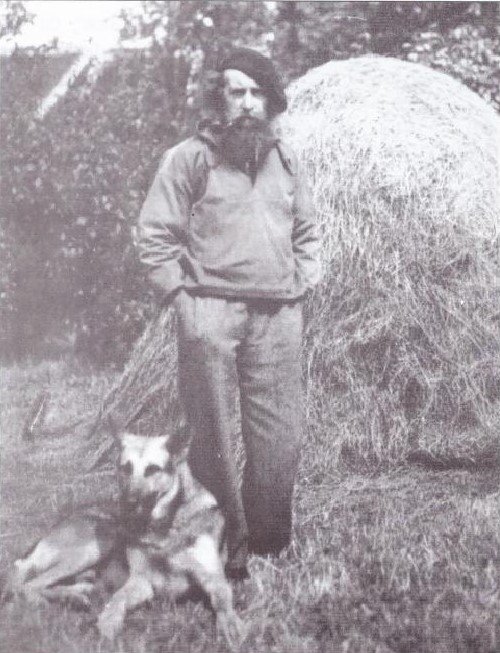
Trained in the studio of the symbolist Jean Delville (1867-1953) at the Academy of Fine Arts in Brussels, from 1908 to 1914, Georges Higuet was interrupted in his momentum by the First World War. Wounded at the front, he took refuge in the Netherlands and chose to live precisely in Nuenen, the village where Vincent Van Gogh, certainly one of his most important influences, had lived. From there, he went to Amsterdam, following in the footsteps of Rembrandt. In the city's ghetto, he produced portraits of popular types, demonstrating his admiration for the Dutch master and his search for truth in art.
After failing to win the Belgian Prix de Rome in 1919, he spent several years wandering between Paris and Brussels, before returning to settle permanently in Belgium in 1926, in Marcinelle, near the coal pits of Bois du Cazier. Georges Higuet was linked to both the working class and the art world of his city. One of his most fervent friends was the Belgian poet Jules Destrée (1863-1936).
Apart from a few exhibitions, his work appears to have been rarely shown during the artist's lifetime. He was, however, appreciated for his strong and sincere social commitment, continuing that of Constantin Meunier but amplifying his expressionist tone, which built his work as a tragic, robust, wild painter, using rough materials.
In December 1929, Higuet founded the magazine La Hache ("the Axe") and decided from then on to accompany the signature of his works with a drawn axe. In the absence of this axe on our sheet, it is possible to date our drawing from the early years of Georges Higuet in Marcinelle, that is to say between 1926 and 1928.
In 1926 precisely, the Belgian writer Georges Eekhoud (1854-1927) had published his fascinating novel Voyous de velours in which we find these lines which could very well accompany our drawing:
"Such a rag-picker, such a beggar, makes me fall into a slump; I would ask them to come and see me every day, to be a feast for my eyes. These poor devils are ignorant of their splendor. No one would esteem it as I do."
Portrait of a Miner / Study of an écorché, a man's torso (after Jean Antoine Houdon)
Charcoal on paper, double-sided drawing
55 x 45.5 cm
Signed top left, in charcoal: "Higuet"
Very good condition, some foxing
Framed, under double-sided glass
Dimensions with frame: 68.5 x 58.5 cm
* * *
Exhibition review from February 1936:
"Higuet's charcoal drawings are of a different kind of beauty. It is rare to achieve such sure effect with more sobriety. With a consummate knowledge of lighting, Higuet portrayed types of miners, pit boys, rollers, gypsies of surprising strength. A few essential features, a few charcoal rubbings, and a moving, tragic life emanates from the character. No anecdotes, no declamatory attitude, but a grandiose simplicity and, to put it bluntly, this profound humanity that touches you before you analyze its elements and by which one recognizes, without concern for schools or aesthetic palaver, a true and great artist's soul.
* * *
A remarkable sheet, used on both sides by the artist, and which comes as close as possible to the truth of a portrait, in what this genre has of most sincere, disturbing and profound. On the front of his sheet, the Belgian Georges Higuet (1892-1956) drew the portrait of a miner just out of the shaft in the commune of Marcinelle, today a district of Charleroi. Looking away, he shows a three-quarter profile that reveals the tired features and the inevitable daily exhaustion. The back of the sheet, just as astonishing, is an anatomical study, a drawing certainly executed after the écorché figure of Jean Antoine Houdon which demonstrates, in a different way than the front, all the nuances of realism in drawing.
* * *
Trained in the studio of the symbolist Jean Delville (1867-1953) at the Academy of Fine Arts in Brussels, from 1908 to 1914, Georges Higuet was interrupted in his momentum by the First World War. Wounded at the front, he took refuge in the Netherlands and chose to live precisely in Nuenen, the village where Vincent Van Gogh, certainly one of his most important influences, had lived. From there, he went to Amsterdam, following in the footsteps of Rembrandt. In the city's ghetto, he produced portraits of popular types, demonstrating his admiration for the Dutch master and his search for truth in art.
After failing to win the Belgian Prix de Rome in 1919, he spent several years wandering between Paris and Brussels, before returning to settle permanently in Belgium in 1926, in Marcinelle, near the coal pits of Bois du Cazier. Georges Higuet was linked to both the working class and the art world of his city. One of his most fervent friends was the Belgian poet Jules Destrée (1863-1936).
Apart from a few exhibitions, his work appears to have been rarely shown during the artist's lifetime. He was, however, appreciated for his strong and sincere social commitment, continuing that of Constantin Meunier but amplifying his expressionist tone, which built his work as a tragic, robust, wild painter, using rough materials.
In December 1929, Higuet founded the magazine La Hache ("the Axe") and decided from then on to accompany the signature of his works with a drawn axe. In the absence of this axe on our sheet, it is possible to date our drawing from the early years of Georges Higuet in Marcinelle, that is to say between 1926 and 1928.
In 1926 precisely, the Belgian writer Georges Eekhoud (1854-1927) had published his fascinating novel Voyous de velours in which we find these lines which could very well accompany our drawing:
"Such a rag-picker, such a beggar, makes me fall into a slump; I would ask them to come and see me every day, to be a feast for my eyes. These poor devils are ignorant of their splendor. No one would esteem it as I do."
650 €
Period: 20th century
Style: Modern Art
Condition: Excellent condition
Material: Paper
Width: 45,5 cm
Height: 55 cm
Reference (ID): 1636900
Availability: In stock
Print