THIS OBJECT WAS SOLD
Large Terracotta Reclining Dog (great Dane) - Richard Fath (1900-1952)


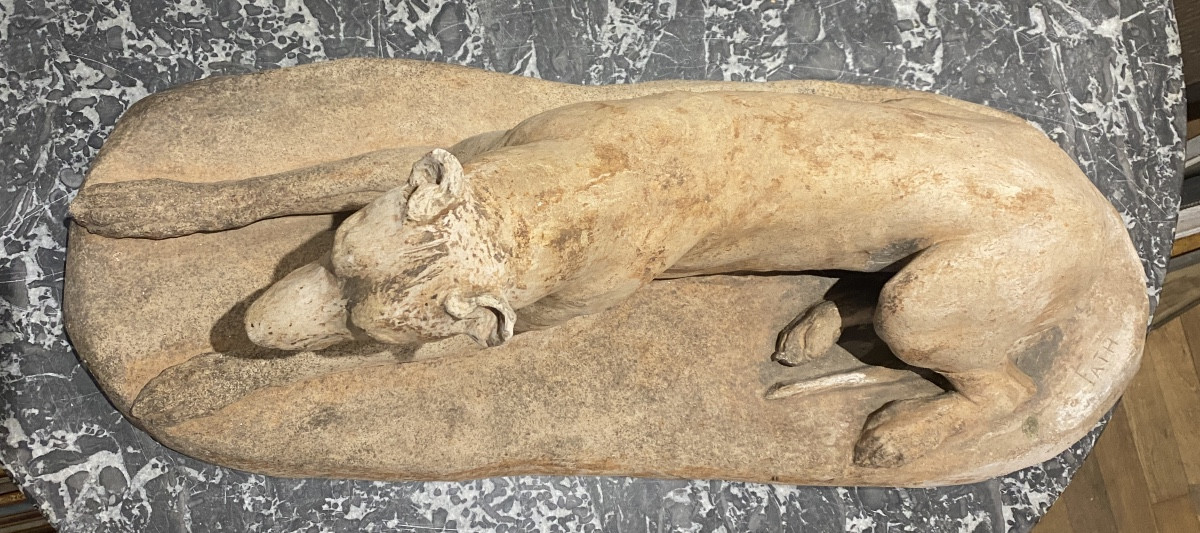


Large terracotta sculpture by Richard Fath, representing a reclining dog (Great Dane). Damaged ears.
Richard Fath was born in Paris on March 2, 1900.
He studied drawing and modeling at the Ateliers de Saint-Maur des Fossés.
He was a sculptor who worked in a variety of techniques: bronze, terracotta, wood carving, and stone. He created medals and jewelry, and also produced paintings in various forms: pastels, gouaches, and more.
He depicted dogs (over 120 species), horses, cats, and farmyard animals in plaster, bronze, and terracotta.
Richard Fath died on November 17, 1952. Fath, a sculptor from father to son. Far from salons and exhibitions, Richard Fath worked in the shadows, indifferent to schools and fashions, and on the fringes of official trends. An extraordinary artistic sensitivity and frenetic creativity that are at the origin of a rich and multifaceted body of work, whose only watchwords were naturalness and emotion. An extraordinary work "My father had a single reference: naturalness." Richard Fath the Younger stands in front of a terracotta bulldog, striking in its realism and emotion, in his father's studio where he is now working to revive his work. He looks at the animal's profile for a long time and smiles at us, full of pride. Richard Fath's work remains little known because it is that of an animal artist, and "animal artists" have always been victims of the modesty of their subject. Social circles marginalized them and made them the poor relations of the family of visual artists – “something like the veterinarian in the army of doctors,” explained Louis Vauxelles, art critic, in 1932. His work is also little known because of his personality and his convictions as an artist, remaining stubbornly away from the beaten track, schools and salons. “I was not made to live in this century,” he once confided to his son, even though he was not used to expressing his feelings. There is no point in looking for “periods” in him like those known to other artists: “Dad saw a dog, a cat, a bird, his son, he drew them, without thinking, because it gave him pleasure – he lived outside his time.” A frantic creativity Born in Paris in March 1900, Richard Fath made his artistic debut in 1923 and his first dog portraits in 1926. From then on, his animal production continued to grow. What he did not express in his life as a man, having always been reserved, a little wild, he expressed abundantly in his work, as if in compensation. Based from 1925 to 1952 in his studio in Bagneux sur Seine, in the suburbs of Paris, he produced an impressive quantity of works, not only of animals. Many remained at the sketch stage; attempts were immediately abandoned to move on to something else and satisfy an inexhaustible curiosity for his models – starting with his own children: “We served as models everywhere and all the time,” joked Richard the son. “Luckily, Mom was there to tell him to leave us alone!” In the countryside, "even when we were walking, he would stop and draw." Very spontaneous, he was able to work anywhere, including in the kitchen, on a corner of a table, forgetting to eat as his thoughts absorbed him, and often being "caught by Mom who would say to him: "Leave your pencil and paper alone for a while!" Technically, Richard Fath dabbled in a bit of everything: "the means don't matter, it's the end that counts," he taught his son and student. Pencil drawing, pastel, charcoal, painting, sculpture on clay, plaster, wood, stone, wax, steel, pewter, ivory... Drawings, sculptures, medals and engravings. Few large works, rather "goldsmith's work," which includes these surprising steels directly carved into tiny dog heads. His priority was the conscientious learning of art. “Be a good craftsman,” he repeated. “If you must have genius, don’t worry about it! Do what you love, just try to achieve it.” And Richard-Camille, son and student, learned the lesson well. “My father would set off in the joy of making an object. He was against declared genius”… A passion for animals and respect for the model Simplicity was a watchword, almost a necessity. “My father had a great sense of observation,” his son says. “He was a great animal artist who sought to recreate the animal as faithfully as possible.” He would go and draw cattle and horses in the fields, nature and the surrounding countryside. He also spent long hours in zoos and menageries with felines. As for dogs, “he was surrounded by them from his earliest childhood, and would go and observe them at dog shows.”
Explore similar pieces and discover your ideal find:
Terracotta Sculptures