THIS OBJECT WAS SOLD
19th Century Clock Signed Raingo Frères Marble And Gilded Bronze

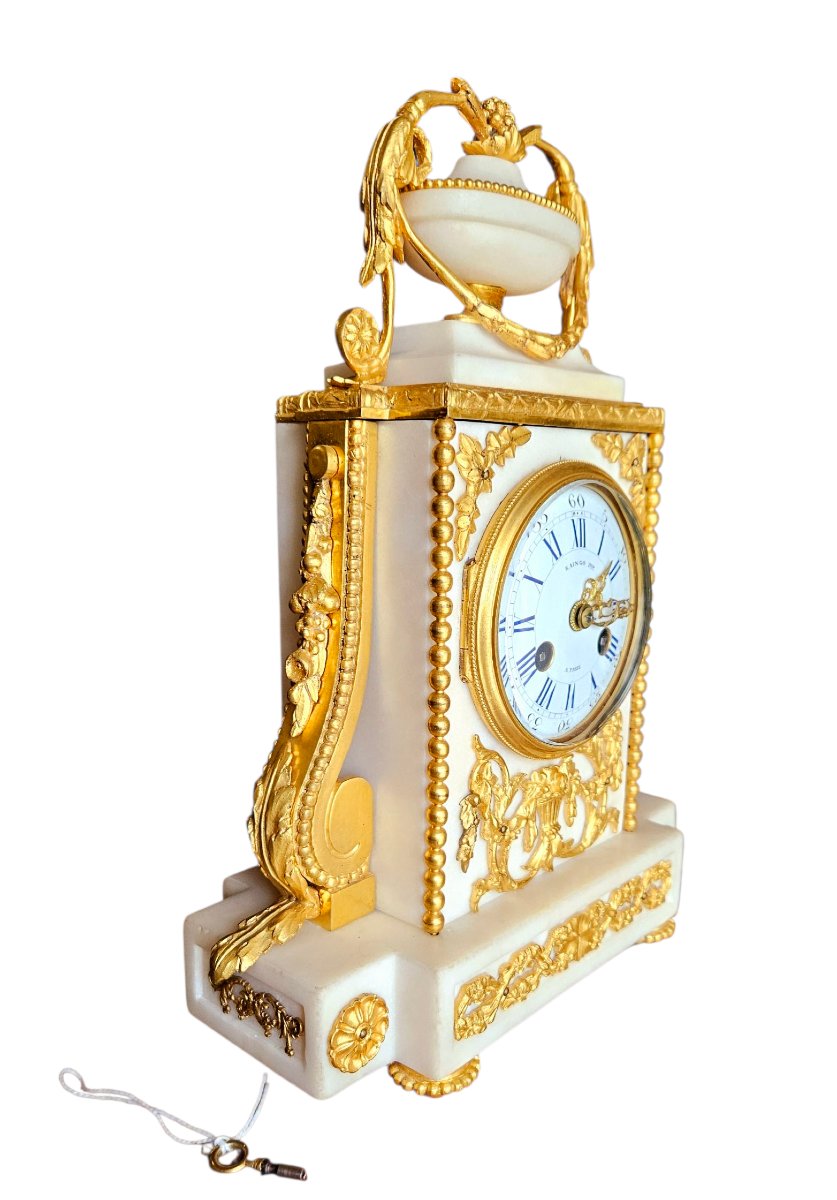

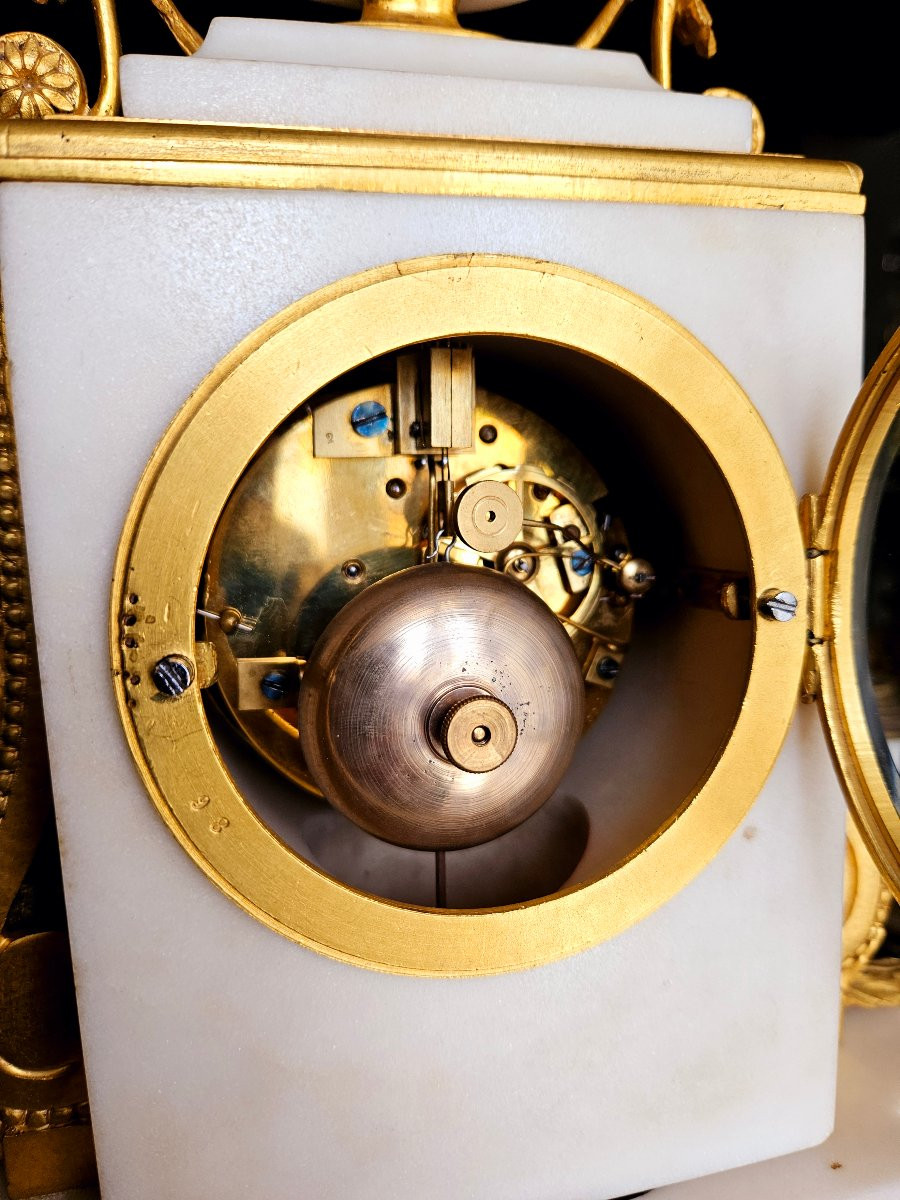


White marble and finely chiseled and gilded bronze clock The dial signed Raingo frères in Paris Louis XVI style and 19th century Excellent condition of presentation and operation *Raingo frères in Paris Watchmaker The life of Zacharie Raingo is relatively little known; his activity extended from 1795 to approximately 1830. Born in Mons, Belgium on July 2, 1775, Zacharie-Joseph Raingo was the son of the watchmaker Nicolas-Joseph Raingo. Trained in his father's workshop, he worked in Tournai from 1795 to 1807, then developed his activity in Ghent from 1810, finally deciding to settle in Paris on rue de Cléry in 1813. It was at the time of his installation in the capital that Raingo specialized in the production of particularly sophisticated planetary clocks equipped with mechanisms for rotating the spheres intended to demonstrate the positions and trajectories of the celestial bodies of the solar system then known at the time; he then filed a patent to protect his research. He quickly achieved great renown among watchmaking enthusiasts and, in 1823, received the title of Clockmaker-Mechanic to HSH Monseigneur the Duke of Chartres (future King Louis-Philippe), then, the following year, that of Clockmaker-Mechanic to the Garde-Meuble de la Couronne. Raingo became in the space of a few years the most famous precision watchmaker of the Empire and Restoration periods. Thus, it should be noted that a clock by the clockmaker was briefly described in 1834 during the auction of the collection of Jacques Laffitte (one of Napoleon's financial advisors and nicknamed the King of Bankers): "A clock on mahogany columns, decorated with gilded brass, mechanical movement by Mr. Raingo. »Four of his sons, Adolphe-Hubert-Joseph, Charles-François-Victor, Denis-Lucien-Alphonse and Dorsant-Emile-Joseph, followed in their father's career and the "Raingo Frères" company was founded in 1823, the workshop being moved a few years later to 8 rue de Touraine. At the 1844 Industrial Products Exhibition, the jury rewarded the company by praising it: "Messrs. Raingo brothers, in Paris, rue Saintonge, 11. Before talking about their products, let us say a word about these manufacturers: it is a family of industrialists composed of four brothers whose intelligence is constantly acquired for the prosperity of their establishment, in Paris and abroad. The commercial part dominates, and the figure of their export is considerable. Among the large number of objects on display, we noticed a Louis XIV clock, the chariot of Neptune, accompanied by two candelabras and two very rich vases; a Renaissance clock, decorated with painted porcelain, and vases decorated with bronzes; two groups, hunting subjects; a clock, Poetry and Eloquence, with children's candelabras, are testimonies to the zeal and activity that reign in this factory. In consideration of the importance of this house and the services rendered to trade, the jury awards the bronze medal to MM Raingo frères" (Report of the central jury, Exhibition of French industrial products in 1844). Today, some of the works of Maison Raingo belong to the most important international private and public collections, including clocks kept in the English royal collections at Windsor Castle, the Kelvin Grove Museum in Glasgow, the Science Museum in London, the Poldi Pezzoli Museum in Milan, the Museum of Art and History in Brussels and the Museum of Arts and Crafts in Paris. *La pendulerie.com
Explore similar pieces and discover your ideal find:
Mantel Clocks