THIS OBJECT WAS SOLD
Jean - Démosthène Dugourc & François Rémond - Large Pair Of Louis XVI Style Candlesticks




See our website for more detailed photos: LINK
We send this article worldwide, professionally packaged, with registered and fully insured shipping at a fair price.
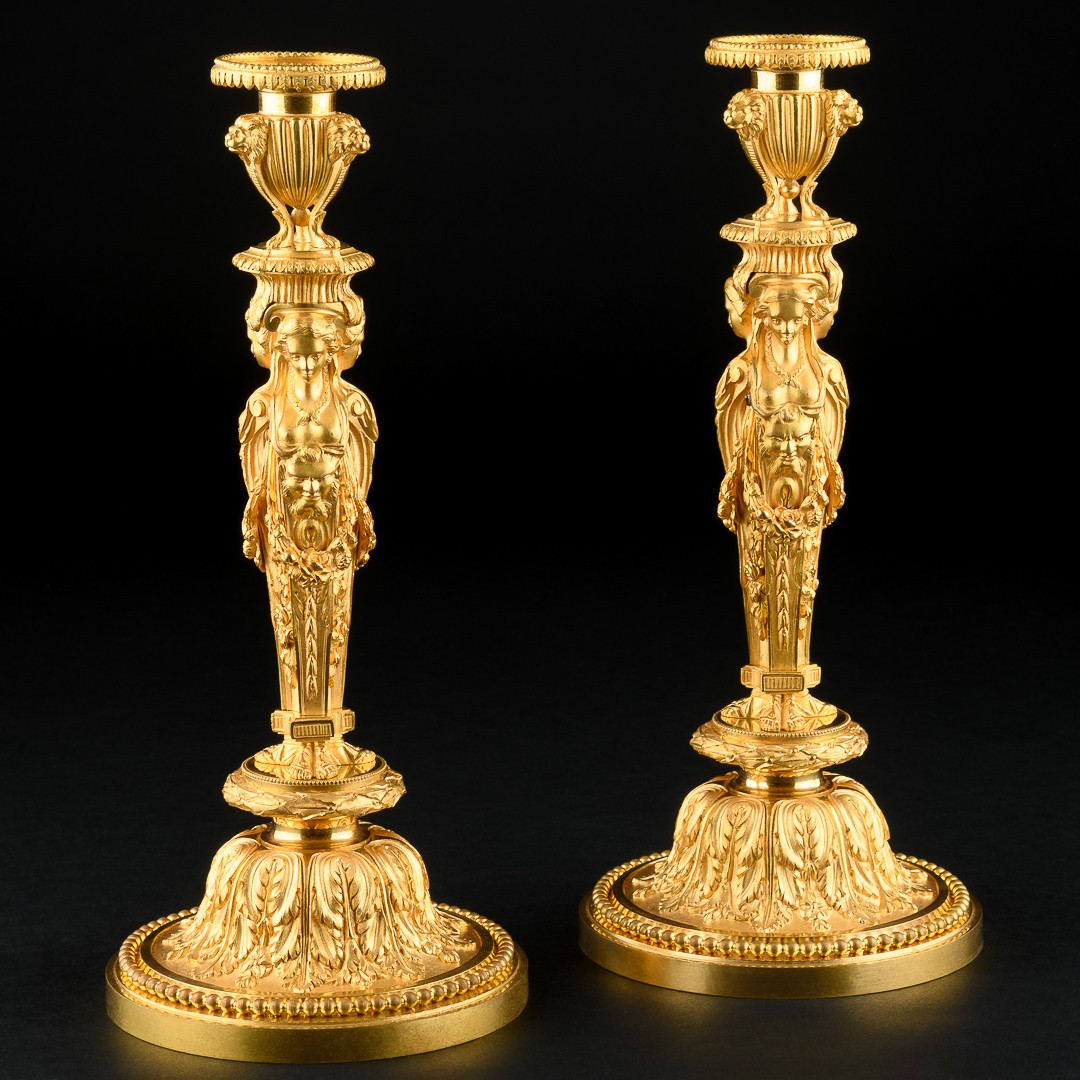
A rare and imposing pair of early nineteenth-century French gilt-bronze candlesticks, after a design by Jean-Démosthène Dugourc (1749–1825), finely chiselled and retaining their original period gilding. Each candlestick is surmounted by a gadrooned vase-shaped socket adorned with three lion heads and rests upon a tripod of lion paws. The shaft comprises three female caryatids in the antique manner, embellished with satyr masks on the chest and draped with garlands of flowers, terminating in sandaled feet standing upon a circular spreading base. Richly decorated with alternating acanthus leaves and fleurons, the base is encircled by a prominent string of pearls. The chiselling is of exceptional refinement, with an extraordinary interplay of matte and burnished mercury gilding, highlighting both the sculptural presence and exquisite finish of the work. Conceived by Dugourc and executed by a leading Parisian bronzier circa 1820, this distinguished model exemplifies the finest neoclassical taste of the period.
This model is based on a design by Jean-Démosthène Dugourc, the eminent French designer and ornamentalist whose work epitomised the late eighteenth-century taste for arabesque and Etruscan motifs. The design is recorded in a watercolour by Dugourc, dated circa 1790, now preserved in the Musée des Arts Décoratifs in Paris. François Rémond, maître ciseleur-doreur since 1774 and one of the foremost bronziers of his generation, is thought to have drawn upon Dugourc’s designs in executing closely related “Etruscan-style” candlesticks. Closely related examples survive in major international collections: one at Pillnitz Castle near Dresden, another in the Wallace Collection in London, while further examples were formerly in the collection of Karl Lagerfeld.
These superb, large French candlesticks exemplify the elegance of early nineteenth-century French bronze work, surviving in excellent condition with their original matte and burnished mercury gilding finely executed and fully intact.
Origin: Paris circa 1820.
Dimensions: Height 33 cm (13″), Diameter base 14.5 cm (5.7″).
Jean-Démosthène Dugourc (1749–1825) was a French designer and ornamentalist whose work epitomised the late eighteenth-century vogue for arabesque and Etruscan taste. Trained in Rome and active at the French court, he became designer to the Comte de Provence, created costumes for the Paris Opéra, and in 1784 was appointed designer of the Garde‐Meuble de la Couronne (the Crown Furniture Repository). His refined drawings, blending classical motifs with natural forms, informed the work of leading contemporaries such as the architect François-Joseph Bélanger, the furniture maker Georges Jacob, and the bronziers Rémond, Gouthière and Thomire, while also shaping the silks of Camille Pernon. During the Revolution he turned to industrial ventures and symbolic designs, before entering the service of the Spanish crown in 1800. Restored to his former position under the Bourbon monarchy, he ended his career in Paris, leaving a legacy that profoundly influenced European decorative arts.
Literature
- Collection Musée des Arts Décoratifs, Paris, inv. nr. CD 2703.
- H. Ottomeyer, P. Proschel et al., “Vergoldete Bronzen – Die Bronzearbeiten des Spätbarock und Klassizismus”, München, 1986, Vol. I, p.286-287, fig. 4.15.2 and 4.15.6.
- P. Hugues, The Wallace Collection, “Catalogue of Furniture”, III, London, 1996, p.1246-1250,
- Pierre Verlet, “Les bronzes dorés français du XVIIIe siècle”, Picard, Paris, 1999, p. 294 fig. 325.
- Collection Lagerfeld sale at Christie’s, Monaco.
We remain at your disposal via our website and WhatsApp. Fluent in French, English, German and Dutch, we will be delighted to assist with any enquiries or to arrange an appointment.
Explore similar pieces and discover your ideal find:
Candlesticks