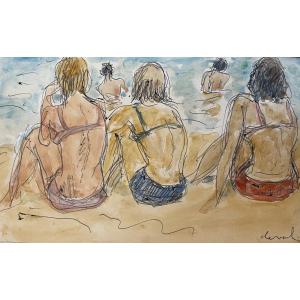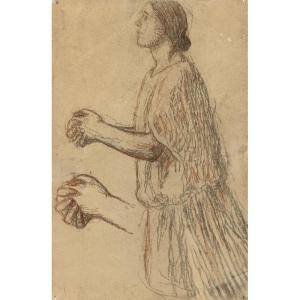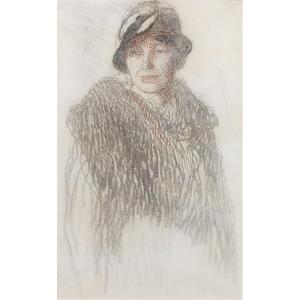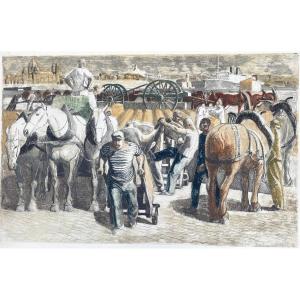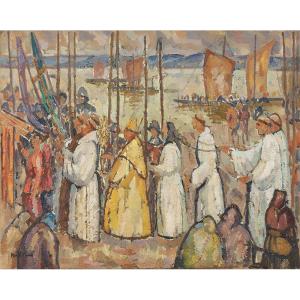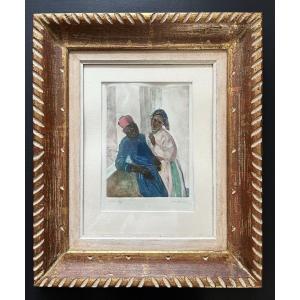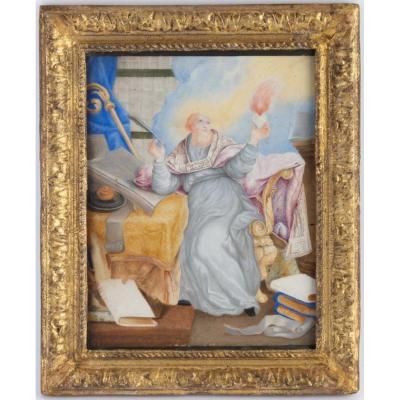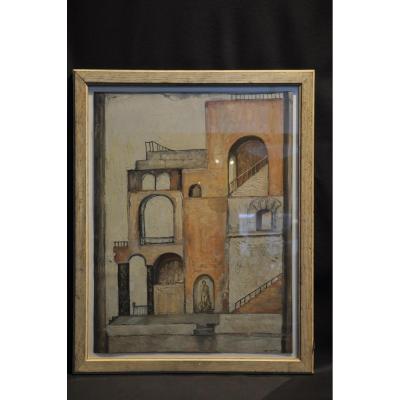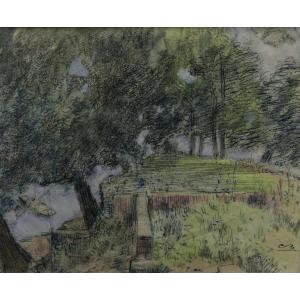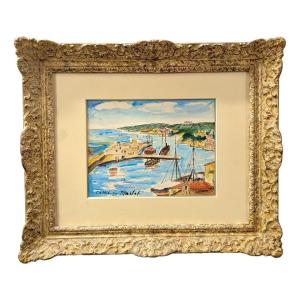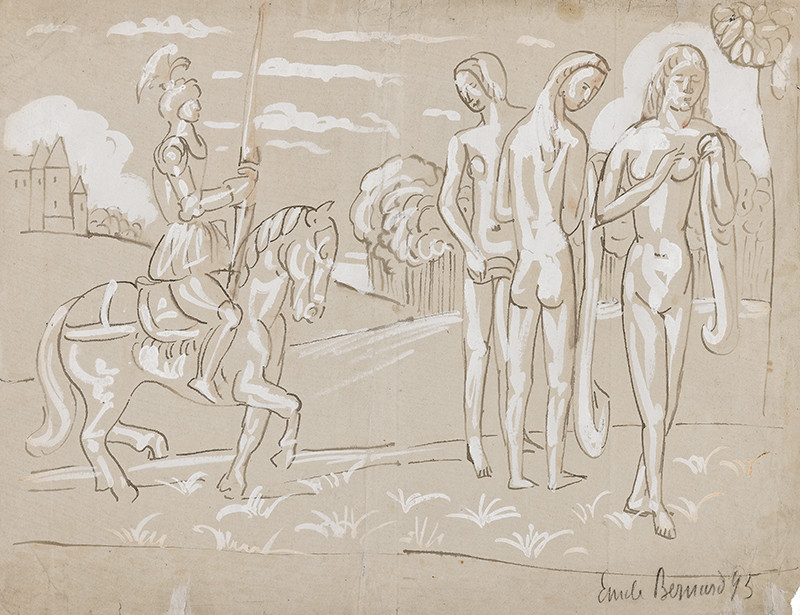


Emile Bernard (1868 - 1941) — The Knight, 1895
Ink and white gouache on paper, signed and dated 95 lower right.
39.4 x 51.1 cm
Provenance:
André Maire Collection
Marie-Laure Harscoët-Maire Collection, granddaughter of the artist.
Certificate of authenticity issued by Ms. Béatrice Recchi-Altarriba on behalf of the Emile Bernard Archives.
Émile Bernard – A Visionary Painter Between Modernity and Tradition
Émile Bernard’s family left Lille, where he was born in 1868, and moved to Paris. As a young man, he studied drawing at the École des Arts Décoratifs, and in 1884, he joined Fernand Cormon’s studio, where he met Louis Anquetin and Henri de Toulouse-Lautrec. He was eventually expelled for disciplinary reasons, rejecting what he saw as the conservative doctrines of his master.
Bernard turned toward a more solitary and instinctive learning process, grounded in the observation of nature and the study of Old Masters. He soon embarked on a six-month walking tour through Normandy and Brittany, a formative journey that shaped his artistic identity.
Émile Bernard is best known for co-developing, alongside Louis Anquetin, a radically new visual vocabulary, which he would continue to refine in the years that followed.
In the fall of 1888, his encounter with Paul Gauguin at Pont-Aven marked a decisive turning point. Together, they laid the foundations of a new art, built on formal simplification, emotional resonance, and the rejection of naturalism.
Cloisonnism — with flat areas of color outlined in bold contours — became a tool for expressing inner vision, based on memory and emotion rather than direct observation.
Their approach, also known as Synthetism, combined spiritual meaning with structural harmony, paving the way for Symbolist painting and influencing the 20th-century avant-gardes.
“It was no longer a matter of painting in front of the thing, but of painting it from the imagination that had received it…”
— Émile Bernard, Unpublished Memories on Gauguin, 1941.
In 1891, after a definitive break with Gauguin — whom he accused of taking credit for their shared innovations — Bernard moved to Egypt, where he remained for ten years. In 1894, he married the daughter of a wealthy Egyptian family. During these years of exile, he became immersed in the Orient, absorbing its light, rhythm, and symbols.
His art turned increasingly toward mysticism, nourished by philosophical and spiritual questions, and by a gradual return to the tradition of European painting.
Returning to France, Bernard took the young painter André Maire under his wing — who would later become his son-in-law. He founded the journal La Rénovation Esthétique, where he published numerous texts, often under pseudonyms, fervently defending a return to beauty, classicism, and reverence for the past. Though he grew increasingly opposed to the avant-garde, Bernard remained a profound and complex artist, whose work — though more conservative in appearance — was always deeply aligned with his inner convictions.
In 2015, a major exhibition at the Musée de l’Orangerie, organized by the Musée d’Orsay, brought renewed attention to Émile Bernard’s work. It revealed a painter-thinker of exceptional depth, whose contributions to modern art had long been underestimated.
Discover more of this artist's works on the gallery's website: https://www.galeriepentcheff.fr/fr/peintre-emile-bernard
Period: 19th century
Style: Other Style
Condition: Good condition
Material: Gouache
Reference (ID): 1601595
Availability: In stock