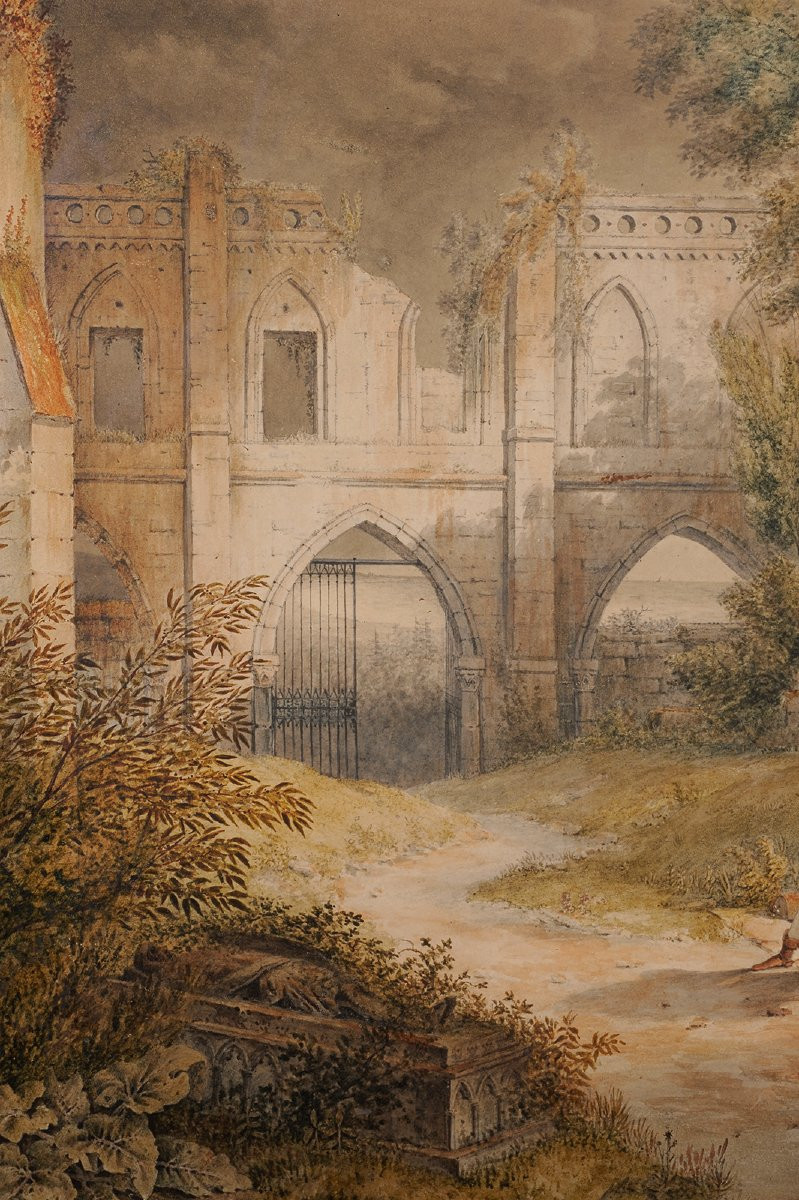


Jean-jacques Champin (1796-1860) William Wallace Thanking Heaven
Artist: Jean-jacques Champin Et Jean-baptiste Thomas
Jean-Jacques CHAMPIN
(Sceaux, 1796 - Paris, 1860) and Jean-Baptiste THOMAS (Paris, 1791 - Paris, 1833)
William Wallace thanking heaven for having escaped Edward I, after The Scottish Chiefs by Jane Porter
Watercolor
H. 74.5 ; W. 61 cm
Signed at the bottom and dated 1820
Exhibition:
Salon of 1822 under number 209 : “Wallace, watercolor. He comes out of an underground passage communicating with the cemetery of Fincklay Abbey, and escapes the pursuit of Edward I, King of England. Subject taken from The Scottish Chiefs. The figures in these two paintings * are by Mr. Thomas.”
* The other painting is number 208: “The Death of Malvina, watercolor. She expires in the arms of blind Ossian."
Born in Sceaux, Jean-Jacques Champin was the son of a former squire-quartermaster of the King's household who became mayor of Sceaux and named his son Jean-Jacques in homage to Rousseau. Champin remained faithful to his hometown where he was a close friend of Napoléon Mortier, Duke of Trévise, owner of the Sceaux estate. His first lithograph was entitled The Church of Sceaux and the Entrance to the Park of Trévise, and he drew numerous views of Sceaux and the Ile-de-France region. A student of Felice Storelli and Jacques Auguste Régnier, a student of Bertin, Champin devoted himself primarily to landscapes, which he most often treated in watercolor or in the technique of which he was a pioneer since its appearance in France: lithography. Encouraged by Régnier, he participated in various works allowing visitors to discover sites in France or Italy. His collection of Habitations of the Most Famous People in France from 1790 to the Present Day was prefaced by Charles Nodier. Champin had frequented the Salon held by the latter at the Bibliothèque de l'Arsenal in the 1820s, which allowed him to rub shoulders with the entire Romantic circle. However, although it is part of the "troubadour" movement born at the very beginning of the century, it is already a Romantic spirit that animates the large watercolor that we present. The subject is taken from an episode in the life of William Wallace (1272-1305), hero of Scottish independence who led his people against English domination during the reign of Edward I and met a cruel end. But in our image, Wallace managed to escape through an underground passage, and the artist represents him on his knees, his arms raised to Heaven, as if to thank it for his salvation. The figure, however, is tiny, as is the little monk who disappears under a porch. (To create these figures, Champin also called upon a specialist, the Prix de Rome winner Jean-Baptiste Thomas; this kind of collaboration was common between painters.) This is because the true subject of the painting is this impressive Gothic abbey, drawn with the precision of an architect, whose towers are seen from a low angle. Curiously, the building is partly ruined, although one might assume it was recently built... Left abandoned, invaded by vegetation - with this large bush of hollyhocks and these wild grasses attacking a recumbent figure - the adjacent cemetery is lit by the strange orange light that precedes a storm. Panic-stricken birds try to flee the threatening black mass of clouds. Barely sketched, fir trees appear through the arch of a portal, a detail that evokes contemporary visions of Gaspar David Friedrich. The emerging taste of artists for medieval monuments, castles, churches and cloisters, previously disdained, takes on a fantastic dimension here that transcends archaeological interest. The early date of the work (1820), the unusual size of the sheet, the importance given to it by the author by exhibiting it two years later at the Salon, the choice of Gothic architecture and a cemetery as the scene of the action, justified our choosing this work among other illustrations of a dark romanticism.
(Sceaux, 1796 - Paris, 1860) and Jean-Baptiste THOMAS (Paris, 1791 - Paris, 1833)
William Wallace thanking heaven for having escaped Edward I, after The Scottish Chiefs by Jane Porter
Watercolor
H. 74.5 ; W. 61 cm
Signed at the bottom and dated 1820
Exhibition:
Salon of 1822 under number 209 : “Wallace, watercolor. He comes out of an underground passage communicating with the cemetery of Fincklay Abbey, and escapes the pursuit of Edward I, King of England. Subject taken from The Scottish Chiefs. The figures in these two paintings * are by Mr. Thomas.”
* The other painting is number 208: “The Death of Malvina, watercolor. She expires in the arms of blind Ossian."
Born in Sceaux, Jean-Jacques Champin was the son of a former squire-quartermaster of the King's household who became mayor of Sceaux and named his son Jean-Jacques in homage to Rousseau. Champin remained faithful to his hometown where he was a close friend of Napoléon Mortier, Duke of Trévise, owner of the Sceaux estate. His first lithograph was entitled The Church of Sceaux and the Entrance to the Park of Trévise, and he drew numerous views of Sceaux and the Ile-de-France region. A student of Felice Storelli and Jacques Auguste Régnier, a student of Bertin, Champin devoted himself primarily to landscapes, which he most often treated in watercolor or in the technique of which he was a pioneer since its appearance in France: lithography. Encouraged by Régnier, he participated in various works allowing visitors to discover sites in France or Italy. His collection of Habitations of the Most Famous People in France from 1790 to the Present Day was prefaced by Charles Nodier. Champin had frequented the Salon held by the latter at the Bibliothèque de l'Arsenal in the 1820s, which allowed him to rub shoulders with the entire Romantic circle. However, although it is part of the "troubadour" movement born at the very beginning of the century, it is already a Romantic spirit that animates the large watercolor that we present. The subject is taken from an episode in the life of William Wallace (1272-1305), hero of Scottish independence who led his people against English domination during the reign of Edward I and met a cruel end. But in our image, Wallace managed to escape through an underground passage, and the artist represents him on his knees, his arms raised to Heaven, as if to thank it for his salvation. The figure, however, is tiny, as is the little monk who disappears under a porch. (To create these figures, Champin also called upon a specialist, the Prix de Rome winner Jean-Baptiste Thomas; this kind of collaboration was common between painters.) This is because the true subject of the painting is this impressive Gothic abbey, drawn with the precision of an architect, whose towers are seen from a low angle. Curiously, the building is partly ruined, although one might assume it was recently built... Left abandoned, invaded by vegetation - with this large bush of hollyhocks and these wild grasses attacking a recumbent figure - the adjacent cemetery is lit by the strange orange light that precedes a storm. Panic-stricken birds try to flee the threatening black mass of clouds. Barely sketched, fir trees appear through the arch of a portal, a detail that evokes contemporary visions of Gaspar David Friedrich. The emerging taste of artists for medieval monuments, castles, churches and cloisters, previously disdained, takes on a fantastic dimension here that transcends archaeological interest. The early date of the work (1820), the unusual size of the sheet, the importance given to it by the author by exhibiting it two years later at the Salon, the choice of Gothic architecture and a cemetery as the scene of the action, justified our choosing this work among other illustrations of a dark romanticism.
16 000 €
Period: 19th century
Style: Louis Philippe, Charles 10th
Condition: Perfect condition
Material: Water color
Length: 74,5 cm hors cadre
Width: 61 cm hors cadre
Reference (ID): 1597945
Availability: In stock
Print