THIS OBJECT WAS SOLD
Jean Cotelle 1645-1708 Venus And Adonis Oil On Canvas

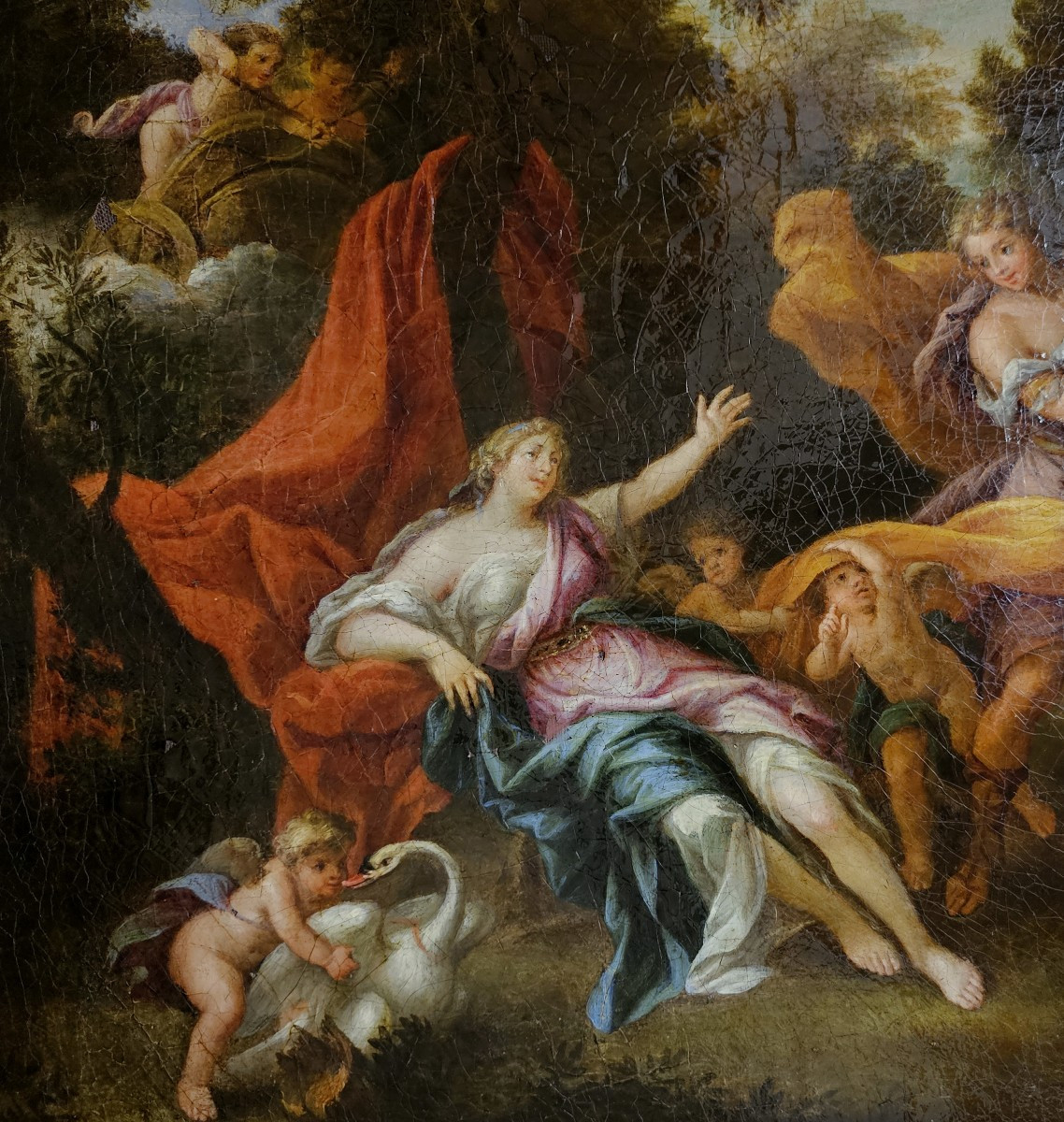
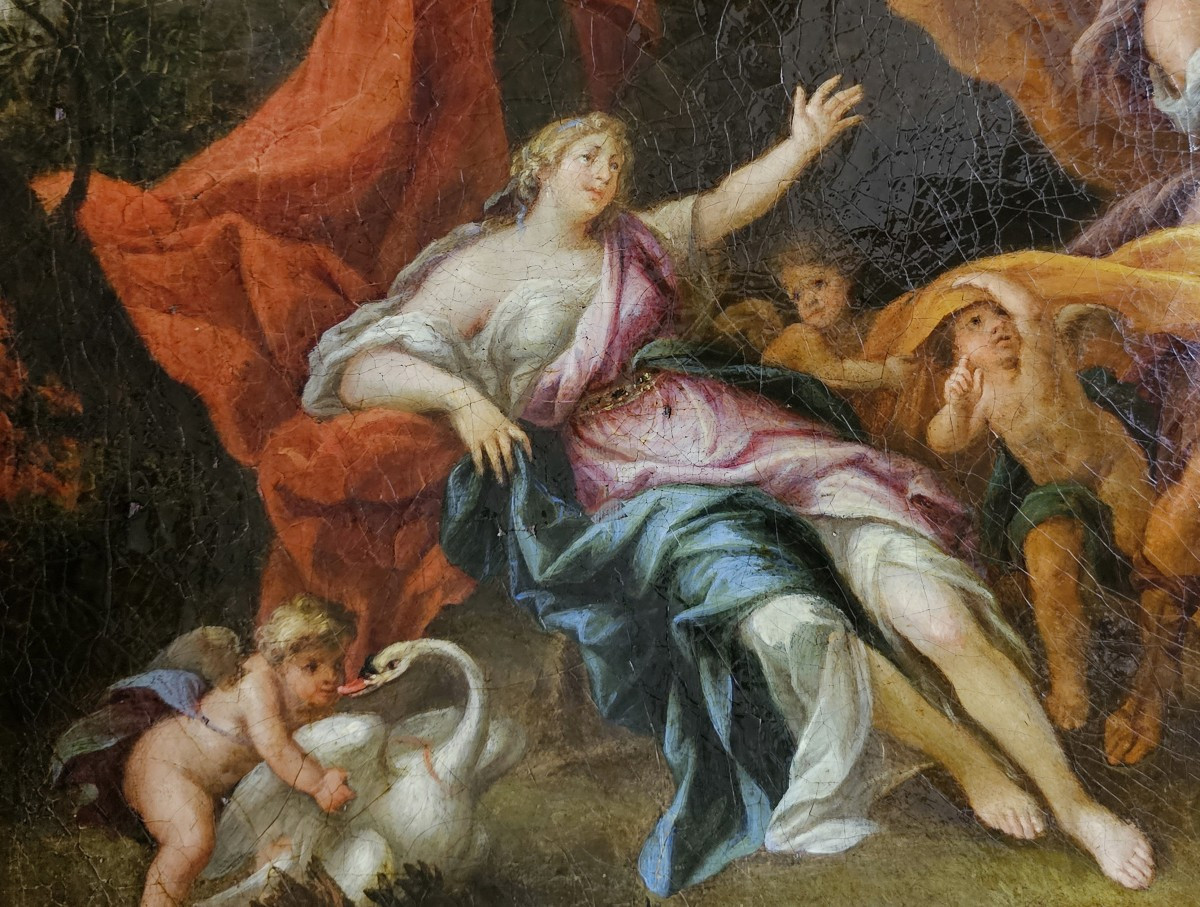



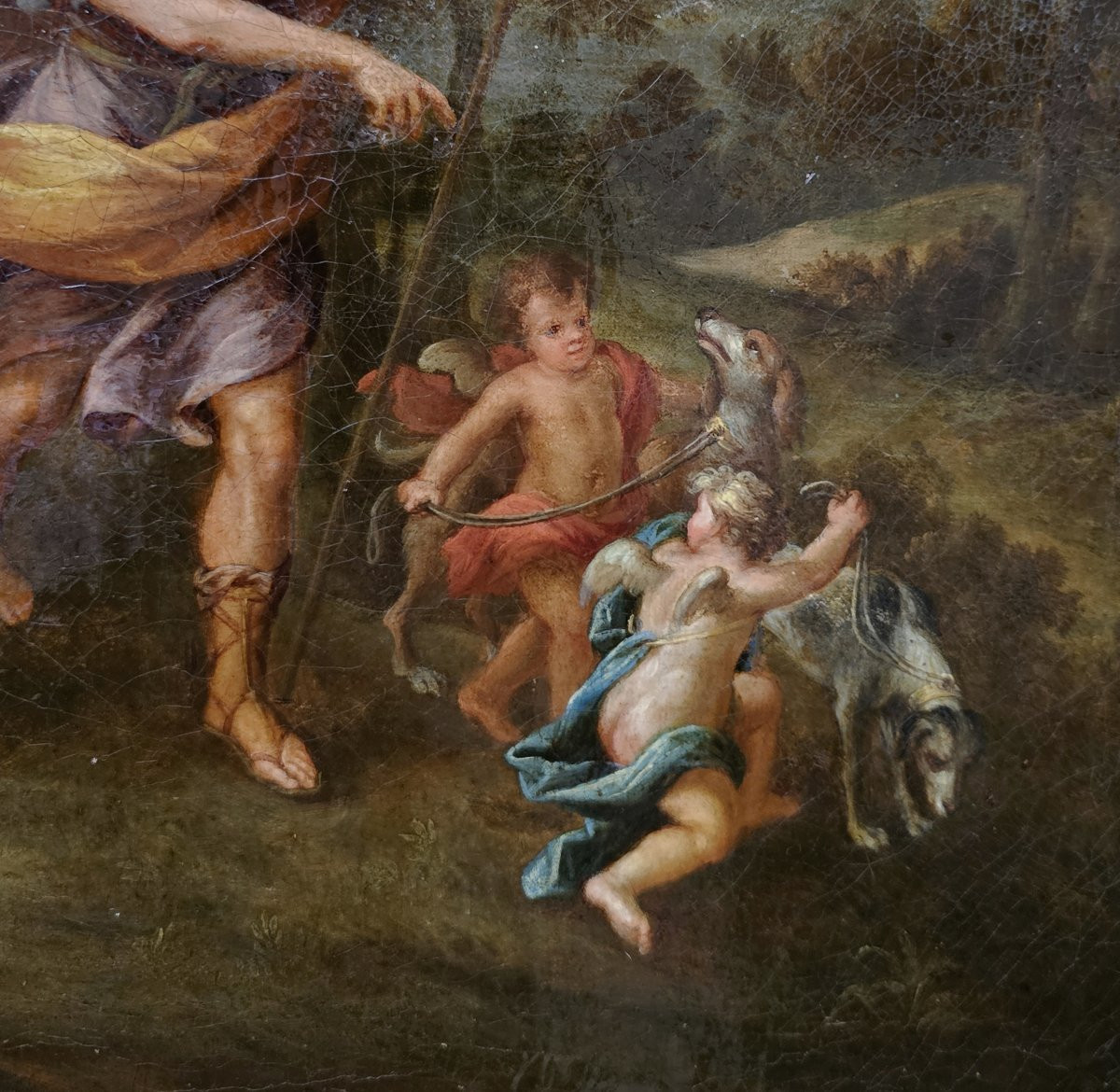


Jean Cotelle1645-1708Venus and AdonisOil on canvas46.5 cm x 56 cm (image dimensions)Expertise François Marandet, LondonThe painter Jean Cotelle, known as the Younger, son of the painter and decorator Jean Cotelle (1607-1676), is known to have traveled to Italy in his early years, between 1662 and 1670. Upon his return to Paris, he was admitted to the Royal Academy of Painting and Sculpture in 1672 after presenting a miniature entitled "The Triumphal Entry of the King and Queen into Paris" (now lost). Despite his specialization as a miniaturist, Cotelle received public commissions, which has allowed us to discover paintings in which the figures appear monumental. Cotelle was indeed chosen to create the annual painting of the "month of May" for Notre-Dame Cathedral in 1682 (now preserved in the church of Yssingeaux). Cotelle is above all the author of an important series of mythological paintings created between 1688 and 1693 for the Trianon, the leisure residence of King Louis XIV at Versailles. In addition, the brochures of the exhibitions of the members of the Royal Academy (1673 and 1704) attest to Cotelle's participation with a series of paintings (most of which have been lost). Recent publications, however, have not taken Cotelle's involvement in this field into account. In reality, some of these paintings by Jean Cotelle still exist, and the originality of our work (ill. 2) lies in the fact that it belongs to this category. As is often the case, Cotelle's motifs are borrowed from the paintings of Nicolas Loir (1624-1679), who was also his brother-in-law. The other obvious source is the art of the famous 17th-century Bolognese painter Francesco Albani (1578-1660). Cotelle was well aware that French collectors of his time highly valued Albani's paintings, which were in turn considered miniatures, especially those painted on copper. It is certainly no coincidence that our composition illustrates the story of Venus and Adonis: in 1671, a painting by Albani on the same theme was acquired for the royal collections (now in the Louvre; fig. 1). It is clear that Cotelle was inspired by the basic idea of the loving couple surrounded by putti and especially by the emphasis on nature. Comparisons with other works by Cotelle are possible, even though some of them are attributed to other artists. One example is Cotelle's Ceres, currently offered on the Italian art market (and wrongly attributed to Noël Coypel; fig. 3), in which the personification of summer (or Ceres) is depicted in a similar way to Venus in our painting. Cotelle's trademark seems to have been a tendency to summarize and soften forms. Our artwork can also be compared to the paintings made for the Trianon. A detail from "The Basin of Neptune with the Judgement of Paris" (Trianon) is reproduced here (ill. 4). The proportions of the individual figures correspond perfectly to those in our painting (and also to those of Ceres). Given the difference in height between these different paintings (which combine real views of the gardens of Versailles with mythological themes) and the reduced format of the stories, the figures almost take on the form of miniatures. It is clear that the balance would be restored as soon as Cotelle used the larger format of easel paintings, which is clearly the case in our painting. The impression of miniaturized figures would disappear and Cotelle's paintings would almost resemble one of those mythologies by Bon Boullogne (1649-1717) and his younger brother Louis de Boullogne (1654-1733) or those of Nicolas Loir. The more compact conception of the figures in the series made for the Trianon, which contrasts with the freer representation of forms in our painting, suggests that the latter was painted in the last years of Cotelle's life, that is to say around 1700, or even later.Francois Marandet, London, June 30, 2025. Works by this artist are very rarely offered on the art market. Inv. No. 3.7628 €500
Explore similar pieces and discover your ideal find:
Other Paintings