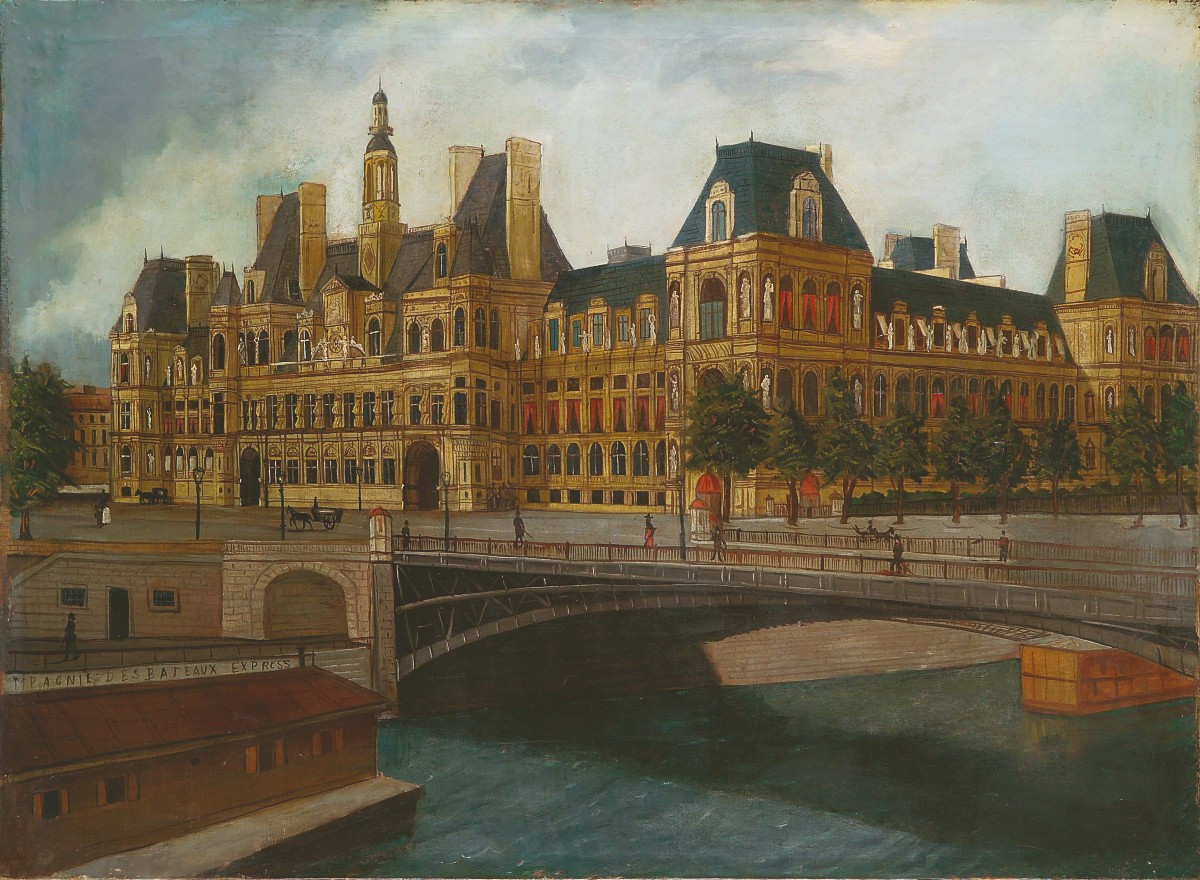



A frontal view of the Hôtel de Ville, this canvas attributed to Louis Vivin holds the eye through a restrained idiom: firm contours, façades built “stone by stone,” the river reduced to a continuous band, figures set down without anecdote. The large format—uncommon in the naïf vein—gives the motif a stability that privileges legibility over effect, as if the image were held at a deliberate remove to let the architecture emerge.
The work stands at the threshold of the “modern primitives” championed by Wilhelm Uhde: a non-academic gaze, informed by vernacular imagery (postcards), that organizes space into superposed planes and rejects atmospheric illusion. It enters into a muted dialogue with Rousseau (architecture as stage) and, by virtue of its urban subject, with Utrillo, while departing from both through a deliberately regular topography.
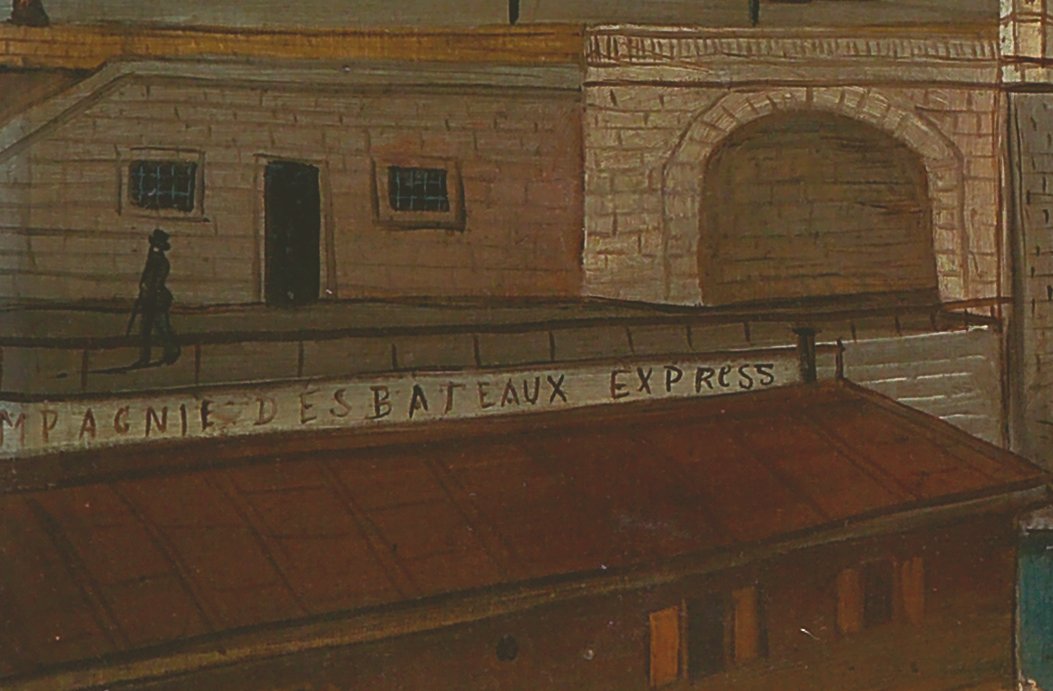
Historical context adds another layer. Rebuilt between 1874 and 1882 after the fire of 1871, the Hôtel de Ville became an emblem of the Third Republic and its civic uses. The barge bearing “Compagnie des Bateaux-Express” anchors the view in 1883–1886, at a moment when passenger traffic on the Seine still structured the city, before the rise of tramways and the Métro. The execution, likely later (late 1920s), thus condenses two temporalities: a memory of fin-de-siècle Paris and an interwar gesture. From this tension springs the subject’s interest—at once a document of a shared visual culture and a stable image of republican Paris.
A detailed note is available upon request.








 Le Magazine de PROANTIC
 TRÉSORS Magazine
 Rivista Artiquariato