
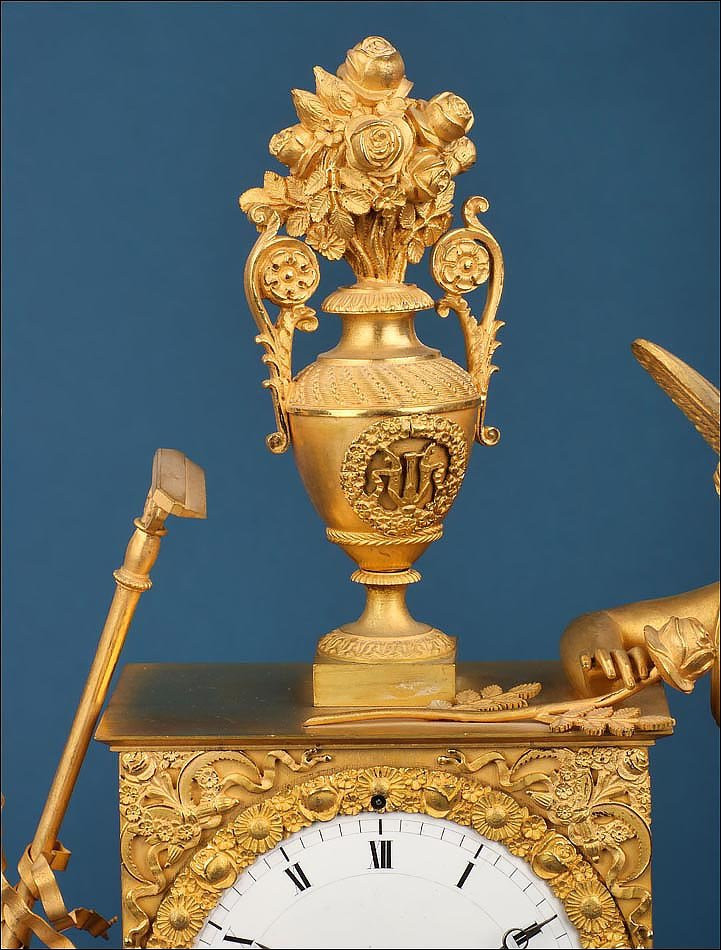


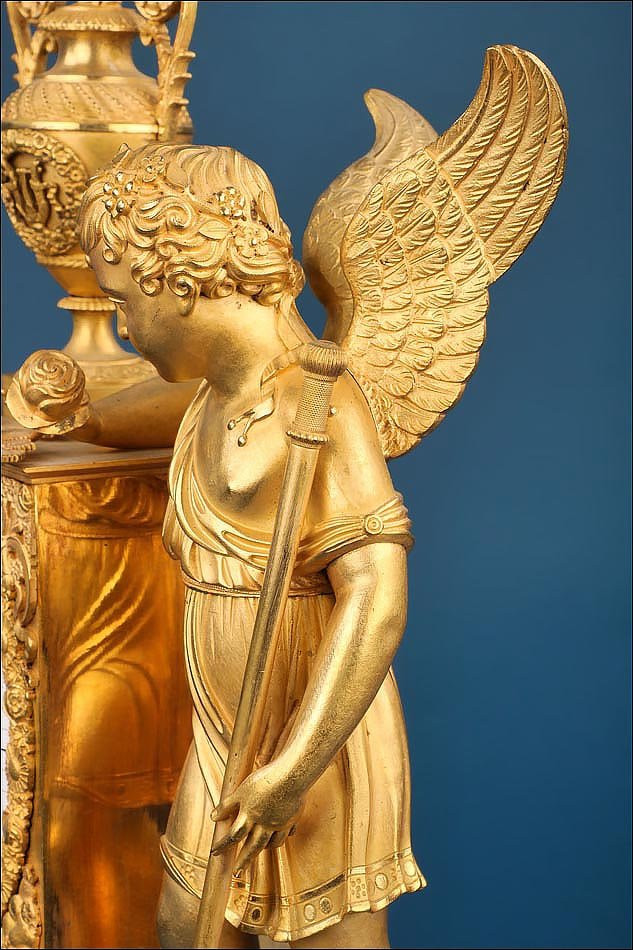


"Antique Gardening Allegory Gilt Bronze Mantel Clock. France, Circa 1840"
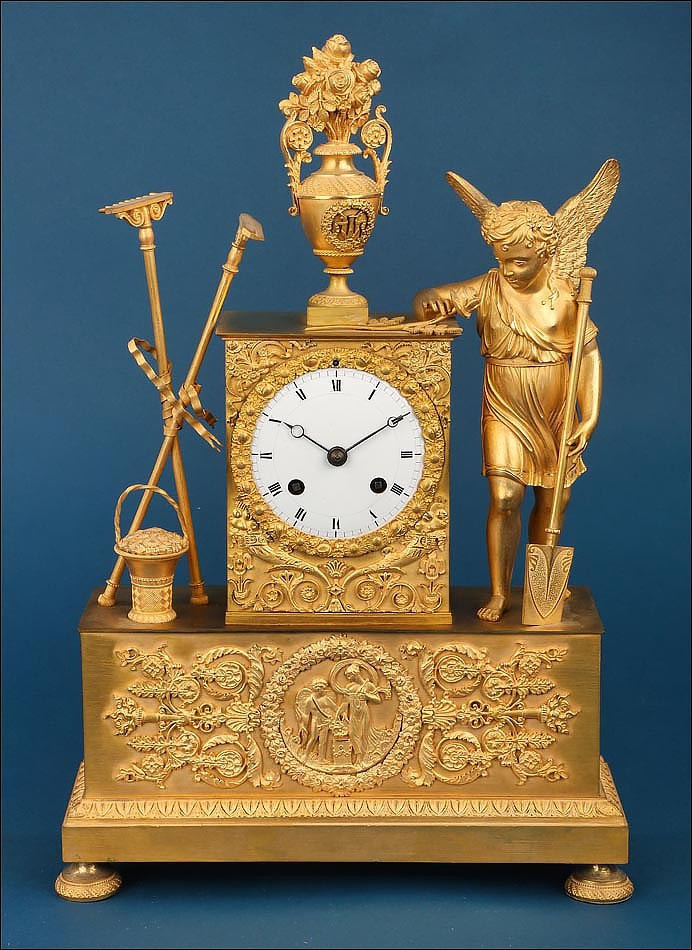
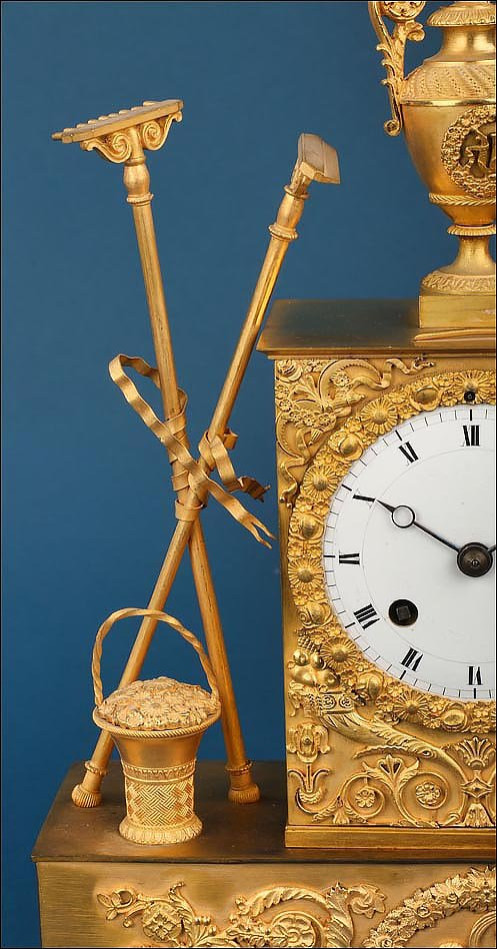
This beautiful French mantel clock, made around 1840, is an outstanding example of 19th-century decorative arts, especially notable for its excellent overall condition. Crafted in mercury-gilded bronze —a traditional technique now banned due to its toxicity— the original gilding is in exceptional condition, retaining its uniform shine without visible wear or oxidation. This rare level of preservation significantly enhances both its visual appeal and value.The clock features an allegory of gardening, a theme often found in neoclassical iconography. A finely modelled cherub leans casually on the clock case while holding a small spade, accompanied by gardening tools such as a rake, hoe, and a basket overflowing with flowers. A classical urn filled with roses crowns the top, symbolising cultivated nature and fertility. The sculptural group is finely executed, demonstrating the skill of the best Parisian foundries of the period.
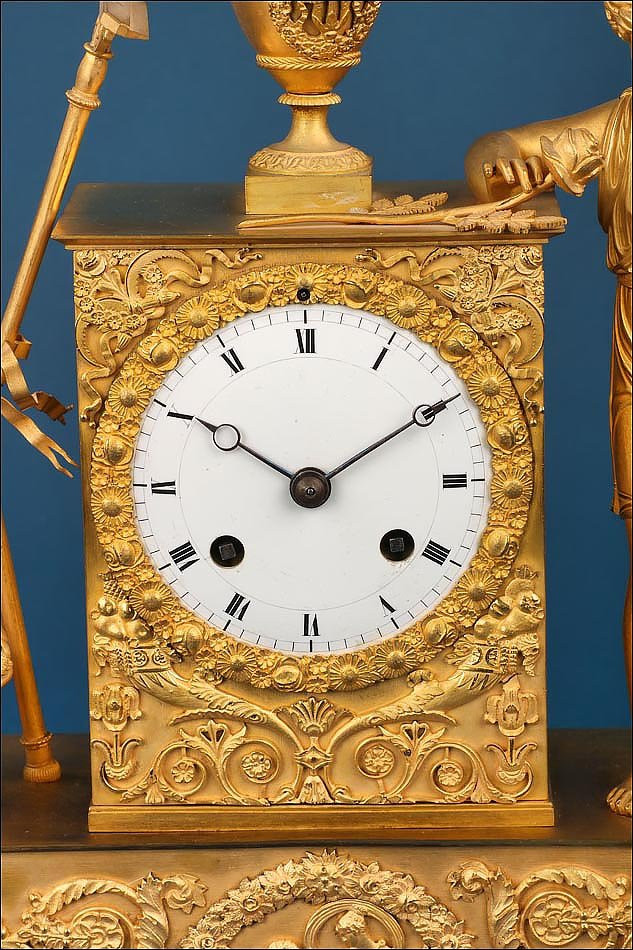
The clock face is seamlessly integrated into the scene, featuring a white porcelain dial in perfect condition, with black Roman numerals and Breguet-style hands. It is framed by a delicately sculpted bronze garland, while the rectangular base is adorned with a raised medallion depicting a classical scene flanked by symmetrical floral elements, all in excellent condition.
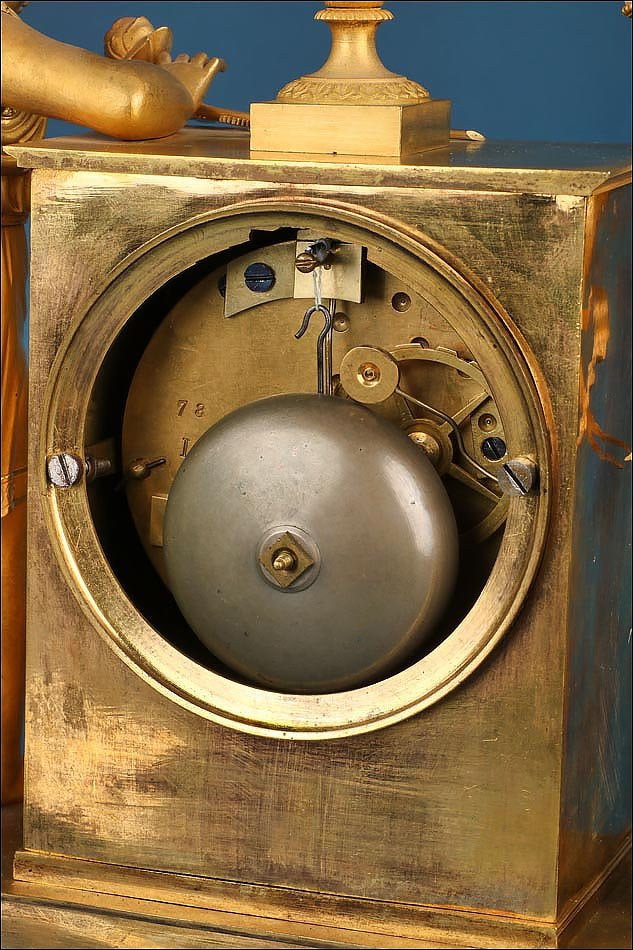
The mechanism is a classic Paris movement, featuring silk thread suspension and a bell strike for the hours and half-hours. It runs perfectly, has been professionally serviced, and is delivered in working order. Its smooth and precise operation confirms the excellent technical state of the clock. The strike is clear and well-synchronized, adding practical value to its sculptural beauty.
Clocks like this, with an intact original gilding, a working movement, and allegorical subject matter, are increasingly rare. This is a superb piece for collectors or anyone seeking a historical decorative object of high quality. It offers both aesthetic and functional value and fits beautifully in traditional interiors or as a refined contrast in more contemporary spaces.
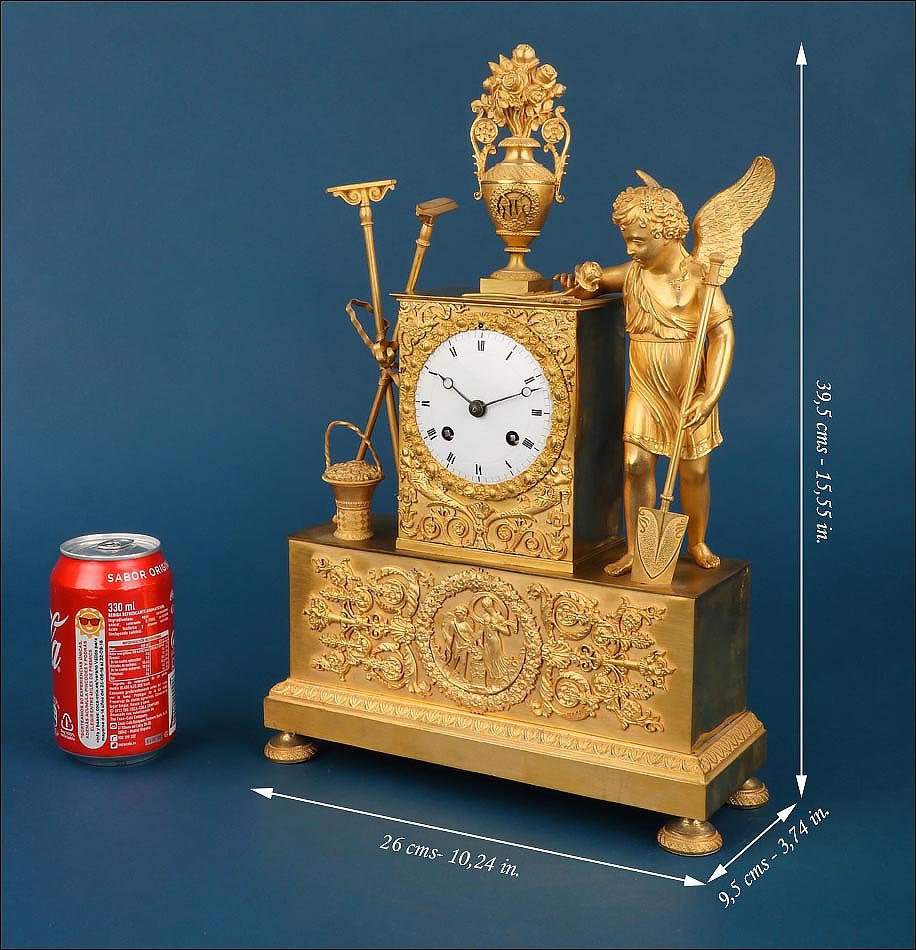
Dimensions: 39.5 x 26 x 9.5 cm (15.55 x 10.24 x 3.74 in).
History of 19th-Century French Mantel Clocks
Throughout the 19th century, France —and especially Paris— became a world-renowned center for the production of artistic mantel clocks. Bronze casters, sculptors, and clockmakers worked closely together to create pieces that measured time while expressing cultural ideals. Allegorical scenes, such as this homage to gardening, were highly popular and intended to convey aesthetic and moral values.
Mercury gilding provided a bright, durable finish, now highly valued when preserved in its original state without modern overpainting. The Paris movement, used for over a century, remains prized today for its reliability and ease of maintenance. The combination of silk suspension and bell strike made these movements a reference point in quality clockmaking.
These clocks are in high demand due to their dual function as precise timepieces and refined decorative objects. Examples in such good condition are becoming harder to find and continue to appreciate in value over time, both for collectors and connoisseurs of period interiors.









 Le Magazine de PROANTIC
 TRÉSORS Magazine
 Rivista Artiquariato