THIS OBJECT WAS SOLD
French School Of The Late 17th Century - The Aldobrandine Wedding




French School of the late 17th century.
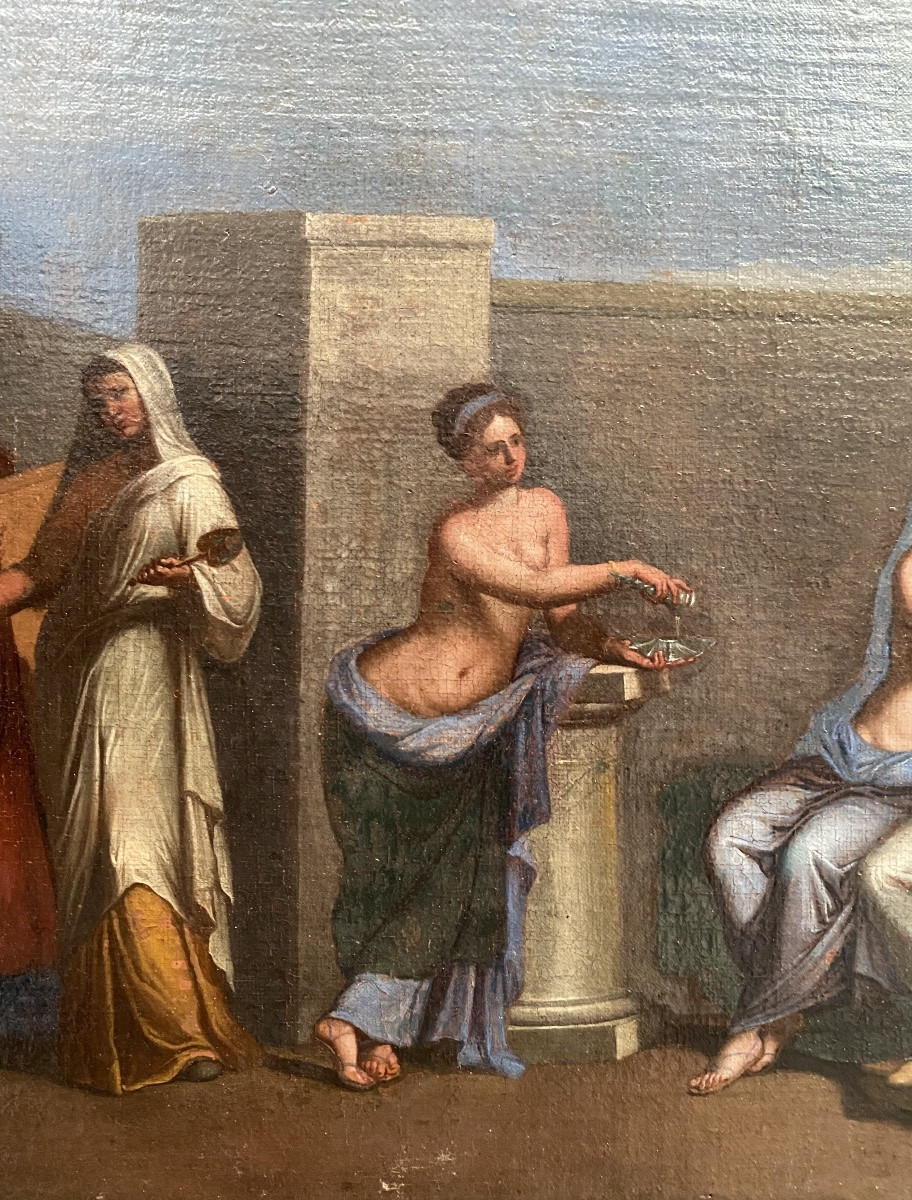
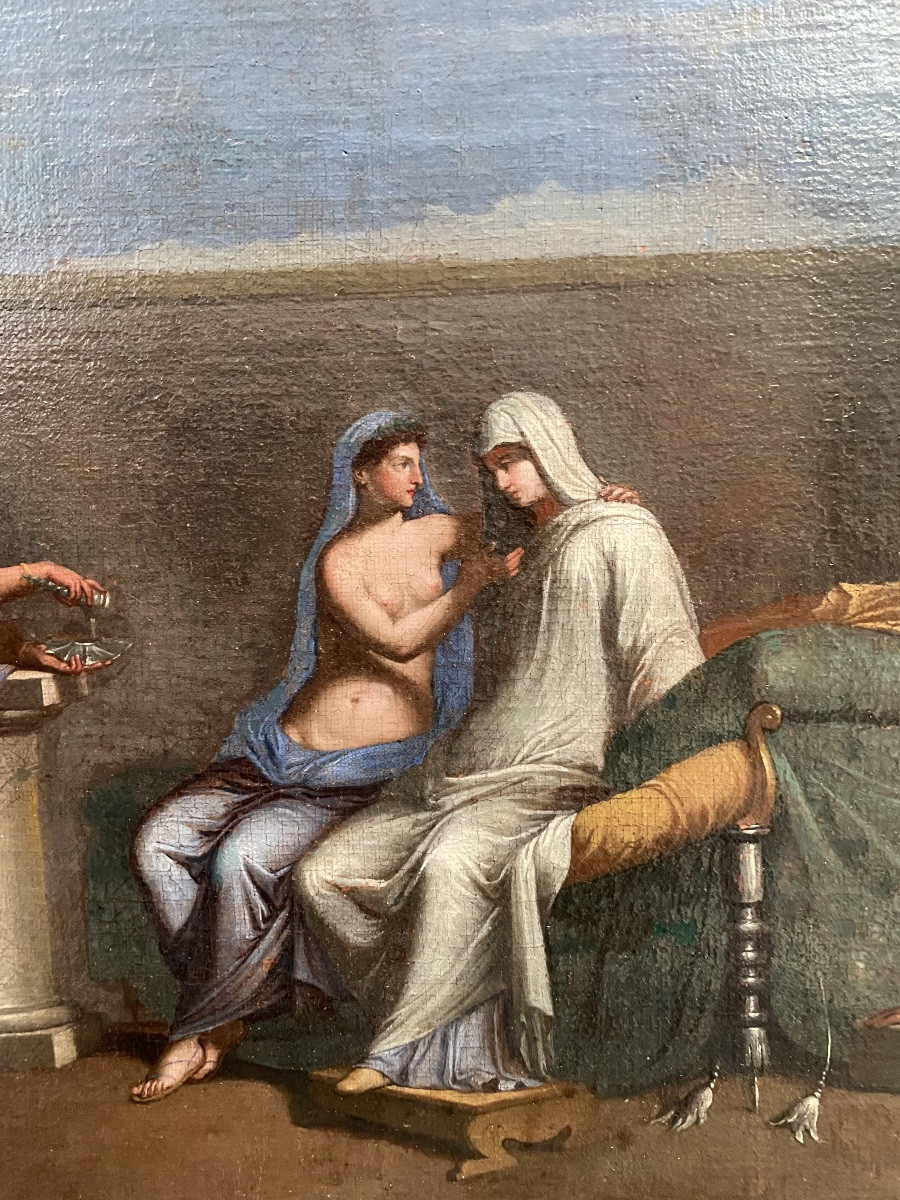
The Aldobrandine Wedding.
Oil on canvas
35 x 95.5 cm.
This painting is a remake of the famous fresco exhibited in the so-called Aldobrandine Hall of the Vatican. Dating from the time of Augustus (1st century BC). The Aldobrandine Wedding is the only Roman painting that has survived. This fresco was discovered in Rome around 1604-1605 on the Esquiline Hill, in the area probably occupied today by Piazza Vittorio Emanuele.
The work owes its name to the family that owned it. Giovanni Aldobrandini, its discoverer, who then bequeathed it to Cardinal Pietro Aldobrandini, nephew of Pope Clement VIII. The Cardinal kept it in the famous Aldobrandini Palace that he had built in Rome at the beginning of the 17th century, among his collection of antiques, canvases by Veronese and Titian. The Aldobrandine wedding remained there until 1818, when it was ceded to Pope Pius VII. Since then, the fresco has been exhibited in the Vatican, in the room that takes its name from it, which was decorated, in its time, by Guido Reni.
As is often the case, Roman art takes up a Greek theme. Mythology is applied to the representation of an ordinary wedding, mixing the ideal and the real. In its technique and iconography, The Aldobrandine wedding refers to the frescoes of the Villa of the Mysteries. Some have believed they saw Thetis and Peleus, Alexander and Roxana, or a subject taken from the theater of Euripides. It is more likely an evocation of marriage that can be linked to the 61st poem of Catullus, developing a similar theme, the 1st century BC being the golden age of Latin poetry.
The Aldobrandine wedding is in fact only a fragment of a much larger fresco. The theme of the wedding is approached in a succession of images depicting the different phases of the ceremony: Venus calms the fears of the seated bride, a woman pours the ritual perfumes, a man (Dionysus or the groom?) waits.
There are several reproductions of this unique Roman painting, which has always aroused the admiration of painters. Thus, a canvas, now preserved in the Galleria Doria Pamphili in Rome, was long attributed to Poussin.
The Aldobrandine Wedding.
Oil on canvas
35 x 95.5 cm.
This painting is a remake of the famous fresco exhibited in the so-called Aldobrandine Hall of the Vatican. Dating from the time of Augustus (1st century BC). The Aldobrandine Wedding is the only Roman painting that has survived. This fresco was discovered in Rome around 1604-1605 on the Esquiline Hill, in the area probably occupied today by Piazza Vittorio Emanuele.
The work owes its name to the family that owned it. Giovanni Aldobrandini, its discoverer, who then bequeathed it to Cardinal Pietro Aldobrandini, nephew of Pope Clement VIII. The Cardinal kept it in the famous Aldobrandini Palace that he had built in Rome at the beginning of the 17th century, among his collection of antiques, canvases by Veronese and Titian. The Aldobrandine wedding remained there until 1818, when it was ceded to Pope Pius VII. Since then, the fresco has been exhibited in the Vatican, in the room that takes its name from it, which was decorated, in its time, by Guido Reni.
As is often the case, Roman art takes up a Greek theme. Mythology is applied to the representation of an ordinary wedding, mixing the ideal and the real. In its technique and iconography, The Aldobrandine wedding refers to the frescoes of the Villa of the Mysteries. Some have believed they saw Thetis and Peleus, Alexander and Roxana, or a subject taken from the theater of Euripides. It is more likely an evocation of marriage that can be linked to the 61st poem of Catullus, developing a similar theme, the 1st century BC being the golden age of Latin poetry.
The Aldobrandine wedding is in fact only a fragment of a much larger fresco. The theme of the wedding is approached in a succession of images depicting the different phases of the ceremony: Venus calms the fears of the seated bride, a woman pours the ritual perfumes, a man (Dionysus or the groom?) waits.
There are several reproductions of this unique Roman painting, which has always aroused the admiration of painters. Thus, a canvas, now preserved in the Galleria Doria Pamphili in Rome, was long attributed to Poussin.
Explore similar pieces and discover your ideal find:
Other Paintings