Milivoj Uzelac was born on July 23, 1897, in Mostar to a Serbian family, which was then part of Austria-Hungary. In 1903, the family moved to Banja Luka. At high school, he began drawing and painting under the guidance of Pero Popović, a former student of Vlaho Bukovac. There he met his fellow artist Vilko Gecan, with whom he formed a lasting friendship. Uzelac's father died in the fall of 1911, and the following year his mother took Milivoj and his two sisters to Zagreb. In 1912-1913, Uzelac and Vilko Gecan attended the private art school of Tomislav Krizman. In November of the same year, they discovered the work of Miroslav Kraljević, who would have a significant influence on the art of their generation. At the age of 16, Uzelac passed the entrance exam to the College of Arts and Crafts and spent two years studying under Oton Iveković
In 1915, during World War I, Uzelac moved to Prague, where he worked in the studio of painter Jan Preisler while attending classes at the Academy. He was later joined by Vilko Gecan, Marijan Trepše, and Vladimir Varlaj. After the end of the war, in 1919, all four returned to Zagreb, where they exhibited their works at the Spring Salon.
In the fall of 1920, the Association of Artists awarded him a studio in Zagreb, where he produced some of his most notable works. In 1921, he spent the beginning of the year in Paris, in the Montparnasse district.
In 1923, Uzelac moved to Paris and settled in the suburb of Malakoff. [ 2 ] He painted extensively and absorbed the ideas of classicism and cubism. He integrated perfectly into his new environment, received commissions, and sold his works successfully. Only a year after his arrival, he presented four paintings at the Salon d'Automne.
In 1925, Uzelac's success enabled him to exhibit for the first time in Paris, at the Bibliothèque Marguerite. He worked hard during the day and led a busy social life at night. Success brought prosperity and he frequented many influential personalities and collectors, as well as beautiful women. In 1928, he left the suburbs for a studio in the city, where Vilko Gecan visited him that summer.
In 1930, Uzelac met Rosemarie da la Rayère, who became his permanent model and life partner.
From 1935 onwards, Uzelac spent more and more time in the south of France, and in 1963 the family settled in Cotignac.
In 1971, the Galerie Moderne in Zagreb dedicated a retrospective exhibition to him. In 2008-2009, the Pavillon des Arts dedicated a posthumous retrospective to him.
Milivoj Uzelac died on June 6, 1977, in Cotignac, France.
Legacy
Uzelac and his fellow painters made Prague an important reference point for modern Croatian art. They drew new ideas from Jugendstil (Art Nouveau), German symbolism, secessionism, and expressionism, as well as from Manet and Cézanne, Parisian cubist ideas, Miroslav Kraljevic of Zagreb, and old masters such as Velázquez, Van Dyck, and Goya.
During the Prague-Zagreb years (until 1923), Uzelac's work reflected the spirit of war-torn Austria-Hungary, with strong social content and a movement back to nature. Between 1918 and 1923, his work included narrative and expressive scenes of nightmarish and sometimes erotic quality. The images depict a bohemian party with an interesting cast of characters—artists, writers, singers, actors, dancers, circus performers—particularly girls and young women.
Some of Uzelac's best works from this period were produced in his studio in Zagreb, notably “In the Bohemian's Studio” (1920). This painting shows strong influences from Miroslav Kraljević and Édouard Manet, and demonstrates a new maturity in Uzelac's work. His brief stay in Paris in early 1921 brought him neocubist ideas from the school of André Lhote. In the paintings that followed his return to Zagreb, a new spatial organization and an active reduction of forms appeared. In 1923, Uzelac produced the painting now considered his masterpiece: “Self-Portrait in Front of a Bar.”
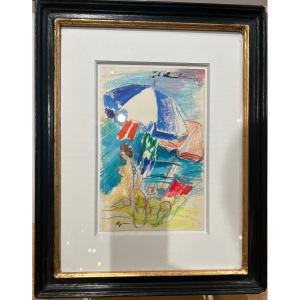
After settling permanently in France (1923-1977), Uzelac produced a large number of works in a wide range of techniques: oil, tempera, lacquer, gouache, chalk, ink, and graphic design. He created numerous decorative panels for private homes and public spaces, theater sets, posters, illustrations, and ceramics. Uzelac's work can be considered more eclectic than avant-garde. He painted portraits, landscapes, street scenes, cafés, and scenes from private life with an ease that could seem superficial. Uzelac was a master at modeling the human body, especially that of female subjects. His portraits create a sense of intimacy, a strong feature of his pictorial style. His travels in the south of France produced a series of lighter paintings in a brighter color palette. Among his extensive output are a series of large works in which references to Matisse and Derain were executed in Uzelac's personal style. These include Portrait of a Woman with a Model Sailboat (1931), View from the Window (1932), Plane Trees (1933), Black Skin (1934), Odalisque on Cushions (1934), and Painter and Model (1934).
Although he spent much of his life in France, Uzelac continued to maintain ties with the Croatian art scene, exhibiting in Zagreb and elsewhere in the former Yugoslavia until the end of his life.
In 2002, the Croatian postal service issued a stamp featuring Uzelac's “Girl in a Boat” as part of its series on Croatian modern art.
Exhibitions
During his lifetime, he participated in numerous solo exhibitions and the Zagreb Spring Salon, as well as the Group of Four.








 Le Magazine de PROANTIC
 TRÉSORS Magazine
 Rivista Artiquariato