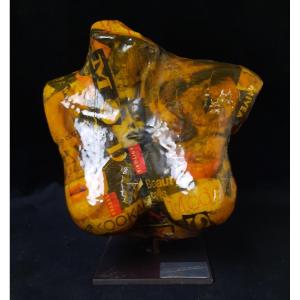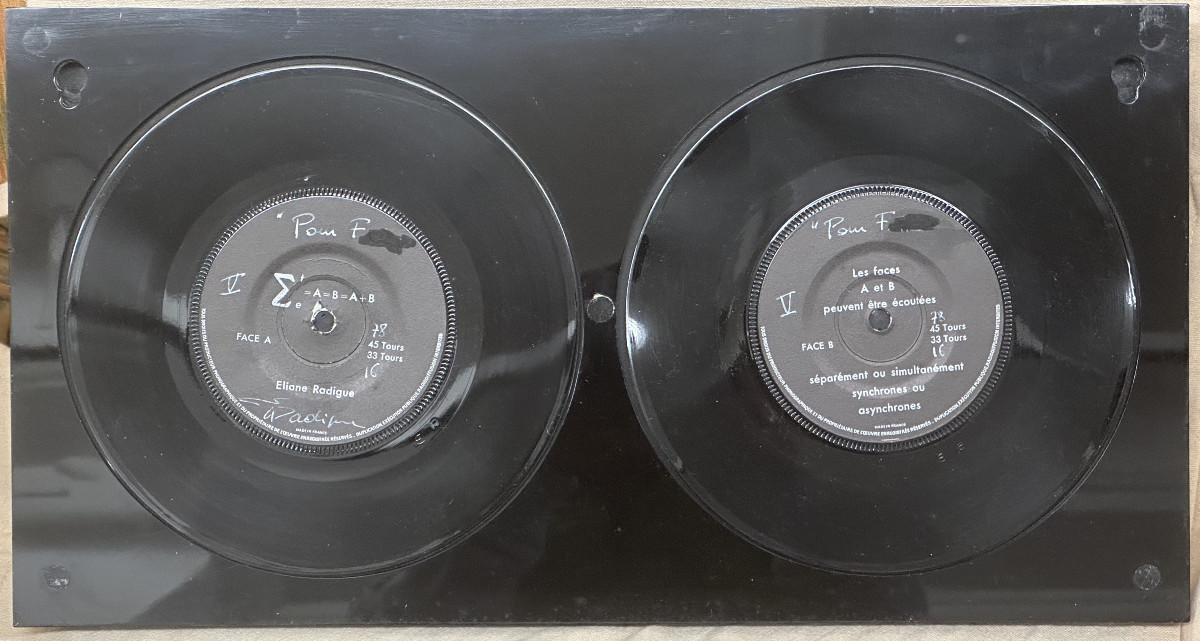


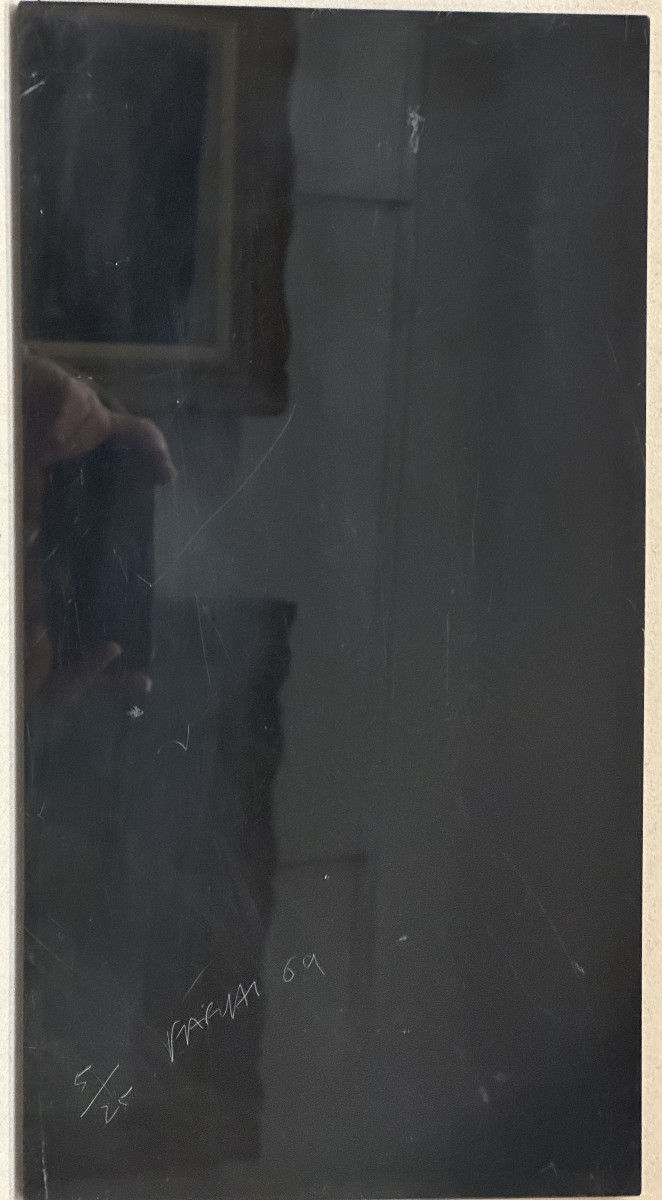
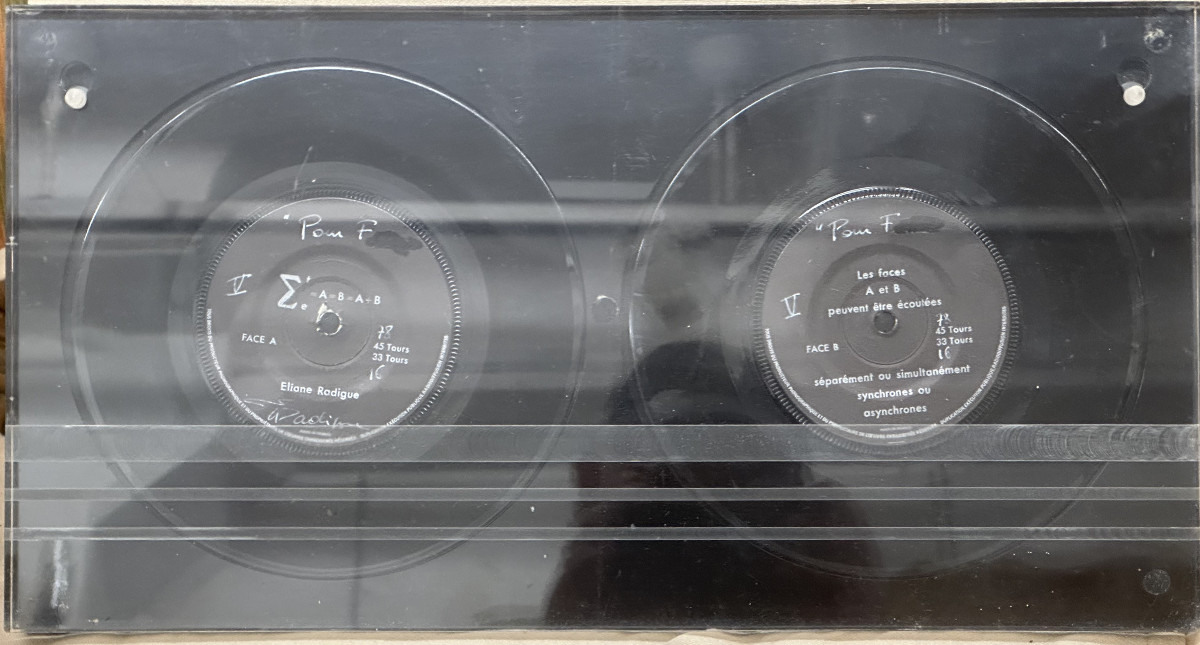


Jean-claude Farhi (1940-2012) "double Disc Eliane Radigue"; Plexiglas, Nice School; 1969
Jean-Claude FARHI (1940-2012) "Double disc Eliane RAdigue DJ turntable"; Plexiglas, École de Nice; 1969 Jean-Claude Farhi was born in Paris on February 11, 1940. In 1946, he moved to Bogota (Colombia). In 1957, he moved to Nice, where he took drawing classes at the Arts Décoratifs de Nice. He did his military service, partly in Algeria, from 1960 to 1962. He returned to Nice where he met the main artists of the École de Nice: Ben, Gilli Alocco, Malaval… and the new realists Arman and Raysse, who introduced him to the critic Pierre Restany. In 1965/1966, he worked on the "Motorcolors", then the sculptures in plexiglass or metal. He worked for a time with César. From 1968 (exhibition at the Iris Clert gallery), he devoted himself mainly to plexiglass sculptures (with the support of the "Polivar" factories): columns and discs, pyramids, and then so-called "variable geometry" sculptures, a direction in which his work would develop with monumental works. His last monumental sculpture "SECRET POINT" in corten steel (dedicated to his daughter Domitilla Farhi) was installed in Saint-Paul-de-Vence, at the crossroads of the roads to the village center and the Maeght Foundation a few kilometers from his studio. His wife Silvia Farhi and his daughter Domitilla live in the family home in Tourrettes-sur-Loup. Pierre Restany wrote: "We can speak of deconstructed constructivism in connection with these new sculptures by Farhi. We can think of the telephone sculptures proposed by Moholy-Nagy. But in this specific case, the telephone communication would have suffered from serious Art Deco and Post-Modern interference. [2]. Claude Fournet, at the time director of the Museums of Nice, declared: "The mastery of plastic material, which was the primary element of his research, is combined with a functionality of forms that he borrows from the world of Futurism and Bauhaus. With this deviation, which is the basis of every artist today, an act of playful appropriation and which masterfully places Jean-Claude Farhi in the line of the New Realists when, playing with forms, in his very colorful material, he offers us sculptures which are as many purities, drawn in the light of pure color. "
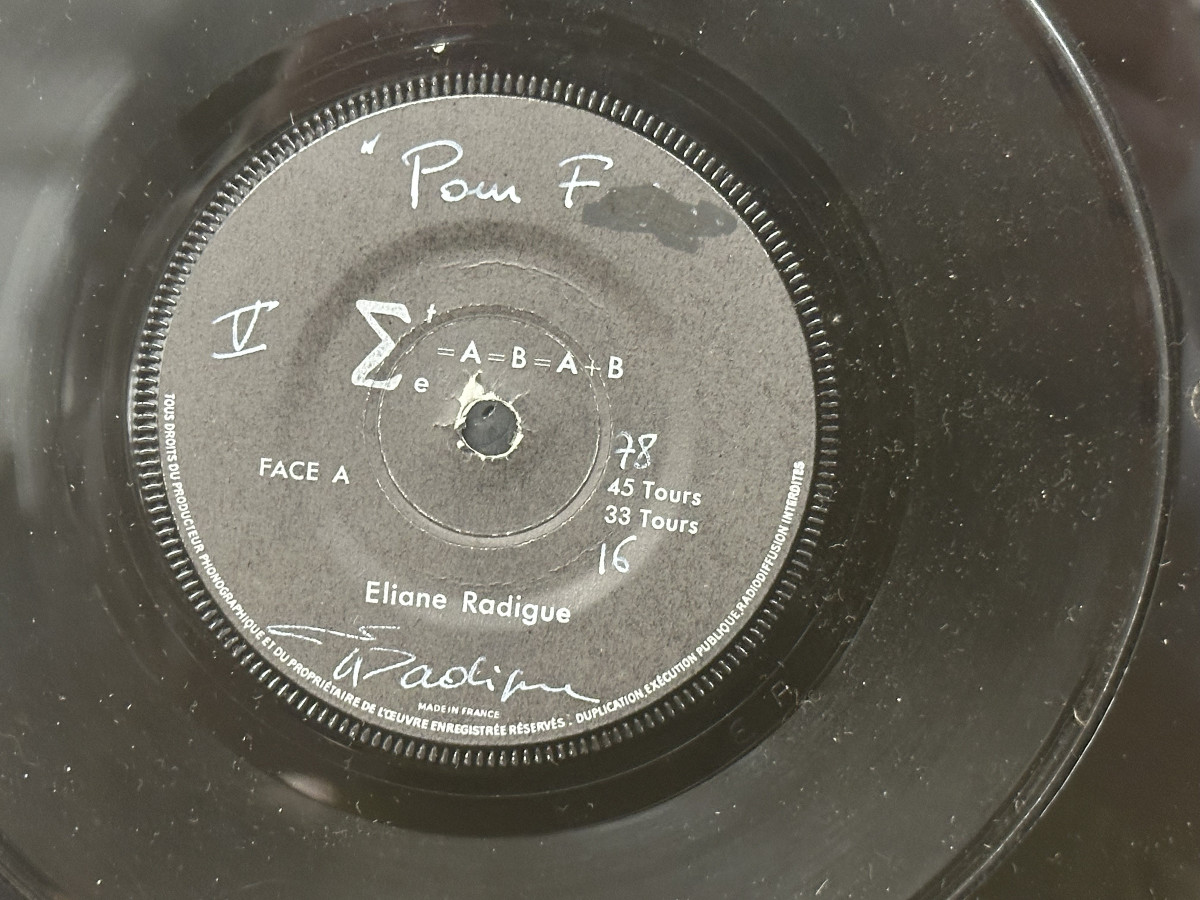
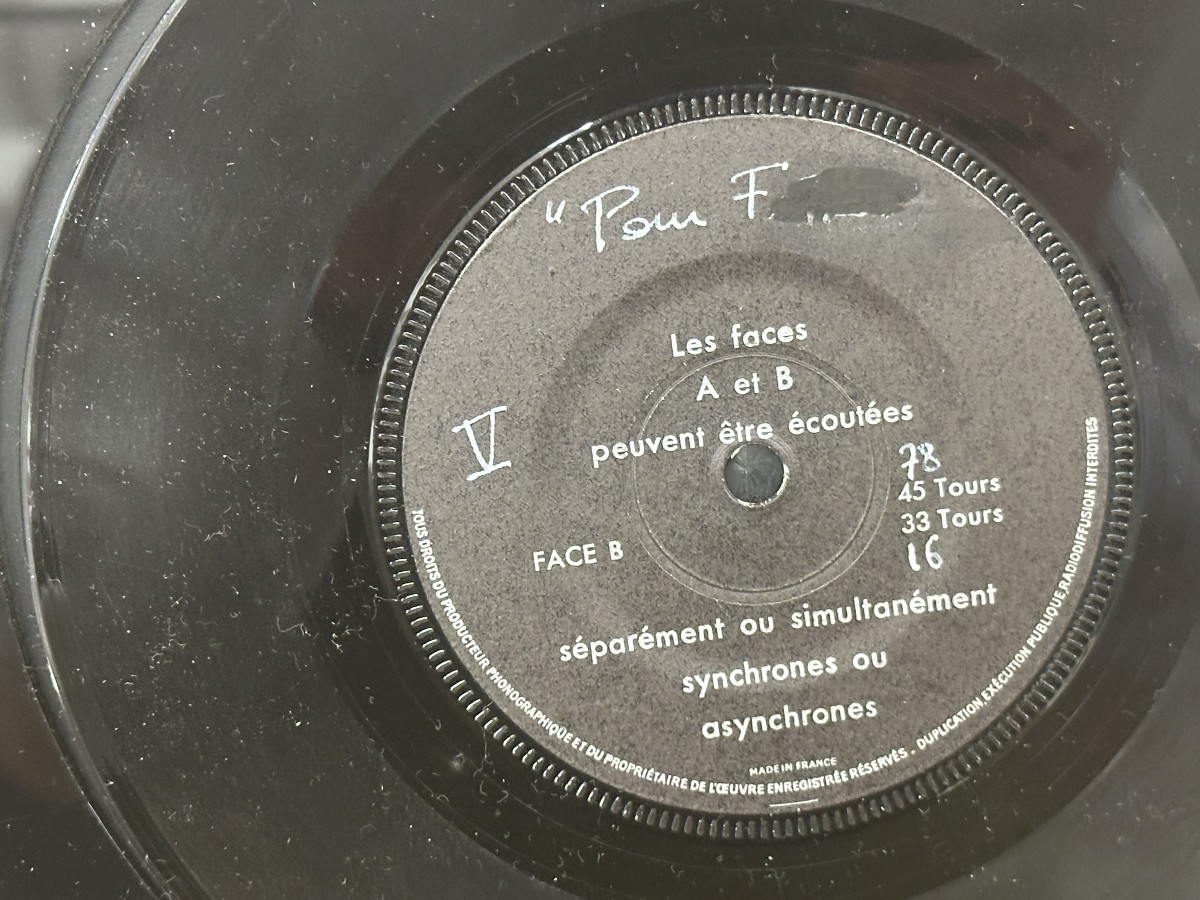
This first record by Eliane Radigue is a double 7-inch single, financed by Yvon Lambert – some of Eliane’s pieces could be heard in Yvon’s gallery, and right up until the 2010s, original copies of this extremely rare record could be found at the Yvon Lambert bookshop. This copy comes from the original period edition that Fahri incorporated into this 1969 work. Here, the two records are played simultaneously; their sound was created using microphone feedback, recorded and edited by her using equipment given to her by Pierre Henry whilst she was working on cataloguing the sounds produced by Pierre Schaeffer. Musique concrète passed through her hands, and this 7-inch single bears witness not only to her virtuosity but also, through her approach, to her radical way of conceiving records and
This first record by Eliane Radigue is a double 7-inch single, financed by Yvon Lambert – some of Eliane’s pieces could be heard in Yvon’s gallery, and right up until the 2010s, original copies of this extremely rare record could be found at the Yvon Lambert bookshop. This copy comes from the original period edition that Fahri incorporated into this 1969 work. Here, the two records are played simultaneously; their sound was created using microphone feedback, recorded and edited by her using equipment given to her by Pierre Henry whilst she was working on cataloguing the sounds produced by Pierre Schaeffer. Musique concrète passed through her hands, and this 7-inch single bears witness not only to her virtuosity but also, through her approach, to her radical way of conceiving records and
1 200 €
Period: 20th century
Style: Modern Art
Condition: Condition of use
Length: 40
Width: 21
Height: 2,5
Reference (ID): 1518236
Availability: In stock
Print