
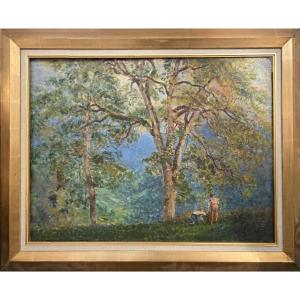


Louis‑claude paviot (1872–1943), The Walnut Harvest (revel, dauphiné)
Artist: Louis-claude Paviot (1872 – 1943)
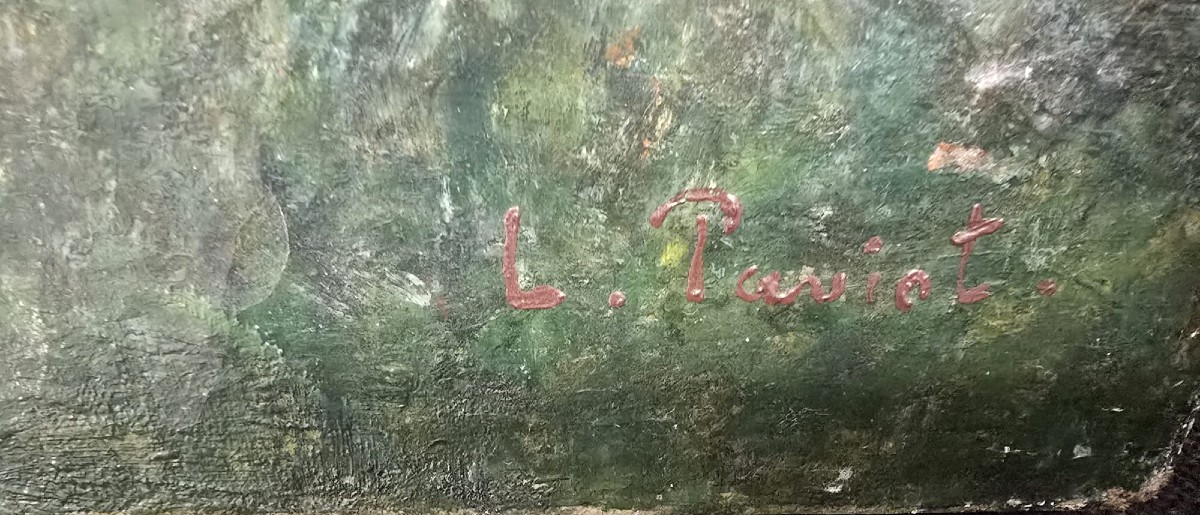
Oil on canvas. 65,5 x 50 cm. Signed lower right.
Originally from Ain (France), Louis-Claude Paviot (1872–1943) began his training at the École des Beaux-Arts in Lyon, where he studied under Adolphe-Louis Castex-Desgranges. In 1895, he was already participating in the Lyon Salons, before moving to Paris to attend the Académie Julian under Jean-Paul Laurens and Henri Doucet. A friend of Renoir, he also moved within the circles of Bonnard, Signac, Matisse, and Dunoyer de Segonzac.
Reserved by temperament, Paviot devoted himself primarily to landscape painting. Working directly from nature, he sought to capture shifting light and the rhythms of the seasons. His works, now relatively rare, are admired for their sincerity and freshness. He exhibited regularly in Paris, notably at the Salon des Indépendants from 1896, and at Berthe Weill’s gallery between 1905 and 1924. In Lyon, he showed at the Société lyonnaise des Beaux-Arts (1895–1901), the Salon d’Automne (1907–1918), and later at the Salon du Sud-Est (1934–1940). His paintings are preserved in several museums, including the Musée des Beaux-Arts de Lyon, the Musée des Beaux-Arts de Reims, and the Musée Paul-Dini.
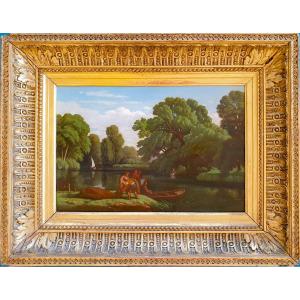
The present work exemplifies his art. In a luminous woodland clearing, two figures blend harmoniously with a luxuriant natural setting. One bends down to gather walnuts—an autumnal motif—while the other stands nearby, ready to assist. The scene, at once simple and serene, evokes the generosity of nature. The foreground, with its vivid green expanse, anchors the composition, while the distant blue-toned hills add depth and tranquility. Paviot’s lively, visible brushstrokes—especially in the leaves rendered with quick, scattered touches—convey both movement and the shimmering play of light.
Originally from Ain (France), Louis-Claude Paviot (1872–1943) began his training at the École des Beaux-Arts in Lyon, where he studied under Adolphe-Louis Castex-Desgranges. In 1895, he was already participating in the Lyon Salons, before moving to Paris to attend the Académie Julian under Jean-Paul Laurens and Henri Doucet. A friend of Renoir, he also moved within the circles of Bonnard, Signac, Matisse, and Dunoyer de Segonzac.
Reserved by temperament, Paviot devoted himself primarily to landscape painting. Working directly from nature, he sought to capture shifting light and the rhythms of the seasons. His works, now relatively rare, are admired for their sincerity and freshness. He exhibited regularly in Paris, notably at the Salon des Indépendants from 1896, and at Berthe Weill’s gallery between 1905 and 1924. In Lyon, he showed at the Société lyonnaise des Beaux-Arts (1895–1901), the Salon d’Automne (1907–1918), and later at the Salon du Sud-Est (1934–1940). His paintings are preserved in several museums, including the Musée des Beaux-Arts de Lyon, the Musée des Beaux-Arts de Reims, and the Musée Paul-Dini.
The present work exemplifies his art. In a luminous woodland clearing, two figures blend harmoniously with a luxuriant natural setting. One bends down to gather walnuts—an autumnal motif—while the other stands nearby, ready to assist. The scene, at once simple and serene, evokes the generosity of nature. The foreground, with its vivid green expanse, anchors the composition, while the distant blue-toned hills add depth and tranquility. Paviot’s lively, visible brushstrokes—especially in the leaves rendered with quick, scattered touches—convey both movement and the shimmering play of light.
2 200 €
Period: 20th century
Style: Modern Art
Condition: Excellent condition
Material: Oil painting
Length: 65,5
Height: 50
Reference (ID): 1454706
Availability: In stock
Print