THIS OBJECT WAS SOLD
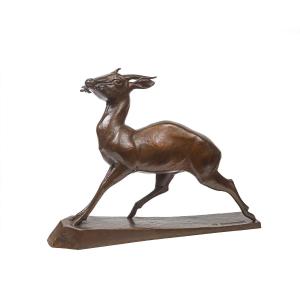
Sculpture - Kevel , Antoine - Louis Barye (1795-1875) - Bronze


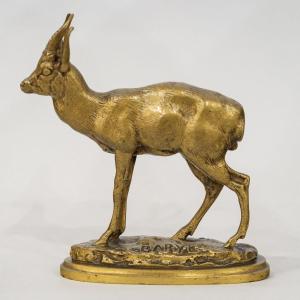


Bronze proof with golden patina , representing a standing chamois "KEVEL" by Antoine-Louis Barye (1795-1875) .
Model created in 1837 by A.L Barye .
Bronze signed "BARYE" in hollow , on the naturalist terrace .
Signature of the founder "F.BARBEDIENNE.PARIS", on the back of the terrace .
Old edition sculpture , period second part of the 19th century , circa 1887.
Very good state of conservation and patina .
Dimensions : 11 cm x 9 cm x 4 cm
So much realism is not due to chance. Indeed, Antoine-Louis Barye knows animal anatomy perfectly .
The sculptor revolutionized the way of representing animals .
For him , they are no longer political symbols or even mythological attributes , they become on the contrary , the unique subject , the animal as such and nothing else .
This vision of the subject allowed Antoine - Louis Barye to create unique works , imbued with elegance and naturalism .
Antoine - Louis Barye (1795-1875)
Famous for his animal sculptures , Antoine-Louis Barye is a silversmith's son , who is trained in metalwork with a military equipment manufacturer and Jacques - Henri Fauconnier.
In 1818 , he entered the Paris School of Fine Arts and apprenticed in the studio of sculptor François Joseph Bosio and painter Jean-Antoine Gros .
After several failures at theThe Grand Prix of Rome , Antoine-Louis Barye slammed the door of the Fine Arts in 1825 .
He then turned to animal sculpture which he would bring back up to date .
With his friend Delacroix , he goes regularly to the menagerie of the Natural History Museum to study and observe animals .
It was in 1831 that A.L Barye made himself known to the general public by exhibiting "The Tiger Devouring a Gavial" (Louvre) at the Salon , a work staging a violent fight "of impressive virtuosity".
Two years later , he triumphed with "The Lion and the Snake" plaster , which was also successfully exhibited in its bronze version at the Salon of 1836 .
Preferring bronze to marble considered too cold , the artist multiplied statuettes and small groups animals,that he melts and chisels himself .
Antoine-Louis Barye died at the age of 80 , leaving behind an important production of drawings , watercolors and paintings as well as sculptures , pieces of goldsmith's work .
His works can be seen at the Louvre and Orsay Museums .
Model created in 1837 by A.L Barye .
Bronze signed "BARYE" in hollow , on the naturalist terrace .
Signature of the founder "F.BARBEDIENNE.PARIS", on the back of the terrace .
Old edition sculpture , period second part of the 19th century , circa 1887.
Very good state of conservation and patina .
Dimensions : 11 cm x 9 cm x 4 cm
So much realism is not due to chance. Indeed, Antoine-Louis Barye knows animal anatomy perfectly .
The sculptor revolutionized the way of representing animals .
For him , they are no longer political symbols or even mythological attributes , they become on the contrary , the unique subject , the animal as such and nothing else .
This vision of the subject allowed Antoine - Louis Barye to create unique works , imbued with elegance and naturalism .
Antoine - Louis Barye (1795-1875)
Famous for his animal sculptures , Antoine-Louis Barye is a silversmith's son , who is trained in metalwork with a military equipment manufacturer and Jacques - Henri Fauconnier.
In 1818 , he entered the Paris School of Fine Arts and apprenticed in the studio of sculptor François Joseph Bosio and painter Jean-Antoine Gros .
After several failures at theThe Grand Prix of Rome , Antoine-Louis Barye slammed the door of the Fine Arts in 1825 .
He then turned to animal sculpture which he would bring back up to date .
With his friend Delacroix , he goes regularly to the menagerie of the Natural History Museum to study and observe animals .
It was in 1831 that A.L Barye made himself known to the general public by exhibiting "The Tiger Devouring a Gavial" (Louvre) at the Salon , a work staging a violent fight "of impressive virtuosity".
Two years later , he triumphed with "The Lion and the Snake" plaster , which was also successfully exhibited in its bronze version at the Salon of 1836 .
Preferring bronze to marble considered too cold , the artist multiplied statuettes and small groups animals,that he melts and chisels himself .
Antoine-Louis Barye died at the age of 80 , leaving behind an important production of drawings , watercolors and paintings as well as sculptures , pieces of goldsmith's work .
His works can be seen at the Louvre and Orsay Museums .
Explore similar pieces and discover your ideal find:
Bronze Animal Sculptures