THIS OBJECT WAS SOLD
Polylobed Saucer With “imari” Decor, Mark Of Auguste Le Fort - Japan Late 17th Edo Period


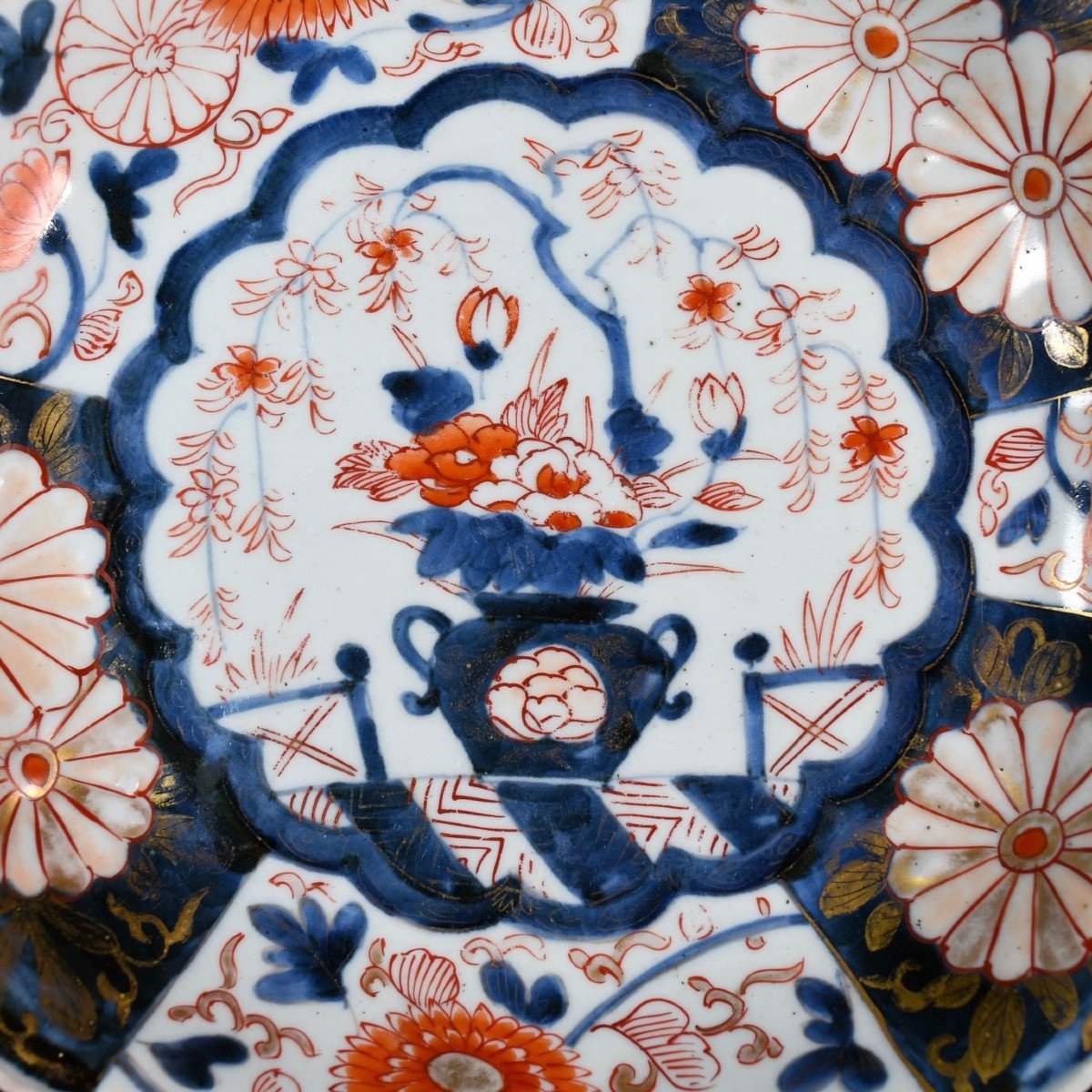


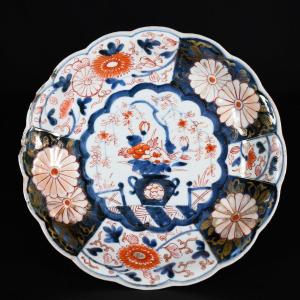


Polylobed porcelain cup with so-called “Imari” decoration of flower planters in the center. The border is richly decorated with two types of alternating flower reserves.
ON THE REVERSE, THE INCISED MARK FROM THE INVENTORY OF AUGUSTE LE FORT, JOHANNEUM, DRESDEN
JAPAN LATE 17th/EARLY 18th century
Edo period (1600-1868)
Diameter: 23.1cm
The cup bears on the reverse the mark N+49, dedicated mark in the collection of Japanese porcelain at the Palace of Dresden.
A few similar models have been on the market in recent years, notably bearing the N+44 brand, although of different diameters, 22.5 or 25cm. Two identical models of smaller sizes are still in the collection of the Dresden Palace, bearing the number N+65 PO.2952, and N+65 PO.5099.
Thanks to the recent publication of the inventory of Augustus the Strong, and its virtual visualization we can easily find this model in the first inventory of 1721, however none are still in the current collection of the palace of Dresden.
The Johanneum Palace mark on Chinese porcelain differs from that of Japanese porcelain, indeed the “:” will separate the prefix from the number for Chinese porcelain where the “+” will separate the N from its number on Japanese porcelain. This allows them to be distinguished in the inventory.
PROVENANCE:
- Auguste le Fort
- Collection from Central-Eastern France
Some chips.
More informations and photos on request.
ON THE REVERSE, THE INCISED MARK FROM THE INVENTORY OF AUGUSTE LE FORT, JOHANNEUM, DRESDEN
JAPAN LATE 17th/EARLY 18th century
Edo period (1600-1868)
Diameter: 23.1cm
The cup bears on the reverse the mark N+49, dedicated mark in the collection of Japanese porcelain at the Palace of Dresden.
A few similar models have been on the market in recent years, notably bearing the N+44 brand, although of different diameters, 22.5 or 25cm. Two identical models of smaller sizes are still in the collection of the Dresden Palace, bearing the number N+65 PO.2952, and N+65 PO.5099.
Thanks to the recent publication of the inventory of Augustus the Strong, and its virtual visualization we can easily find this model in the first inventory of 1721, however none are still in the current collection of the palace of Dresden.
The Johanneum Palace mark on Chinese porcelain differs from that of Japanese porcelain, indeed the “:” will separate the prefix from the number for Chinese porcelain where the “+” will separate the N from its number on Japanese porcelain. This allows them to be distinguished in the inventory.
PROVENANCE:
- Auguste le Fort
- Collection from Central-Eastern France
Some chips.
More informations and photos on request.
Explore similar pieces and discover your ideal find:
Porcelain Plates & Dinnerware