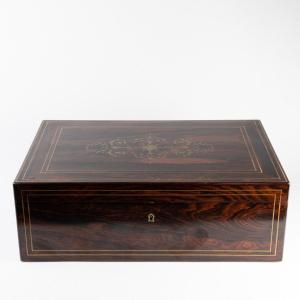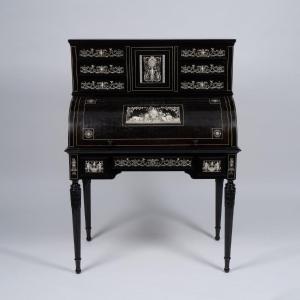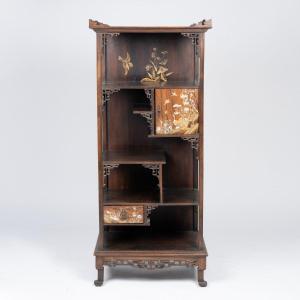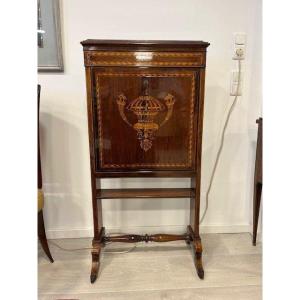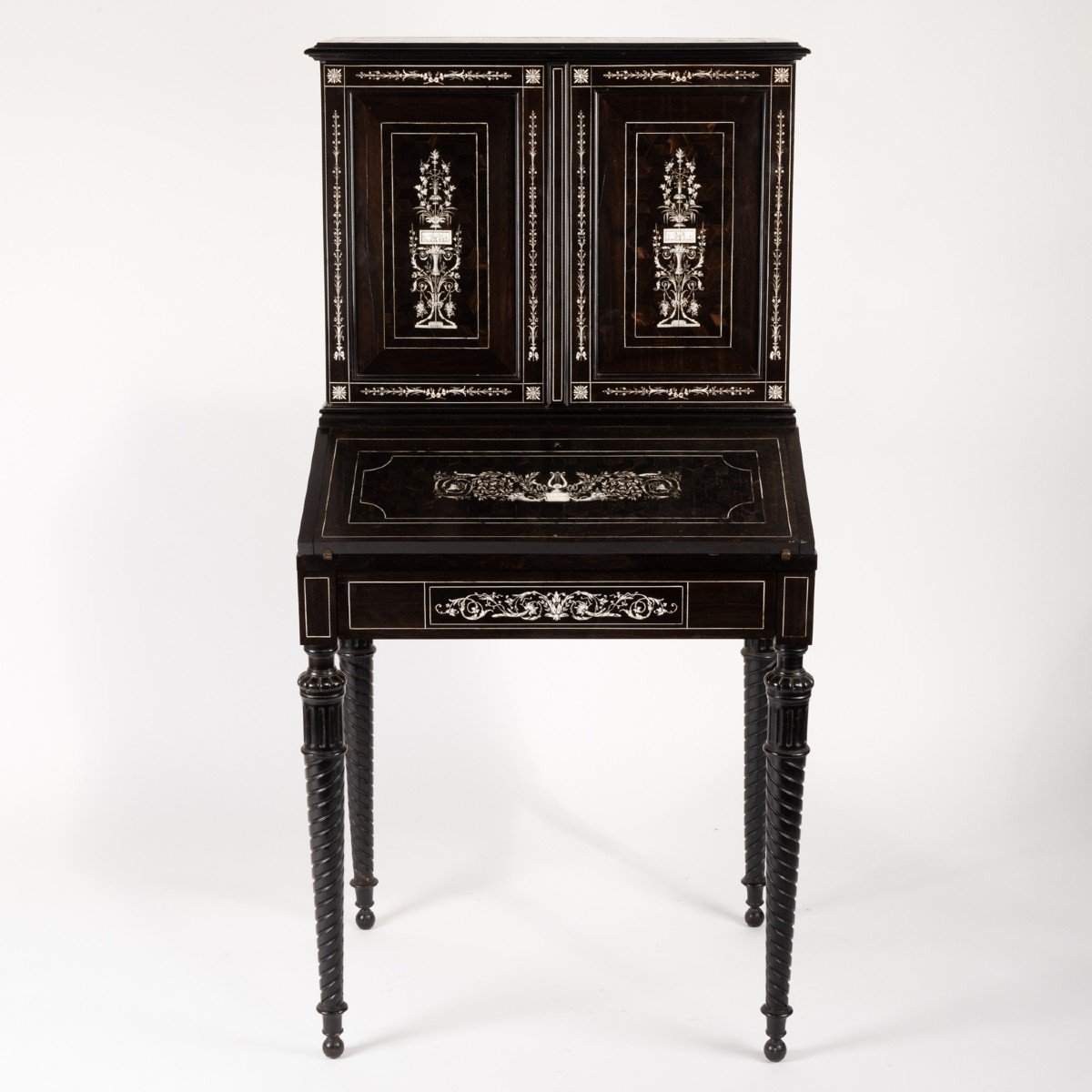
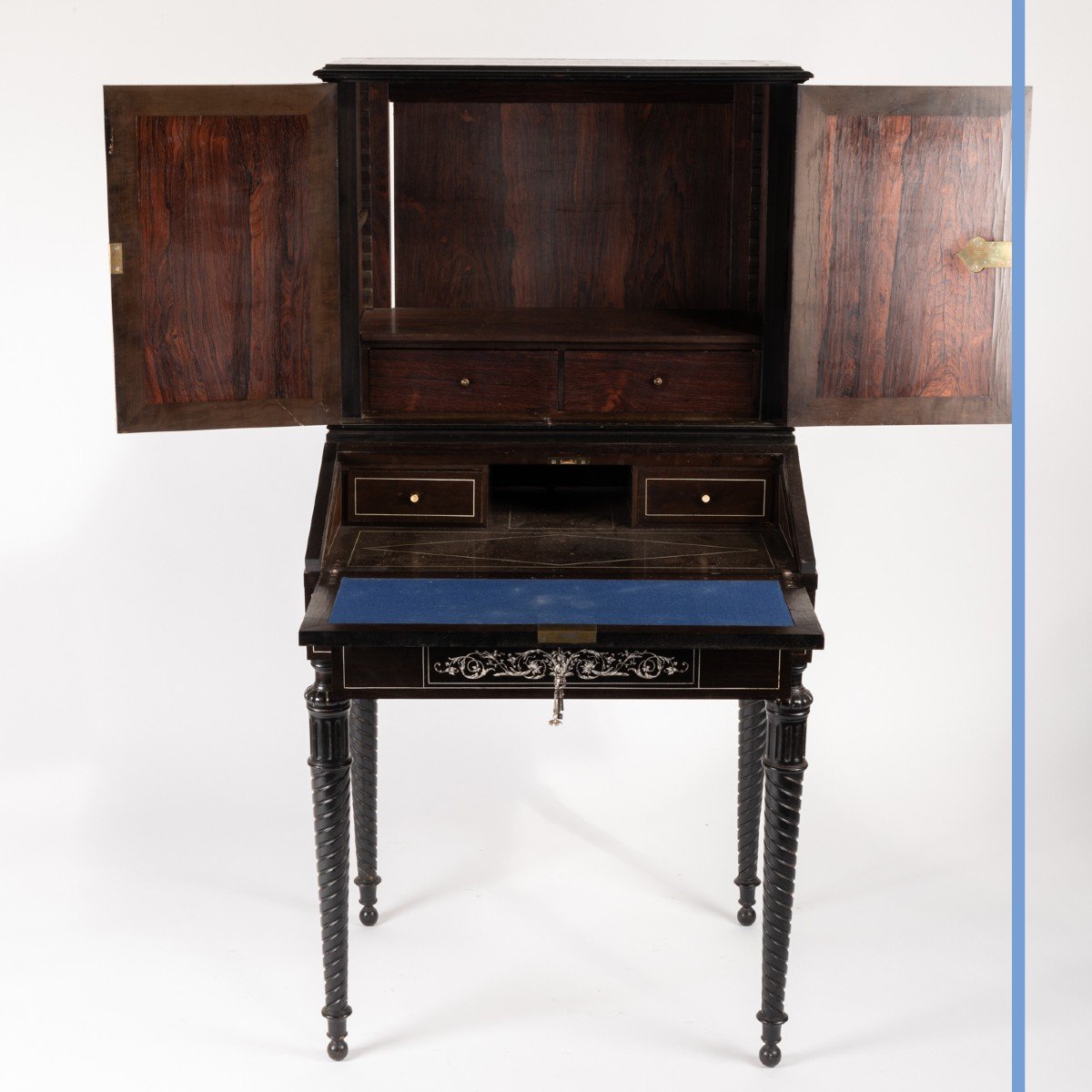
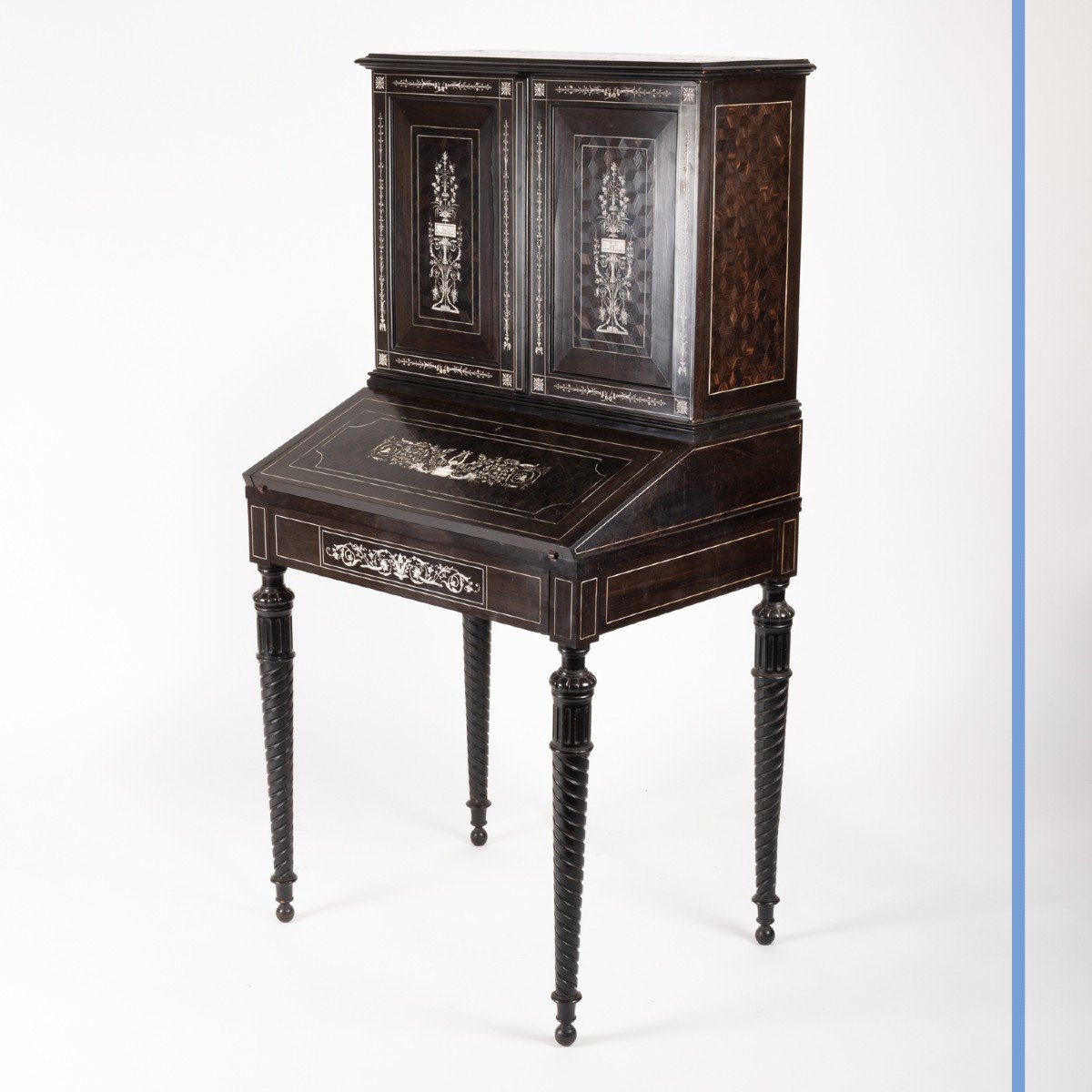
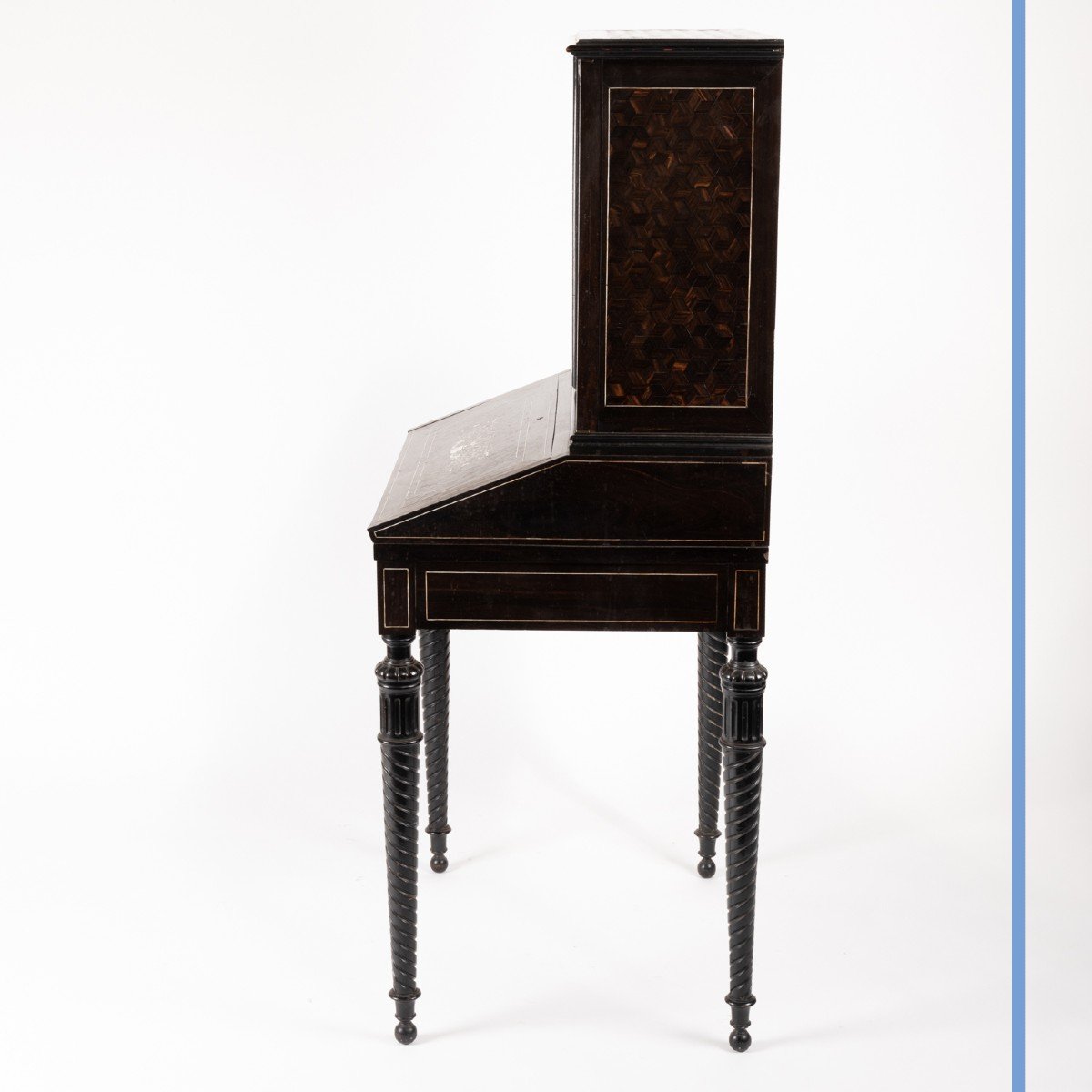
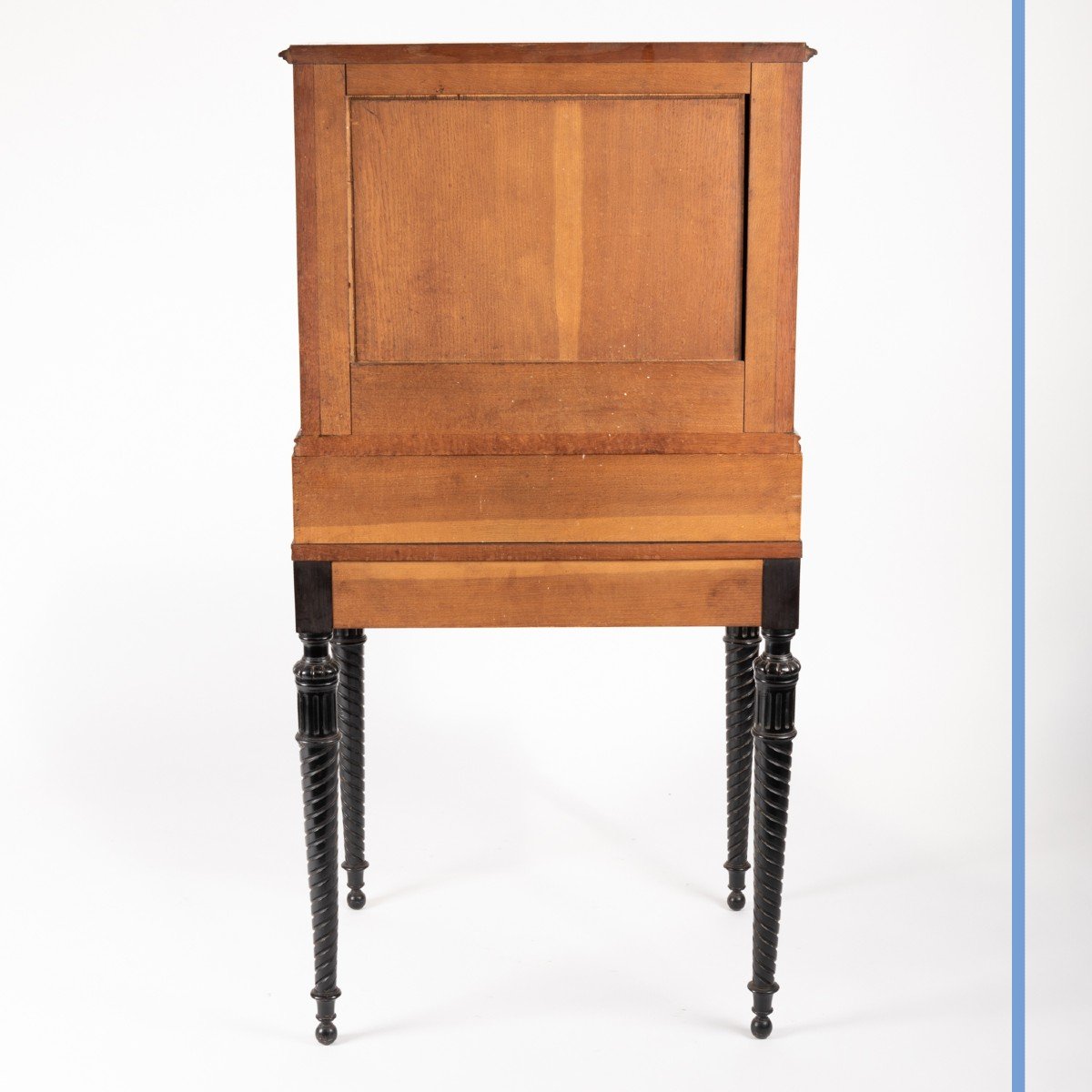
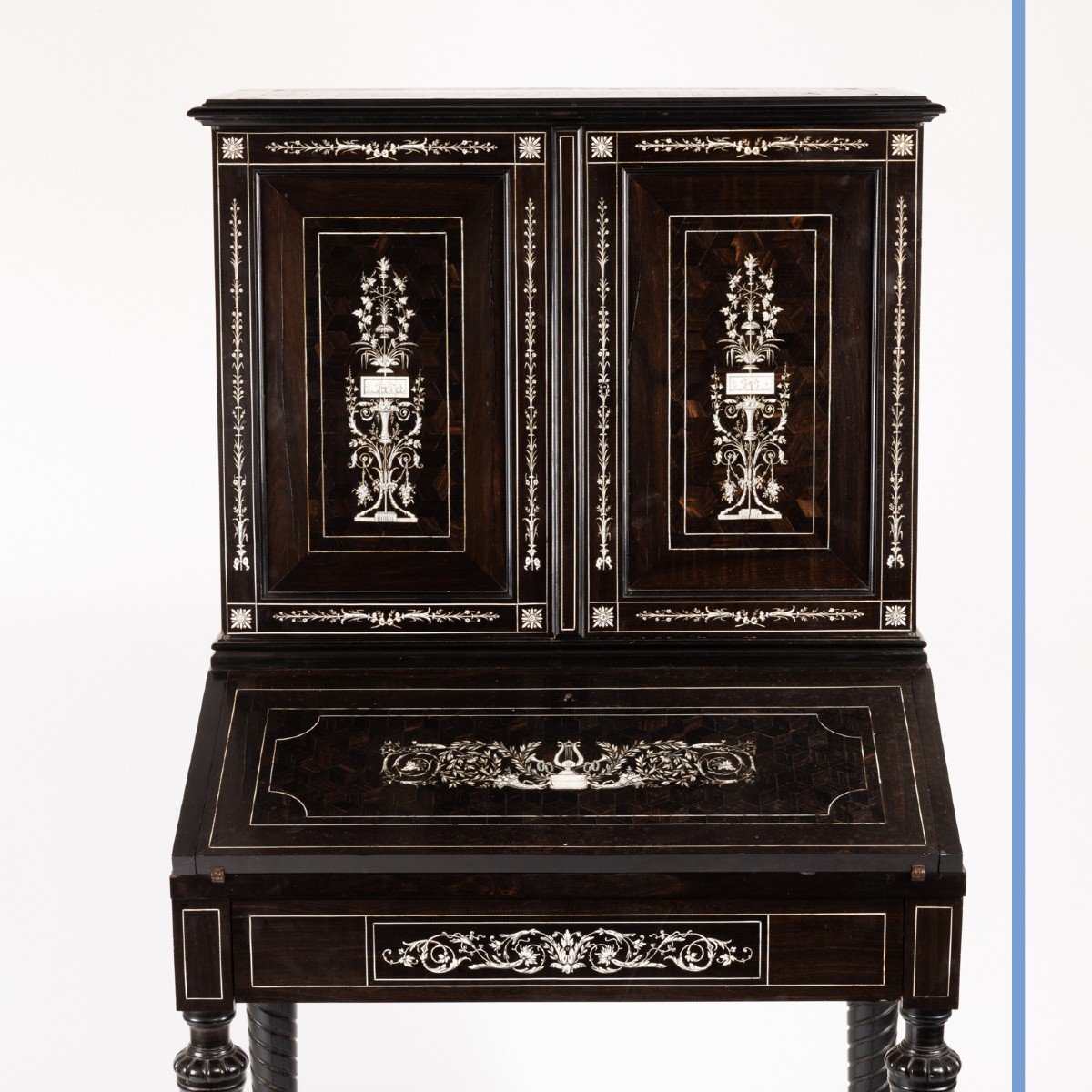
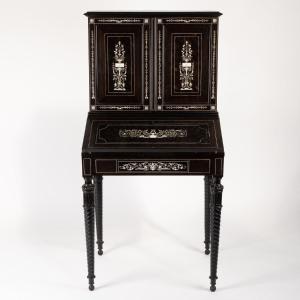


Charles Hunsinger (1823-1893), Bonheur Du Jour In Ebony And Ivory Inlays, 19th Century
Artist: Charles Hunsinger (1823-1893)
Charles Hunsinger (1823-1893)
Bonheur du jour
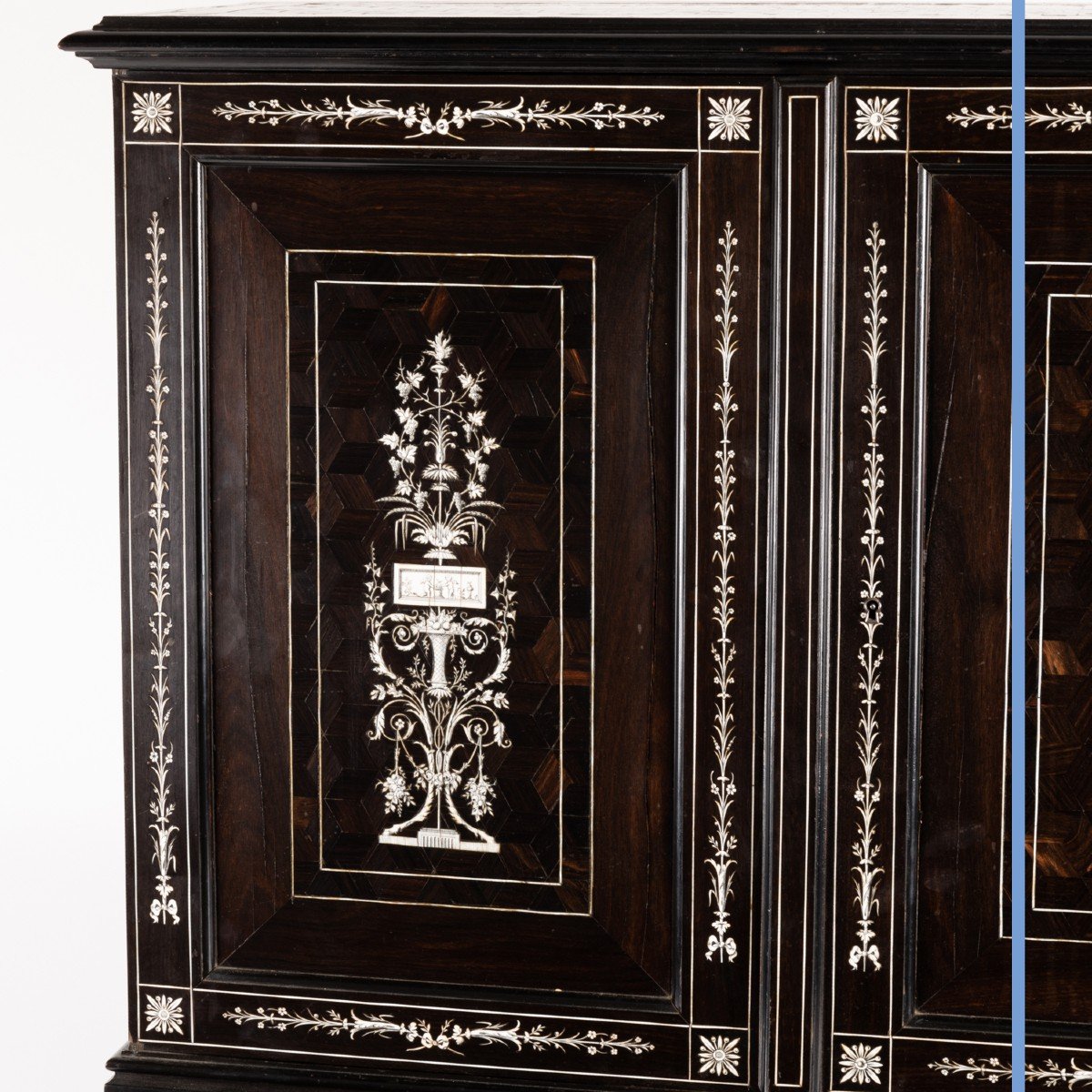
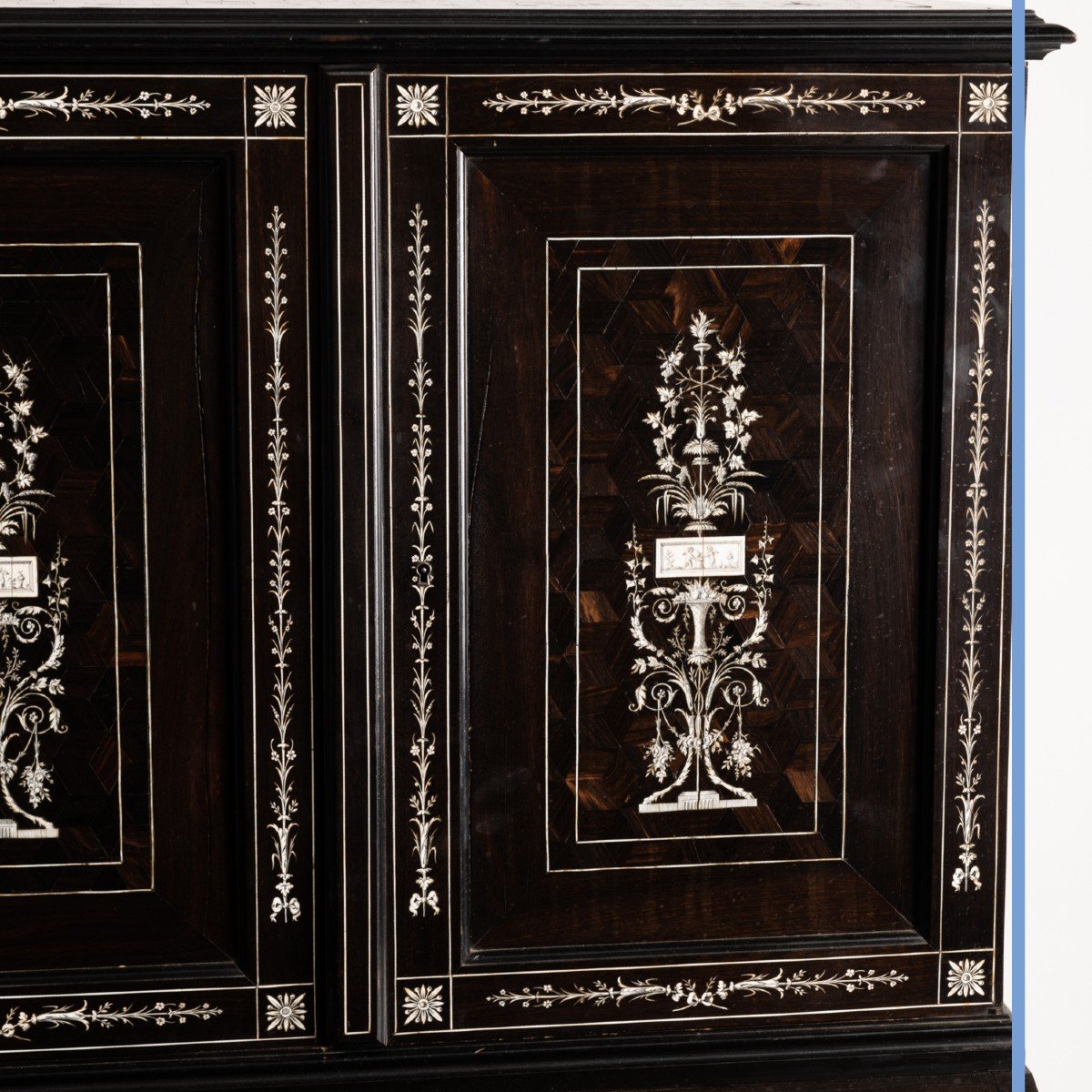
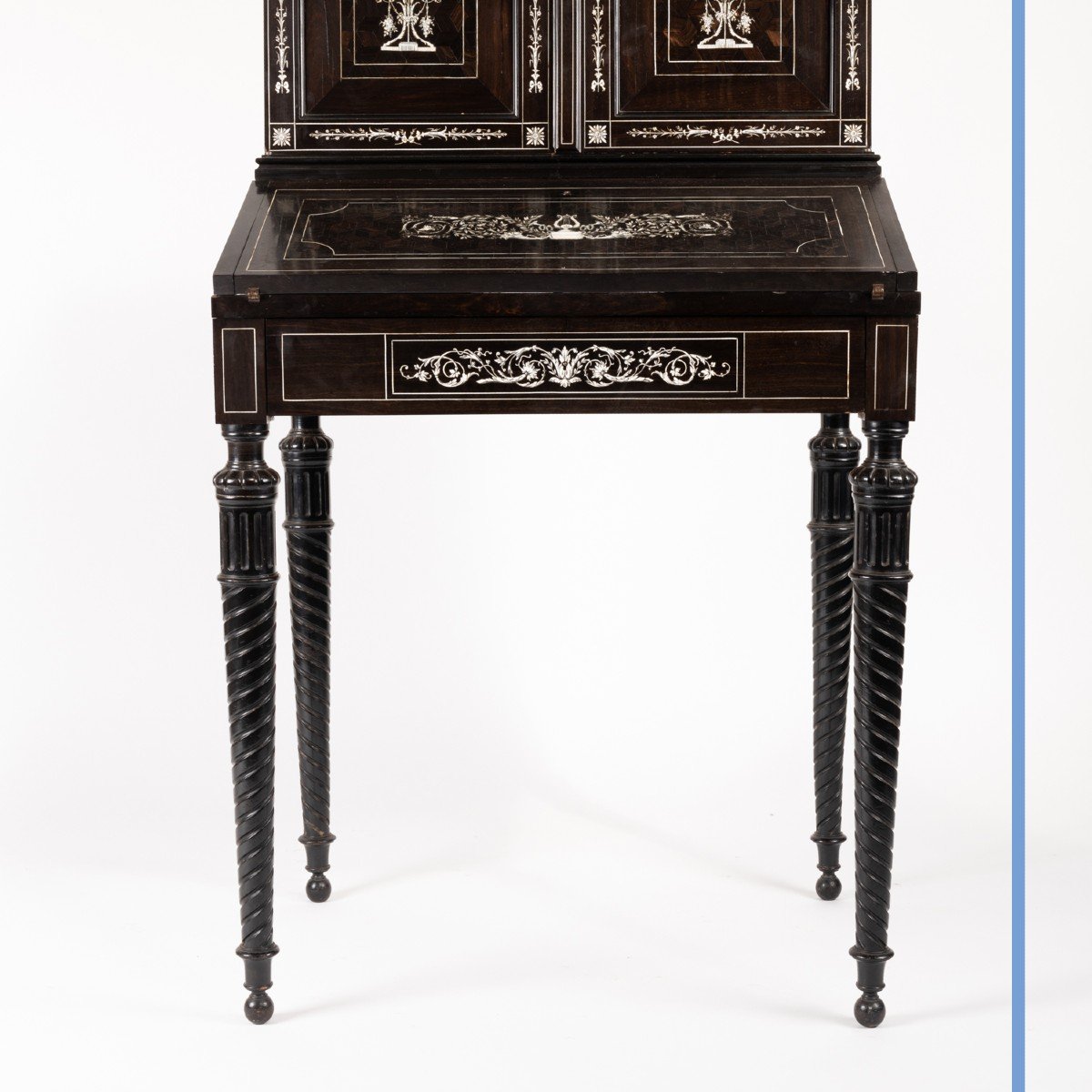
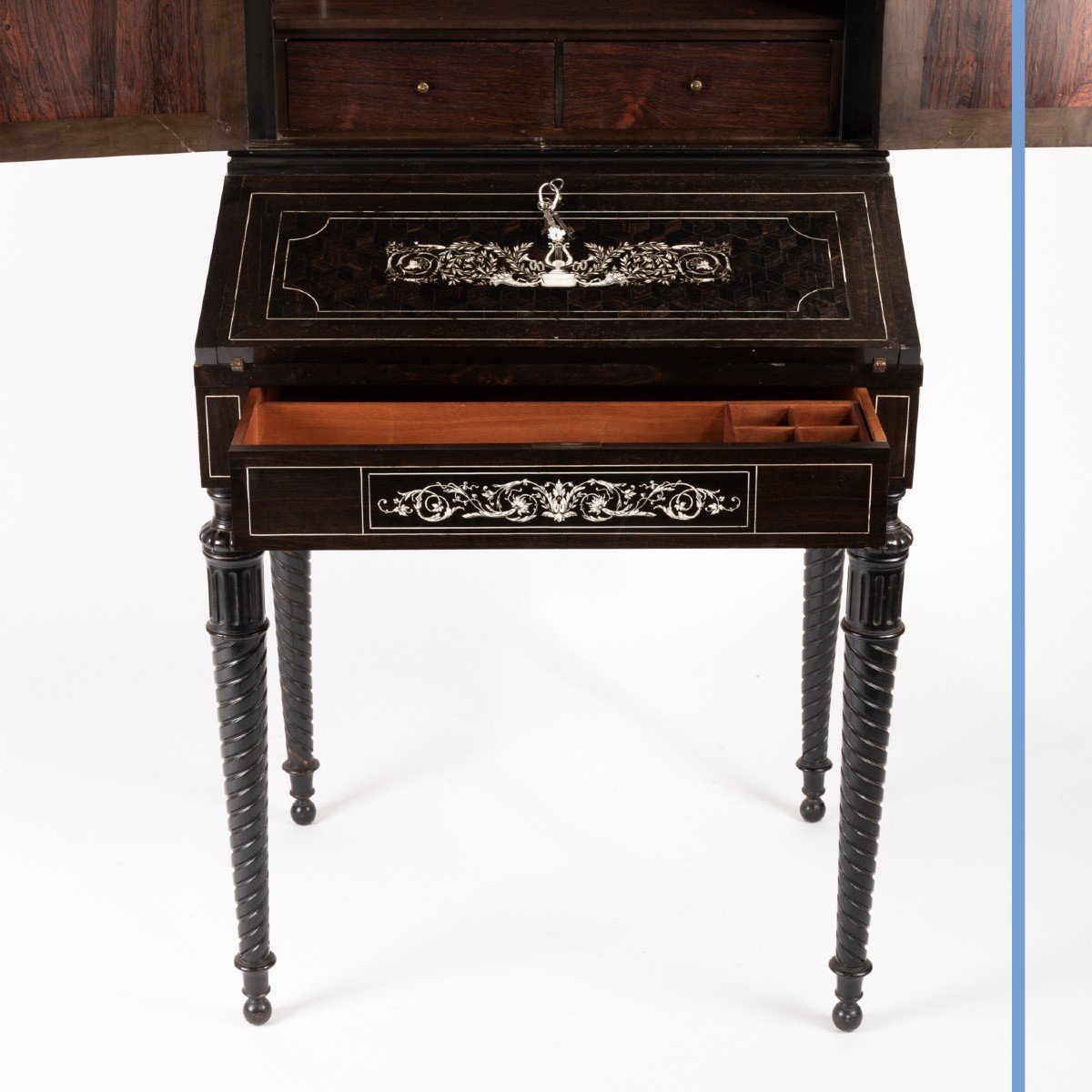
Ebony, ebony veneer, and ivory inlays
Circa 1880
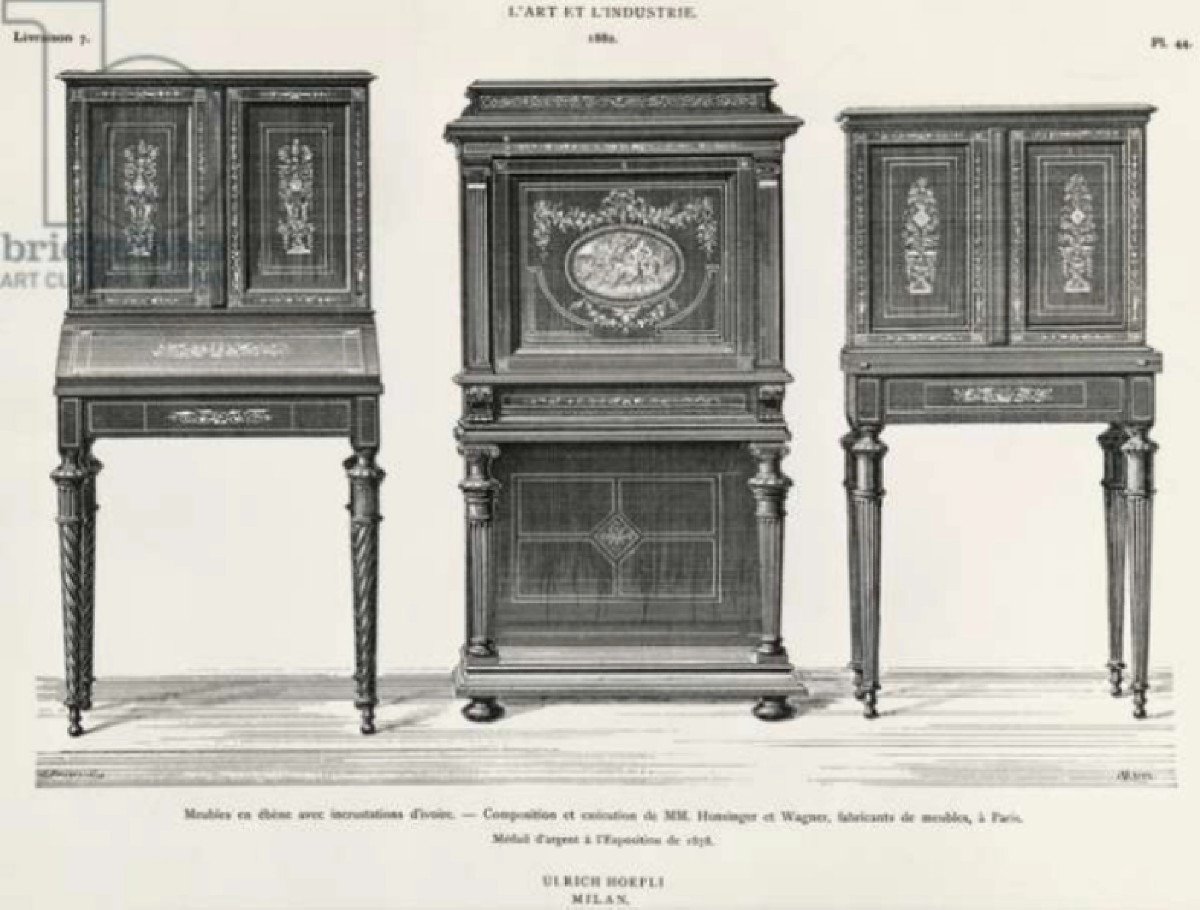
A demand for taste and comfort became essential to furniture design in the last decades of the 19th century. Rationalist ideas also flourished during the last quarter of the century. The formal excesses of eclecticism therefore had to be softened and redesigned to meet these new imperatives. Hunsinger and Wagner could not escape these new demands and even benefited from this trend. While the taste for the Louis XVI style logically engendered linear rigor and formal restraint, this trend was further reinforced by the general attraction to Victorian English furniture, often black lacquered and rectilinear. It was appealing for its great simplicity, which was associated with ideas of luxury and elegance. Hunsinger and Wagner, moreover, made English furniture one of their references. Their 1882 advertisement stated: “For several years, Messrs. Hunsinger and Wagner, drawing inspiration from the comfort of English furniture, succeeded in imbuing their designs with that practical elegance, that rich and tasteful luxury, and that solidity that distinguishes the craftsmanship of our neighbors across the Channel. They created a true specialty in this genre, and the numerous examples of furniture, living room sets, dining room sets, boudoirs, etc., still displayed in their shops, testify to serious and reasoned craftsmanship. The desk, sideboard, and cabinet reproduced in 1882 in L'Art et l'Industrie demonstrate Hunsinger and Wagner's formal explorations. While the panels incorporate the grotesque motifs used by the cabinetmakers from the beginning of their collaboration, the lines of the furniture are straight, and sculpted reliefs are eliminated in favor of greater simplicity. The decoration is limited to ivory inlays and ebony marquetry in a diamond pattern.
RELATED WORKS:
- Reproduction of furniture by Charles Hunsinger and Charles Wagner in 1882 in L'Art et l'Industrie, inlaid and engraved ebony and ivory.
Aurore Janson (Research and writing). For more information, we invite you to download the "research report."
Some restoration work is needed: estimates available upon request.
Bonheur du jour
Ebony, ebony veneer, and ivory inlays
Circa 1880
A demand for taste and comfort became essential to furniture design in the last decades of the 19th century. Rationalist ideas also flourished during the last quarter of the century. The formal excesses of eclecticism therefore had to be softened and redesigned to meet these new imperatives. Hunsinger and Wagner could not escape these new demands and even benefited from this trend. While the taste for the Louis XVI style logically engendered linear rigor and formal restraint, this trend was further reinforced by the general attraction to Victorian English furniture, often black lacquered and rectilinear. It was appealing for its great simplicity, which was associated with ideas of luxury and elegance. Hunsinger and Wagner, moreover, made English furniture one of their references. Their 1882 advertisement stated: “For several years, Messrs. Hunsinger and Wagner, drawing inspiration from the comfort of English furniture, succeeded in imbuing their designs with that practical elegance, that rich and tasteful luxury, and that solidity that distinguishes the craftsmanship of our neighbors across the Channel. They created a true specialty in this genre, and the numerous examples of furniture, living room sets, dining room sets, boudoirs, etc., still displayed in their shops, testify to serious and reasoned craftsmanship. The desk, sideboard, and cabinet reproduced in 1882 in L'Art et l'Industrie demonstrate Hunsinger and Wagner's formal explorations. While the panels incorporate the grotesque motifs used by the cabinetmakers from the beginning of their collaboration, the lines of the furniture are straight, and sculpted reliefs are eliminated in favor of greater simplicity. The decoration is limited to ivory inlays and ebony marquetry in a diamond pattern.
RELATED WORKS:
- Reproduction of furniture by Charles Hunsinger and Charles Wagner in 1882 in L'Art et l'Industrie, inlaid and engraved ebony and ivory.
Aurore Janson (Research and writing). For more information, we invite you to download the "research report."
Some restoration work is needed: estimates available upon request.
3 800 €
Period: 19th century
Style: Napoleon 3rd
Condition: Condition of use
Material: Marquetry
Width: 67,5 cm
Height: 136 cm
Depth: 52 cm
Reference (ID): 1263718
Availability: In stock
Print