THIS OBJECT WAS SOLD
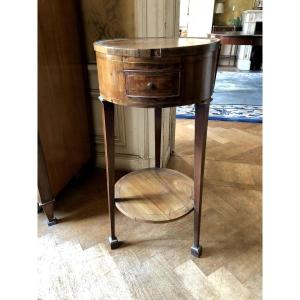
Salon Table Stamped Georges Jacob (1739-1814)

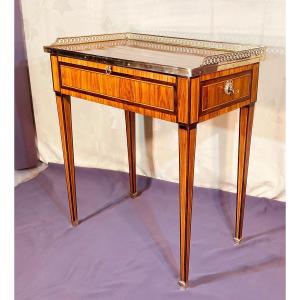
Exceptional Louis XVI Salon Table, in Satin Veneer, Stamped Georges JACOB, opening with a Side Drawer which closes with its Key. It has a writing tablet on the front covered with Havana leather gilded with Petits Fers, which comes with its original Ring. The Tray is in Satin Veneer Wood, surrounded by an Openwork Gallery in Gilt Bronze. It is stamped G. IACOB for Georges JACOB (1739-1814) received Master on September 4, 1765. French work, Louis XVI period. It measures 66 CM in length, 40 cm in depth and 75 cm in height. JACOB Georges Georges Jacob (1739-1814) – master's degree on September 4, 1765: He is the most famous and the most creative of all the carpenters in seat of the XVIIIth century in France. At the forefront of its wealthy clientele is the royal family. Georges Jacob was born in 1739 in Cheny in the Burgundy region. Son of Etienne Jacob and Françoise Beaujan, laborers, he arrived in Paris at a very young age in 1755 as an apprentice carpenter with Jean-Batipte Lerouge – established in rue de Charenton. He then entered as a companion at Louis DELANOIS, the supplier of Madame du Barry, mistress of Louis XV. A promoter of the neoclassical style in seating, Delanois unquestionably exerted an influence on Jacob's models. Received master in 1765 thanks to a small seat in gilded wood, Jacob then created his own workshop from scratch. Two years later, he married Jeanne-Germaine Loyer from a family of master embroiderers. Established in his early years on rue de Cléry, his workshops were moved to rue Meslée in 1775, where the most favorable period of his career took place and where the greatest royal commissions were executed. Georges Jacob is an innovator: it is also in the arrangement and decoration of the legs and in the arms of his seats that we find formulas launched if not imagined by him. Many of its seats thus rest on tapered legs with rudent grooves. These feet are connected to the belt by a die or box, decorated with a rosette. In the most luxurious models ribbons, garlands or foliage sometimes wrap around the feet where the grooves are replaced by bundles of arrows. But the great novelty put in the spotlight by the cabinetmaker and exploited almost exclusively by him is that of the console legs, finished at the top by a volute. They usually feature on racket-backed chairs and office or vanity swivel chairs. He is also the promoter of the variously profiled and sculpted baluster-shaped armrest supports. Finally, sculpture plays a leading role in the majority of Jacob's seats, carpentry furniture, screens and consoles, which are often quite abundant. It includes friezes of twisted ribbons, more or less embellished with foliage or pearls, friezes of interlacing, scrollwork of foliage, or rows of piastres - in particular on the curved parts of the armrests - rows of pearls, rais-de-coeur, stylized acanthus leaves, or finally straight or twisted grooves. On command seats such as the famous “ears of corn” furniture, a sculpted ornamentation of the most naturalistic nature develops, for which the most curious want to find the origin in the peasant ancestry of the cabinetmaker. One finds there thus treated with a rare meticulousness of the flowers, lilac, lily of the valley, violet and rose, and foliage, vine, laurel and oak. The animal kingdom is also present with eagle heads on the backs and armrests of several seats or lion's muzzles as on the armchairs of the Marquise de Marboeuf. These sculptures are sometimes entrusted to sculptors like Jean-Baptiste Rode. Gilder painters can also be called upon. The Revolution nevertheless placed him in a difficult position. Many of his clients emigrate and do not settle their debt. In 1796, he ended up going bankrupt and passed on his workshop to his two sons, Georges Jacob Fils and François-Honoré who created the company Jacob Frères Rue Meslée, active under the Directory and the Consulate.
Explore similar pieces and discover your ideal find:
Side Tables