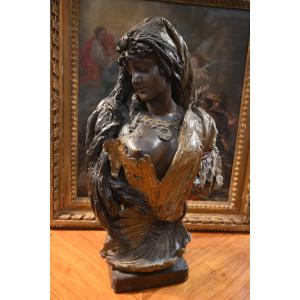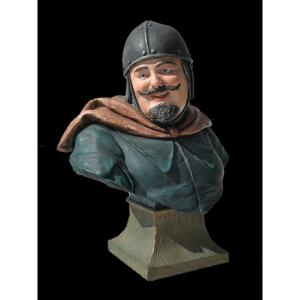


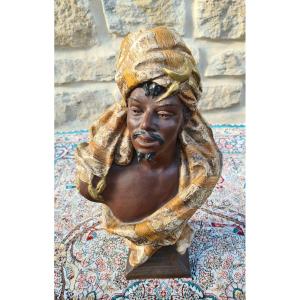


Terracotta Bust "smiling Arab Chief" By René Charles Masse
Artist: Charles Masse (1855-1913)
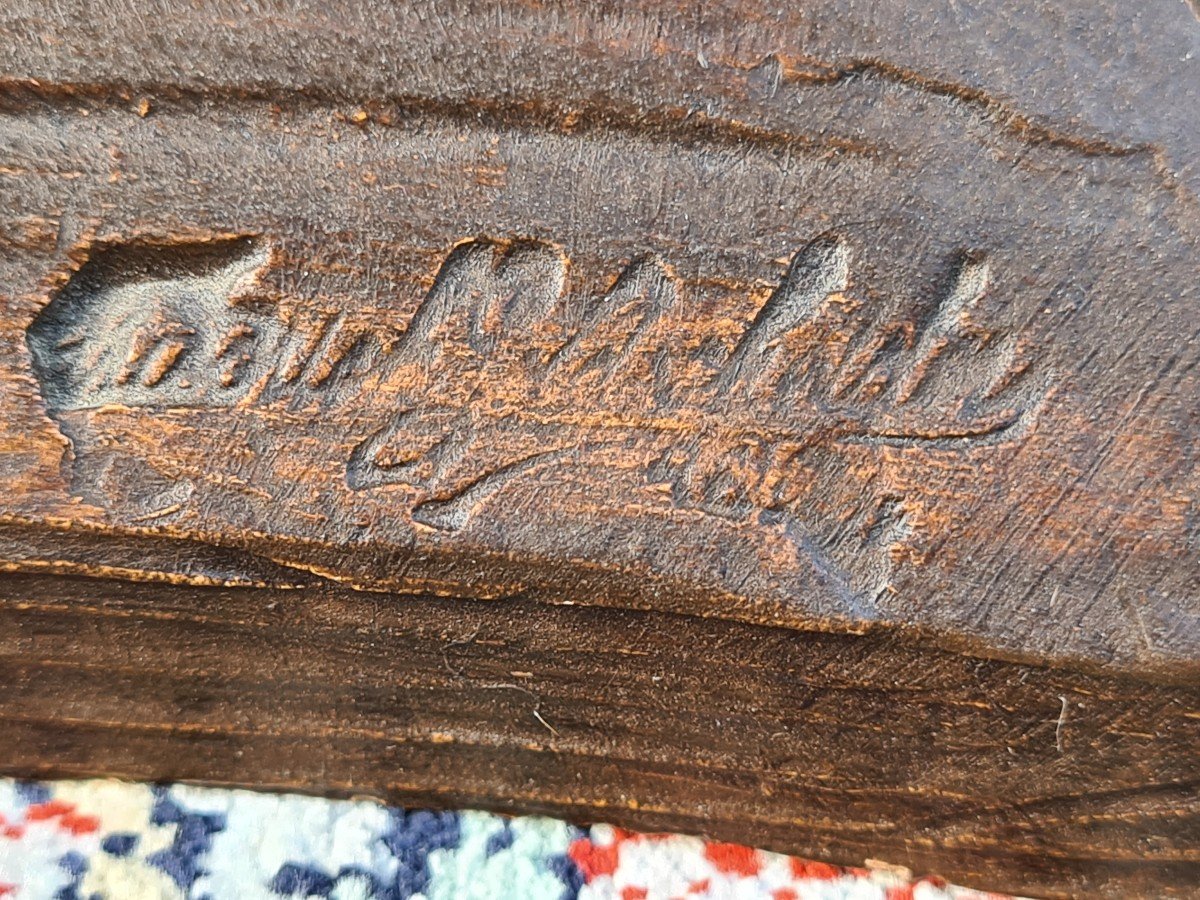
Chef arabe souriant. Epreuve en terre cuite polychrome, signée sur la base et au dos. Socle 12 x 12 cm. Etat naturel Une preuve similaire est reproduite à la page 208 du livre de Stéphane Richemond, « Terres cuites orientalistes et africanistes », 1860-1940, Editions de l'Amateur, Paris 1999.
CHARLES MASSE AND "DIENVILLE CERAMICS"...
Born in Saône-et-Loire, Charles Masse (1855-1913) trained in Paris in Eugène Piat's studio.
A sculptor now renowned for his Orientalist work, he first worked in Paris, taking part in the Salons and winning a prize at the Exposition Universelle in Paris in 1899.
He then linked his destiny to the clay soil of the Aube region.
He is said to have worked for a time at the Sainterie de Vendeuvre.
What is certain is that he set up his own business in Dienville, probably around 1900. His "Horloge des jours" survives from this period, with Charles Masse's signature and the handwritten words "Dienville-Aube" on the back.
The rue Bleue address in Paris later served as the head office of the company that Charles Masse set up in 1901 with a Parisian friend, Ernest Labrit: "La Céramique d'Art de Brienne-le-Château".
In both cases, he had his pieces fired at the Mielle pottery in Radonvilliers. But the second experience did not last any longer than the first...
By 1903, Charles Masse was living in Troyes. He seems to have worked mainly for the Manufacture de Villenauxe, which published several of his works in biscuit porcelain.
CHARLES MASSE AND "DIENVILLE CERAMICS"...
Born in Saône-et-Loire, Charles Masse (1855-1913) trained in Paris in Eugène Piat's studio.
A sculptor now renowned for his Orientalist work, he first worked in Paris, taking part in the Salons and winning a prize at the Exposition Universelle in Paris in 1899.
He then linked his destiny to the clay soil of the Aube region.
He is said to have worked for a time at the Sainterie de Vendeuvre.
What is certain is that he set up his own business in Dienville, probably around 1900. His "Horloge des jours" survives from this period, with Charles Masse's signature and the handwritten words "Dienville-Aube" on the back.
The rue Bleue address in Paris later served as the head office of the company that Charles Masse set up in 1901 with a Parisian friend, Ernest Labrit: "La Céramique d'Art de Brienne-le-Château".
In both cases, he had his pieces fired at the Mielle pottery in Radonvilliers. But the second experience did not last any longer than the first...
By 1903, Charles Masse was living in Troyes. He seems to have worked mainly for the Manufacture de Villenauxe, which published several of his works in biscuit porcelain.
1 400 €
Period: 19th century
Style: Napoleon 3rd
Condition: Good condition
Material: Terracotta
Width: 24 cm
Height: 42 cm
Depth: 16 cm
Reference (ID): 1147984
Availability: In stock
Print