

So if you’ve ever wondered what exactly cherubs, putti, cupids, and all their winged cousins are doing in works of art, you’ve come to the right place. Knowing what we are actually looking at when we see plump winged babies or toddlers can be surprisingly tricky. From the Renaissance onward, artists often borrowed the visual language of the ancient putto for angels—or rather, for certain kinds of angels.
Because the subject is a little tangled (where theology, mythology, and art history all meet), we thought it would be more playful to explore it through four artworks featured on PROANTIC, dating from the Italian Renaissance and Baroque periods. Italy was, after all, the artistic cradle of this shift from putto to cherub, and these two periods saw a remarkable flourishing of these charming winged figures.
And before you leave, don’t miss our Lexicon of Winged Childlike Figures at the end of the article—a handy little guide to the key terms used for these airborne children.
When Cherubs Are Indeed Angels: Religious Scenes
Artwork 1: A 19th-century glazed terracotta plaque (73 × 47 cm), after “The Annunciation” by Andrea della Robbia (1435-1525), from the Ospedale degli Innocenti, Florence.
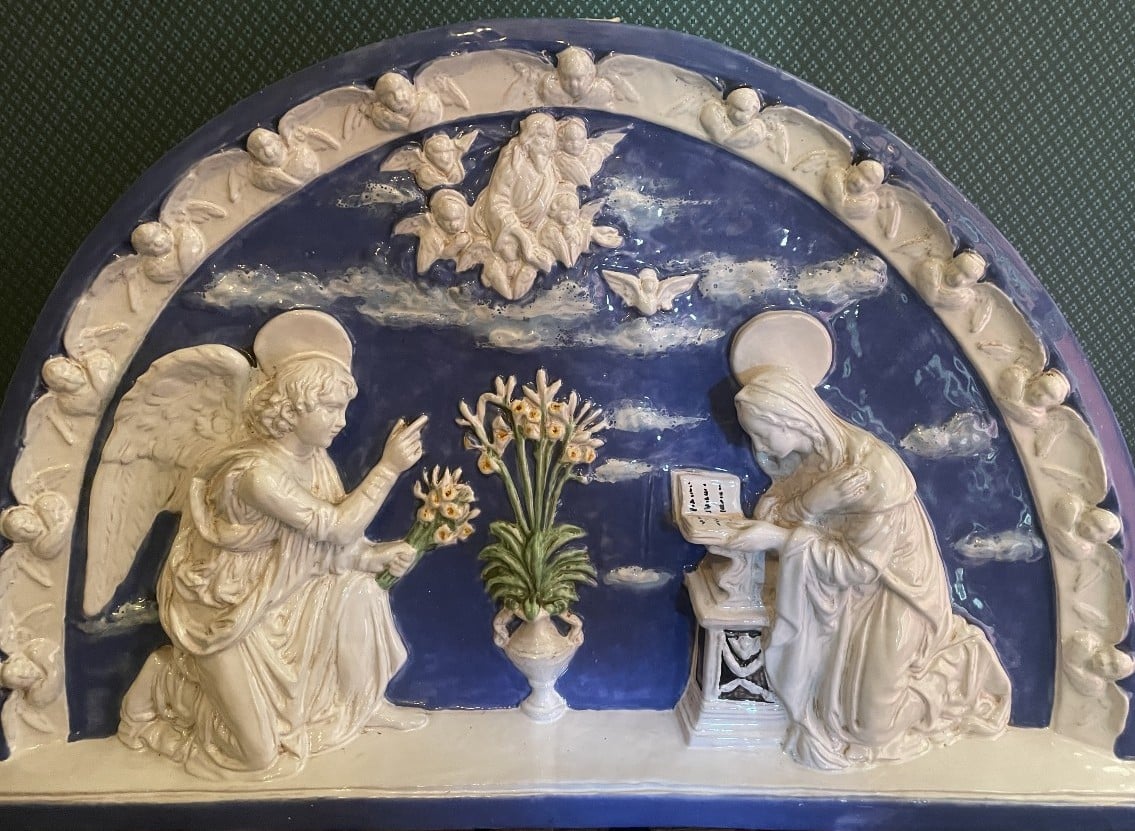
The glazed terracotta plaque of the Annunciation by Andrea della Robbia, inspired by a monumental composition created around 1490 for the Ospedale degli Innocenti, offers a rich and subtle vision of angelic presence in late Quattrocento Florence. Originally measuring approximately 145 × 290 cm, the work belongs to a setting deeply associated with childhood and charity: the hospital, founded from 1419 under the direction of Filippo Brunelleschi, bore as its emblem a swaddled infant (putto in fasce)—itself modeled by Della Robbia.
Within this Annunciation scene, three distinct types of angels can be discerned: the archangel Gabriel, who addresses the Virgin; the radiant seraphim; and, carrying God, the cherubim. The cherubs appear here as small winged heads—bearing two pairs of wings—emerging from a celestial field. Their form derives from medieval iconographic tradition, in which cherubim often closely resemble seraphim, sometimes shown with up to three pairs of wings, and are distinguished chiefly by color: blue for cherubim, red for seraphim.
Cherubs Evolution From the Middle Ages
In the early sixth century, Pseudo-Dionysius the Areopagite composed “The Celestial Hierarchy”, a foundational text of Christian angelology. In that system, angels participate in divine light according to a graded order. Yet by the late 15th century, this abstract theology begins to soften visually: the multiplication of wings gives way to more approachable, almost decorative forms. The cherubs in Della Robbia’s plaque still retain something of their hieratic origin, but they are already moving toward a gentler, more intimate presence.
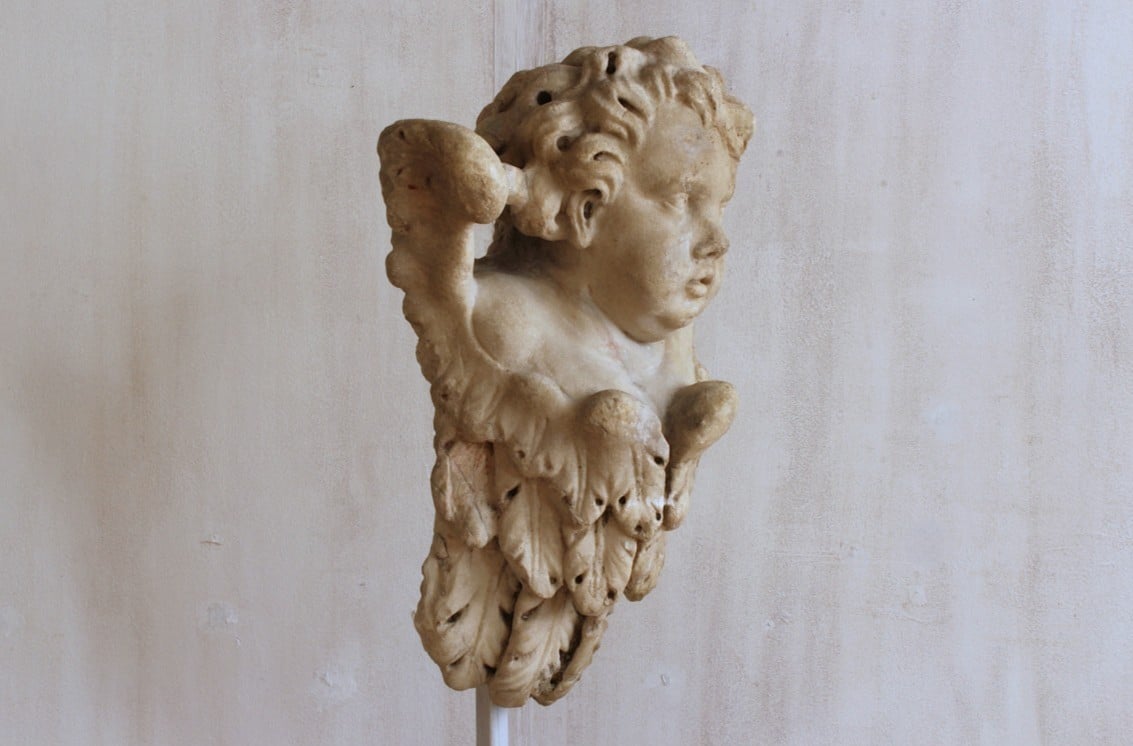
A 17th-century sculpted angel head in marble from Italy. The wings folded across the torso of this moving cherub recall Isaiah’s description of the seraphim, two of whose wings covered their feet. © Deulin Antiques
This transformation cannot be understood without situating Della Robbia within his artistic milieu. Trained in the circle of Nanni di Banco—notably active on the Porta della Mandorla of Florence Cathedral, where varied angelic types already appear—Della Robbia was also close to Donatello. Donatello, in particular, played a decisive role in redefining the visual language of angels by reintroducing the classical putto: the nude, winged infant of Greco-Roman antiquity. Through this revival, cherubs gradually acquired softer bodies, playful attitudes, and a more humanized presence. What had once been a symbolic, almost abstract sign of divine intelligence became increasingly childlike, even tender.
Cherubs as Companions of the Virgin Mary and Christ
In religious imagery, cherubs are most frequently associated with scenes involving the Virgin Mary and the Christ Child. They populate representations of the Nativity, hover around the Virgin and Child, and accompany key moments such as the Presentation in the Temple, the Assumption of Mary, or the Lamentation and Entombment of Christ. Their presence often signals a heavenly dimension, bridging the earthly and the divine. In Marian imagery especially, a theological shift occurs: the Virgin is exalted “above the angelic choirs,” becoming not only the mother of Christ but, symbolically, a maternal figure for all celestial beings. This reconfiguration of spiritual kinship—linking angels and humanity through Mary—may help explain the progressive “infantilization” of angels at the end of the Middle Ages.
Thus, in Della Robbia’s Annunciation, cherubs occupy a liminal space between doctrine and devotion, tradition and innovation. They remain rooted in medieval theology while already anticipating the charming, ubiquitous putti of the Renaissance and beyond.
The Comeback of the Antique Putto During the Renaissance
Artwork 2: A winged putto bronze (26 cm high), from the Venetian workshop of Niccolò Roccatagliata (1593-1636).
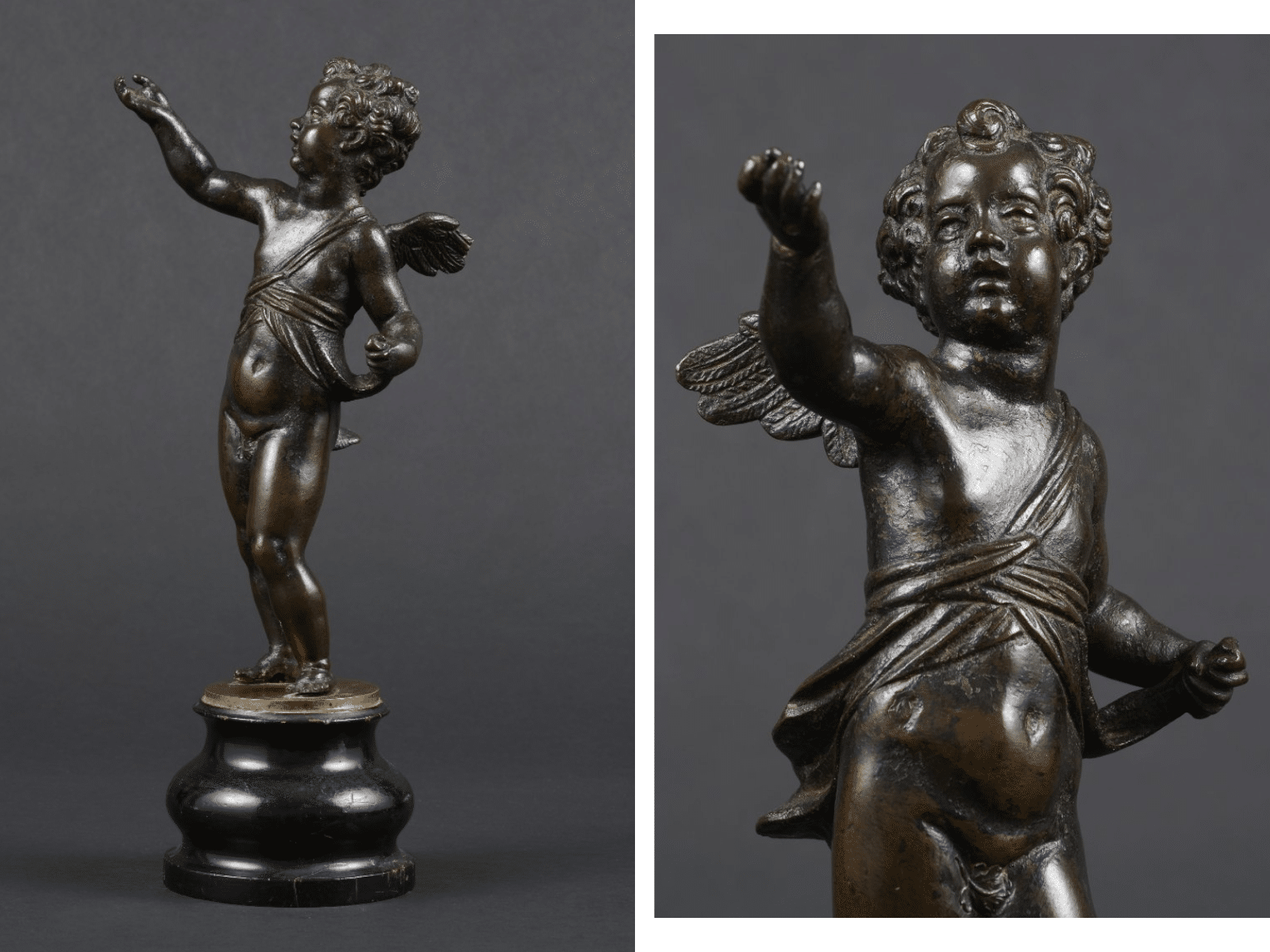
The small winged bronze putto attributed to Niccolò Roccatagliata, produced in Venice in the early seventeenth century, offers a refined example of how Renaissance artists revived and transformed the imagery of antiquity. The figure stands lightly poised, dressed in a short, finely rendered tunic that clings to the body like antique drapery. Its curly hair gathers at the crown and temples, framing a face with heavy eyelids that suggest both softness and introspection. The wings, small in proportion to the body, appear almost symbolic rather than functional. This is not a theological angel in the strict medieval sense, but rather a putto in its original artistic meaning: a charming, self-contained figure whose identity lies as much in classical tradition as in later reinterpretations.
Roccatagliata, who worked primarily in Venice, was described by the art historian Leo Planiscig as a “master of the putto.” His figures seem to emerge almost directly from Roman antiquity, much like those of Donatello, whose influence on the Renaissance rediscovery of the putto was decisive. Donatello reintroduced into sculpture the ancient motif of the nude or lightly draped winged child, drawing inspiration from classical sarcophagi, reliefs, and small bronzes. Through his work, the putto regained a central place in artistic vocabulary, no longer as a marginal decorative element but as a dynamic and expressive figure. This legacy continued in Venice with sculptors such as Tiziano Aspetti, whose lively bronze putti also reflect a deep engagement with antique models.
The Putti of the Antiquity…
The resurgence of the putto during the Renaissance must be understood within the broader rediscovery of antiquity. In Rome, the exploration of the buried chambers of the Domus Aurea—Nero’s vast imperial residence—revealed a wealth of painted decoration known as grotesques. Among the hybrid creatures, vegetal motifs, and fantastical beings that adorned these walls, putti appeared too: climbing, playing, carrying garlands, or participating in mythological scenes. These rediscovered images profoundly influenced Renaissance artists, who adapted their motifs to new contexts. The putto, in particular, offered a versatile figure capable of bridging pagan antiquity and Christian imagery.
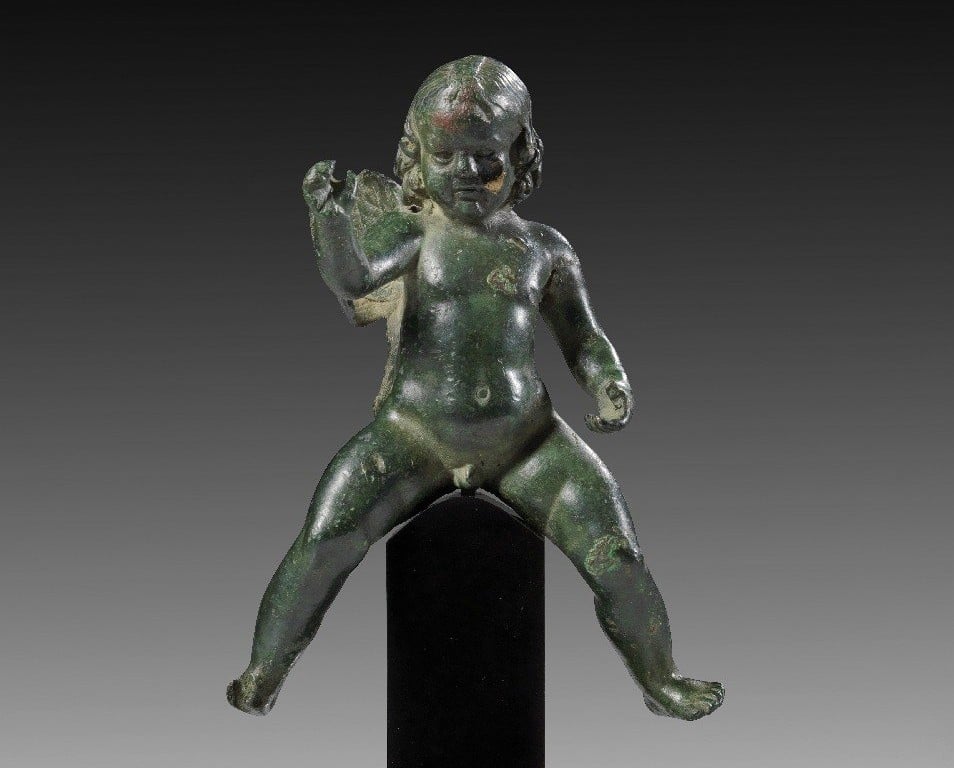
Ancient Roman Bronze Cupid in the pose of riding a dolphin. 2nd century A.D. © Cavagnis Lacerenza Fine Art
In antiquity, putti (or erotes, closely related to figures such as Eros or Cupid) were associated with a wide range of meanings and activities. They often appeared in playful or even mischievous roles: engaging in games, harvesting grapes, participating in Bacchic rites, or accompanying deities such as Venus. Their attributes—garlands, musical instruments, animals, or wine vessels—emphasized themes of fertility, pleasure, and the cycles of nature. They were not angels but rather mythological or symbolic beings, embodying forces of life and desire in a light, accessible form.
…Turned Into Cherubs During the Renaissance
It is precisely this flexibility that made the putto so appealing to Renaissance artists. While in Roccatagliata’s bronze the figure remains essentially a putto—graceful, decorative, and rooted in classical tradition—the motif was increasingly “diverted” to represent cherubs in Christian art. The transition is subtle but significant: the winged child, once a companion of pagan gods, becomes an inhabitant of the Christian heaven. In this process, the putto lends its body and charm to the cherub, contributing to the gradual transformation of angelic imagery from the abstract and hieratic forms of the Middle Ages to the tender, childlike figures that populate Renaissance and Baroque art.
Thus, Roccatagliata’s bronze stands at a crossroads of meanings. It embodies the Renaissance fascination with antiquity while also participating in a broader visual shift, in which the ancient putto becomes the model for the modern cherub—an enduring example of how forms can migrate across cultures, religions, and centuries.
Ambiguity Arising From the Evolution of Angels
Artwork 3: Oil on canvas (110 × 87 cm) depicting a musician angel playing the flute beside a tambourine, attributed to Francesco Vecellio (c. 1475/1483-1560), brother of Titian.
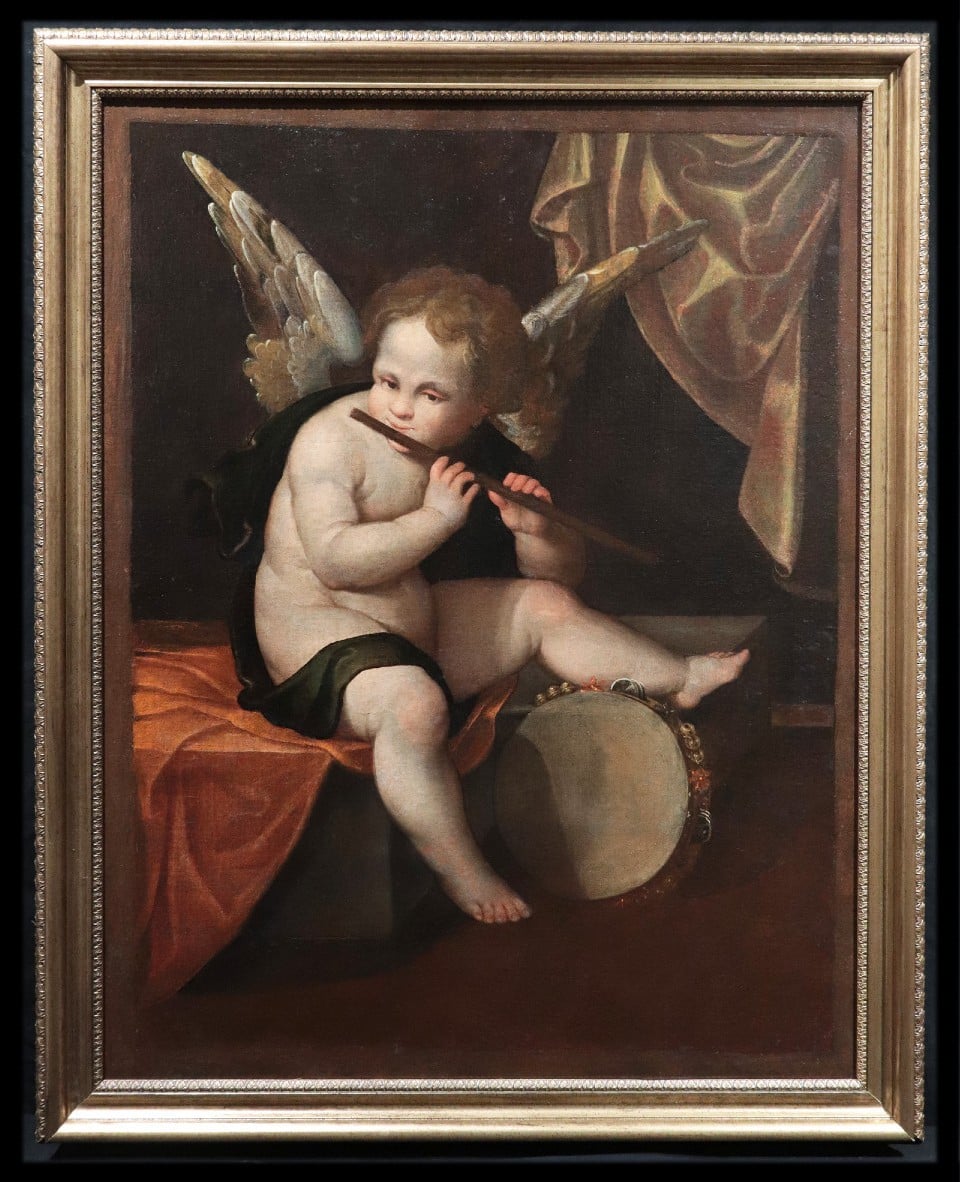
This painting, attributed to Francesco Vecellio, presents a winged child absorbed in music, holding a flute and accompanied by a tambourine. At first glance, the figure seems disarmingly simple: a youthful body, softly modeled, animated by the act of playing. Yet this apparent simplicity conceals an ambiguity. Is this figure a putto, inherited from antiquity, or a cherub—an angelic being integrated into Christian iconography? The presence of musical instruments complicates the answer. The flute and tambourine could easily evoke pagan associations, recalling Bacchic festivities and the playful world of classical putti. At the same time, given Vecellio’s artistic milieu and his frequent depiction of angels surrounding the Virgin, the figure can just as plausibly be understood as a musician angel.
Francesco Vecellio, active in Venice and traditionally considered the brother of Titian, worked within one of the most influential artistic circles of the sixteenth century. In Titian’s monumental Assumption of the Virgin for the Frari, a host of cherubs surrounds and lifts the Virgin toward heaven. Among them, several play instruments—tambourines, flutes, and others—contributing to a celestial concert that underscores the glory of the scene. These figures, with their soft bodies and often delicately colored or white wings, exemplify the fusion of the antique putto with the Christian angel. Vecellio’s winged musician belongs fully to this visual language, where distinctions between categories are blurred.
Where Did the Musician Angels Go?
The theme of musician angels has a long history, reaching back well before the Renaissance. From the early fourteenth century to the mid-sixteenth century, angels are frequently depicted singing or playing instruments, often with a musical score in hand. They accompany the Virgin and Christ, filling sacred space with sound. In theological terms, music becomes synonymous with praise: angels are those who proclaim the glory of God. Drawing on the celestial hierarchy described by Pseudo-Dionysius the Areopagite, the highest orders of angels—among them the cherubim—are those who ceaselessly sing divine hymns: “Holy, holy, holy, Lord God of Sabaoth.” In scenes of the Apocalypse or the Last Judgment, angels often sound trumpets, their instruments embodying the very voice of God announcing the end of time.
Yet this rich musical imagery began to shift in the later sixteenth century. Following the Council of Trent (1545-1563), a more restrained conception of sacred music emerged, emphasizing intelligible text and spiritual clarity. In visual art, this contributed—unevenly across regions—to a decline in the representation of purely instrumental musician angels, particularly in more rigorously reformed centers such as Rome or Milan. Venice, however, retained a certain freedom, and figures like Vecellio continued to explore the expressive potential of musical putti and cherubs.
Angels’ Wings
Another change affecting cherubs—and angels more broadly—between the Middle Ages and the Renaissance was the gradual softening of wing colors, which increasingly shifted toward beige and white tones. In medieval art, angelic wings were often vividly colored, sometimes resembling those of parrots. Their hues, in fact, echoed the rainbow, a symbol of the covenant between God and humanity.
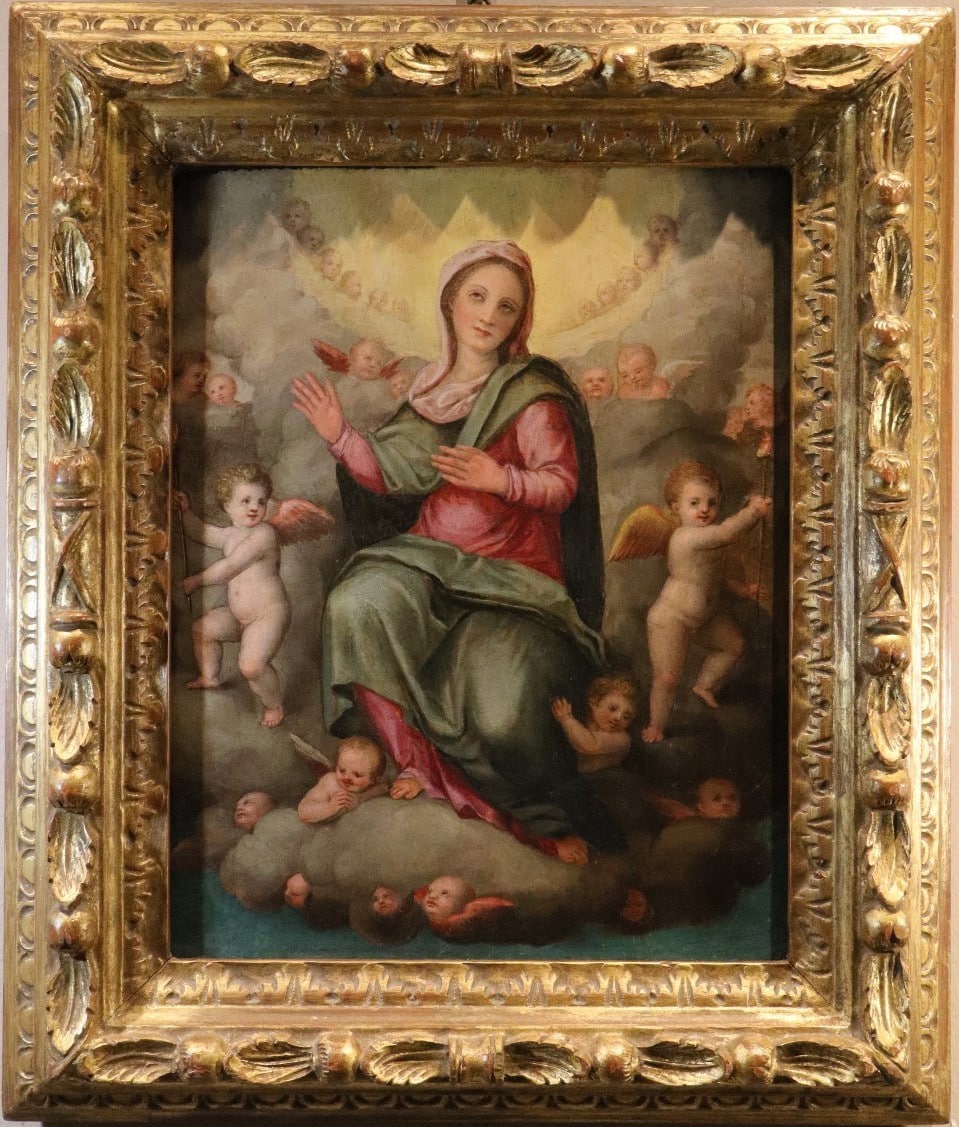
Late 16th-century Virgin Mary in glory surrounded by angels and cherubs. A painting attributed to Giovanni Balducci (1560 – after 1631), active in Florence, Rome, and Naples. The colors of the angels’ wings vary from one angel to another—ranging from white to yellow, green, or pink—and above all reflect the painting’s palette. Overall harmony takes precedence. © Antichità Castelbarco
By the Renaissance, a more naturalistic treatment became increasingly common, with wings rendered in delicate gradations of white, brown, and other muted tones—more evocative of doves than parrots, and perhaps carrying a faint classical echo of the dove as the bird of Venus, emblem of love in antiquity. This evolution was by no means absolute, however, and artists retained considerable freedom in their compositions. The two pensive cherubs at the bottom of Sistine Madonna by Raphael, painted around 1513, still display brightly colored wings.
In Vecellio’s winged musician, all these elements converge. The figure hovers between worlds—pagan and Christian, decorative and devotional, child and angel. This ambiguity is not a weakness but a defining feature of Renaissance art, where inherited forms are reinterpreted, and where the putto and the cherub become, at times, indistinguishable.
Cherubs and Putti Become Increasingly Decorative in Baroque Art
Artwork 4: Oil on wood, dated 1697, from the Roman workshop of Carlo Maratta (1625-1713) with two putti in the clouds holding a flower garland and the motto “Pulchriora latent” on a scroll.
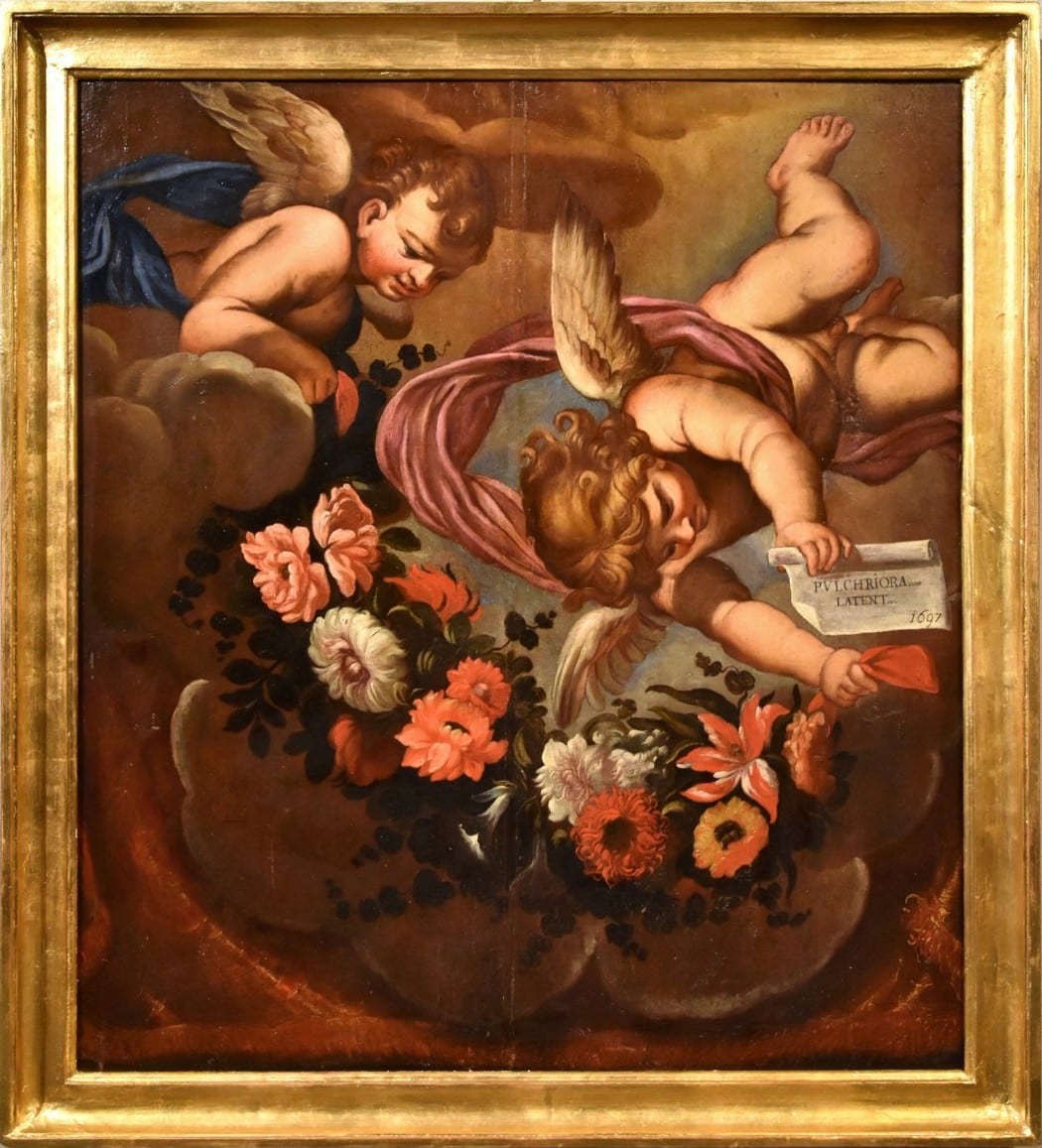
The charming composition attributed to the workshop of Carlo Maratta depicts two winged children suspended on clouds, holding between them a garland of flowers and a scroll bearing the motto “pulchriora latent.” The Latin phrase can be translated as “more beautiful things lie hidden,” suggesting that what is not immediately visible surpasses what is offered to the eye—an idea likely tailored to the patron’s intentions or identity. The figures themselves are striking for their lightness and grace: they hover effortlessly, their bodies animated in playful movement, one even appearing upside down. Their presence is less that of solemn celestial beings than of elegant, almost mischievous intermediaries. Retaining wings and a heavenly setting, these figures are closer to cherubs than to strictly classical putti, though their role is no longer primarily spiritual.
This decorative turn becomes clearer when situating the work within Maratta’s artistic context. A leading painter in late seventeenth-century Rome, Carlo Maratta was deeply involved in prestigious decorative cycles. Notably, in 1692, the banker Francesco Montioni commissioned a series of paintings for his Roman palace, in which Maratta collaborated with the still-life specialist Franz Werner von Tamm. Together, they developed compositions where putti or cherubs interact with abundant garlands of flowers and fruits, blending human, vegetal, and symbolic elements into a unified decorative scheme. These compositions proved so successful that Maratta later repeated them, again with von Tamm, for the Marquis Nicolò Maria Pallavicini. In such contexts, the winged children serve less as theological figures than as ornamental agents, enhancing the richness and elegance of aristocratic interiors. This reflects a broader Roman taste, where youthful figures evoke not only innocence but also abundance, fertility, and a kind of timeless golden age.
Putti as Symbols of Abundance
The use of putti and cherubs as decorative motifs, however, has much older roots. In antiquity, putti—often identified with erotes—frequently adorned sarcophagi, friezes, and domestic decoration. Their small scale and adaptable forms made them ideal for filling corners, framing compositions, or animating otherwise rigid structures. They carried garlands, harvested grapes, or played among vegetal scrolls, contributing to a visual language of abundance and continuity. During the Middle Ages, a similar practicality applied to cherubim, which were often reduced to winged heads and placed in architectural spaces such as capitals, spandrels, or voussoirs. In both periods, beyond their symbolic meanings, these figures fulfilled an essential decorative function.
The garland of flowers held by the two cherubs in this composition is particularly significant. Floral garlands have long been associated with cycles of life, beauty, and renewal. In ancient funerary art, putti carrying garlands often appear on sarcophagi, evoking both celebration and the continuity of life beyond death. In the Baroque period, this motif is revived and amplified: garlands become lush, dynamic, and sensuous, often intertwined with allegorical meaning. Here, the garland frames the motto, visually reinforcing the idea that beauty—perhaps moral, spiritual, or intellectual—lies beneath the surface.

Two 17th-century walnut candle-bearing putti carrying fruit baskets on their heads and holding heraldic shields. © Ars Antiqua
Winged Attendants
Putti commonly appear in allegories, carrying symbols or coats of arms. They sometimes serve a central figure, bearing various attributes or accessories. Putti seem to love carrying things around. In large decorative schemes, they may also be placed in smaller secondary panels, such as overdoors. They enhance symbolic motifs and give tangible form to ideas by lending them a warm, living presence. In Maratta’s circle, this versatility is fully exploited: the winged child becomes a vehicle for meaning as much as an ornament.
Thus, in this Baroque composition, cherubs no longer serve solely as messengers of the divine. They become part of a sophisticated decorative language, where beauty, symbolism, and playfulness intertwine—perfectly illustrating that, indeed, pulchriora latent.
Conclusion
What a journey for angels and cherubs. From beings often described in scripture without wings, they became inseparable from their wings. In the 4th century, John Chrysostom explained that the wings given to these heavenly beings were meant for one purpose only: to suggest the sublimity of their nature.
Many forces—both formal and conceptual—help explain the visual transformation of the angel and its borrowing from the ancient putto, the gradual blending of the Christian angel with the imagery of classical Love. Over time, the angel’s theophanic role weakened, and its ties to the biblical world grew looser. As the biblical angel partly receded, a real break opened in the iconographic tradition.

This marble sculpture of a “Sleeping Eros with the Attributes of Heracles” is attributed to Tommaso della Porta (c. 1546-1606). It is closely related to another sleeping Cupid now preserved in the Museo di Antichità di Torino. The latter was formerly attributed either to Michelangelo or to Tommaso della Porta, a sculptor active within the circle of Guglielmo della Porta. © Galerie Sismann
Our examples have been Italian, but the phenomenon did not remain confined to Italy. It spread throughout Western art, and by the time of the Rococo, winged children had embraced the very exuberance of the style. In religious settings, cherubs came to populate the clouds—whether painted directly or merely suggested through their presence. They carry paintings, support pulpits, and draw back curtains. In short, they are everywhere.
The great French Rococo painters—Antoine Watteau, Jean-Honoré Fragonard, and François Boucher—took them beyond the religious sphere, using them above all to celebrate love. Returning to mythological subjects, they filled their canvases with lively strings of cupids and putti, whose playful presence brought movement, charm, and delight to the scene.
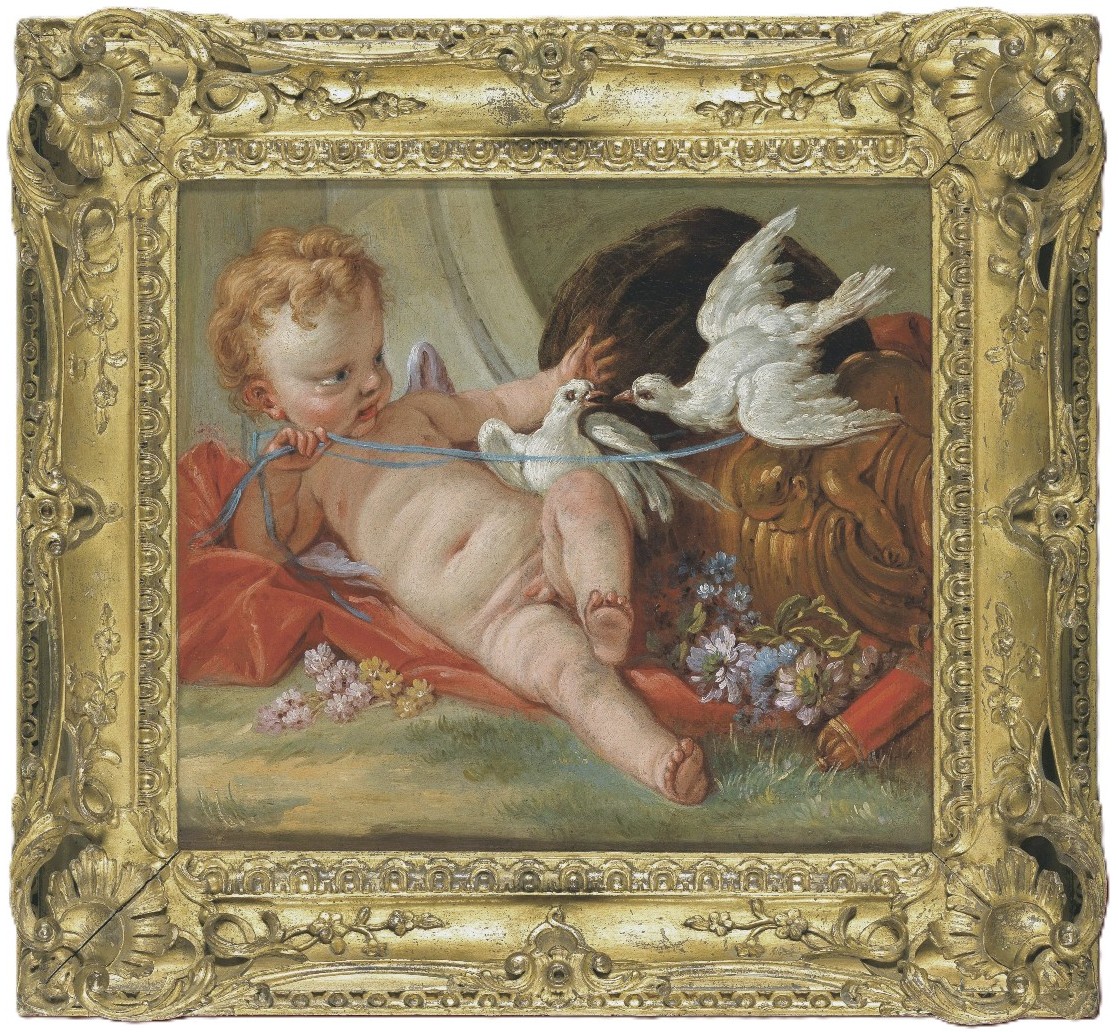
This painting, in its original carved and gilded Louis XV frame, was published in 1976 and 1980 by Ananoff and Wildenstein as the autograph work of François Boucher (1703-1770). It refers to one of the lower corners of a painting in the Staatliche Museen zu Berlin, engraved by Duflos as “Vénus tranquille“. © Dr Jansen Kunsthandel
Lexicon of Winged Childlike Figures
From Judeo-Christian Tradition
Angel: The word comes from a Greek noun meaning “messenger.” In the Abrahamic religions, an angel is an intermediary between God and the world. Angels surround God and announce or carry out His missions, most often protective ones—hence their role as guardian angels. In The Celestial Hierarchy by Pseudo-Dionysius the Areopagite (often regarded as the founding father of angelology), angels are arranged in a hierarchy of nine choirs divided into three orders. In his description, the angels form the lowest choir in this hierarchy and, by virtue of that position, serve as the common denominator of all the supernatural beings within it.
Cherub (plural: cherubim or cherubs): The word comes from Hebrew and, most likely even earlier, from the Akkadian karābu, meaning “to pray,” “to bless,” or “to adore.” The kāribu was a hybrid creature—part human, part animal—that stood as a guardian at temple entrances. As guardians, these beings were meant to inspire fear, and they are related to sphinxes.
In the Old Testament, cherubim first appear as guardians of the Garden of Eden. They are also associated with the Tabernacle and the Temple of Jerusalem: two cherubim guarded the Ark, serving as a footstool for the divine throne. It is not entirely clear what cherubim looked like, but in relation to the Ark we know they had two wings.
In the Christian celestial hierarchy, cherubim belong to the highest order, closest to God, just below seraphim. They embody divine wisdom and knowledge. Because of their rich symbolism and the enigmatic, sometimes inconsistent nature of the scriptural descriptions, artists were granted considerable freedom in representing them.
During the Middle Ages, cherubim were sometimes depicted as tetramorphs and/or with eyes on their wings (following Ezekiel), but more commonly they appeared as beings with a human face—sometimes even a fully human body—and up to three pairs of wings, one pair often covering the front of the body. Technically, six wings belonged to seraphim and four to cherubim, though there was, at times, a certain… creative confusion between the two. A conventional distinction, however, associated seraphim with red and cherubim with blue. They can sometimes be seen together, for instance, forming a mandorla around Christ in Majesty.
Seen from this perspective, the transition from the medieval cherub to the cherub as it is commonly imagined today—a chubby winged child—becomes easier to understand, especially if one considers the growing visual importance of wings and the rejuvenation of angels during the 14th century.
From Antiquity
Cupid (or Amor) / Eros (plural: erotes): In Roman and Greek mythology, he is the youthful god of love, usually described as the son of Venus (Aphrodite). He embodies vital impulse, primordial force, desire, and erotic love. His attributes are the bow and arrows.
First represented as a winged adolescent, he came to be depicted as a plump toddler during the Hellenistic period. He was frequently shown on pagan sarcophagi and later on Christian sarcophagi, where he could serve as a counterpoint to death.
Amorino (plural: amorini): Amor (Cupid / Eros) is often accompanied by many other children, the amorini, who symbolize the many facets of love. They appear as a lively band of young children, dancing together and playing games or pranks.
Putto (plural: putti): It is an Italian word attested in 14th-century sources, meaning “little boy.” From the 15th century onward, it came to be used in art to describe the winged cupids revived from antiquity by artists such as Donatello and others.
Spiritello (plural: spiritelli): Less common than amorino or putto, the term is nevertheless used by some art historians to describe winged children. Meaning “little spirit” in Italian, it is more ambiguous and less clearly defined, closer to the idea of a genius—neither angelic nor malevolent.
You May Like
Angels | Cherubs | Putti | Cupid | Eros