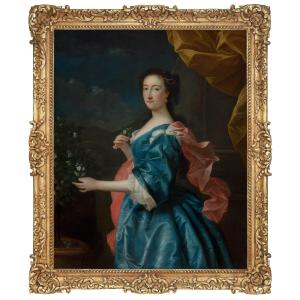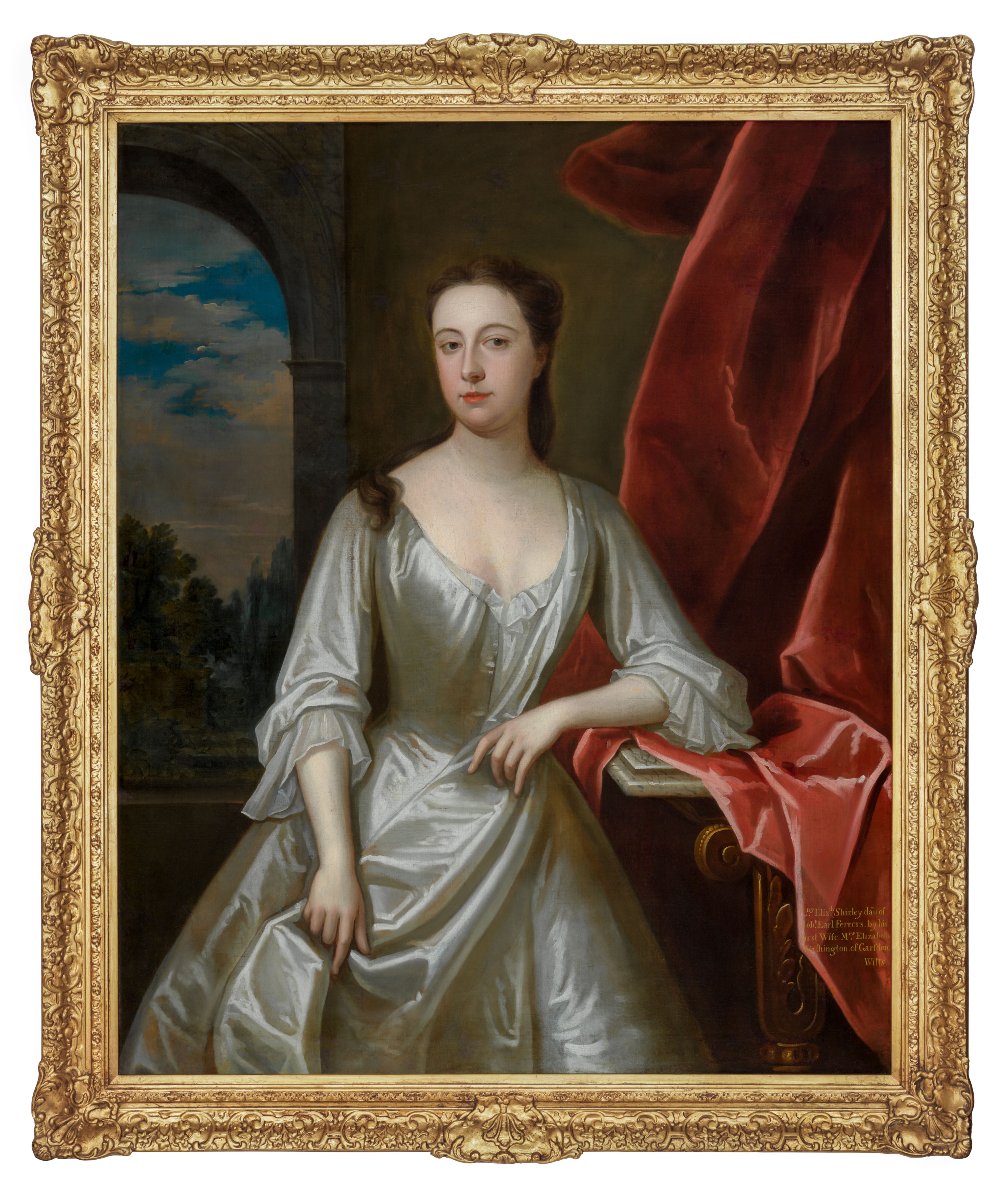
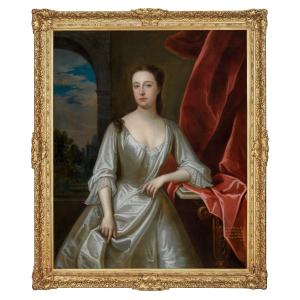


Portrait de Lady Elizabeth Shirley, sur une véranda près d'une table en marbre, vers 1705-1710
Artiste : Entourage De Sir Godfrey Kneller (1646–1723)
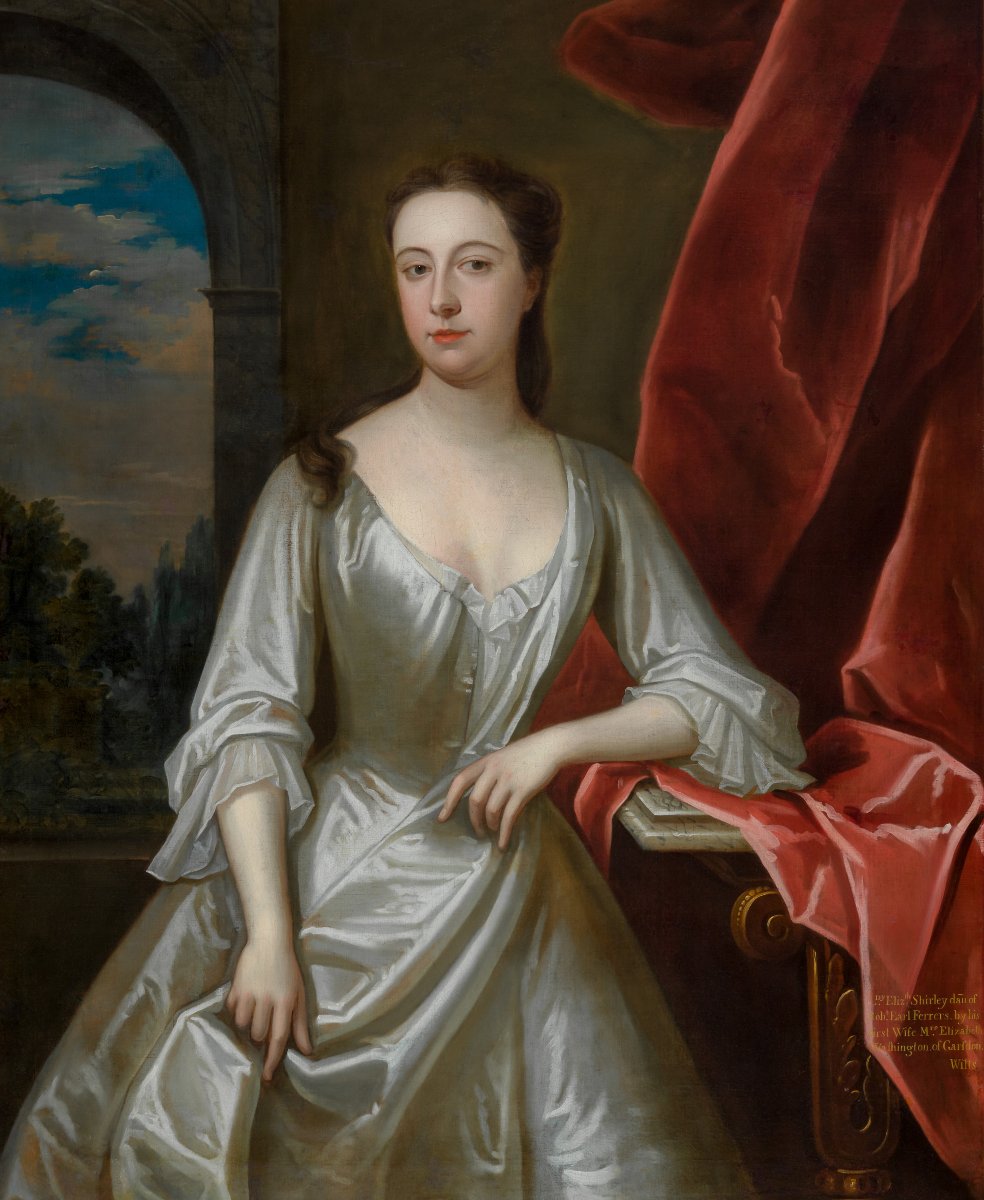
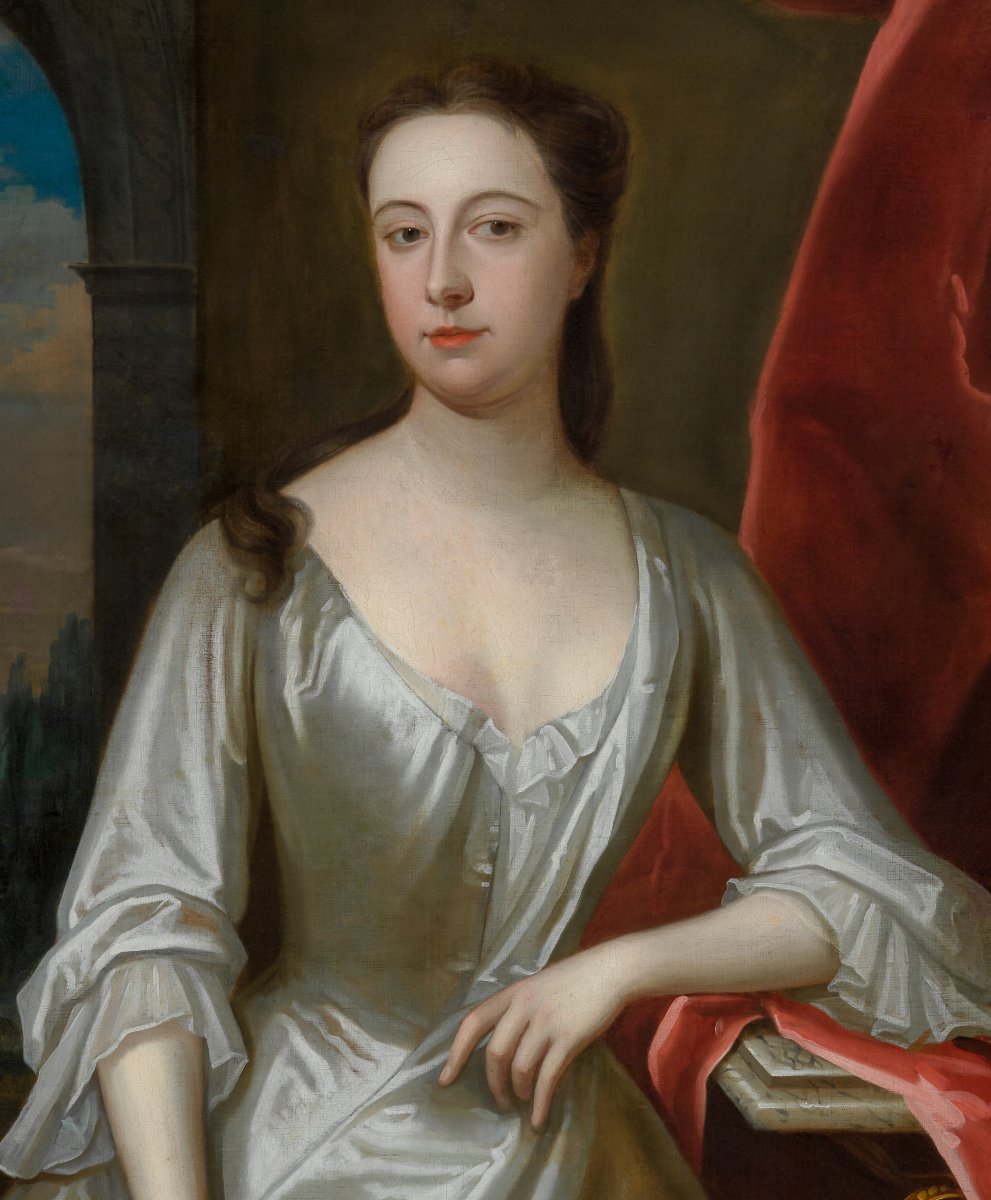
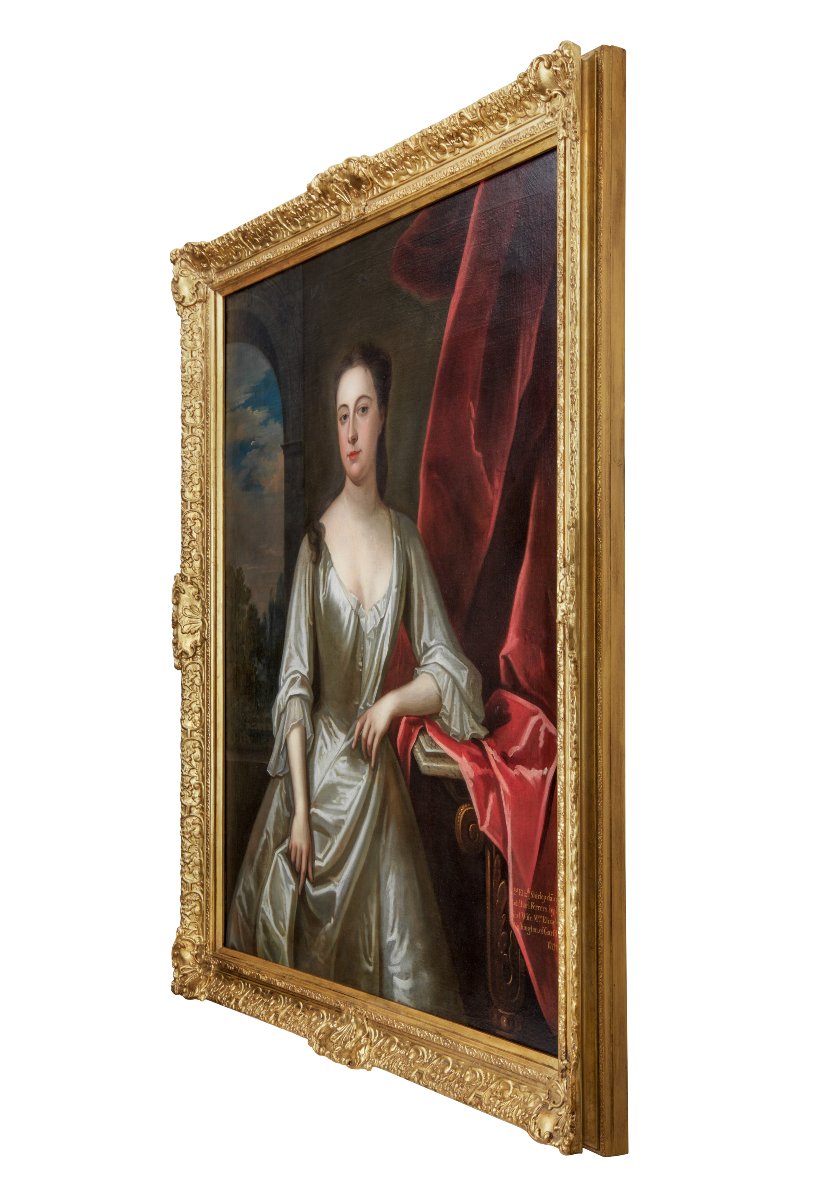
Peu de portraits de cette époque allient une telle envergure, une identification du modèle aussi certaine et des liens aussi évocateurs avec l'une des grandes dynasties terriennes d'Angleterre. Réalisé alors que Lady Elizabeth Shirley avait une trentaine d'années, cet impressionnant portrait à mi-corps faisait très probablement partie de la collection familiale des Shirley, comtes Ferrers, dont le domaine principal du Leicestershire était Staunton Harold. L'œuvre est dans un excellent état de conservation pour une toile vieille de plus de trois siècles : les carnations restent nettes et lisibles, les drapés argentés conservent leurs reflets éclatants et les magnifiques passages de tentures cramoisies gardent toute la richesse théâtrale sur laquelle repose la composition.
Par sa mère, Elizabeth Washington, le modèle partageait les mêmes origines familiales anglaises que George Washington, futur premier président des États-Unis.
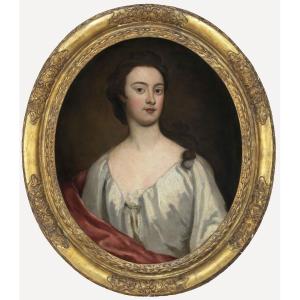
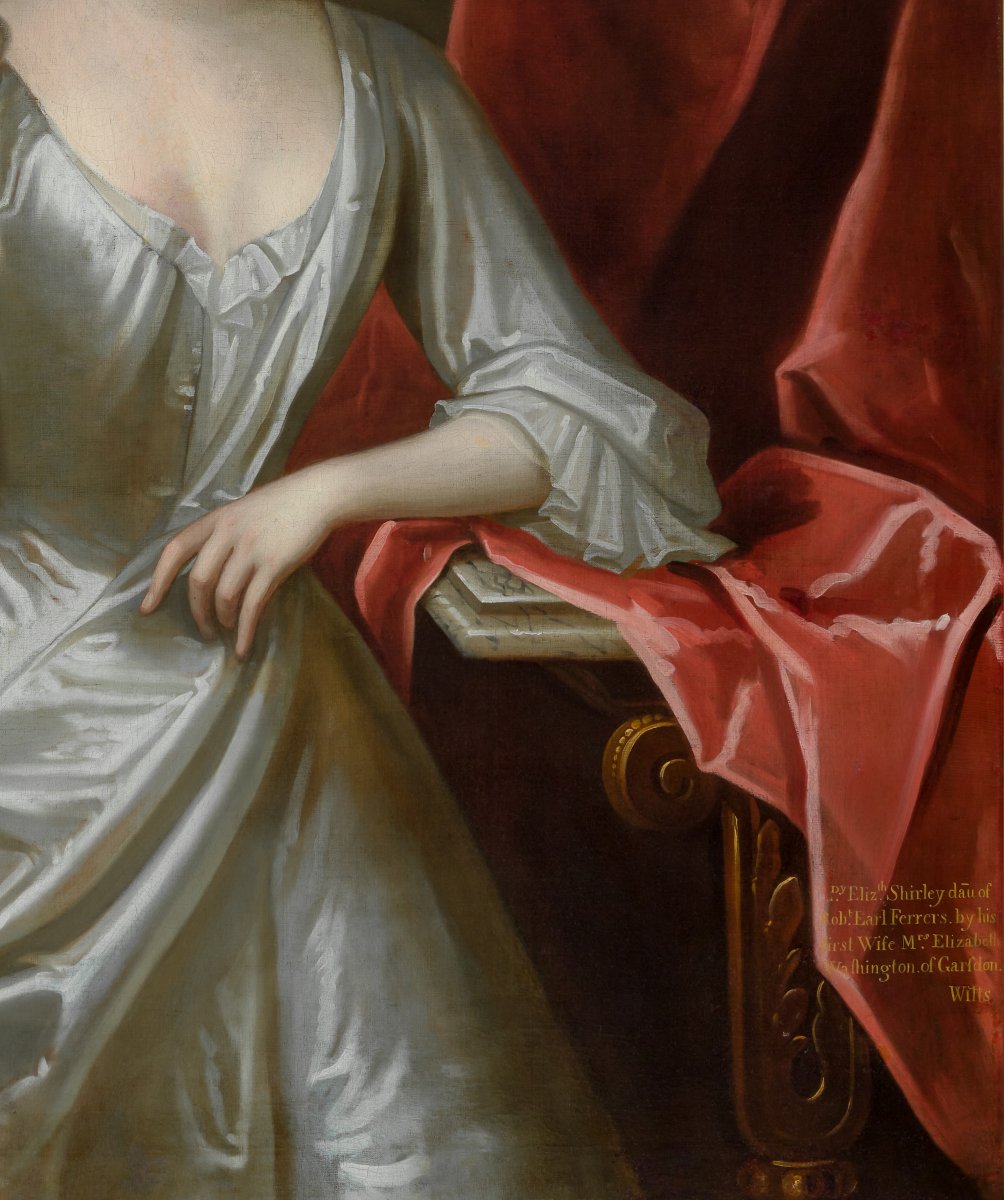
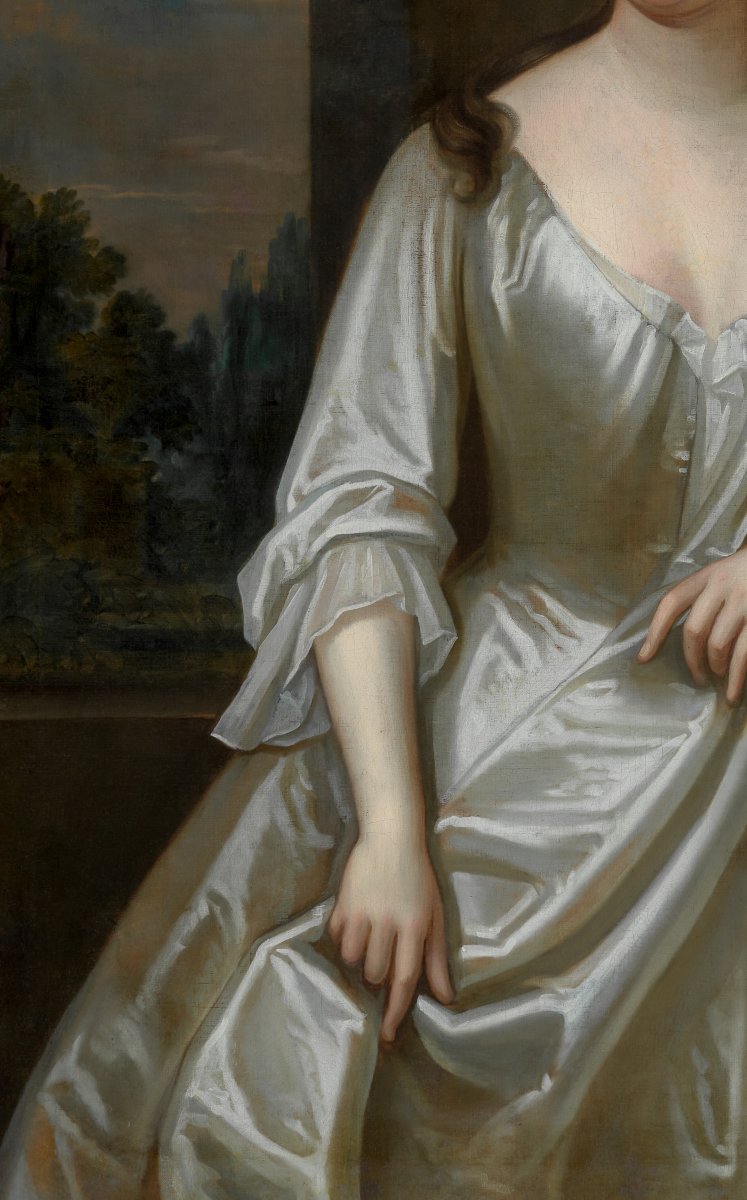
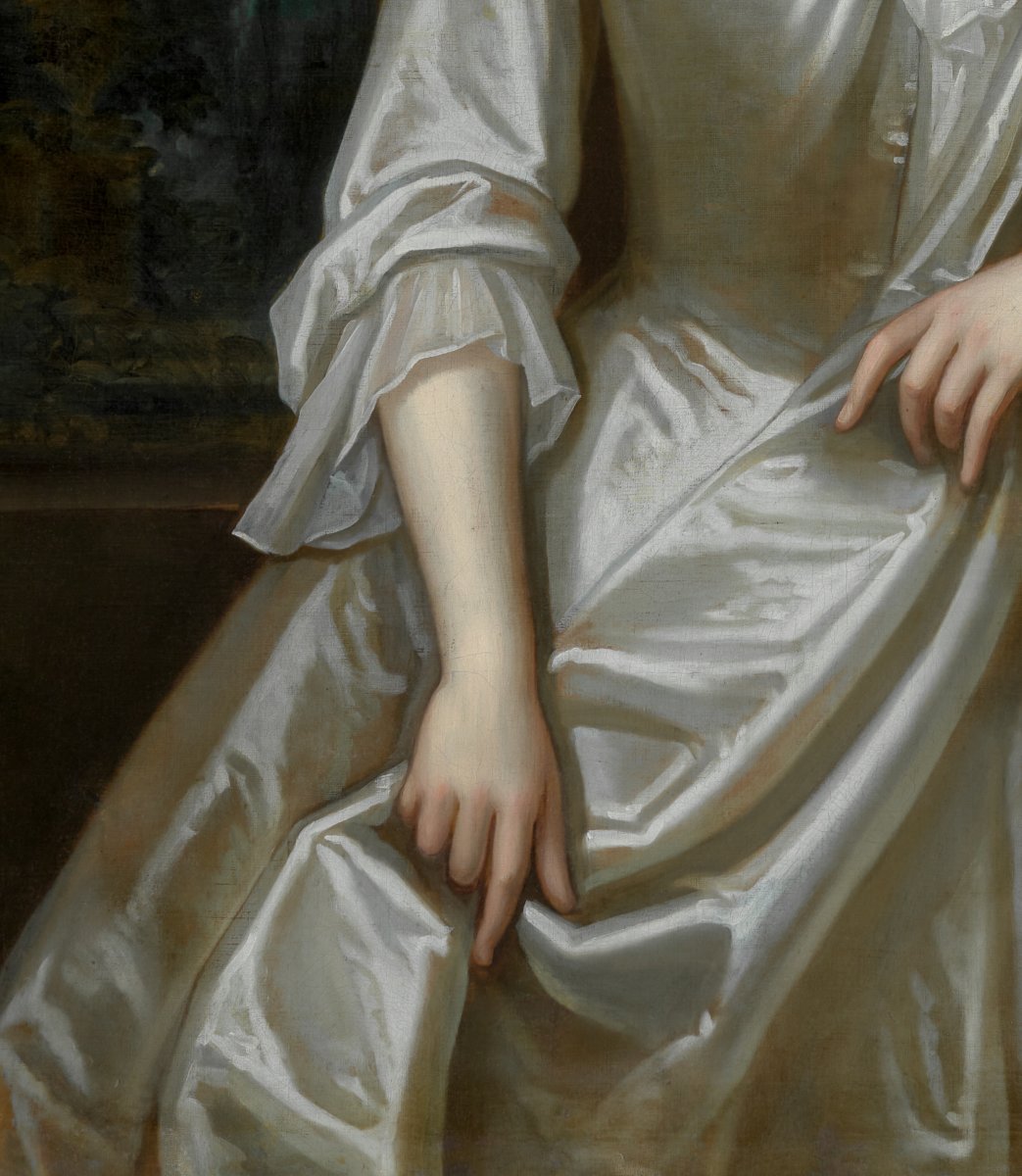
Lady Elizabeth est assise près d'une table au plateau de marbre ; son bras gauche repose avec une aisance étudiée sur le bord du meuble, tandis que son autre main rassemble les plis soyeux de sa robe. À gauche, une ouverture architecturale donne sur des arbres et un ciel bleu, allégeant l'intérieur sombre et conférant au tableau l'ampleur caractéristique du portrait d'apparat. Les bijoux sont manifestement absents : le rang social s'exprime ici par la richesse des étoffes, l'élégance du geste, le cadre architectural et l'attitude assurée mais empreinte de retenue du modèle.
Le costume et la coiffure situent l'œuvre de manière convaincante dans la première décennie du XVIIIe siècle, très probablement entre 1705 et 1710. L'encolure arrondie et basse, la chemise blanche apparente, les manches amples et les poignets délicatement volantés correspondent à la mode des portraits féminins sous le règne de la reine Anne ; quant à la coiffure, elle est relativement proche de la tête, avec une longue boucle retombant sur une épaule, s'éloignant ainsi des coiffures très hautes en vogue dans les années 1690. Née le 20 juin 1678, Elizabeth avait donc entre vingt-sept et trente-deux ans environ, ce qui correspond à l'âge de la femme représentée ici. L'inscription généalogique est nécessairement postérieure à la séance de pose, puisqu'elle désigne son père sous le titre de « comte Ferrers », dignité que Robert Shirley ne reçut qu'en 1711. Elle fut manifestement ajoutée pour préserver son identité et sa lignée à l'intention des générations futures.
Elizabeth était la fille de Robert Shirley (1650-1717), chef de l'ancienne famille Shirley, et de sa première épouse, Elizabeth Washington, originaire de Garsdon dans le Wiltshire. Robert devint baron Ferrers de Chartley et fut élevé au rang de premier comte Ferrers en 1711 ; de son premier mariage naquit une famille exceptionnellement nombreuse de dix-sept enfants, parmi lesquels Washington Shirley, qui lui succéda en tant que deuxième comte Ferrers. Elizabeth grandit ainsi au sein d'un réseau de demeures, de titres et d'alliances familiales où le portrait ne servait pas seulement de décoration, mais de témoignage visuel de la lignée.
Les origines maternelles du modèle lui confèrent un lien avec l'Amérique particulièrement intéressant. Elizabeth Washington de Garsdon était la petite-fille de Sir Lawrence Washington, dont la branche descendait des Washington de Sulgrave. George Washington, futur premier président des États-Unis, descendait quant à lui d'une autre branche de cette même famille élargie de Sulgrave. Garsdon n'était donc pas la demeure ancestrale directe de George Washington, comme on l'a parfois prétendu par la suite, mais les deux branches partageaient la même origine familiale anglaise. Lady Elizabeth appartenait à la lignée collatérale des Washington dont descendait également le président américain.
Elle épousa plus tard Walter Clarges, fils cadet de Sir Walter Clarges, premier baronnet. Walter mourut à Ludgershall, dans le Wiltshire, en janvier 1723, à l'âge de vingt-six ans seulement ; les principaux arbres généalogiques consultés n'indiquent aucune descendance issue de ce mariage. Elizabeth lui survécut dix-sept ans et s'éteignit à Londres le 7 mars 1740. Une trace particulièrement personnelle de son existence subsiste à la cathédrale de Winchester, où le registre des inhumations la désigne sous le nom de « Lady Betty Shirley ». Une description ancienne des monuments de la cathédrale mentionne sa dalle funéraire brisée, ornée des armoiries des Shirley profondément gravées, et note qu'elle semble avoir été la dernière personne inhumée dans cette partie de l'édifice. Le parcours de la jeune femme à l'allure distinguée représentée ici peut ainsi être retracé, depuis l'univers des demeures de campagne des Shirley jusqu'à un monument commémoratif encore visible dans l'une des plus grandes églises médiévales d'Angleterre.
The portrait was probably not commissioned to commemorate her marriage, which appears to have taken place considerably later, but rather as a dynastic image of an adult daughter of the Shirley house. Its likely date places it in the reign of Queen Anne, amid the War of the Spanish Succession and the political transformation of the 1707 Union of England and Scotland. Portraiture was one of the principal visual expressions of status in this society, and affluent families commissioned imposing likenesses not only to record individuals but to populate the portrait galleries of their houses with successive generations.
The picture is most appropriately placed within the Circle of Sir Godfrey Kneller. Kneller, born at Lübeck in 1646 and trained in Amsterdam under Ferdinand Bol, settled in England in 1674 and became the dominant portrait painter of the later Stuart and early Georgian court. Appointed sole Principal Painter in 1691 and knighted the following year, he developed a highly organised practice capable of meeting extraordinary aristocratic demand. The National Portrait Gallery notes that Kneller commonly painted the faces himself while studio assistants participated in the costume and backgrounds, helping to disseminate a recognisable Knellerian language throughout London portraiture.
The present painting belongs closely to that language. Its scale and format, broad architectural setting, sweeping red drapery, luminous satin and controlled pose find close parallels in Kneller and his immediate orbit. The designation “Circle of Sir Godfrey Kneller” therefore acknowledges a painter working closely within his artistic milieu without overstating the evidence. The picture has nevertheless attracted other names: at Christie’s in 1976 it was sold as Michael Dahl.
Its family provenance is particularly persuasive. The painted inscription corresponds strikingly in its wording, placement, lettering and pale-gold colour to the inscription on a portrait of Elizabeth’s sister, Lady Catherine Shirley, photographed by the Paul Mellon Centre in 1973 while still in the collection of Earl Ferrers at Hedenham Hall, Norfolk. A portrait of their brother Washington Shirley carries another related lower-right inscription. These surviving examples strongly suggest a systematic Ferrers-family programme of identifying ancestral portraits and make it highly probable that Elizabeth’s portrait was within the same dynastic collection when its inscription was applied.
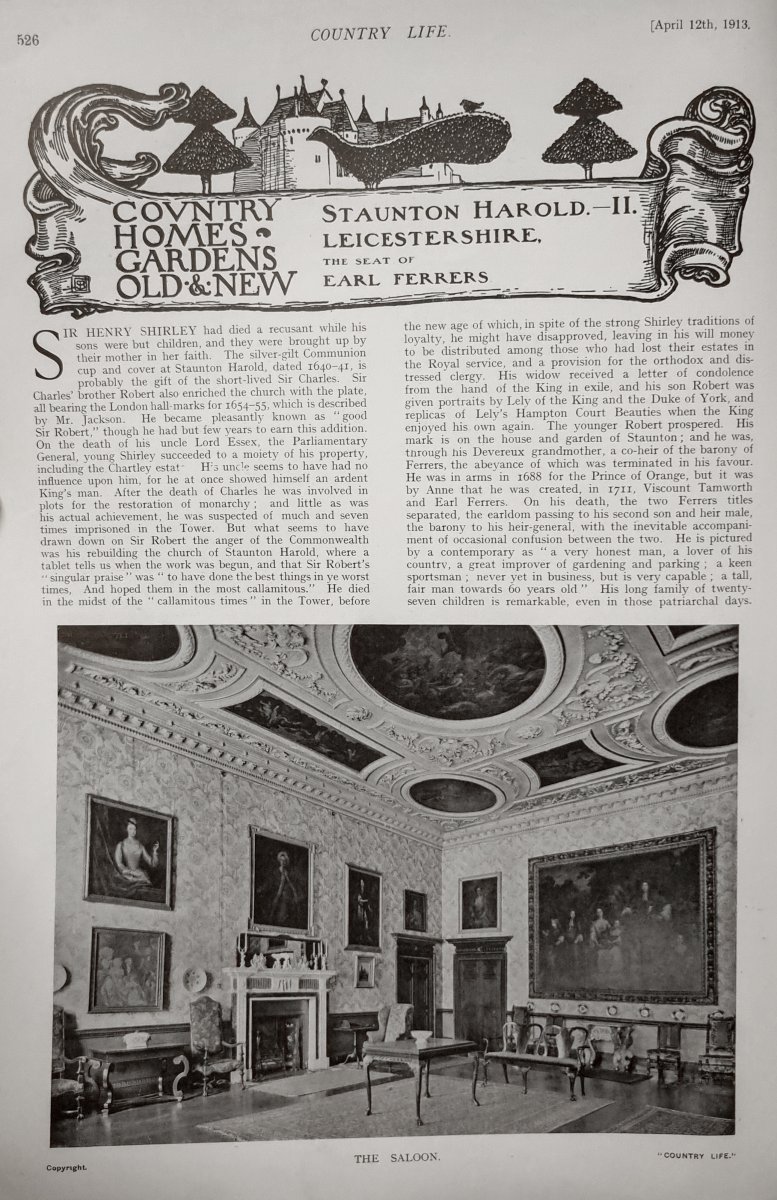
Further evidence appears in the rare catalogue of the Shirley pictures sold at Staunton Hall on 17–18 June 1834. In the Great Drawing Room were a portrait described as “Lady Elizabeth Shirley”, lot 50, and another as “the Daughter of Robert, first Earl Ferrers”, lot 69, both then attributed to Jan van der Vaart; two additional portraits called Lady Elizabeth Shirley were listed elsewhere in the house. As no dimensions were supplied it is impossible to identify the present canvas conclusively with any one of these entries, although the scale, subject and family inscription make the comparison significant. The catalogue itself remarks that many of the early Shirley family portraits were considered to be by Van der Vaart. Significantly, appearing in that sale did not necessarily mean leaving the family permanently: the great Van der Vaart group portrait of Robert Shirley and his family, also listed in 1834, was photographed still hanging at Staunton Harold in both 1913 and 1950.
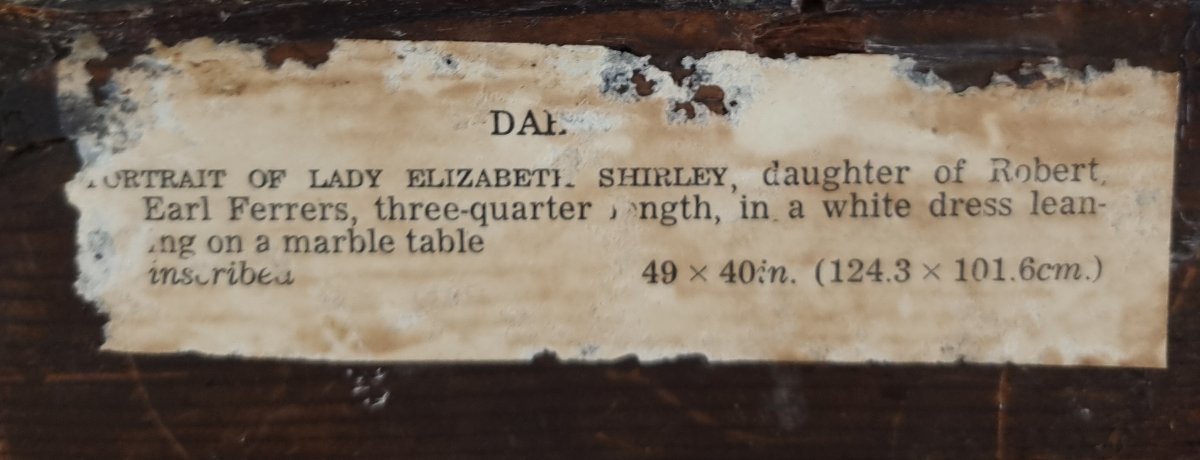
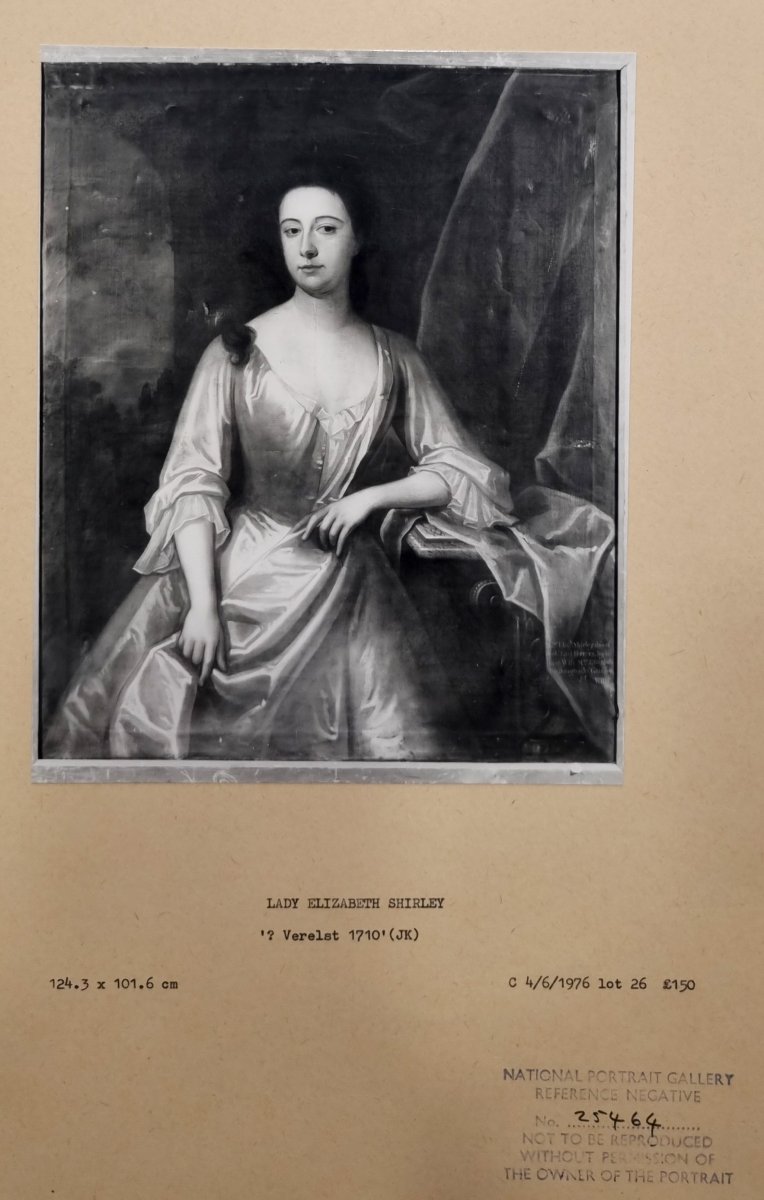
By 4 June 1976 the present portrait was unquestionably at Christie’s, London, appearing as lot 26 in the “Old Master Pictures” sale, attributed to Dahl and described precisely as “Portrait of Lady Elizabeth Shirley, daughter of Robert, Earl Ferrers, three-quarter length, in a white dress leaning on a marble table”, 49 by 40 inches. The Christie’s catalogue cutting remains affixed to the reverse and the stretcher retains the corresponding chalk number “26”, providing unusually tangible physical confirmation of this chapter in the painting’s history.
The portrait is far more than an attractive decorative Old Master: it combines monumental presence, excellent condition, a firmly identified sitter, an unusually rich family story, probable Ferrers collection history, documented Christie’s provenance and the intriguing collateral Washington connection to the family of the first President of the United States. In a market crowded with anonymous “Portraits of a Lady”, this is a picture whose sitter, family, social world and collecting history can be recovered with unusual depth—a portrait that offers both visual impact and a genuinely personal connection with British and transatlantic history.
Provenance
• Probably the Shirley family, Earls Ferrers, Staunton Harold, Leicestershire;
• Possibly Staunton Hall, sale by Mr Cheatle, 17–18 June 1834, lot 50, “Lady Elizabeth Shirley”, or lot 69, “the Daughter of Robert, first Earl Ferrers”, both as Van der Vaart; alternatively one of the portraits of Lady Elizabeth Shirley offered as lots 120 or 122;
• Christie’s, London, “Old Master Pictures”, 4 June 1976, lot 26, as Michael Dahl;
• Private collection
Measurements: Height 145cm, Width 121cm framed (Height 57”, Width 47.5” framed)
Par sa mère, Elizabeth Washington, le modèle partageait les mêmes origines familiales anglaises que George Washington, futur premier président des États-Unis.
Lady Elizabeth est assise près d'une table au plateau de marbre ; son bras gauche repose avec une aisance étudiée sur le bord du meuble, tandis que son autre main rassemble les plis soyeux de sa robe. À gauche, une ouverture architecturale donne sur des arbres et un ciel bleu, allégeant l'intérieur sombre et conférant au tableau l'ampleur caractéristique du portrait d'apparat. Les bijoux sont manifestement absents : le rang social s'exprime ici par la richesse des étoffes, l'élégance du geste, le cadre architectural et l'attitude assurée mais empreinte de retenue du modèle.
Le costume et la coiffure situent l'œuvre de manière convaincante dans la première décennie du XVIIIe siècle, très probablement entre 1705 et 1710. L'encolure arrondie et basse, la chemise blanche apparente, les manches amples et les poignets délicatement volantés correspondent à la mode des portraits féminins sous le règne de la reine Anne ; quant à la coiffure, elle est relativement proche de la tête, avec une longue boucle retombant sur une épaule, s'éloignant ainsi des coiffures très hautes en vogue dans les années 1690. Née le 20 juin 1678, Elizabeth avait donc entre vingt-sept et trente-deux ans environ, ce qui correspond à l'âge de la femme représentée ici. L'inscription généalogique est nécessairement postérieure à la séance de pose, puisqu'elle désigne son père sous le titre de « comte Ferrers », dignité que Robert Shirley ne reçut qu'en 1711. Elle fut manifestement ajoutée pour préserver son identité et sa lignée à l'intention des générations futures.
Elizabeth était la fille de Robert Shirley (1650-1717), chef de l'ancienne famille Shirley, et de sa première épouse, Elizabeth Washington, originaire de Garsdon dans le Wiltshire. Robert devint baron Ferrers de Chartley et fut élevé au rang de premier comte Ferrers en 1711 ; de son premier mariage naquit une famille exceptionnellement nombreuse de dix-sept enfants, parmi lesquels Washington Shirley, qui lui succéda en tant que deuxième comte Ferrers. Elizabeth grandit ainsi au sein d'un réseau de demeures, de titres et d'alliances familiales où le portrait ne servait pas seulement de décoration, mais de témoignage visuel de la lignée.
Les origines maternelles du modèle lui confèrent un lien avec l'Amérique particulièrement intéressant. Elizabeth Washington de Garsdon était la petite-fille de Sir Lawrence Washington, dont la branche descendait des Washington de Sulgrave. George Washington, futur premier président des États-Unis, descendait quant à lui d'une autre branche de cette même famille élargie de Sulgrave. Garsdon n'était donc pas la demeure ancestrale directe de George Washington, comme on l'a parfois prétendu par la suite, mais les deux branches partageaient la même origine familiale anglaise. Lady Elizabeth appartenait à la lignée collatérale des Washington dont descendait également le président américain.
Elle épousa plus tard Walter Clarges, fils cadet de Sir Walter Clarges, premier baronnet. Walter mourut à Ludgershall, dans le Wiltshire, en janvier 1723, à l'âge de vingt-six ans seulement ; les principaux arbres généalogiques consultés n'indiquent aucune descendance issue de ce mariage. Elizabeth lui survécut dix-sept ans et s'éteignit à Londres le 7 mars 1740. Une trace particulièrement personnelle de son existence subsiste à la cathédrale de Winchester, où le registre des inhumations la désigne sous le nom de « Lady Betty Shirley ». Une description ancienne des monuments de la cathédrale mentionne sa dalle funéraire brisée, ornée des armoiries des Shirley profondément gravées, et note qu'elle semble avoir été la dernière personne inhumée dans cette partie de l'édifice. Le parcours de la jeune femme à l'allure distinguée représentée ici peut ainsi être retracé, depuis l'univers des demeures de campagne des Shirley jusqu'à un monument commémoratif encore visible dans l'une des plus grandes églises médiévales d'Angleterre.
The portrait was probably not commissioned to commemorate her marriage, which appears to have taken place considerably later, but rather as a dynastic image of an adult daughter of the Shirley house. Its likely date places it in the reign of Queen Anne, amid the War of the Spanish Succession and the political transformation of the 1707 Union of England and Scotland. Portraiture was one of the principal visual expressions of status in this society, and affluent families commissioned imposing likenesses not only to record individuals but to populate the portrait galleries of their houses with successive generations.
The picture is most appropriately placed within the Circle of Sir Godfrey Kneller. Kneller, born at Lübeck in 1646 and trained in Amsterdam under Ferdinand Bol, settled in England in 1674 and became the dominant portrait painter of the later Stuart and early Georgian court. Appointed sole Principal Painter in 1691 and knighted the following year, he developed a highly organised practice capable of meeting extraordinary aristocratic demand. The National Portrait Gallery notes that Kneller commonly painted the faces himself while studio assistants participated in the costume and backgrounds, helping to disseminate a recognisable Knellerian language throughout London portraiture.
The present painting belongs closely to that language. Its scale and format, broad architectural setting, sweeping red drapery, luminous satin and controlled pose find close parallels in Kneller and his immediate orbit. The designation “Circle of Sir Godfrey Kneller” therefore acknowledges a painter working closely within his artistic milieu without overstating the evidence. The picture has nevertheless attracted other names: at Christie’s in 1976 it was sold as Michael Dahl.
Its family provenance is particularly persuasive. The painted inscription corresponds strikingly in its wording, placement, lettering and pale-gold colour to the inscription on a portrait of Elizabeth’s sister, Lady Catherine Shirley, photographed by the Paul Mellon Centre in 1973 while still in the collection of Earl Ferrers at Hedenham Hall, Norfolk. A portrait of their brother Washington Shirley carries another related lower-right inscription. These surviving examples strongly suggest a systematic Ferrers-family programme of identifying ancestral portraits and make it highly probable that Elizabeth’s portrait was within the same dynastic collection when its inscription was applied.
Further evidence appears in the rare catalogue of the Shirley pictures sold at Staunton Hall on 17–18 June 1834. In the Great Drawing Room were a portrait described as “Lady Elizabeth Shirley”, lot 50, and another as “the Daughter of Robert, first Earl Ferrers”, lot 69, both then attributed to Jan van der Vaart; two additional portraits called Lady Elizabeth Shirley were listed elsewhere in the house. As no dimensions were supplied it is impossible to identify the present canvas conclusively with any one of these entries, although the scale, subject and family inscription make the comparison significant. The catalogue itself remarks that many of the early Shirley family portraits were considered to be by Van der Vaart. Significantly, appearing in that sale did not necessarily mean leaving the family permanently: the great Van der Vaart group portrait of Robert Shirley and his family, also listed in 1834, was photographed still hanging at Staunton Harold in both 1913 and 1950.
By 4 June 1976 the present portrait was unquestionably at Christie’s, London, appearing as lot 26 in the “Old Master Pictures” sale, attributed to Dahl and described precisely as “Portrait of Lady Elizabeth Shirley, daughter of Robert, Earl Ferrers, three-quarter length, in a white dress leaning on a marble table”, 49 by 40 inches. The Christie’s catalogue cutting remains affixed to the reverse and the stretcher retains the corresponding chalk number “26”, providing unusually tangible physical confirmation of this chapter in the painting’s history.
The portrait is far more than an attractive decorative Old Master: it combines monumental presence, excellent condition, a firmly identified sitter, an unusually rich family story, probable Ferrers collection history, documented Christie’s provenance and the intriguing collateral Washington connection to the family of the first President of the United States. In a market crowded with anonymous “Portraits of a Lady”, this is a picture whose sitter, family, social world and collecting history can be recovered with unusual depth—a portrait that offers both visual impact and a genuinely personal connection with British and transatlantic history.
Provenance
• Probably the Shirley family, Earls Ferrers, Staunton Harold, Leicestershire;
• Possibly Staunton Hall, sale by Mr Cheatle, 17–18 June 1834, lot 50, “Lady Elizabeth Shirley”, or lot 69, “the Daughter of Robert, first Earl Ferrers”, both as Van der Vaart; alternatively one of the portraits of Lady Elizabeth Shirley offered as lots 120 or 122;
• Christie’s, London, “Old Master Pictures”, 4 June 1976, lot 26, as Michael Dahl;
• Private collection
Measurements: Height 145cm, Width 121cm framed (Height 57”, Width 47.5” framed)
10 150 €
Epoque : 18ème siècle
Style : Louis XV - Transition
Etat : Très bon état
Matière : Huile sur toile
Largeur : 121
Hauteur : 145
Profondeur : 9
Référence (ID) : 1823561
Disponibilité : En stock
Imprimer fiche