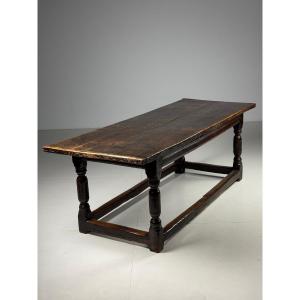
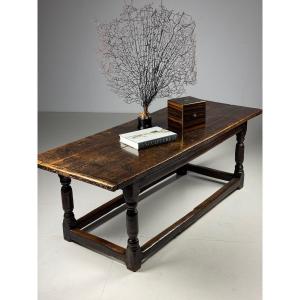
17th-century refectory table. Quite original! Made of solid oak. One of the long sides is adorned with beautiful leaf carvings on the ruler. The other side is plain and undecorated. Magnificent as a s[...]
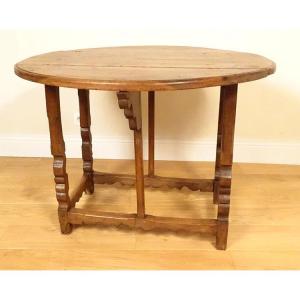
Early Spanish rustic table in carved walnut, known as a "winged" table because it folds thanks to its two drop leaves. The carved, undulating, and crenellated legs have two additional supports for the[...]
17th-century refectory table. Quite original! Made of solid oak. One of the long sides features beautiful leaf carvings on the ruler. The other side is plain and undecorated. Magnificent as a side tab[...]
Mahogany dining table with a straight folding leg, 17th century. The four legs, joined by straight frames and attached to the top by frames, have no notable decorative elements, but they do have a ser[...]
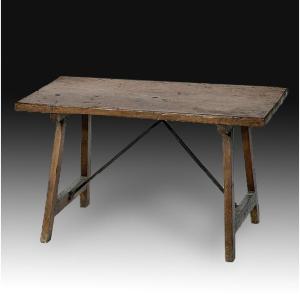
Table with San Antonio legs. Walnut wood, wrought iron. Spain, 17th century. Rectangular tabletop with San Antonio legs (inclined towards the front of the piece and joined by a straight frame), which [...]
Tuscan refectory table in solid walnut belonging to the second half of the 17th century.
The rectangular-shaped solid walnut top has a geometric pattern inlay along the entire perimeter of the top.[...]
Table called "get legs" in walnut from the late 17th or early 18th century Henri II model base Probably Franco/English work 2 flaps that fold down to fold it over in walnut with light wood fillets 1 f[...]
Proantic uses a cookie to analyze traffic and improve its service by using Google Analytics. Data sent to Google Analytics (frequency of visits to the site and pages visited) are anonymous. No other cookie tracks your activity, your personal data is not collected. Thank you for helping us to have better understanding how Proantic is used.













 Le Magazine de PROANTIC
 TRÉSORS Magazine
 Rivista Artiquariato