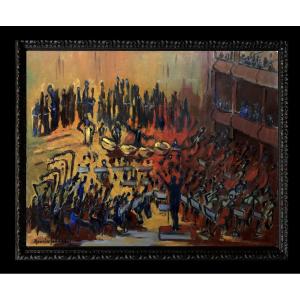
Rolf Kissel (1929–2024) Group Zero, Constructivism, Düsseldorf, Germany, 1961
Artist: Rolf Kissel
Rolf KISSEL (1929–2024)
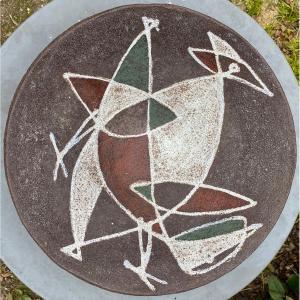
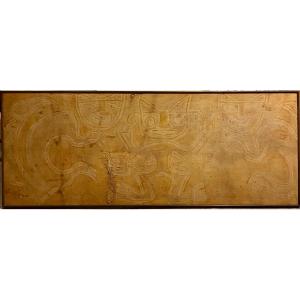
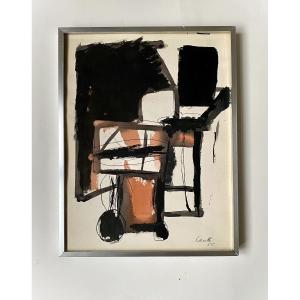
Mixed media on wood panel. Signed on the back and titled 12-B-V 61.
Dimensions: 46 x 35.3 x 5 cm.
Biography :
Kissel studied at the Städelschule in Frankfurt am Main from 1956 to 1961 and became a student of Albert Burkart. In 1961, Kissel held his first solo exhibition at what was then the avant-garde Zimmergalerie Franck in Frankfurt am Main. In 1966, he received—along with Benno Walldorf and Thomas Bayrle—the Young Art in Hesse Prize from the Marielies Hess Foundation in Frankfurt. He was a member of the Association of German Artists and, since 1983, of the Darmstadt Secession. In 2015, he received the Goethe Medal from the Hessian Ministry of Science and the Arts.
Kissel passed away on June 25, 2024.
Kissel focused his artistic practice on object art and structural painting; he created white-light reliefs, aluminum reliefs—including sculptural wall installations in architecture—as well as watercolors, gouaches, prints, and relief drawings.
Kissel considers himself a constructivist and a light artist. His early works moved away from the colorful painting of “Informal Art” and the gestural figuration of the 1960s. His luminous reliefs—aluminum slats on an aluminum background or white wooden slats on a white background—play with the shifting effects of light and shadow, thereby creating a varied visual experience. “White is not achieved by reducing color; rather, white is present from the very beginning as the sum of complementary colors and as a reflection of light.” In the 1980s, Kissel became involved in new social movements (the peace movement, the anti-nuclear movement) and in the conflicts surrounding Frankfurt’s Börneplatz. He created posters, collage drawings, and drawing-based objects.
In 1994–95, his investigations into the historic sites of Weimar and Buchenwald led Rolf Kissel to create a series of drawing-collages titled *Letters from Weimar, Protocol of a Research Project, in which he used official documents and letters, notably the correspondence of the victims. Relatives request the ashes of their deceased loved ones and receive bureaucratic replies; stamps from the National Socialist era, maps, and fragments of Goethe’s conversations with Eckermann are gathered and allowed to fade into black. The attempt to capture the interactions between terror and classical humanity is grounded in the awareness of “the failure of images and the impossibility of renouncing images.”
The series was exhibited in 1995, organized by Klaus Scheunemann, in the Goldhalle of Hessischer Rundfunk in Frankfurt am Main, at NDR in Hanover, and in 1996 by the Weimarer Klassik Foundation at the City Palace in Weimar. It is on permanent loan to the Goethe Museum in Weimar.
ZERO Group
ZERO was a Düsseldorf-based artists’ group founded on April 24, 1958, by Heinz Mack and Otto Piene. Günther Uecker joined the group in 1961. Mack and Piene viewed postwar art as “burdened by excessive baggage.” The artists sought a fresh start, a “zero hour” free from the past. They wanted to counter the forced drama of World War II and its horrors with a purer, healthier world by embracing a hopeful and idealistic vision of life as an alternative to the old artistic values they saw represented in Informel and Tachism. of the postwar period.
ZERO referred to a phase of silence and stillness, an intermediate zone in which an old state transitions into a new one. With their luminous kinetic objects, which penetrate and encompass space through their light and movement, the members created a new purist aesthetic that appears to lie somewhere between painting and sculpture. The group disbanded in 1966 after its members’ artistic and personal paths diverged.
700 €
Period: 20th century
Style: Design 50's and 60's
Condition: Perfect condition
Material: Oil painting on wood
Width: 35,3
Height: 46
Depth: 5
Reference (ID): 1862851
Availability: In stock
Print