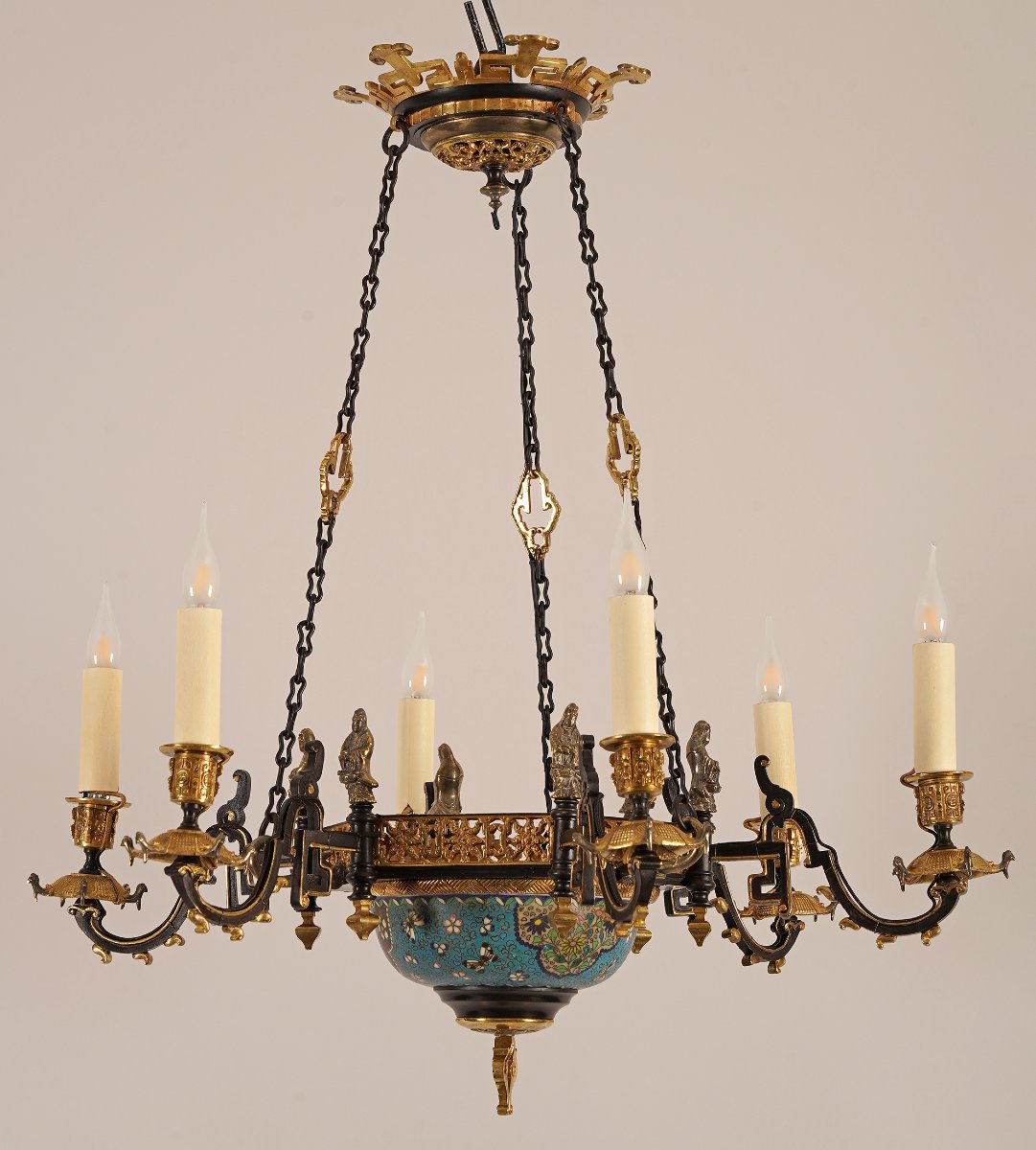
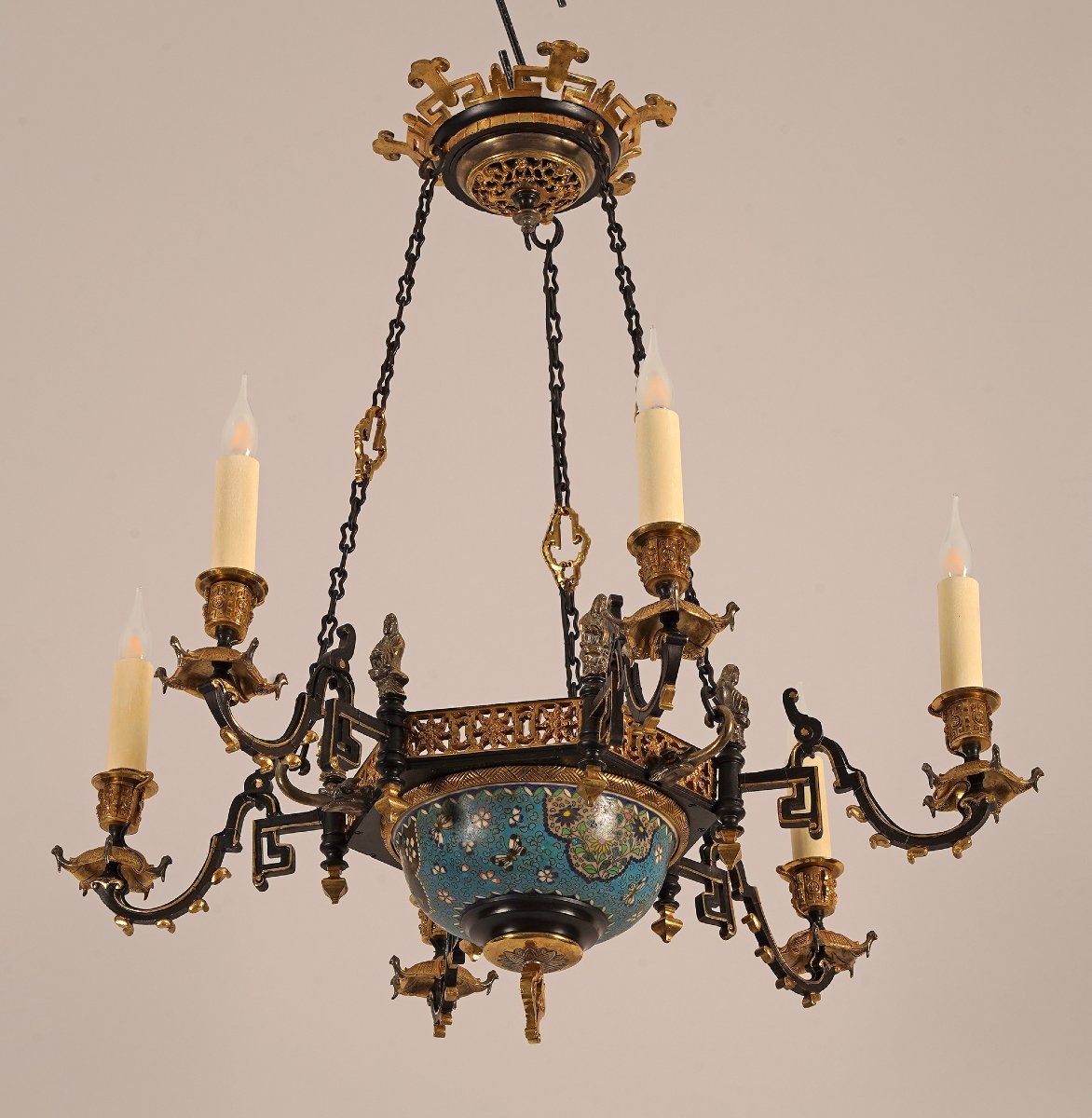
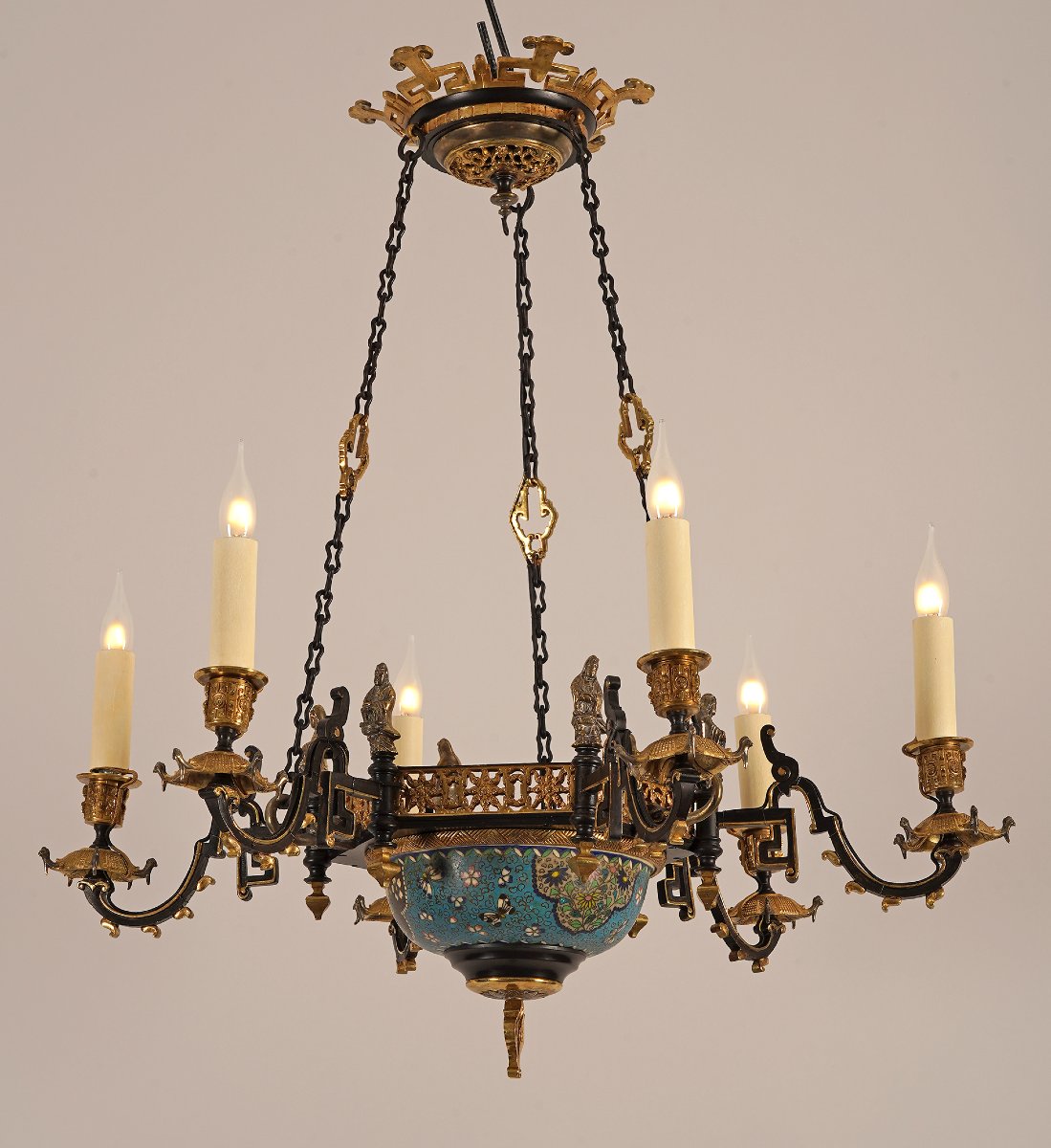


Japanese-style Chandelier In Gilded Bronze And Porcelain, France, Circa 1860
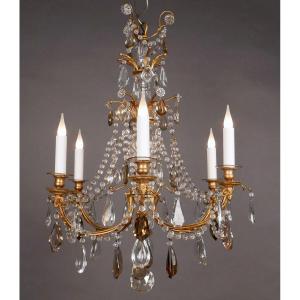
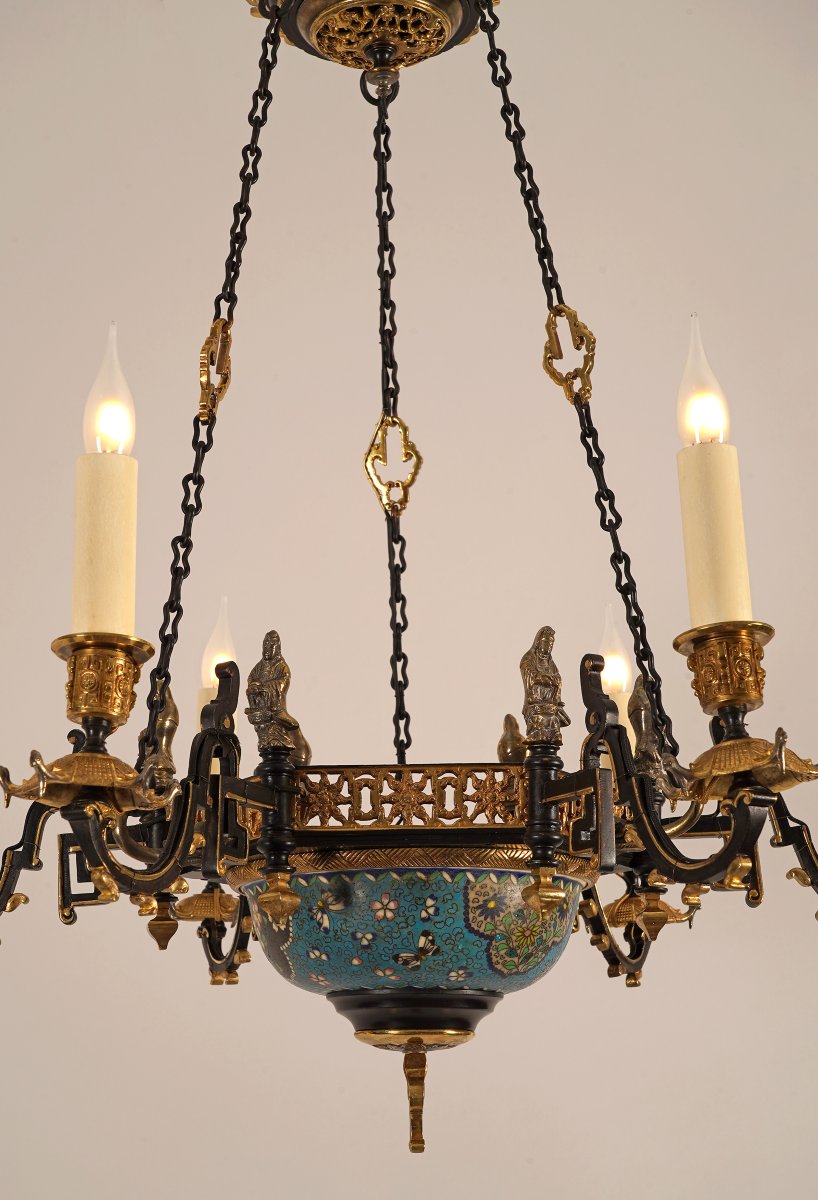
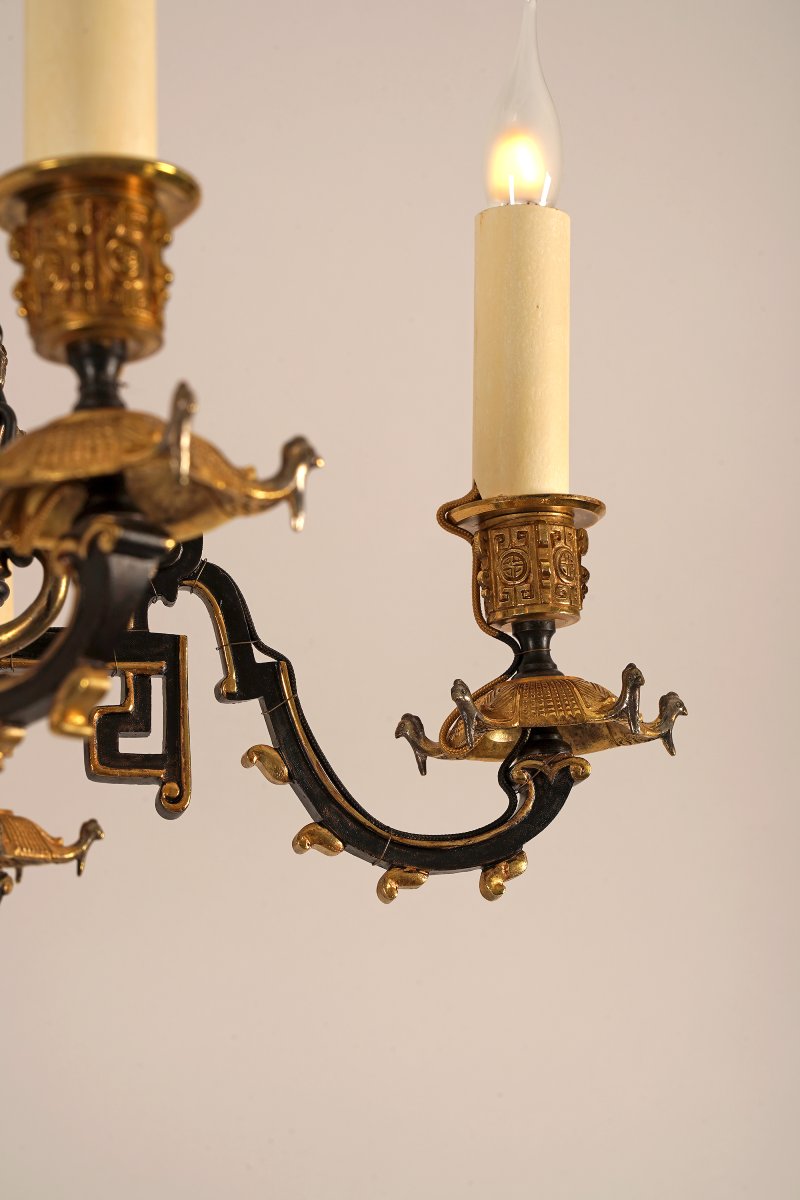
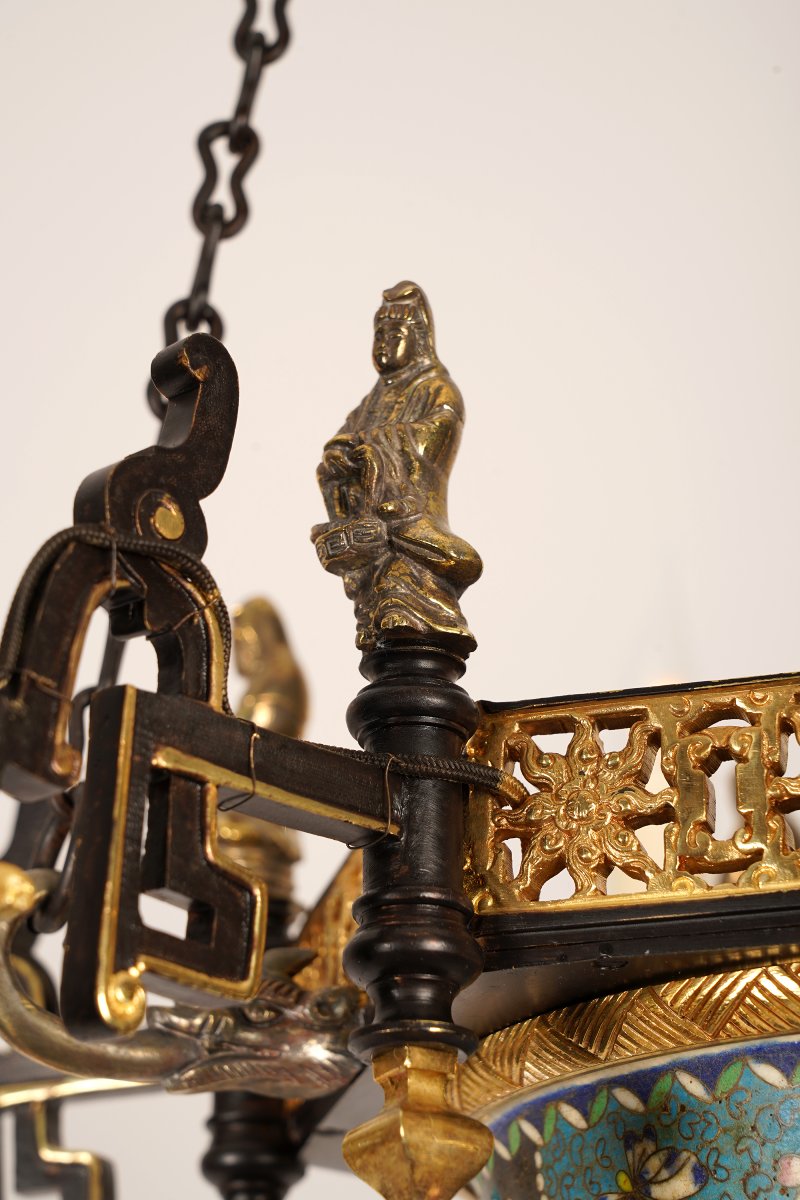
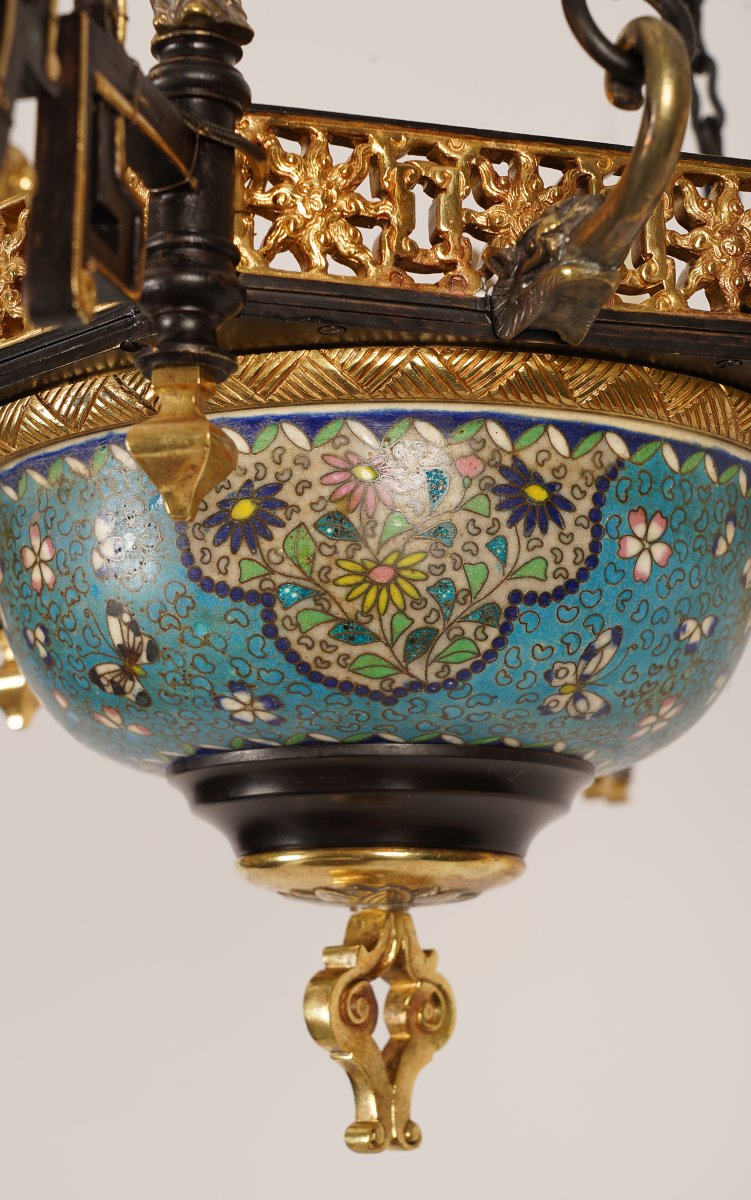
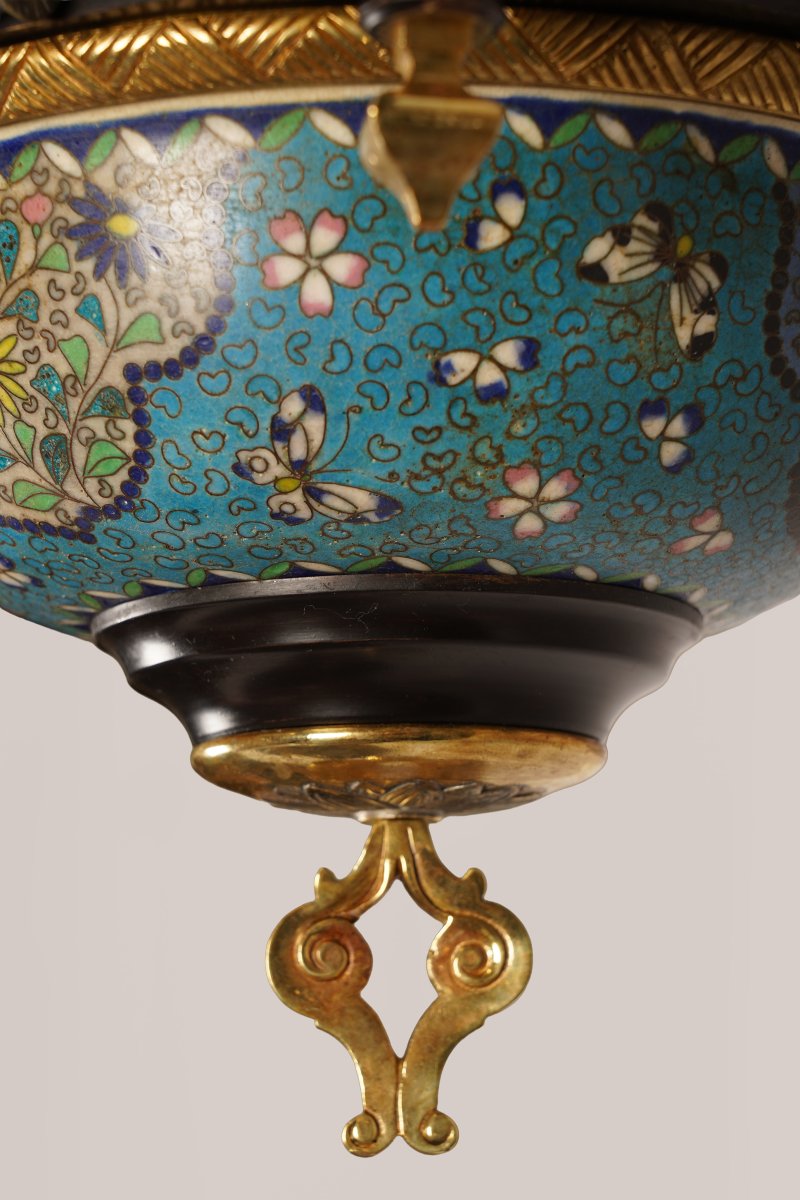
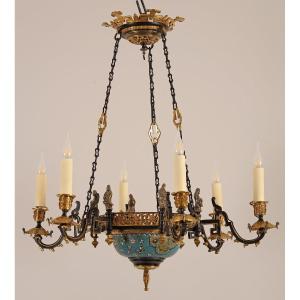
Chandelierwith four curved arms in black-patina bronze, partially gilded and silvered,attached to an openwork crown featuring finely chiseled stylized solar motifs, in thestyle of a balustrade. At the end of each arm is a facetedcurved element imitating the roof of a pagoda. In the center, a porcelain bowlimitating Chinese cloisonné enamel: motifs of flowers andbutterflies, outlined by brown fillets, stand out against aturquoise-blue background. The base of each arm is surmounted by a smallsilver figurine in the round carrying a basket, inspired by Buddhist statuary. The entire piece is suspended by three
chains and culminates in a finial featuring an openwork motif in gilded and
patinated bronze.
In1860, during the Second Opium War, Franco-British troopsransacked the former Summer Palace of the Chinese emperors (Yuánmíng Yuán). Manylooted objects from this building were brought back to Europe and sold atauction in the brand-new Hôtel Drouot (founded in 1852) in Paris and atChristie’s in London. Some became part of the imperial collections, thusthus giving rise to Empress Eugénie’s Chinese Museum. AlthoughChina and Western Europe had maintained commercial andartistic ties dating back to the 16th century—ties that were strengthened by the founding of theEast India Companies in the 17th and 18th centuries—Chinese export production for the European market had, until then,consisted primarily of lacquerware and porcelain. The mass arrival ofvases, lidded pots, and other metal objects covered with cloisonné enamelgave new impetus to the “Chinoiserie” trend. Nineteenth-century artists,however, did not seek to produce copies ofthese objects but instead offered composite reinterpretations blendingreferences to Chinese and Japanese art, in keeping with the eclectic taste of theirtime.
Bibliography
SAMOYAULT-VERLETColombe, DESROCHES Jean-Paul, BEGUIN Gilles (et al.), The Chinese Museum ofEmpress Eugénie, Fontainebleau, National Museum of the Château deFontainebleau, 1994.
QUETTEBéatrice (ed.), Cloisonné, Chinese Enamels from the Yuan, Ming, and QingDynasties, exhibition catalog. New York, Bard Graduate Center, 2011; New Haven, YaleUniversity Press, 2011.
11 500 €
Period: 19th century
Style: Napoleon 3rd
Condition: Good condition
Diameter: 66
Height: 71
Reference (ID): 1844444
Availability: In stock
Print