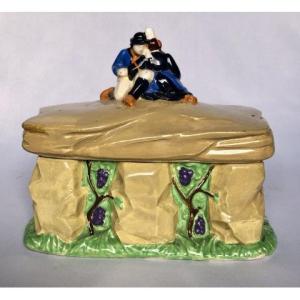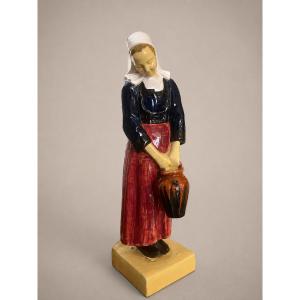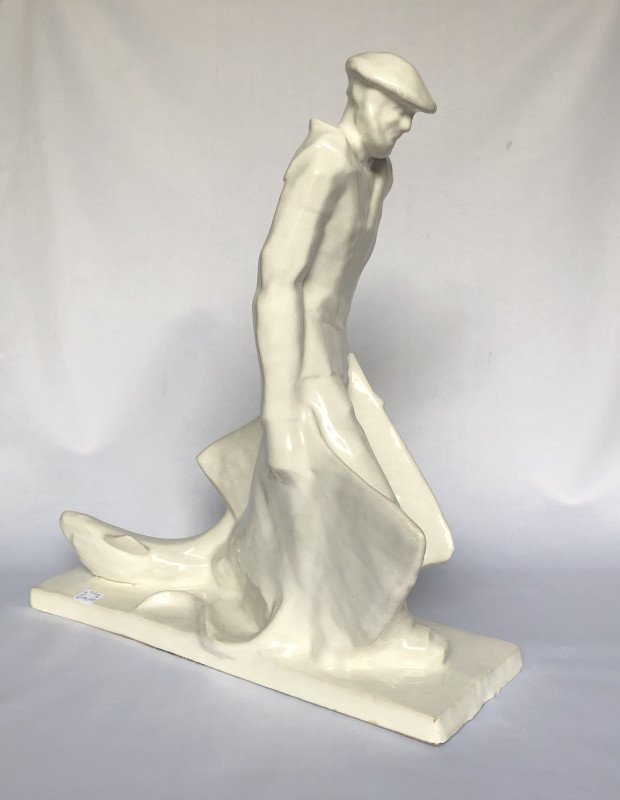
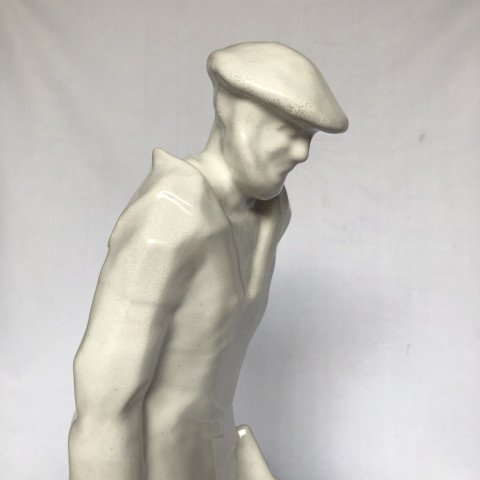

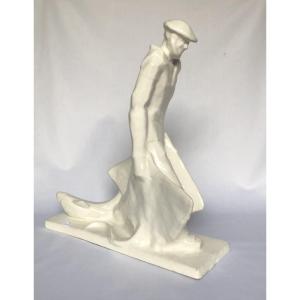


"the Man With The Stripes" By Mathurin Méheut—henriot Manufactory—brittany
Rare white earthenware, circa 1930.
Henriot Manufactory.
This piece was created for Mathurin Méheut’s solo exhibition “Mer et Forêt” (“Sea and Forest”), held at the Galerie Charpentier in Paris in December 1928. This exhibition featured a mix of paintings and sculptures.
Among these works was “L’homme aux raies.”
Mathurin Méheut (1882 – 1958):
Mathurin Méheut is an artist who needs no introduction in Brittany, such is his renown there. And this is only fitting, given the love he had for this land. In 2013, he was honored by the Musée de la Marine in Paris, which paid him a heartfelt tribute during an exhibition tracing his entire body of work as a painter, watercolorist, sculptor, and ceramicist... The exhibition was extended due to its overwhelming success.
The son of a craftsman from Lamballe, Méheut showed artistic talent from an early age and, at the age of twenty, graduated with honors from the École des Beaux-Arts in Rennes. He then enrolled at the École nationale des Arts Décoratifs in Paris and took classes with Eugène Grasset at the École Normale d’Enseignement du Dessin. Very soon, he began working as a decorative painter for the prestigious magazine *Art et Décoration*. He then went to the marine biology station in Roscoff to illustrate *Étude de la mer, flore et faune de la Manche et de l’Océan*. This book, published in 1913, brought him widespread recognition.
He left for Japan in 1914 on the “Around the World” fellowship funded by the Albert Kahn Foundation. In Japan, he found confirmation of his iconographic choices, such as depicting the essential with minimal means. His stay was cut short by general mobilization. As a painter serving on the front lines in Artois and the Argonne, he sketched the daily lives of his fellow soldiers. With pencil or brush always in hand, he brought back a wealth of documentation from this period.
Demobilized in 1919, he retreated to the Bigouden region to try to recharge. For two years, he prepared his second solo exhibition at the Musée des Arts Décoratifs in Paris. He had been thinking about it since his return from Japan. This exhibition was intended to match the success of his previous one in 1913. The works on display reflected his earlier styles as well as new directions—both in terms of their graphic style and subject matter—that foreshadowed the Méheut of the 1930s and 1940s. It is in the second section of the exhibition, dedicated to his native land, that Méheut would bring his art to its fullest expression, establishing himself as the painter of Brittany.
Period: 20th century
Style: Art Deco
Condition: Excellent condition
Material: Earthenware
Width: 37 cm
Height: 43 cm
Reference (ID): 1836275
Availability: In stock