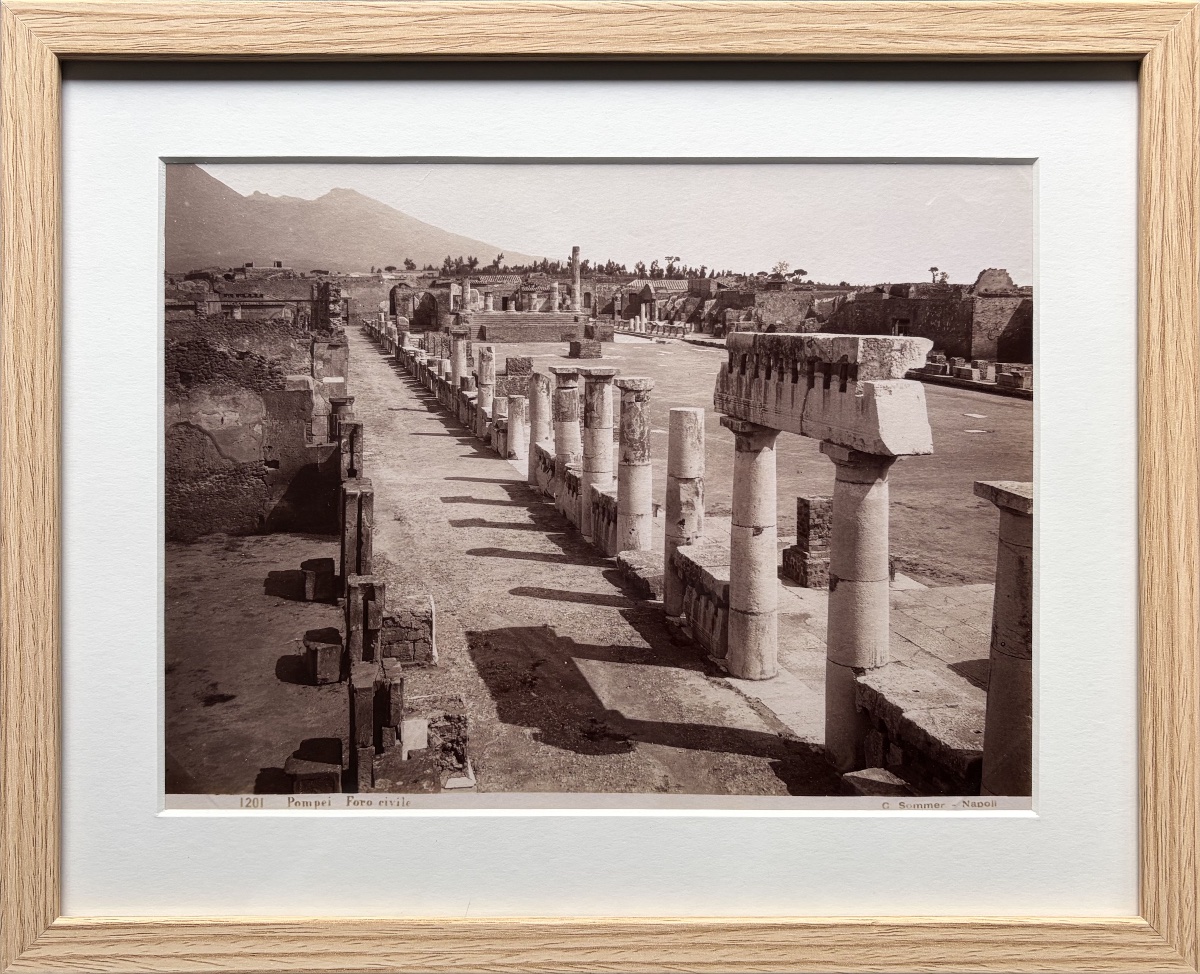
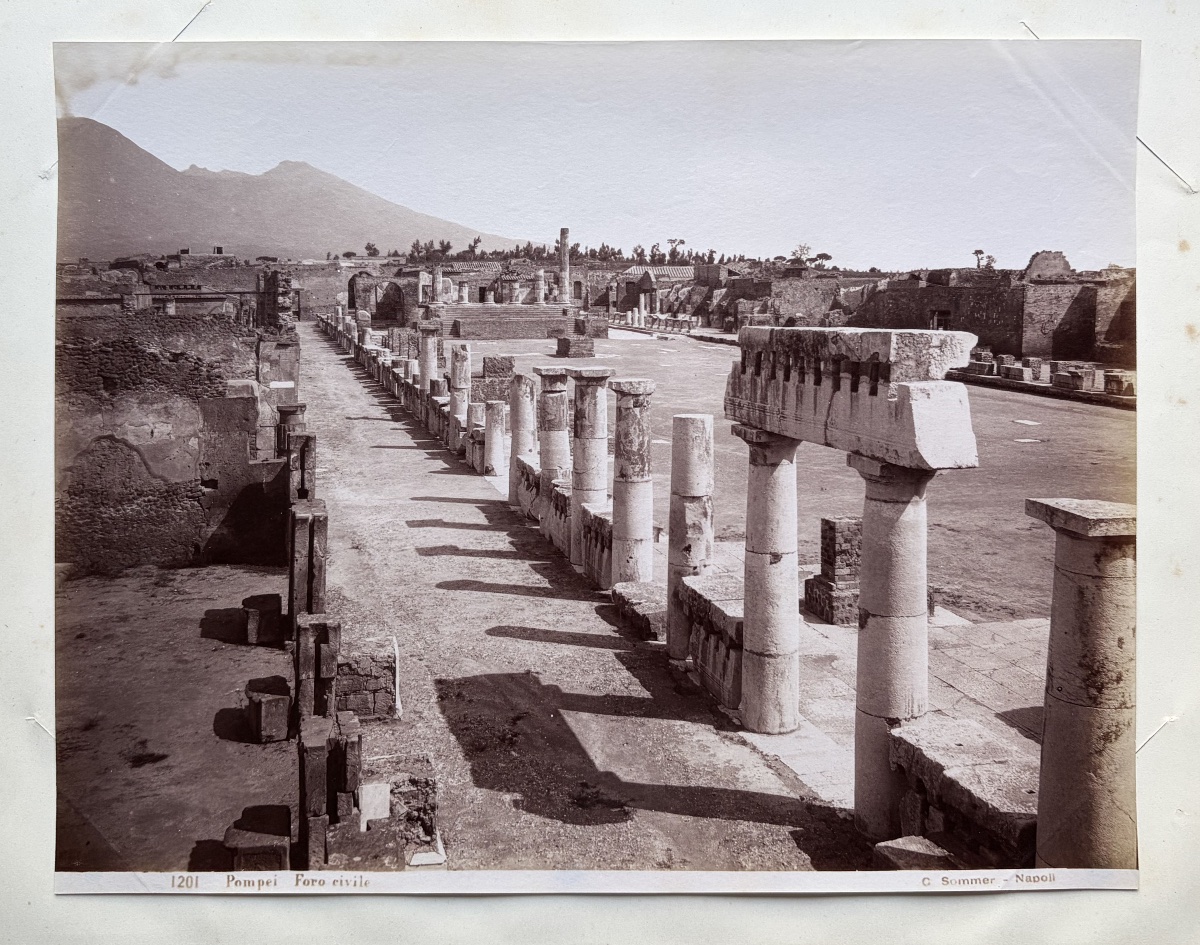

Giorgio Sommer, Pompeii Civil Forum No. 1201, Albumin Print, Ca. 1870–80, Numbered, Titled, And Signed
Artist: Giorgio Sommer (1834- Naples 1914)
Who can remain unmoved by the indescribable poetry of the ruins of the most striking ancient sites, the full power of which Giorgio Sommer helped to convey, particularly in Pompeii, where tragedy lurks everywhere behind the remnants of a splendor instantly consumed by a catastrophic event, so vividly recounted by Pliny the Younger, whose uncle, Pliny the Elder, perished in that historic eruption. Pompeii, a radiant city, frozen in time and nearly reduced to ashes by the height of tragedy.
Giorgio Sommer, a prominent Italian photographer, born in Frankfurt am Main, Germany, opened his studio in Naples in 1857 and was renowned for his views of Naples, the Bay of Naples, and other major surrounding sites, notably Pompeii and Capri, with a keen interest in archaeology.
He became the official photographer of the first king of Italy, Victor Emmanuel II, and helped immortalize the rise of tourism to some of Italy’s sites, a trend stemming from the craze for the Grand Tour.
The Getty Museum, which holds a collection of fifteen albumen prints by Giorgio Sommer, states that his views of Pompeii were likely taken in 1863, and that Sommer won the bronze medal at the 1867 Paris World’s Fair.
Albumen prints, named after a 19th-century process invented in 1850 by Louis-Désiré Blanquart-Evrard, which uses egg albumin to fix silver salts onto paper, have a naturally satiny and smooth finish with warmer tones but remain fragile due to the thinness of the paper, which explains the presence of signs of wear or marks left by previous mountings.
However, despite the demanding nature of preserving these precious historical prints, the quality of the sepia-toned vedute by Giorgio Sommer, their depth, and the mysterious atmosphere masterfully captured by the photographer, have been remarkably well preserved to this day.
The Foro Civile served as the institutional heart of Pompeii—judicial, economic, political, and religious alike. Buried by the eruption of Vesuvius in 79 AD, it was not until the 19th-century excavation campaigns that it was brought back to light, still standing majestically facing the terrible volcano, seemingly defying it. Sommer’s albumen print also appears to depict fumaroles above Vesuvius, obscured by the frame.
It is worth noting that Giorgio Sommer is known to have immortalized the 1872 eruption of Vesuvius; this print, held by the Minneapolis Institute of Art, comes from the collection of the Mr. and Mrs. Julius E. Davis Fund.
Prints of the albumen prints by Giorgio Sommer are also included in the collections of the Musée d’Orsay.
A leading figure in photography as well as a historical record.
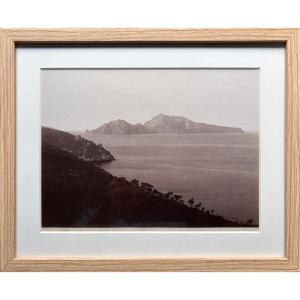
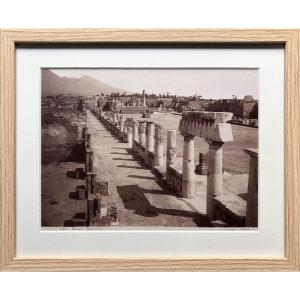
In good condition, with minor marks and typical creases typical of an albumen print. Fumaroles from Vesuvius are visible beneath the mat. Wooden frame.
Numbered, titled, and signed vintage albumen print, sold framed.
Dimensions of the albumen print:
Print only (unframed): 19.5 x 25.2 cm
Framed: 24 x 30 cm
Visible area (slightly smaller than the albumen print): 18 x 24 cm.
Purchase online on our WE ART TOGETHER gallery
Giorgio Sommer, a prominent Italian photographer, born in Frankfurt am Main, Germany, opened his studio in Naples in 1857 and was renowned for his views of Naples, the Bay of Naples, and other major surrounding sites, notably Pompeii and Capri, with a keen interest in archaeology.
He became the official photographer of the first king of Italy, Victor Emmanuel II, and helped immortalize the rise of tourism to some of Italy’s sites, a trend stemming from the craze for the Grand Tour.
The Getty Museum, which holds a collection of fifteen albumen prints by Giorgio Sommer, states that his views of Pompeii were likely taken in 1863, and that Sommer won the bronze medal at the 1867 Paris World’s Fair.
Albumen prints, named after a 19th-century process invented in 1850 by Louis-Désiré Blanquart-Evrard, which uses egg albumin to fix silver salts onto paper, have a naturally satiny and smooth finish with warmer tones but remain fragile due to the thinness of the paper, which explains the presence of signs of wear or marks left by previous mountings.
However, despite the demanding nature of preserving these precious historical prints, the quality of the sepia-toned vedute by Giorgio Sommer, their depth, and the mysterious atmosphere masterfully captured by the photographer, have been remarkably well preserved to this day.
The Foro Civile served as the institutional heart of Pompeii—judicial, economic, political, and religious alike. Buried by the eruption of Vesuvius in 79 AD, it was not until the 19th-century excavation campaigns that it was brought back to light, still standing majestically facing the terrible volcano, seemingly defying it. Sommer’s albumen print also appears to depict fumaroles above Vesuvius, obscured by the frame.
It is worth noting that Giorgio Sommer is known to have immortalized the 1872 eruption of Vesuvius; this print, held by the Minneapolis Institute of Art, comes from the collection of the Mr. and Mrs. Julius E. Davis Fund.
Prints of the albumen prints by Giorgio Sommer are also included in the collections of the Musée d’Orsay.
A leading figure in photography as well as a historical record.
In good condition, with minor marks and typical creases typical of an albumen print. Fumaroles from Vesuvius are visible beneath the mat. Wooden frame.
Numbered, titled, and signed vintage albumen print, sold framed.
Dimensions of the albumen print:
Print only (unframed): 19.5 x 25.2 cm
Framed: 24 x 30 cm
Visible area (slightly smaller than the albumen print): 18 x 24 cm.
Purchase online on our WE ART TOGETHER gallery
450 €
Period: 19th century
Style: Other Style
Condition: Good condition
Material: Paper
Length: 19,5 cm
Width: 24 cm
Reference (ID): 1832725
Availability: In stock
Print