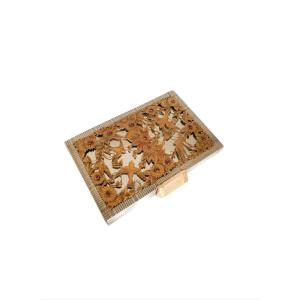


Mithé Espelt (1923–2020), “chevêche” Mirror
Mithé ESPELT (1923–2020),
“Chevêche” Mirror
Lunel Workshop, France, circa 1965
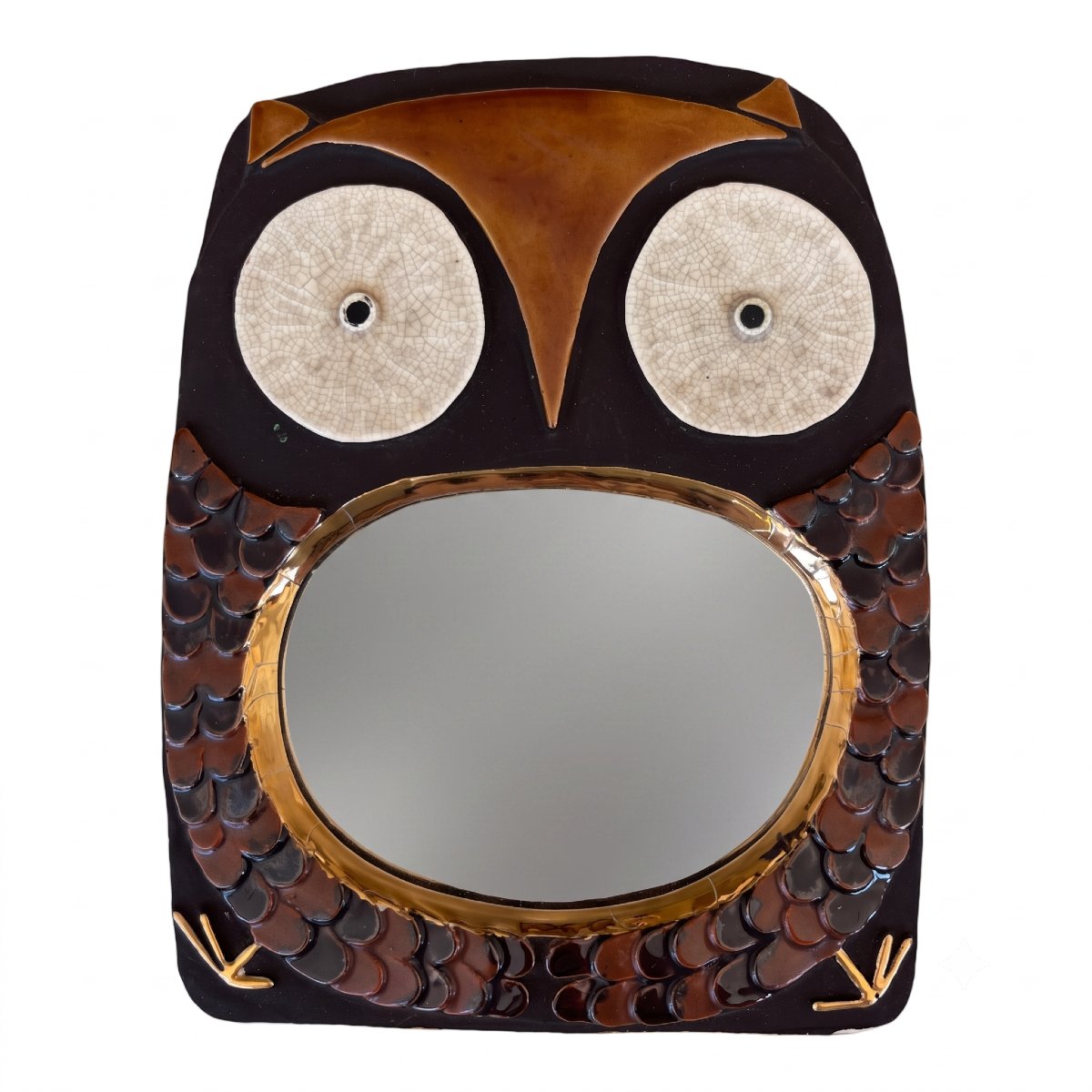
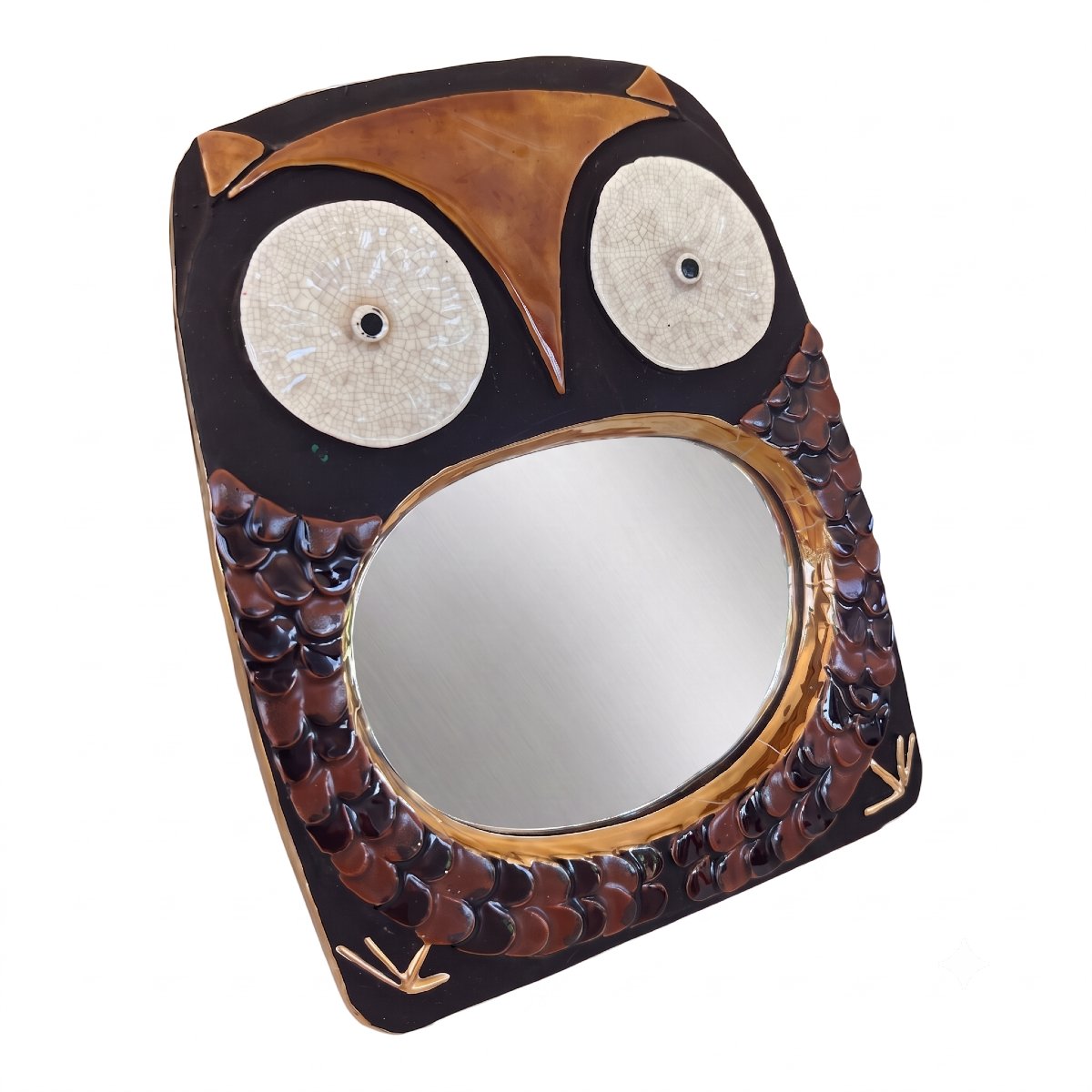
Stamped earthenware with a slightly raised design, brown and ivory crackled glazes, gold highlights, and a mirror.
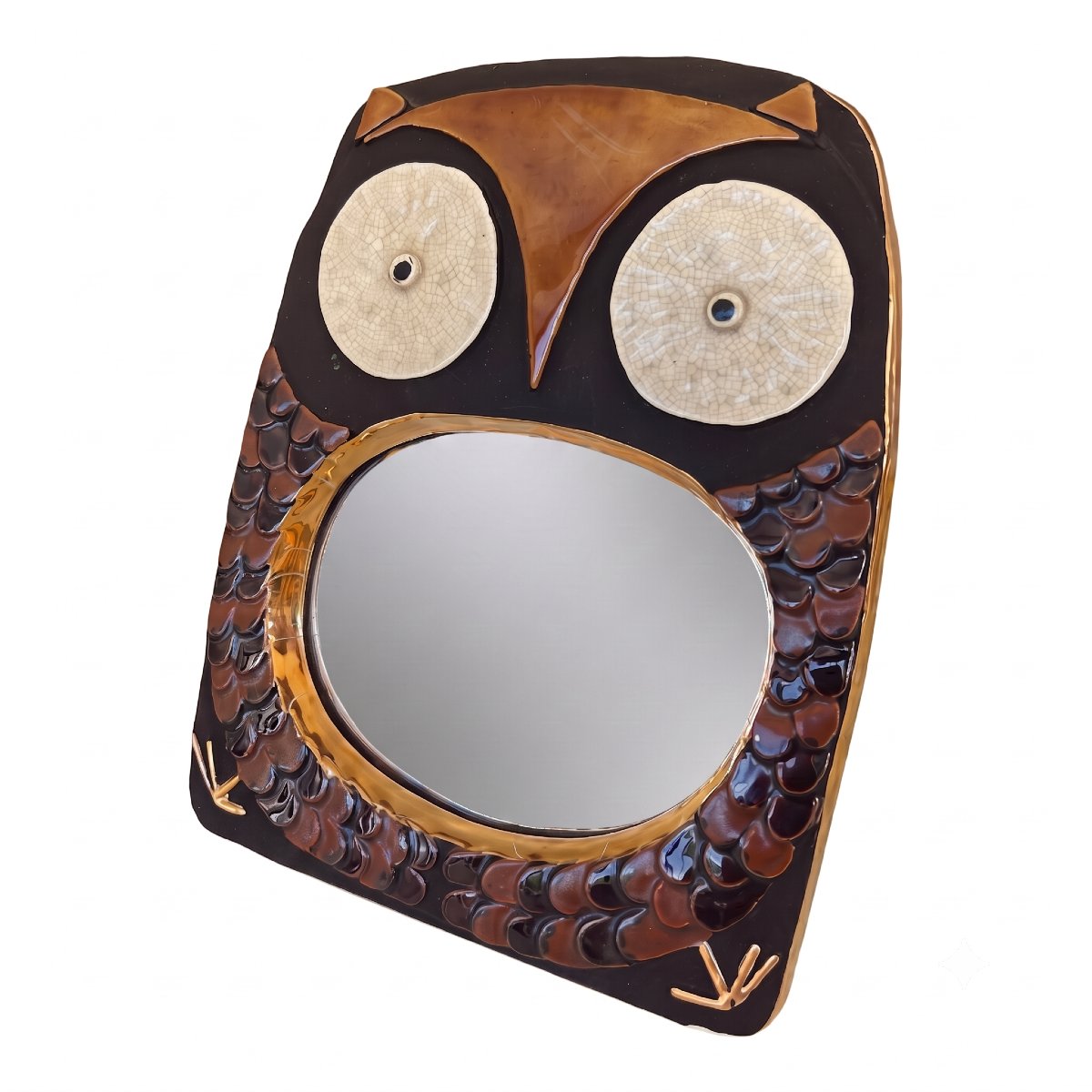
Rectangular wall mirror made of stamped earthenware with rounded corners, depicting a stylized little owl.
The composition is organized around a circular mirror occupying the center of the piece.
The head, with deliberately exaggerated proportions, features two large circular eyes in finely crackled ivory enamel, accented with a black cabochon, framing a small, sculpted triangular beak. The wings, rendered in slight relief, extend on either side of the mirror in a symmetrical pattern, while the body is adorned with a regular design of stamped circular motifs delicately accented with gold. Two stylized talons complete the composition.
Analysis and commentary:
Trained at the École des Beaux-Arts in Montpellier, Mithé ESPELT settled in Lunel in the late 1940s, where—far from industrial production channels—she developed a small-scale production of jewelry, jewelry boxes, mirrors, and decorative objects, all entirely handmade. Rejecting standardization, she favored artisanal craftsmanship, with each piece featuring subtle variations in the enamels and gold accents, making every work a unique piece.
The “Chevêche” model, created around 1965, belongs to the series of zoomorphic mirrors that rank among the artist’s most iconic creations. More than a naturalistic representation, the bird becomes a true decorative motif in which the volumes are reduced to a few essential forms. The design, marked by great simplicity, combines geometry with soft lines in a balance characteristic of the visual vocabulary developed by Mithé ESPELT.
The “Chevêche” model takes its name from the little owl (Athene noctua), a small nocturnal bird of prey widely found in the Mediterranean basin. Associated since antiquity with the goddess Athena, it has traditionally been a symbol of wisdom, knowledge, and vigilance. Mithé ESPELT offers a free interpretation here, faithful to the graphic language that characterizes his entire body of work.
The stamped clay technique, unique to the Lunel workshop, produces a delicately modeled design whose reliefs are then enhanced by nuanced glazes and hand-applied gold highlights. This technical mastery lends the work a presence that is both exquisite and timeless.
Bibliography:
Antoine Candau, Mithé Espelt: The Discreet Luxury of Everyday Life, Éditions Odyssée, 2020.
DIANE CHATELET - IMPOSSIBLE GALLERY
General Antique Dealer
Expert in Furniture and Works of Art with the European Chamber of Art Experts (CECOA)
FREE APPRAISALS - PURCHASES - SALE
Period: 20th century
Style: Other Style
Condition: Excellent condition
Material: Ceramic
Width: 19,5 cm
Height: 25 cm
Depth: 2 cm
Reference (ID): 1804587
Availability: In stock