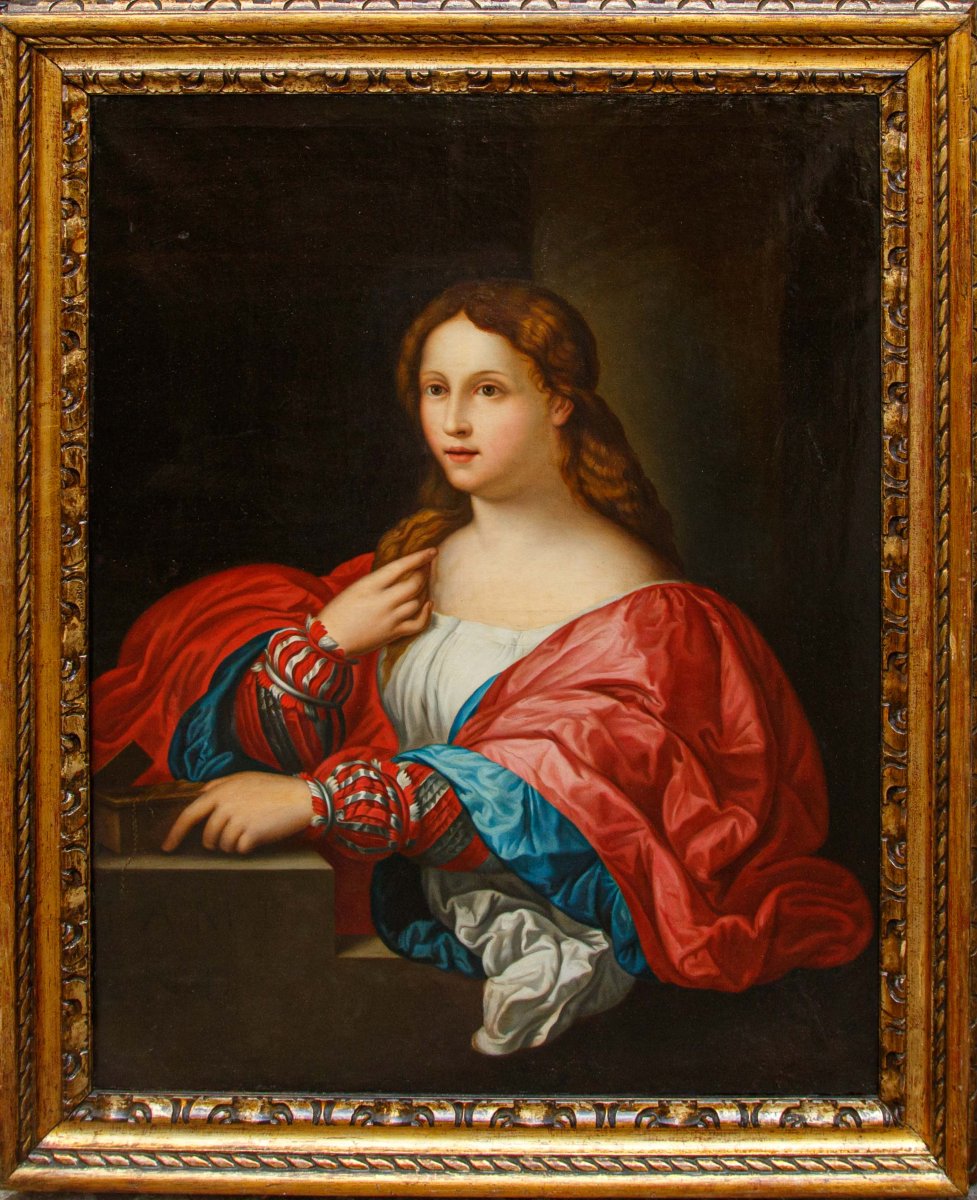
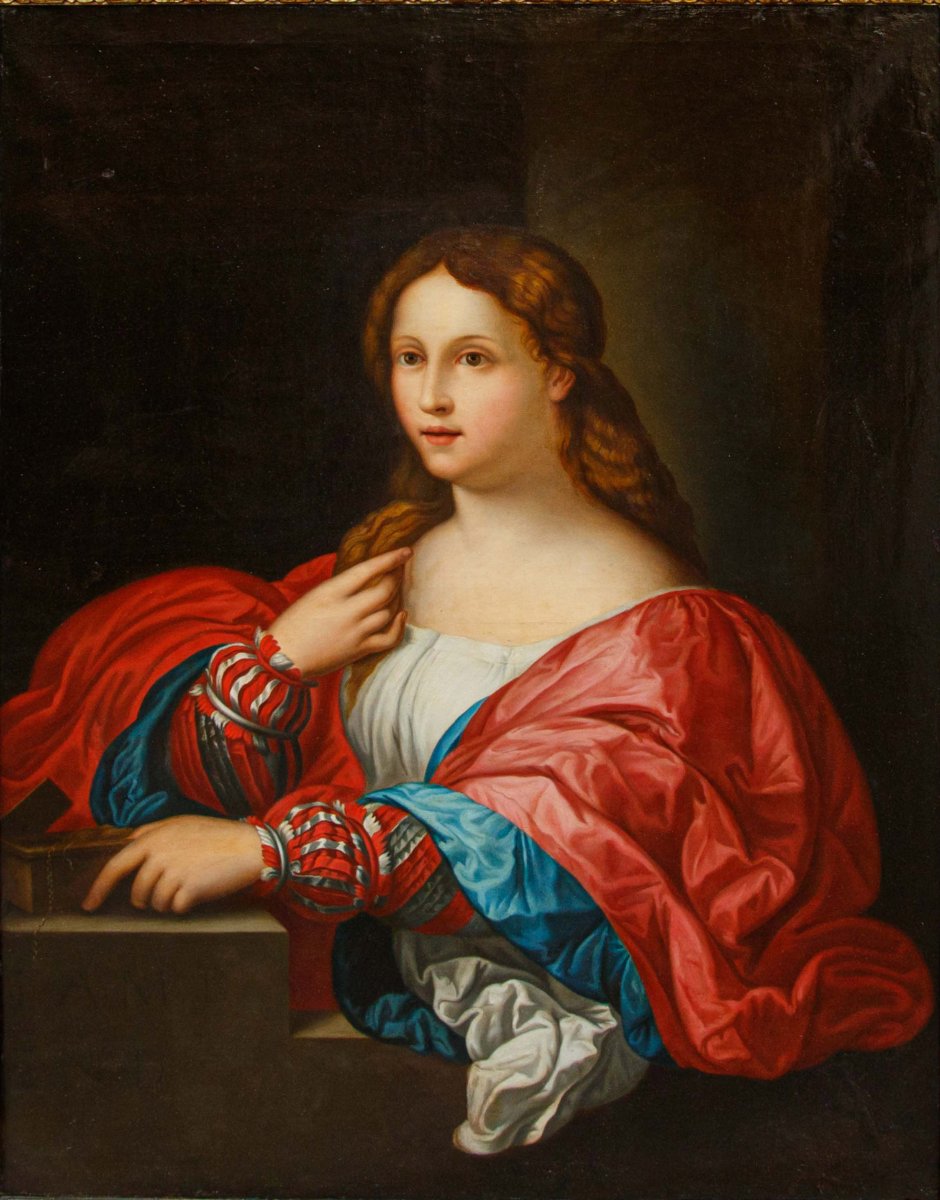
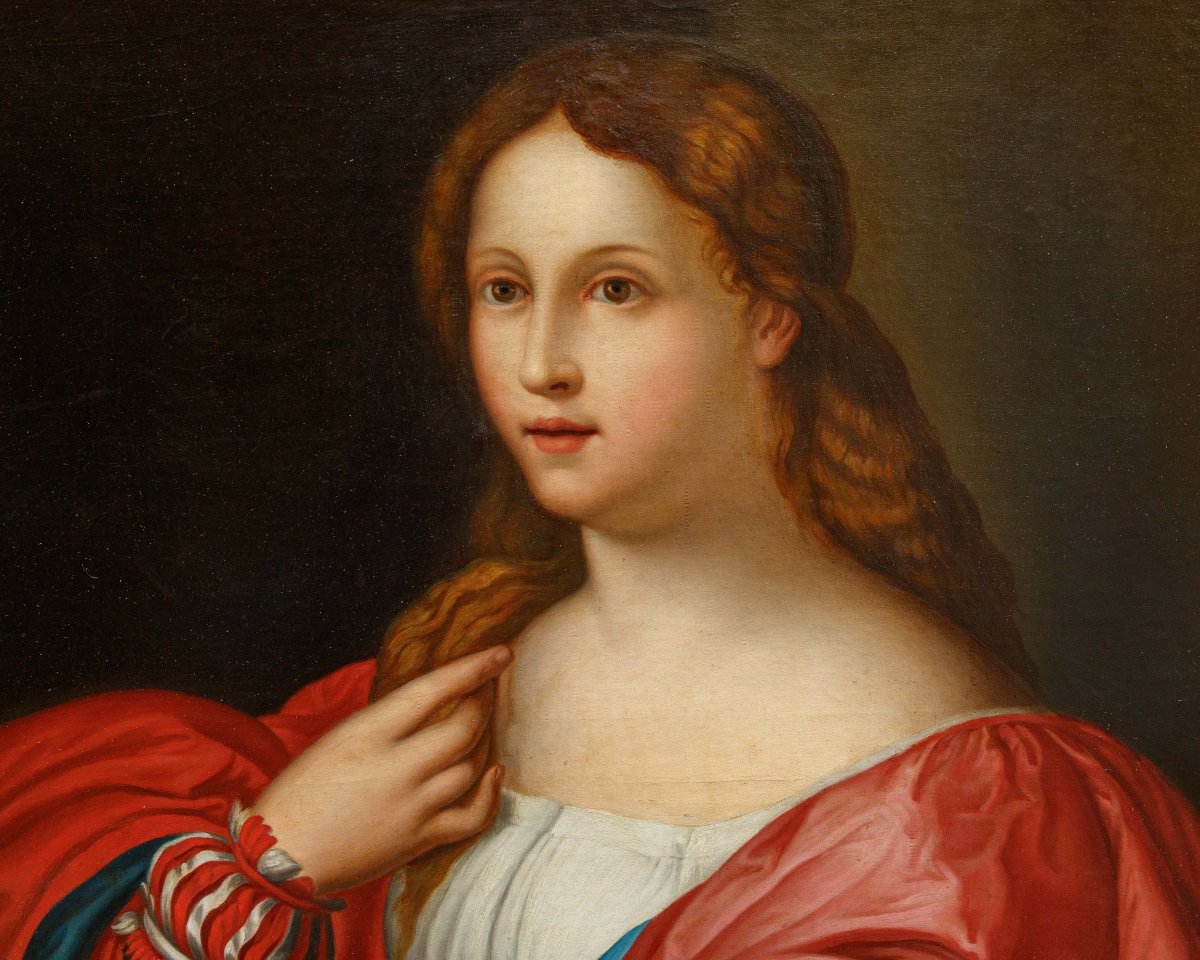
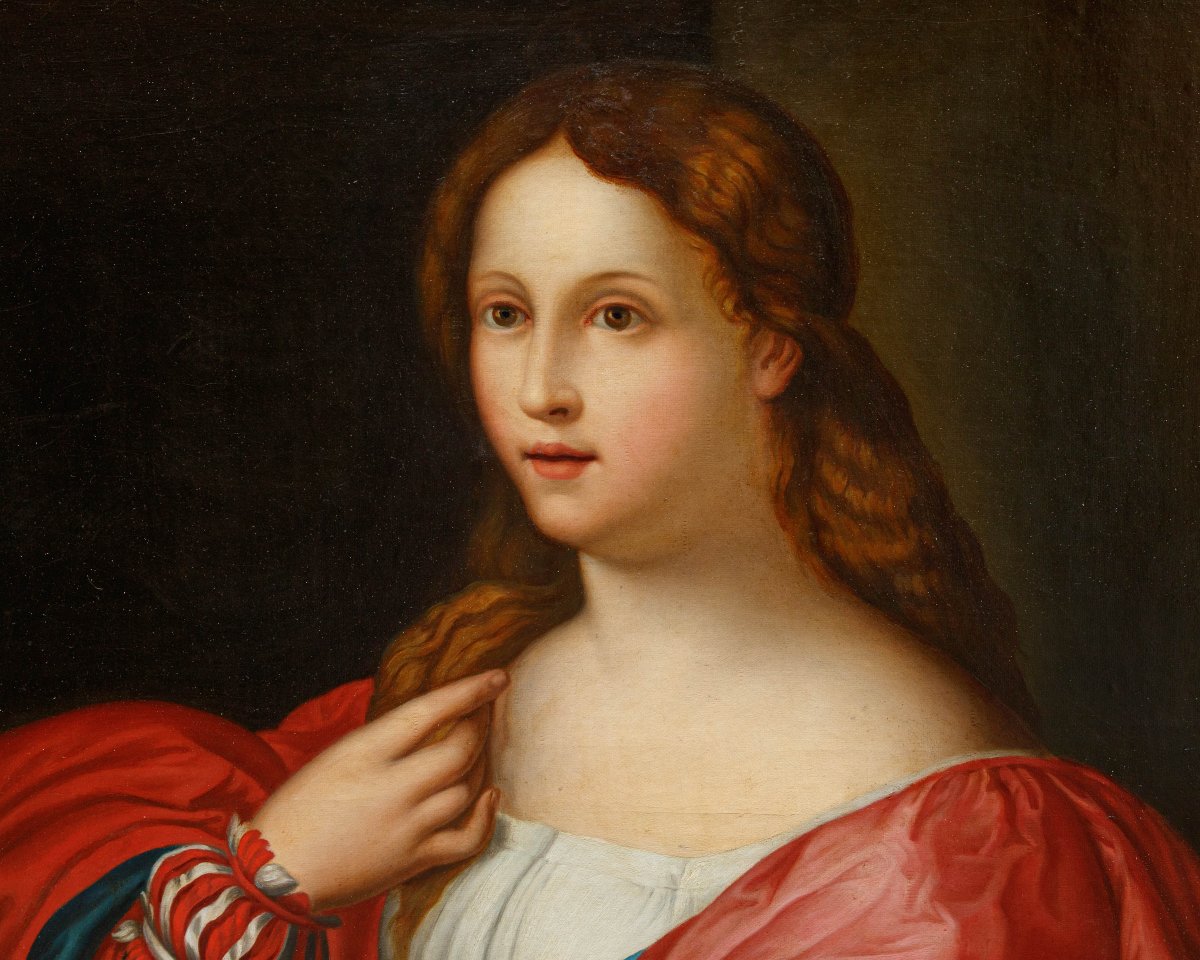
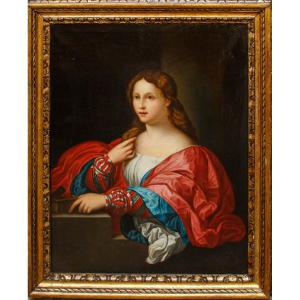


19th Century, By Palma Il Vecchio, *la Bella*
19th century, by Palma il Vecchio
La Bella
Oil on canvas, 102 x 75 cm
With frame, 119 x 93 cm
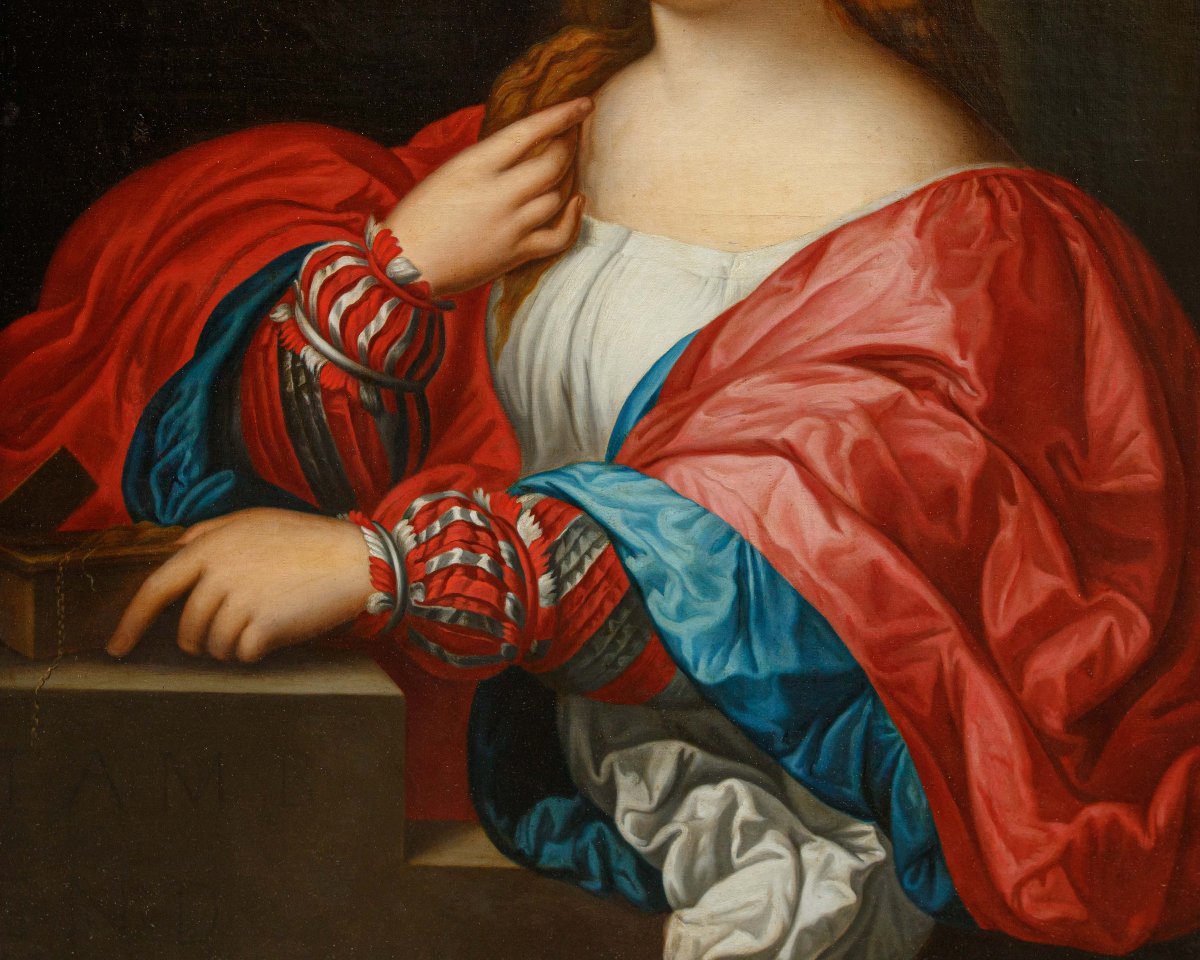
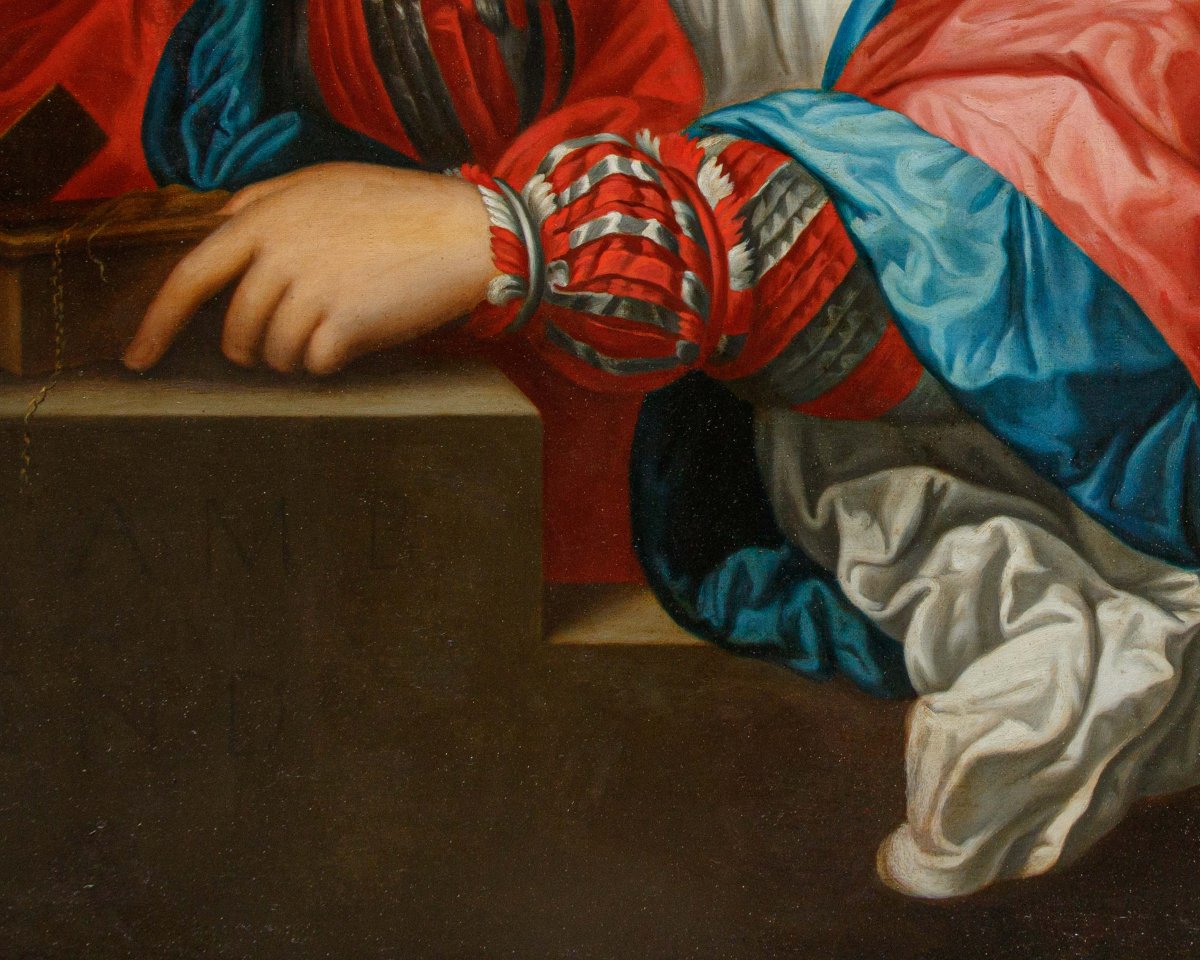
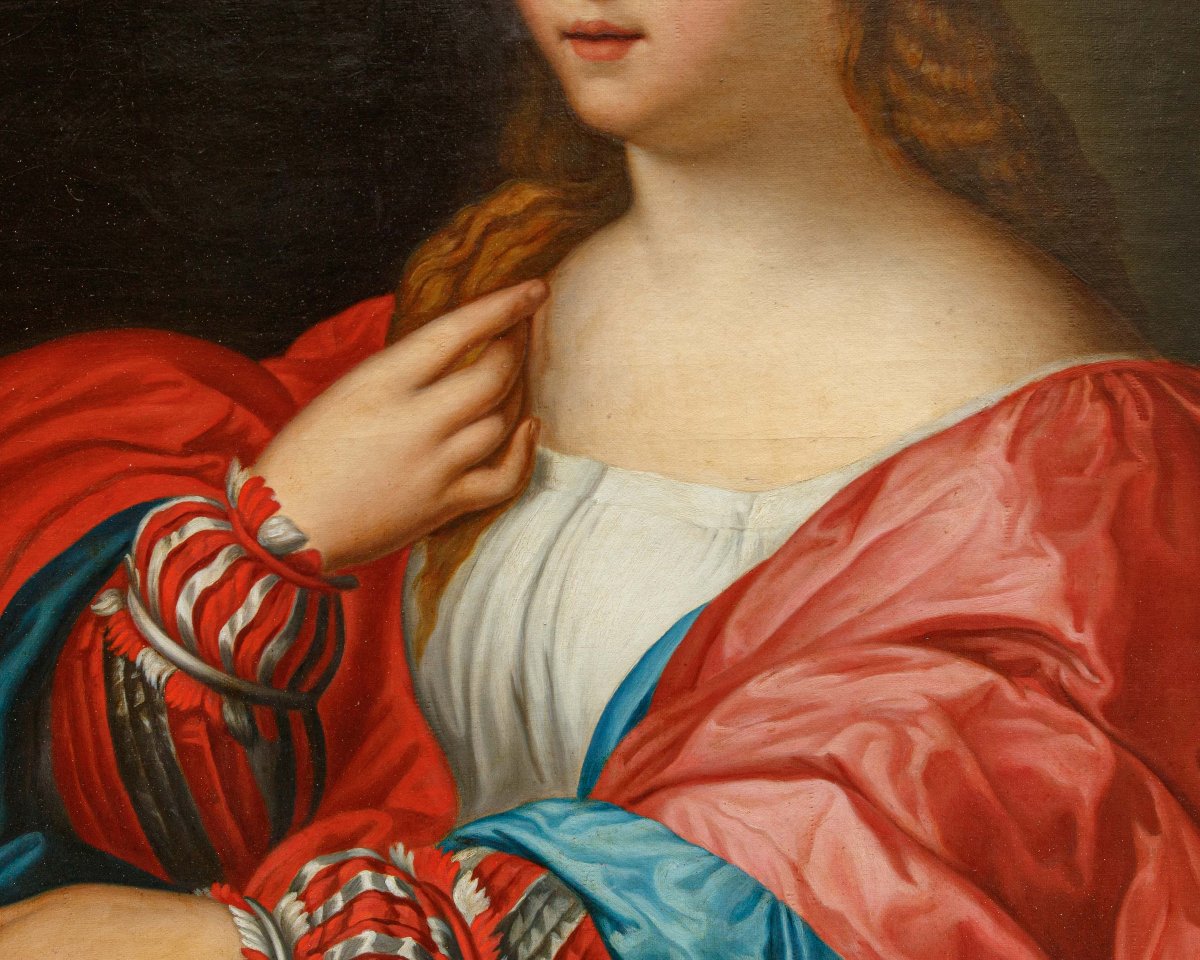
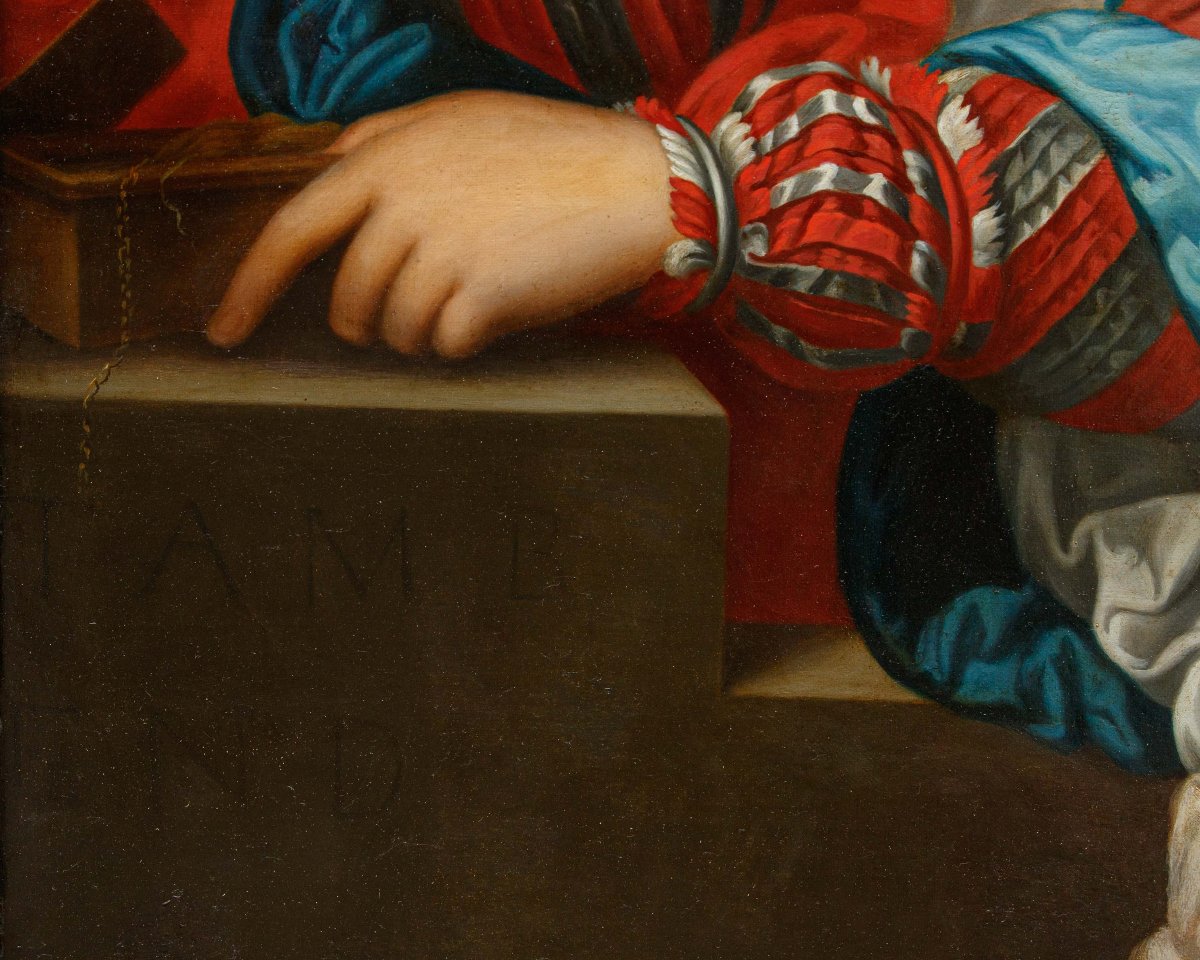
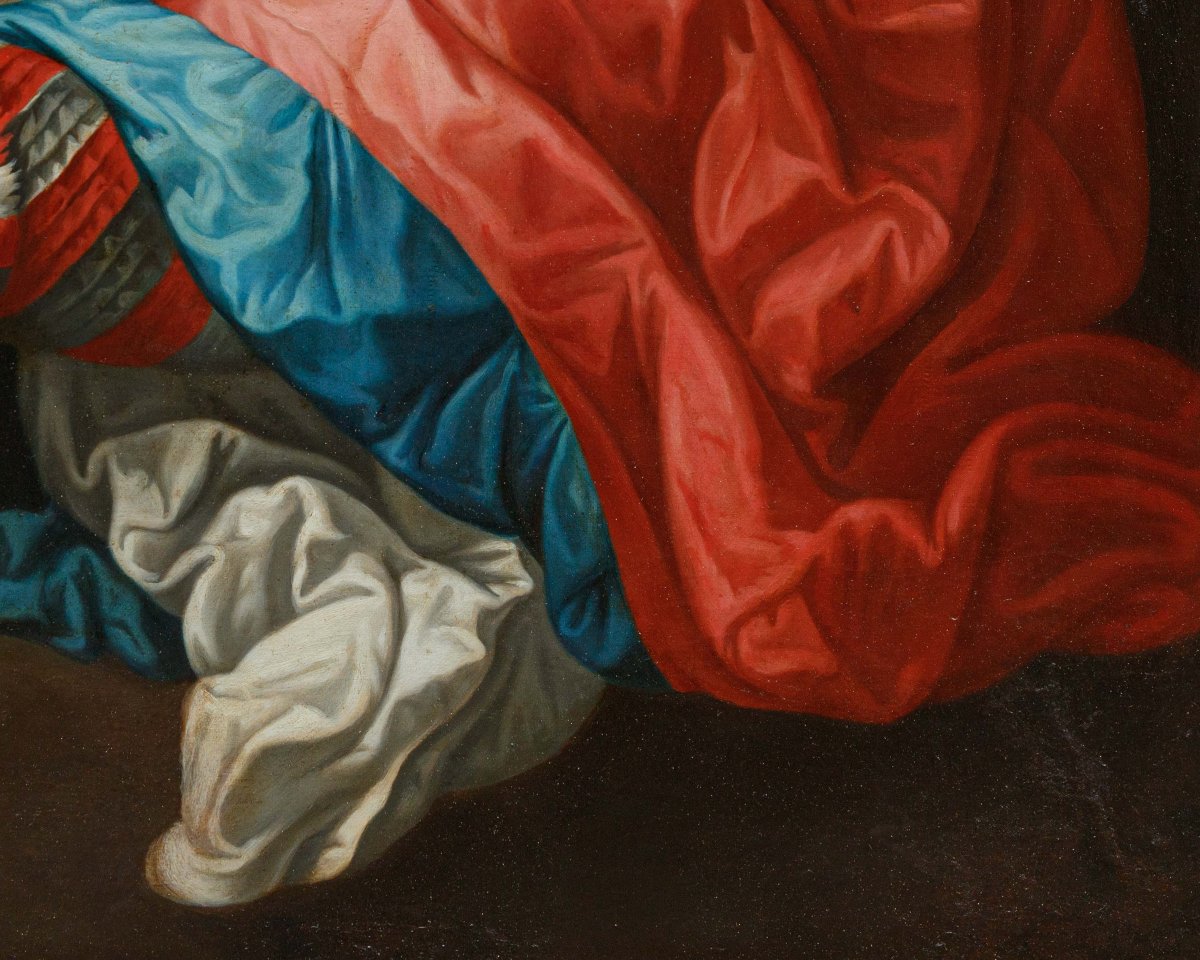
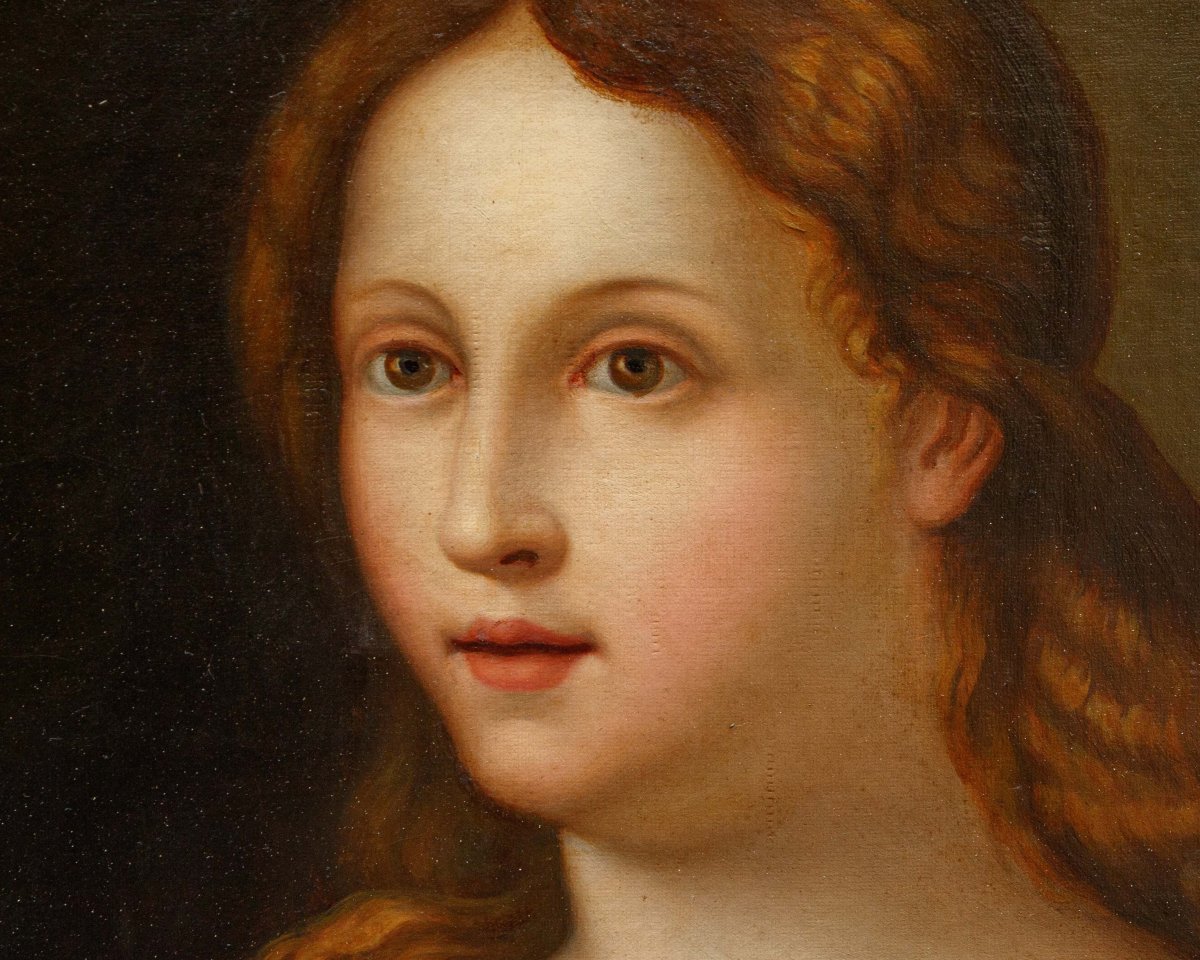
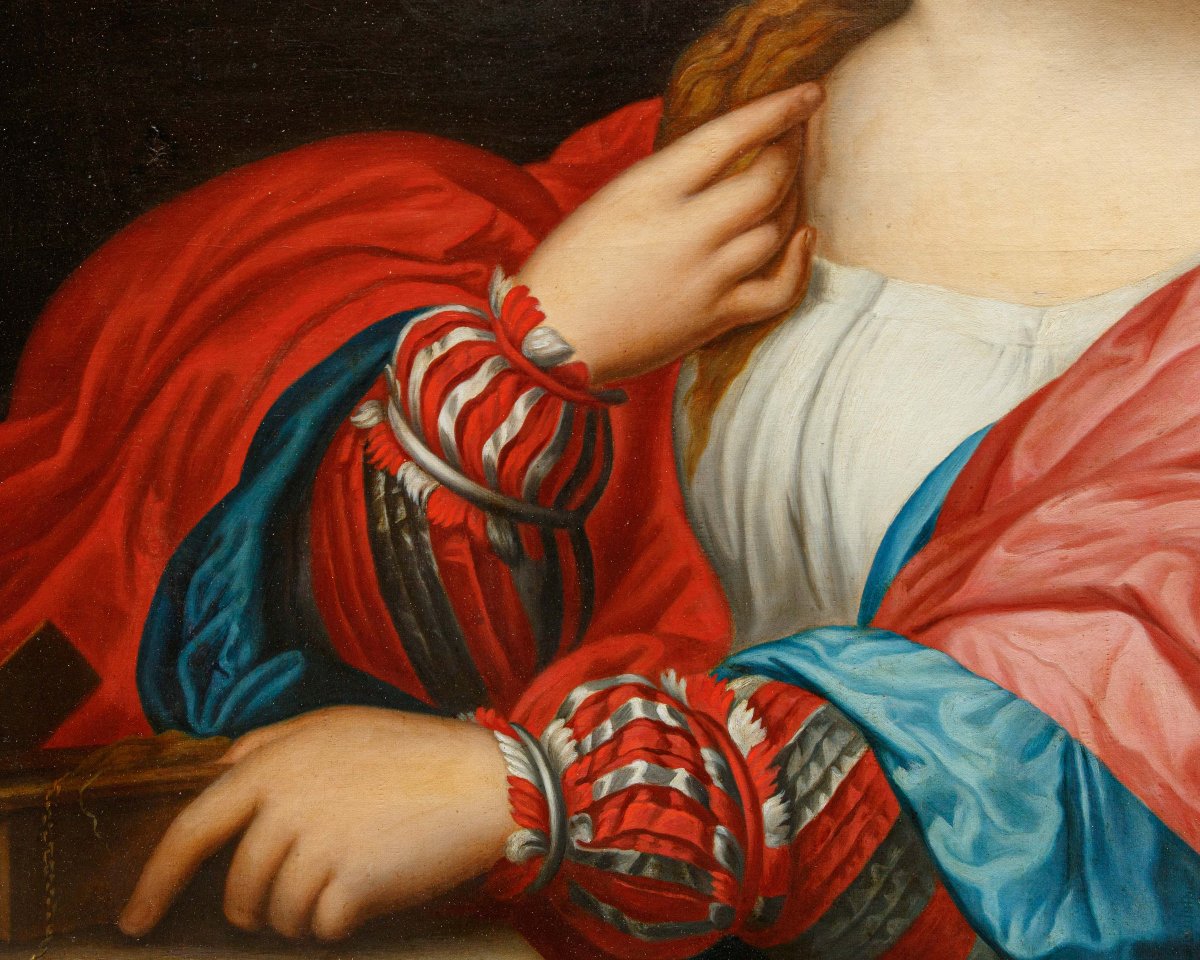
The painting in question directly echoes the famous prototype by Jacopo Negretti, known as Palma il Vecchio (Serina, c. 1480 – Venice, 1528), known as *La Bella*—a half-length portrait of a young woman embodying the aesthetic ideal of the Venetian Renaissance. The female figure stands out against a dark background and is depicted with her gaze turned slightly toward the viewer, characterized by a fair and luminous complexion and soft, auburn-blonde hair falling over her shoulders. With her right hand, the woman elegantly brushes a lock of her thick hair, bringing it toward her chest, while her left hand rests naturally on a stone pedestal in the foreground. Her gown features a deep neckline that leaves her throat and upper torso exposed, revealing a finely pleated white chemise over which rests a sumptuous, vivid red cloak, embellished with teal silk inserts and lapels and featuring puffed sleeves with polychrome inserts. Palma il Vecchio was, in fact, one of the leading figures of Venetian Renaissance painting. Having moved to Venice from the Bergamo area at a very young age, he was able to assimilate and reinterpret the teachings of masters such as Giorgione, Giovanni Bellini, and Titian. His stylistic signature was distinguished by his masterful use of soft, blended colors, the softness of his skin tones, and an extraordinary sensory rendering of fabrics. Highly regarded by both public patrons for his “Sacred Conversations” and private patrons for his allegories and portraits, he gave rise to the famous idealized tradition of the “Belle Donne” — female figures of radiant bridal beauty and serene sensuality that became a true aesthetic model for the era, into which our painting fits. Among the curiosities associated with this model is the enduring debate over the figure’s identity: while in the past these sensual images were often associated with famous courtesans of the era, modern art historians interpret the depiction as an allegorical or idealized image of bridal beauty, rich in references to fertility, modesty, and preparation for marriage, where the gesture of combing or touching one’s hair alludes to the rituals of bridal grooming. In Palma il Vecchio’s autograph masterpiece (now housed at the Thyssen-Bornemisza Museum in Madrid), there is also an enigmatic inscription in capital letters on the stone parapet: “A M B N D,” which scholars have long attempted to decipher as an acronym for a love motto or a dedication that still lends the painting an aura of charm and mystery. The elaboration of this specific pose and the monumental composition of the figure reveal a close and direct derivation from the figurative language of Titian Vecellio, particularly from his famous 1514 masterpiece *Amor Sacro and Amor Profano*. Palma the Elder draws upon and reworks the figure of the clothed bride positioned to the left of Titian’s sarcophagus, borrowing the elegance of the red drapery, the warm chromatic rendering of the skin tones, the soft modeling of the face, and the presence of the marble balustrade used as a spatial and compositional device. Palma assimilates Titian’s approach to the use of soft, blended colors and the tactile rendering of precious fabrics and textiles, transforming Titian’s complex allegory into an icon of seductive serenity and individual beauty. The critical and artistic success of this subject was extraordinary, so much so that over time it generated numerous copies and variations by workshops and collectors fascinated by the myth of Venetian painting. The provenance of Palma il Vecchio’s original prototype attests to the great significance it has always enjoyed: the canvas first belonged to the prestigious Sciarra-Colonna collection in Rome, a historic period during which the painting was initially known and cataloged under the title *La Bella de Tiziano*, demonstrating the very strong Titianesque influence perceived by contemporaries. Subsequently, the work was purchased by Baron Edmond de Rothschild and displayed in the halls of the Château de Ferrières, where it remained until the mid-20th century. It was later sold to Guy de Rothschild and transferred to Villa Favorita, the famous residence in Castagnola on Lake Lugano associated with the Thyssen-Bornemisza family, before finally reaching its current and permanent home in the collections of the Thyssen-Bornemisza Museum in Madrid.
Period: 19th century
Style: Other Style
Condition: Good condition
Material: Oil painting
Width: 75
Height: 102
Reference (ID): 1801984
Availability: In stock