

The Rape Of The Sabine Women, Vincent Malò (cambrai, C. 1595–1600 – Rome, 1649)
Artist: Vincent Malò (cambrai, Vers 1595/1600 - Rome, 1649) Attribué à
The Rape of the Sabine Women
Vincent Malò (Cambrai, c. 1595/1600 – Rome, 1649) attributed (LINK)
Oil on canvas
110 x 193 cm.
In frame 122 x 206 cm.
The Rape of the Sabine Women is one of the most famous episodes in the legendary founding of Rome by Romulus (8th century BC), the city’s first king, who managed to ensure the survival of his people through the daring abduction of the women of Sabine descent.
Shortly after founding Rome, Romulus realised that the city was populated almost exclusively by men (mostly adventurers or shepherds) and that without women, the new community would have no descendants, disappearing within a generation.
He decided to resort to trickery and force to resolve this problem: he organised grand games in honour of the god Consus (the Consualia) and invited the neighbouring peoples, in particular the Sabines, who turned out in great numbers along with their wives and children. While the guests were distracted by the spectacles, the armed young Romans – at a prearranged signal from Romulus – stormed in and abducted the maidens, driving their fathers and brothers away by force.
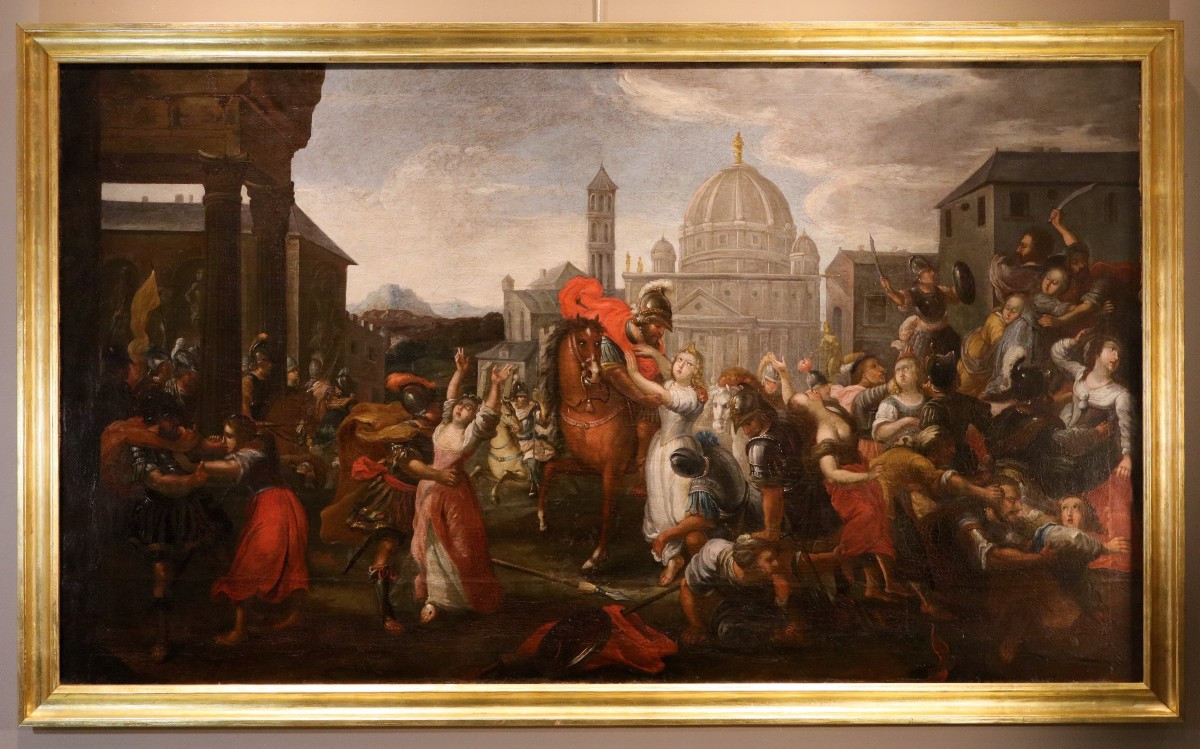
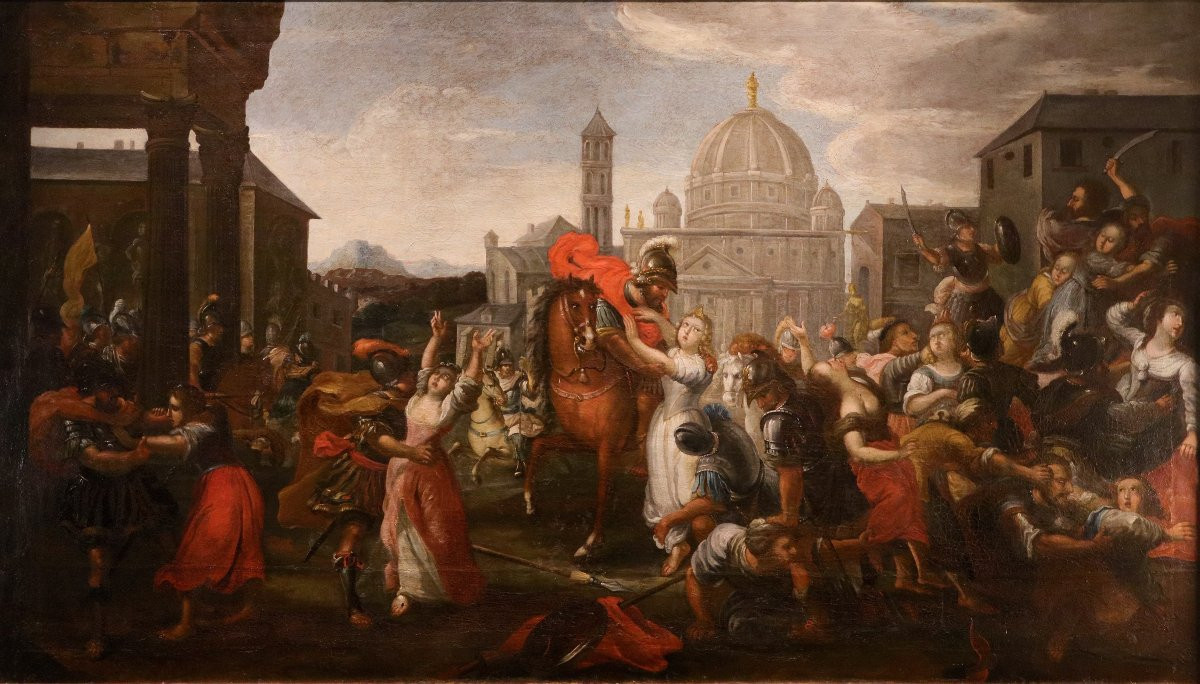
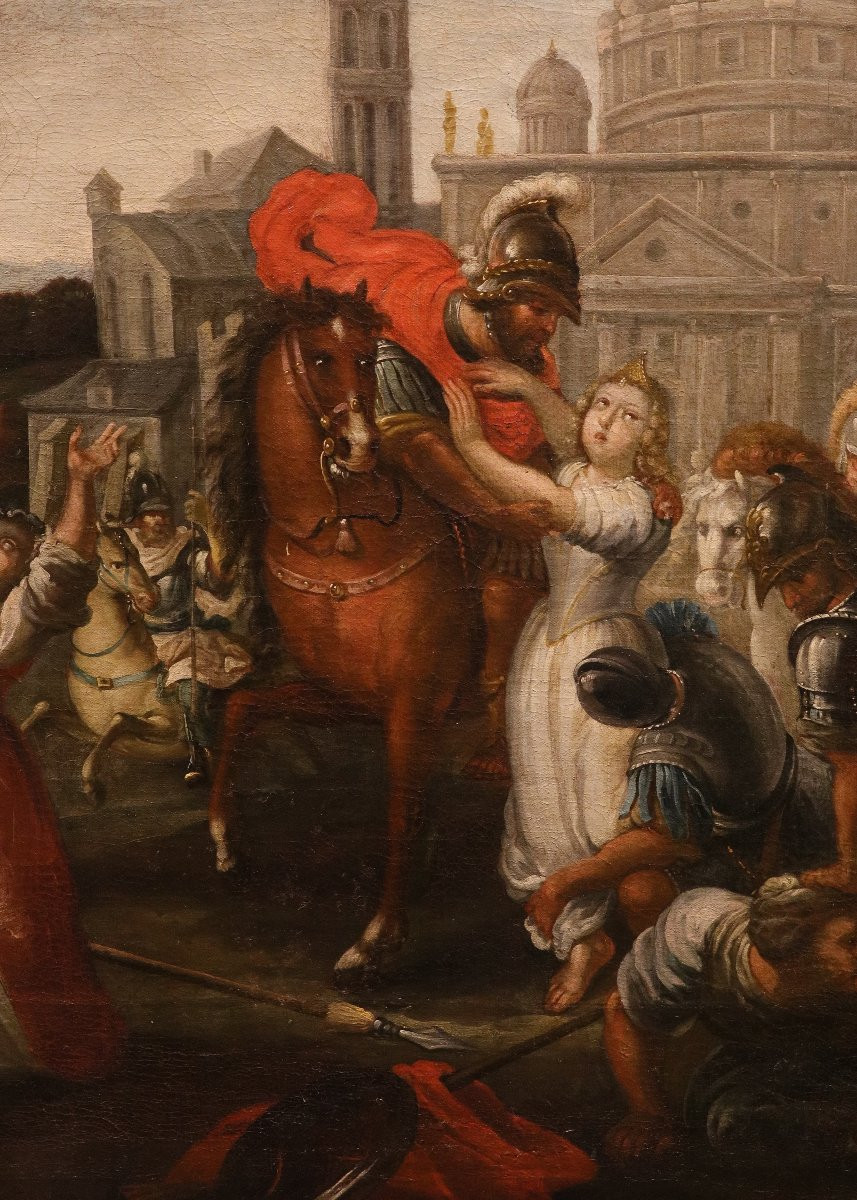
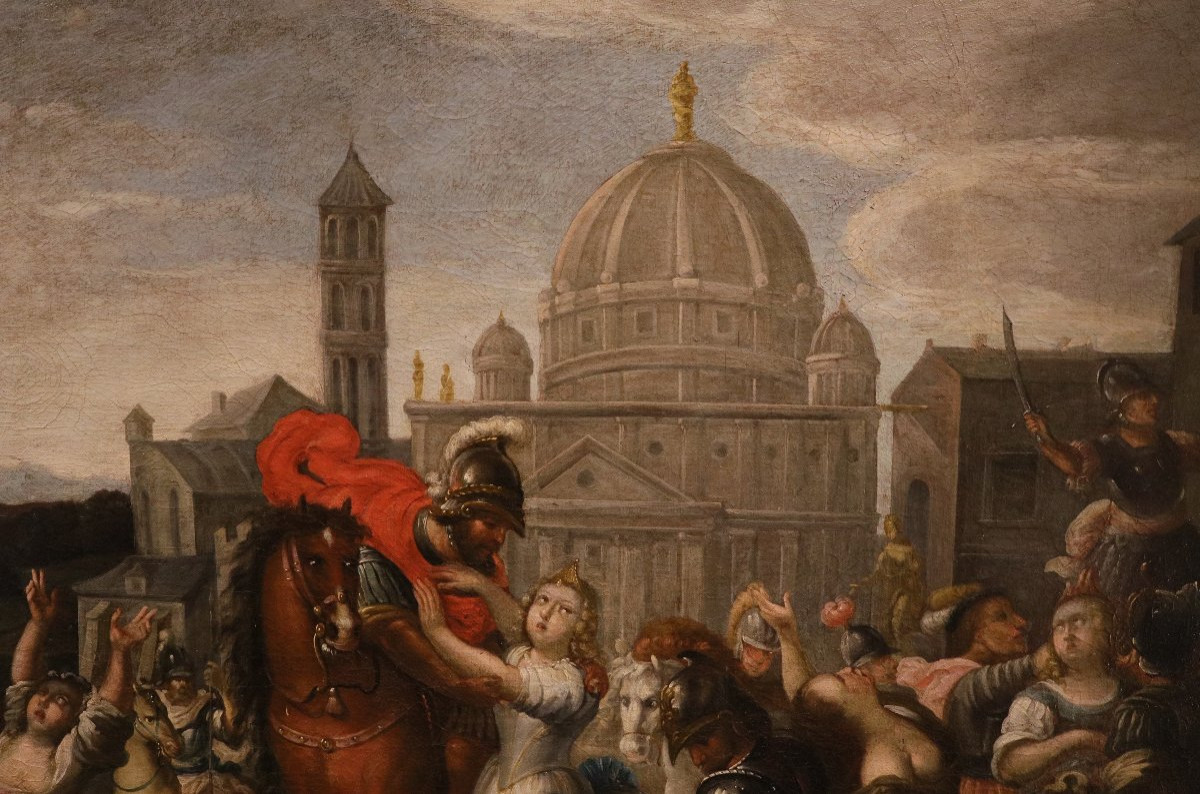
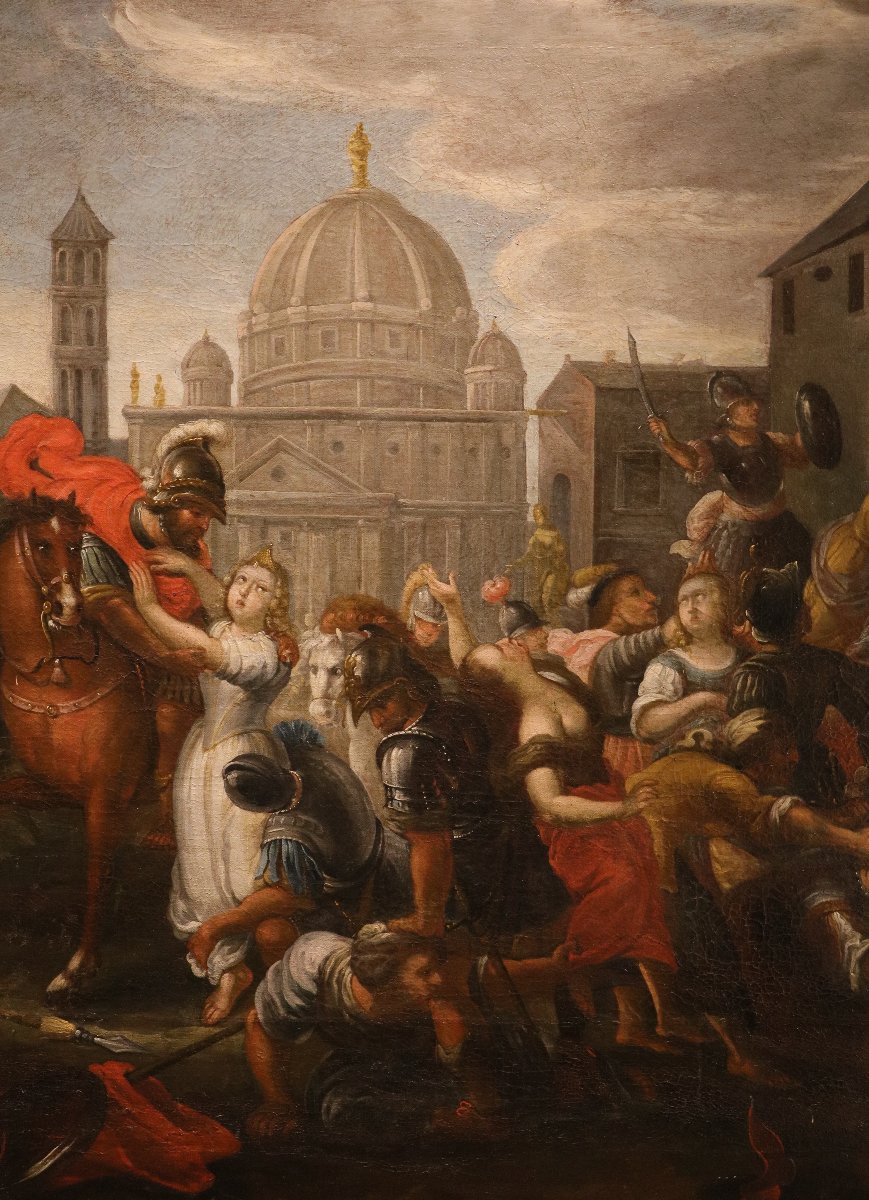
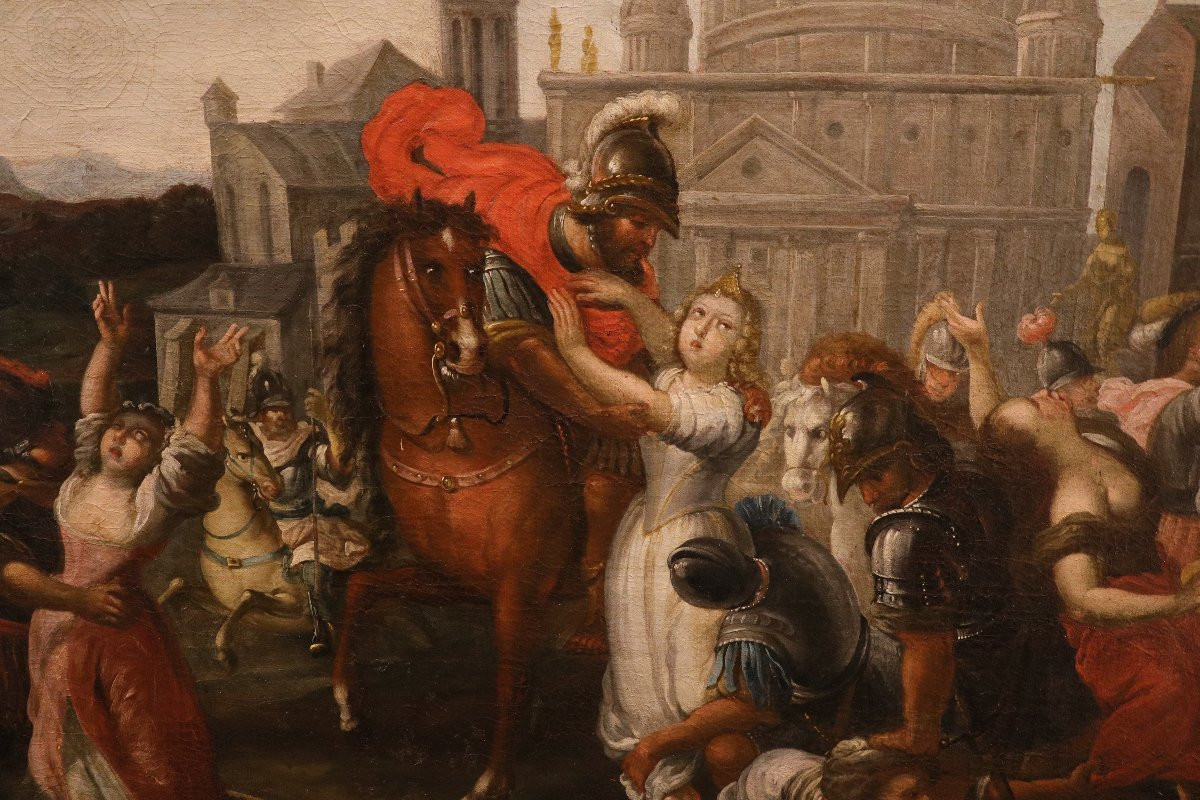
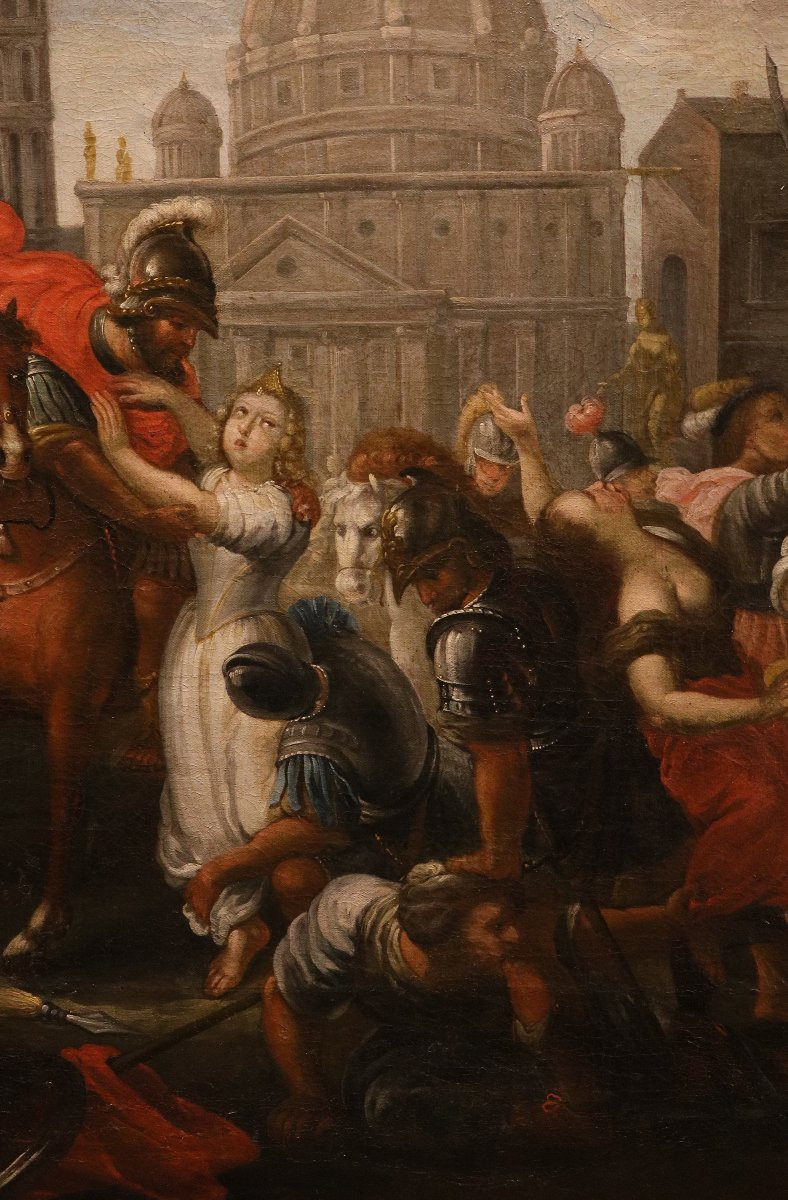
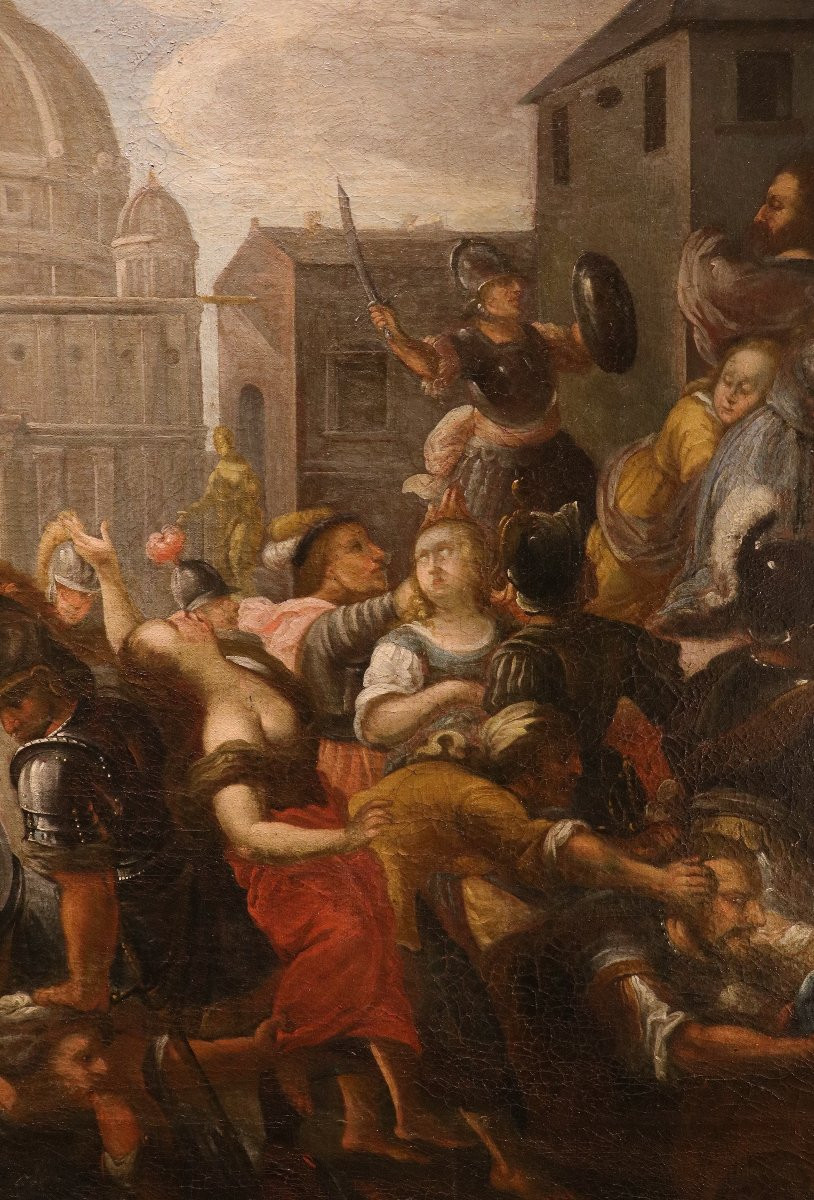
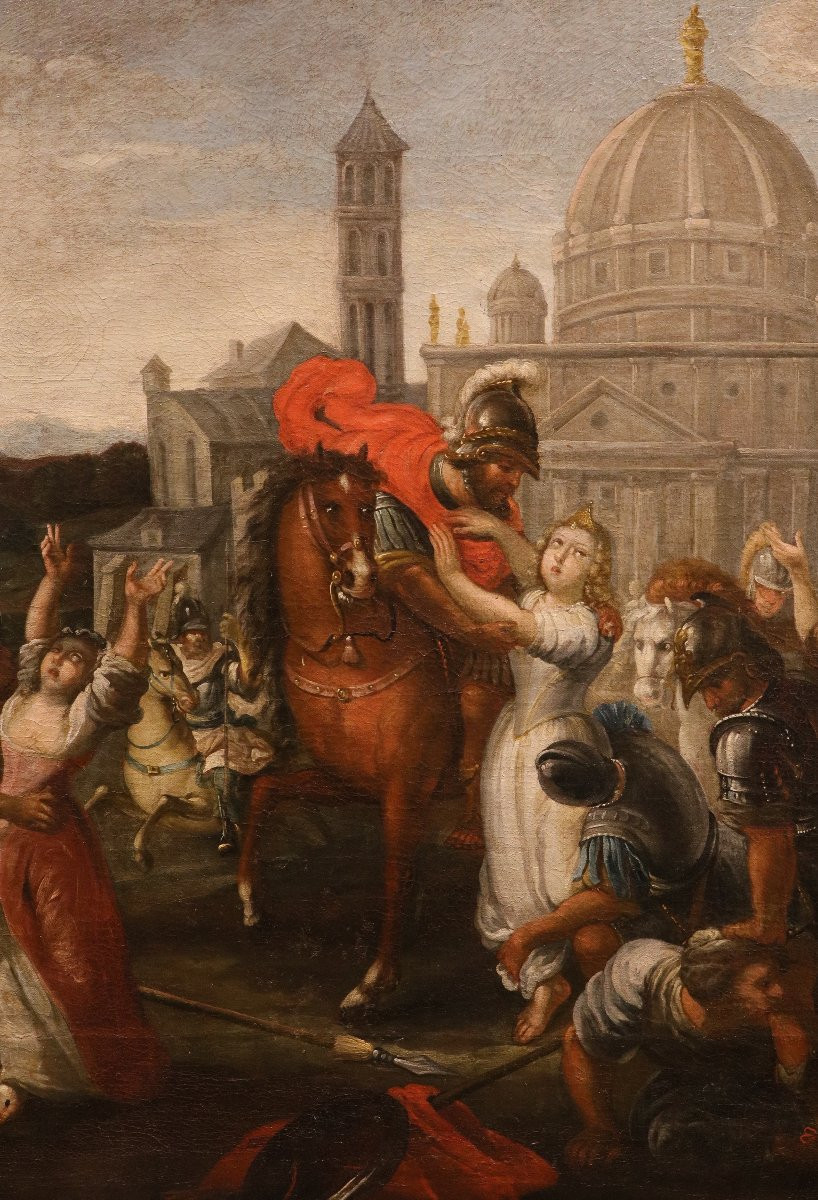
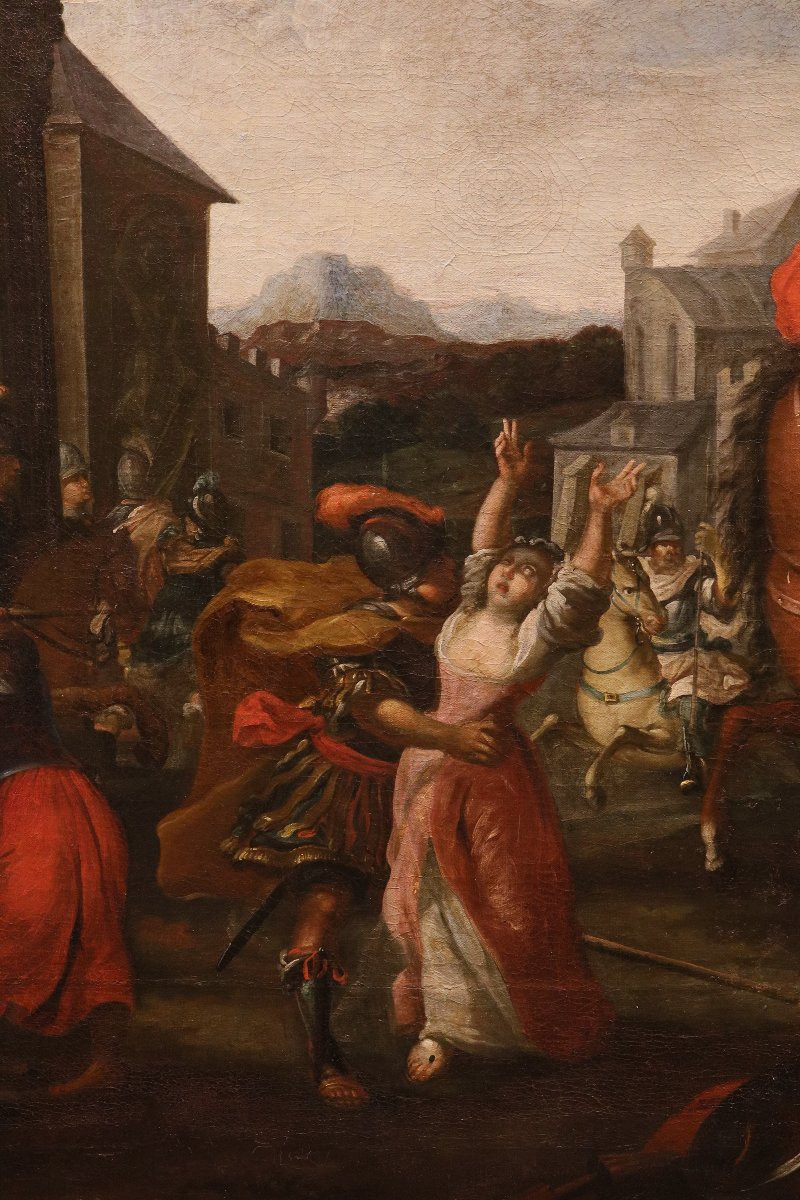
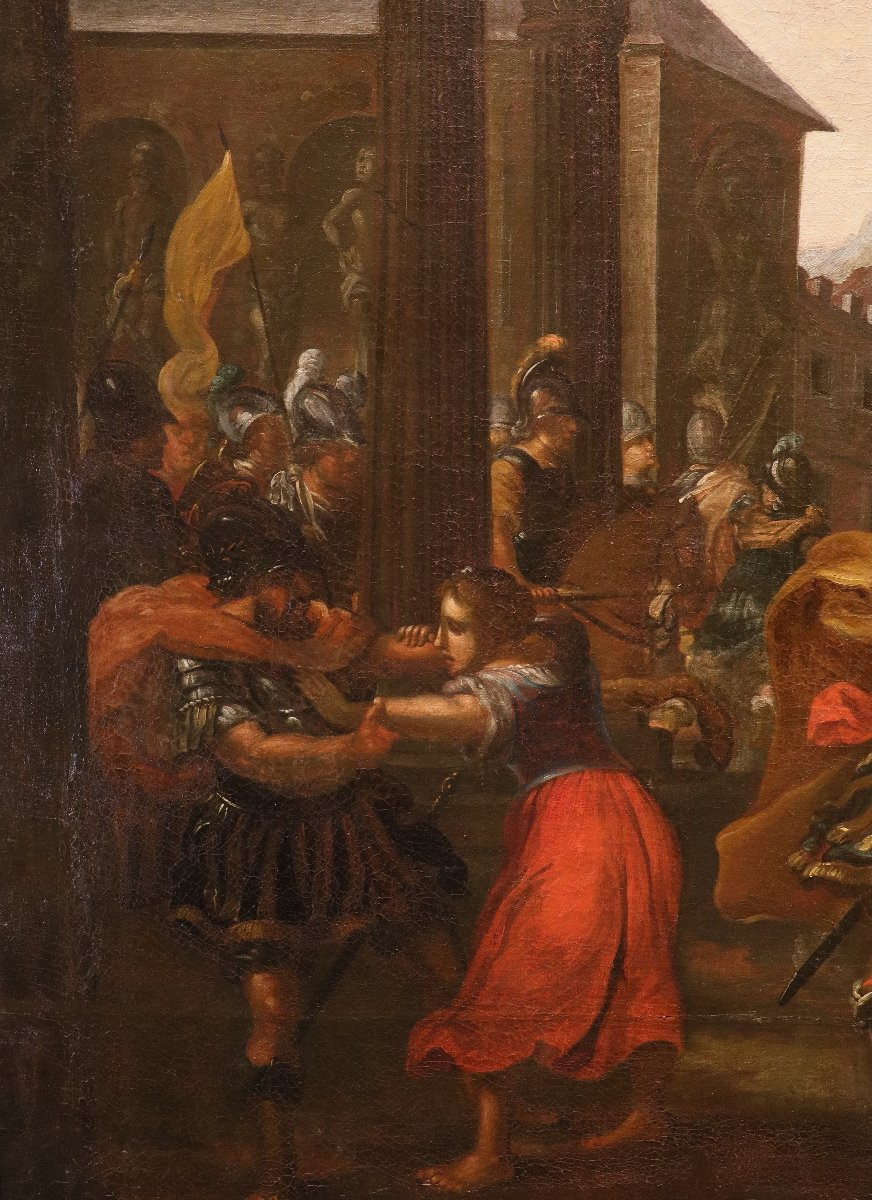
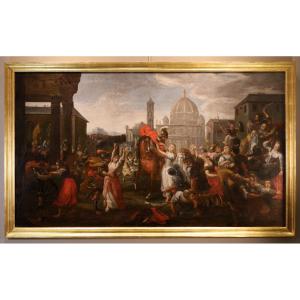
Our composition depicts this dramatic moment, the Rape (or Abduction) of the Sabine Women, capturing the full tension of the episode, with Roman soldiers intent on subduing the women who, in desperation, struggle with all their might to escape.
At the centre of this tangle of bodies, the figure of Romulus on horseback emerges, wearing his legendary red cloak, intent on seizing a woman: she is the noble Ersilia, who will become his wife, chosen for her nobility and wisdom, and from whose union Prima and Avilio will be born.
The painting, personalised by our artist, draws inspiration for certain details from Peter Paul Rubens’s The Rape of the Sabine Women, now in the Belfius Collection (Brussels), commissioned by Philip IV of Spain in 1639 and completed by the Brussels painter Gaspar de Crayer (https://rkd.nl/images/278260).
The work presented here, in particular, shows clear Flemish influences and is attributed to Vincent Malò (Cambrai, c. 1595/1600 – Rome, 1649), a pupil of Rubens in Antwerp, who must therefore have been familiar with the Flemish master’s painting.
In the canvas in question, which demonstrates his ability to compose large groups of figures, as well as his skill in depicting architectural settings, we can discern, from a stylistic point of view, the debt that Malò owed to his master.
We find some of Malò’s characteristic pictorial styles here, particularly in the facial features—such as the typical elongated noses—in the colour choices, and in the landscape setting, which are found in many of his works, along with his preference for grand, theatrical compositions.
The brown and earthy tones contrast with the figures’ pale, translucent complexions, whilst the landscape is rendered with a sensitive sense of atmosphere, featuring skies composed of mixtures of grey and blue, punctuated by the city’s architecture against which the figures stand out.
By way of comparison, we may mention four works by Malò:
The Massacre of the Innocents, Palazzo Bianco Gallery, Genoa, https://rkd.nl/images/22430
The Rape of the Sabine Women, Sotheby’s New York, 22 May 2019, lot 53 (https://www.sothebys.com/en/buy/auction/2019/master-paintings/vincent-malo-abduction-of-the-sabine-w... )
The Massacre of the Innocents, Princeton University Art Museum, New Jersey, https://rkd.nl/images/311613
The Meeting of Abraham and Melchizedek, Neumeister Munich, 5 July 2000, lot 480 https://rkd.nl/images/12754
Malò established himself as a successful painter in Italy, where he presumably arrived around 1634, working mainly in Genoa, but we know that in the final phase of his life he moved to Rome: the setting of the scene makes it plausible that our work may have been commissioned precisely during this phase.
Indeed, we see a beautiful view of Rome with St Peter’s Basilica in the background: this setting in which the scene is set is a very interesting added value for our fine painting.
Unlike the classical versions of this subject set in ancient Rome (notably that by Pietro da Cortona in the Capitoline Museums), in our case this interesting anachronism immediately catches the eye: although it depicts an event from the origins of Rome, and thus set in the 8th century BC, the artist has transposed it to a Baroque Rome where the dome or structure of St Peter’s Basilica stands out.
Added to this is the fact that the artist has also depicted the women in 17th-century dress, bringing the mythical episode closer to his own time.
This iconographic choice reflects the taste of the era for architectural ‘capriccios’ or for the celebration of the continuity between ancient Rome and 17th-century papal Rome.
ADDITIONAL INFORMATION:
The painting is sold complete with an attractive wooden frame and comes with a certificate of authenticity and a descriptive iconographic sheet.
We arrange and organise the transport of purchased works, both within Italy and abroad, using professional and insured carriers.
Please contact us for any further information; we will be happy to assist you.
Follow us on:
https://www.instagram.com/galleriacastelbarco/?hl=it
https://www.facebook.com/galleriacastelbarco/
Vincent Malò (Cambrai, c. 1595/1600 – Rome, 1649) attributed (LINK)
Oil on canvas
110 x 193 cm.
In frame 122 x 206 cm.
The Rape of the Sabine Women is one of the most famous episodes in the legendary founding of Rome by Romulus (8th century BC), the city’s first king, who managed to ensure the survival of his people through the daring abduction of the women of Sabine descent.
Shortly after founding Rome, Romulus realised that the city was populated almost exclusively by men (mostly adventurers or shepherds) and that without women, the new community would have no descendants, disappearing within a generation.
He decided to resort to trickery and force to resolve this problem: he organised grand games in honour of the god Consus (the Consualia) and invited the neighbouring peoples, in particular the Sabines, who turned out in great numbers along with their wives and children. While the guests were distracted by the spectacles, the armed young Romans – at a prearranged signal from Romulus – stormed in and abducted the maidens, driving their fathers and brothers away by force.
Our composition depicts this dramatic moment, the Rape (or Abduction) of the Sabine Women, capturing the full tension of the episode, with Roman soldiers intent on subduing the women who, in desperation, struggle with all their might to escape.
At the centre of this tangle of bodies, the figure of Romulus on horseback emerges, wearing his legendary red cloak, intent on seizing a woman: she is the noble Ersilia, who will become his wife, chosen for her nobility and wisdom, and from whose union Prima and Avilio will be born.
The painting, personalised by our artist, draws inspiration for certain details from Peter Paul Rubens’s The Rape of the Sabine Women, now in the Belfius Collection (Brussels), commissioned by Philip IV of Spain in 1639 and completed by the Brussels painter Gaspar de Crayer (https://rkd.nl/images/278260).
The work presented here, in particular, shows clear Flemish influences and is attributed to Vincent Malò (Cambrai, c. 1595/1600 – Rome, 1649), a pupil of Rubens in Antwerp, who must therefore have been familiar with the Flemish master’s painting.
In the canvas in question, which demonstrates his ability to compose large groups of figures, as well as his skill in depicting architectural settings, we can discern, from a stylistic point of view, the debt that Malò owed to his master.
We find some of Malò’s characteristic pictorial styles here, particularly in the facial features—such as the typical elongated noses—in the colour choices, and in the landscape setting, which are found in many of his works, along with his preference for grand, theatrical compositions.
The brown and earthy tones contrast with the figures’ pale, translucent complexions, whilst the landscape is rendered with a sensitive sense of atmosphere, featuring skies composed of mixtures of grey and blue, punctuated by the city’s architecture against which the figures stand out.
By way of comparison, we may mention four works by Malò:
The Massacre of the Innocents, Palazzo Bianco Gallery, Genoa, https://rkd.nl/images/22430
The Rape of the Sabine Women, Sotheby’s New York, 22 May 2019, lot 53 (https://www.sothebys.com/en/buy/auction/2019/master-paintings/vincent-malo-abduction-of-the-sabine-w... )
The Massacre of the Innocents, Princeton University Art Museum, New Jersey, https://rkd.nl/images/311613
The Meeting of Abraham and Melchizedek, Neumeister Munich, 5 July 2000, lot 480 https://rkd.nl/images/12754
Malò established himself as a successful painter in Italy, where he presumably arrived around 1634, working mainly in Genoa, but we know that in the final phase of his life he moved to Rome: the setting of the scene makes it plausible that our work may have been commissioned precisely during this phase.
Indeed, we see a beautiful view of Rome with St Peter’s Basilica in the background: this setting in which the scene is set is a very interesting added value for our fine painting.
Unlike the classical versions of this subject set in ancient Rome (notably that by Pietro da Cortona in the Capitoline Museums), in our case this interesting anachronism immediately catches the eye: although it depicts an event from the origins of Rome, and thus set in the 8th century BC, the artist has transposed it to a Baroque Rome where the dome or structure of St Peter’s Basilica stands out.
Added to this is the fact that the artist has also depicted the women in 17th-century dress, bringing the mythical episode closer to his own time.
This iconographic choice reflects the taste of the era for architectural ‘capriccios’ or for the celebration of the continuity between ancient Rome and 17th-century papal Rome.
ADDITIONAL INFORMATION:
The painting is sold complete with an attractive wooden frame and comes with a certificate of authenticity and a descriptive iconographic sheet.
We arrange and organise the transport of purchased works, both within Italy and abroad, using professional and insured carriers.
Please contact us for any further information; we will be happy to assist you.
Follow us on:
https://www.instagram.com/galleriacastelbarco/?hl=it
https://www.facebook.com/galleriacastelbarco/
13 900 €
Period: 17th century
Style: Louis 15th - Transition
Condition: Excellent condition
Material: Oil painting
Width: encadré 206 cm.
Height: encadré 122 cm.
Reference (ID): 1759882
Availability: In stock
Print