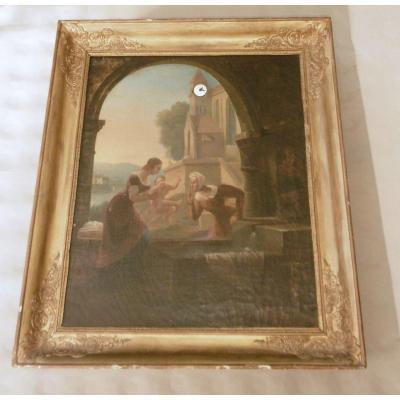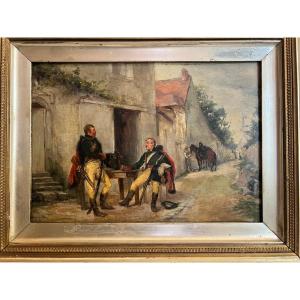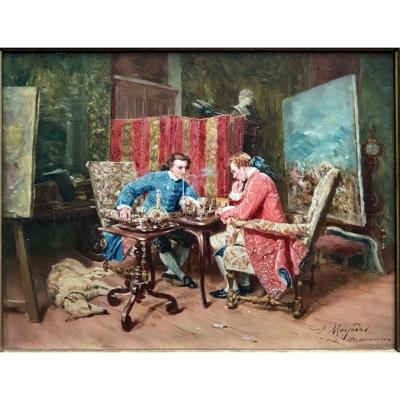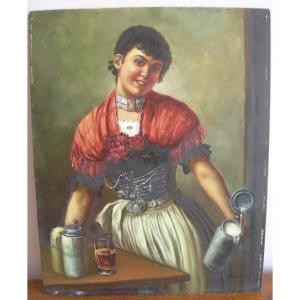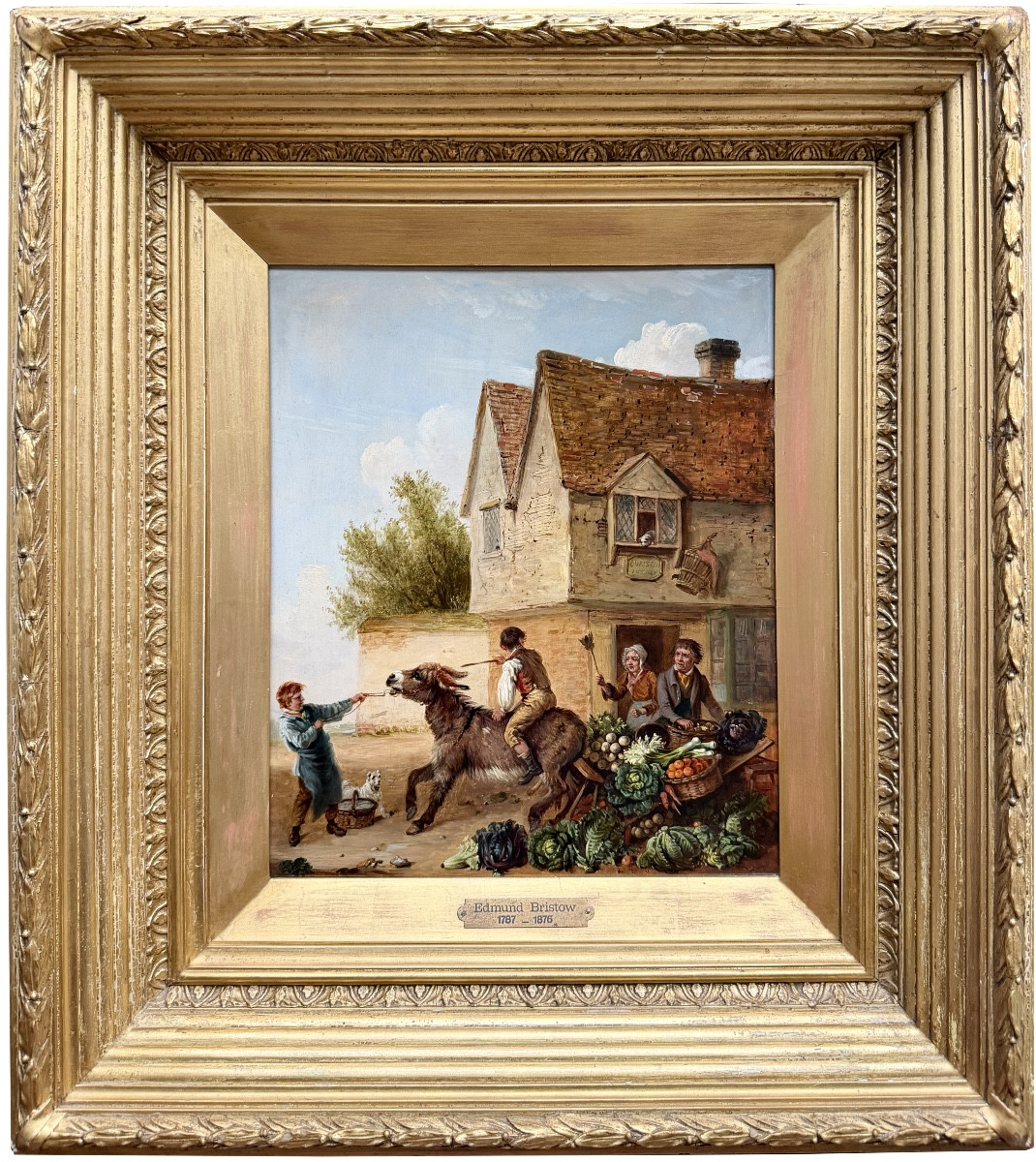
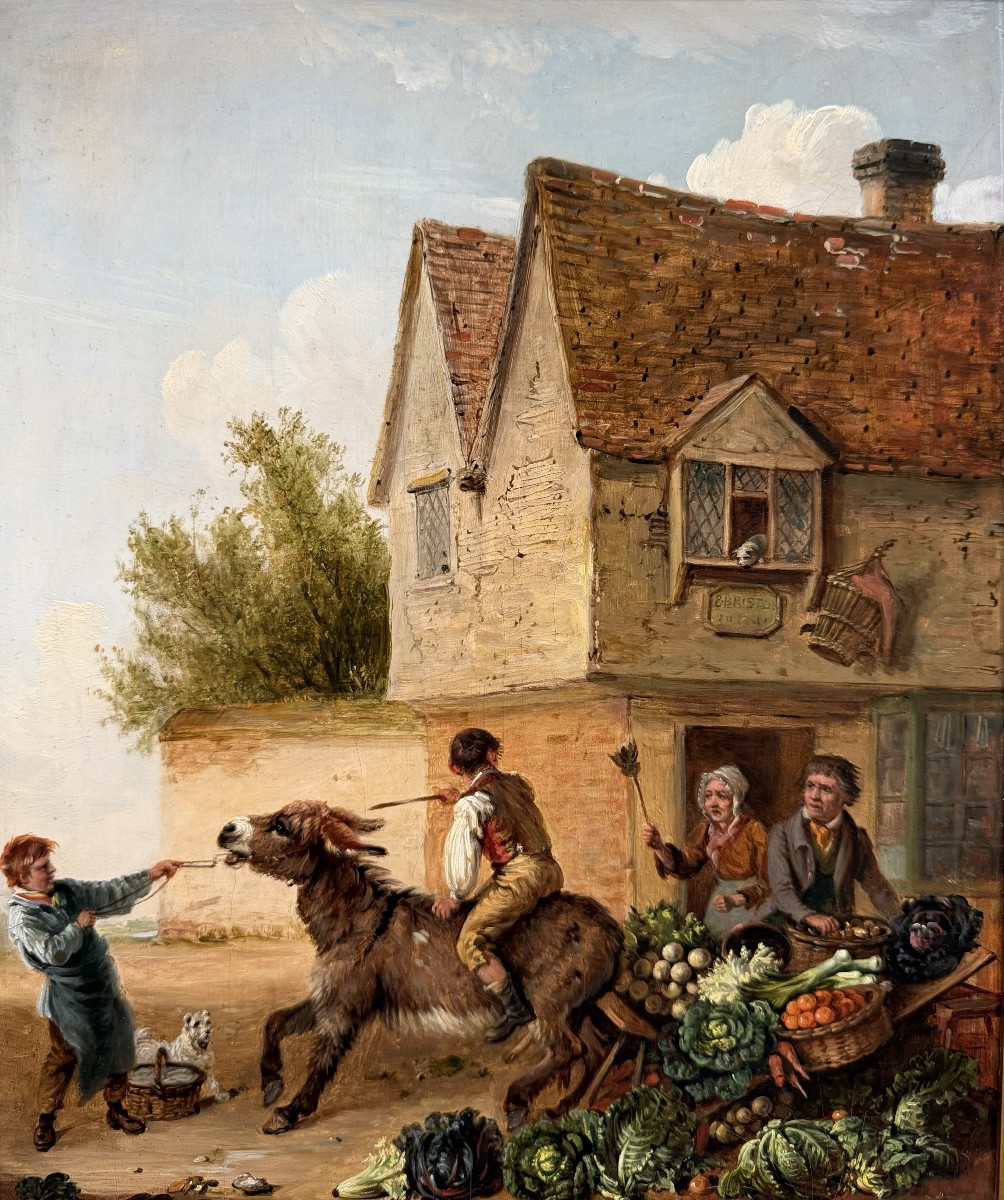
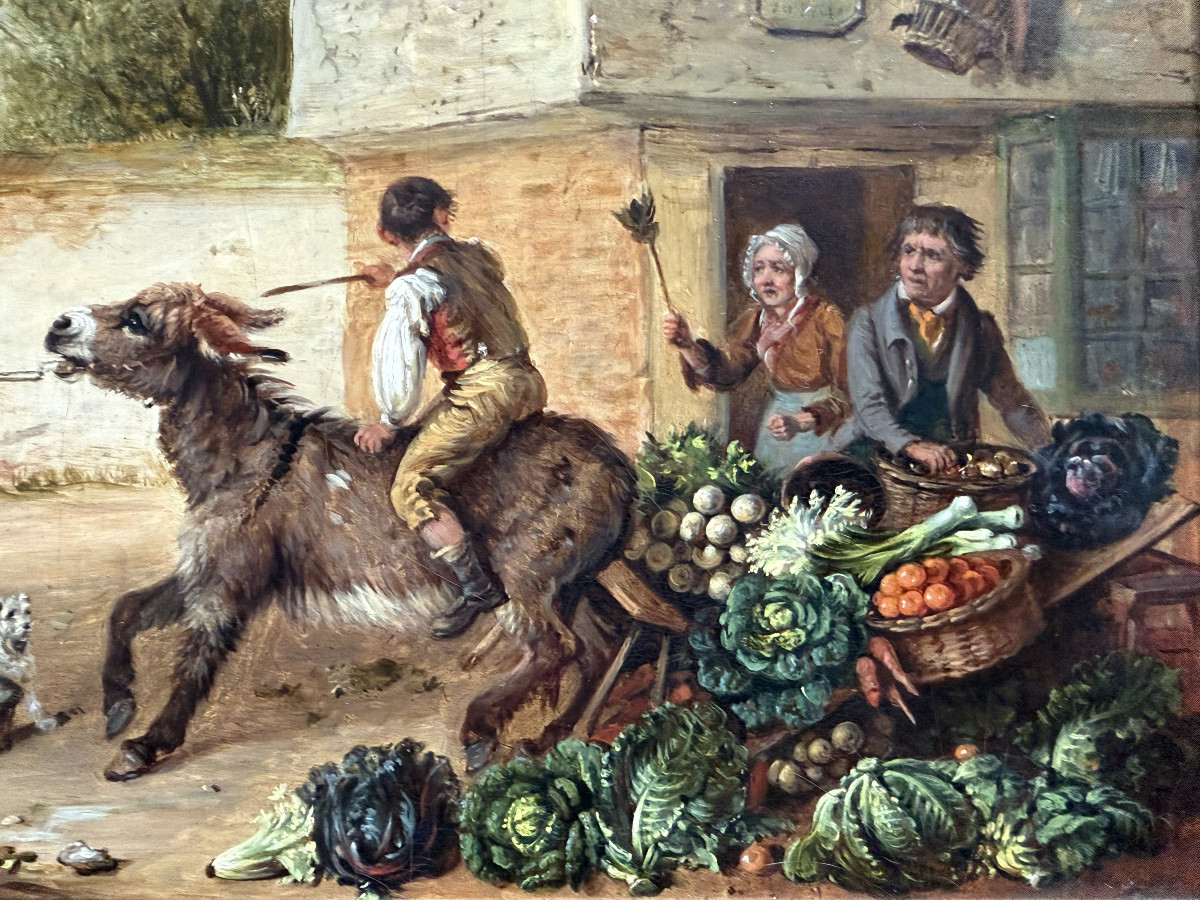
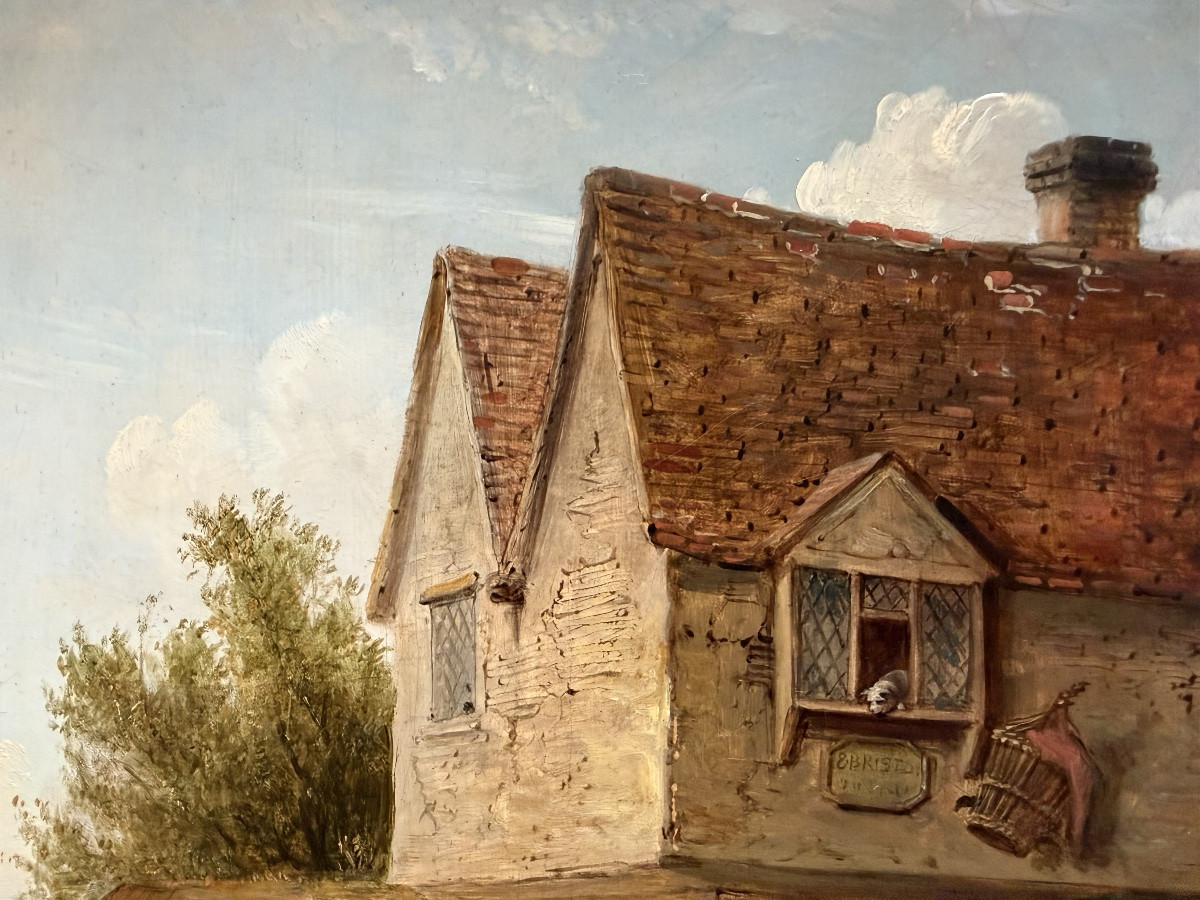
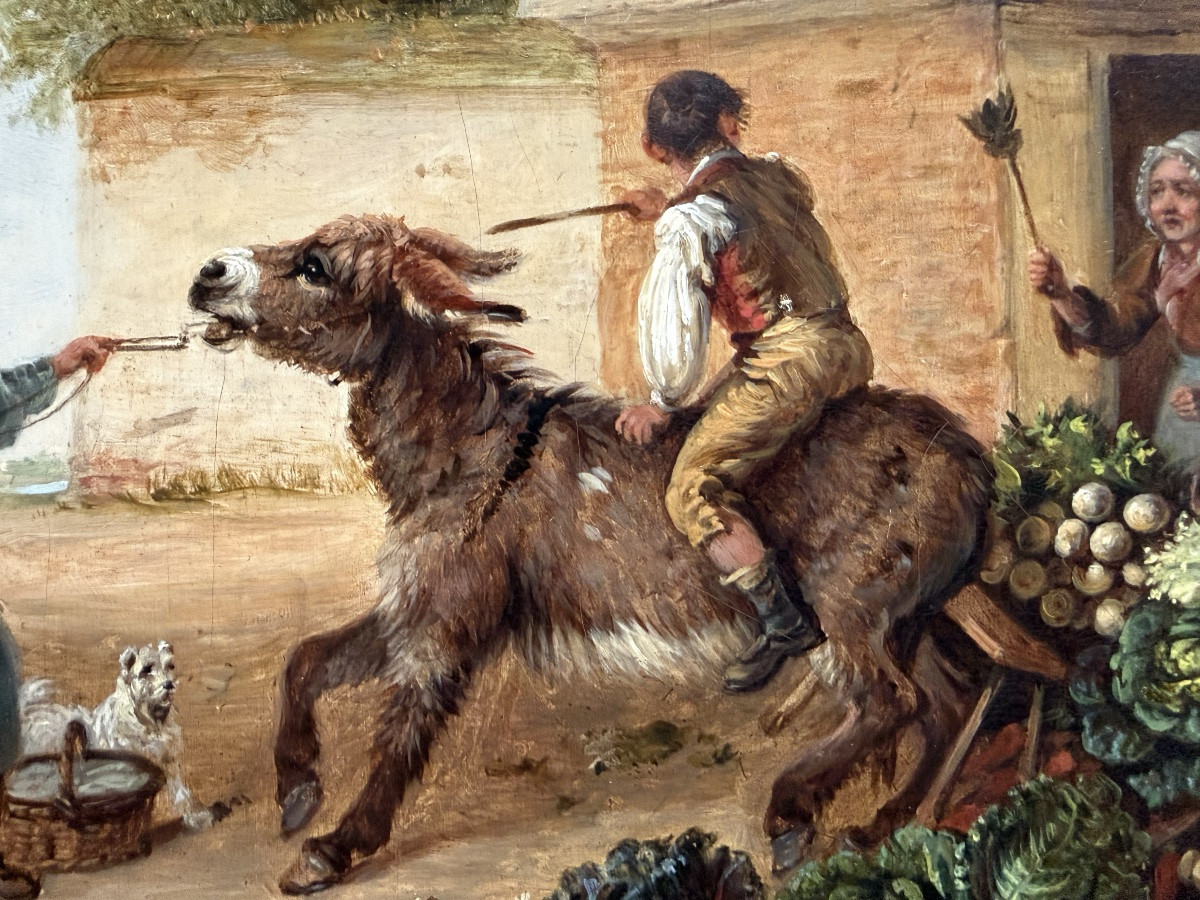
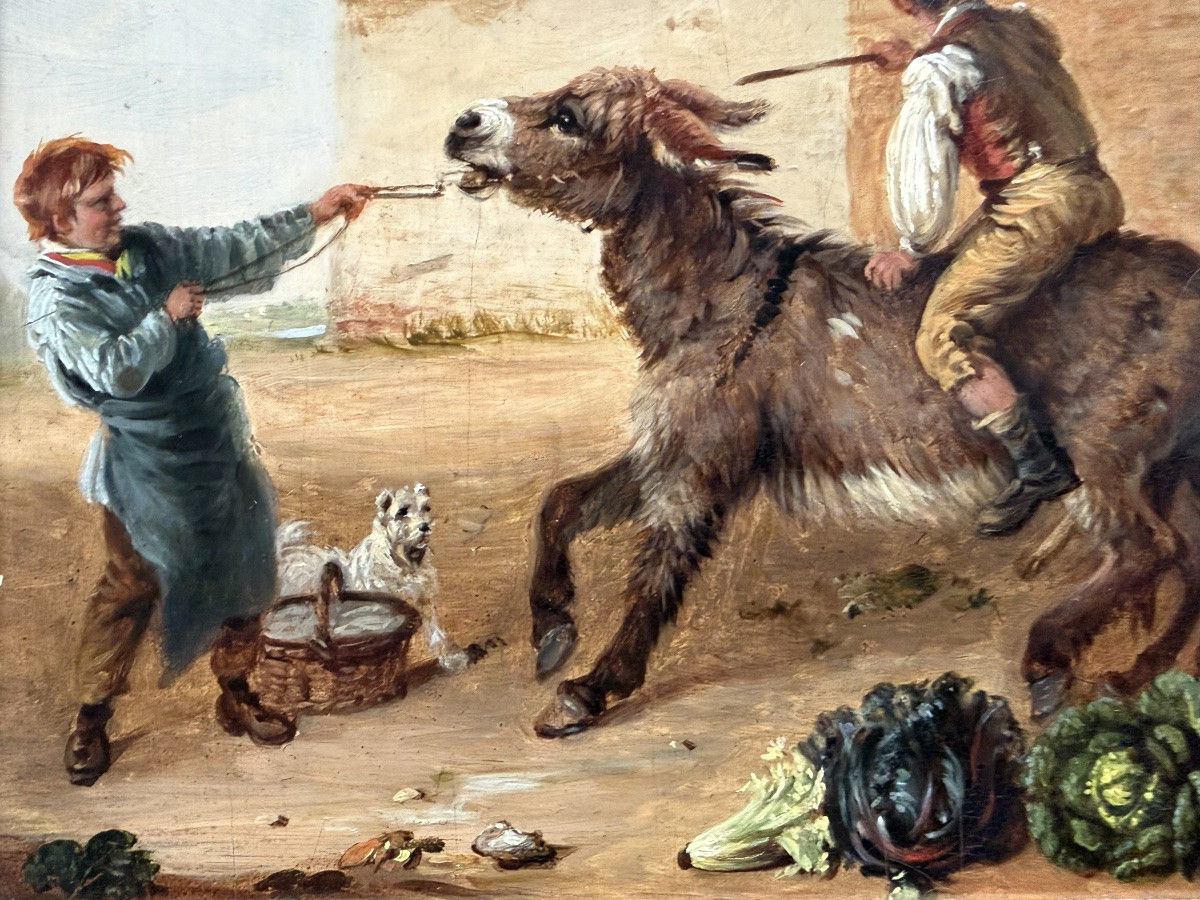
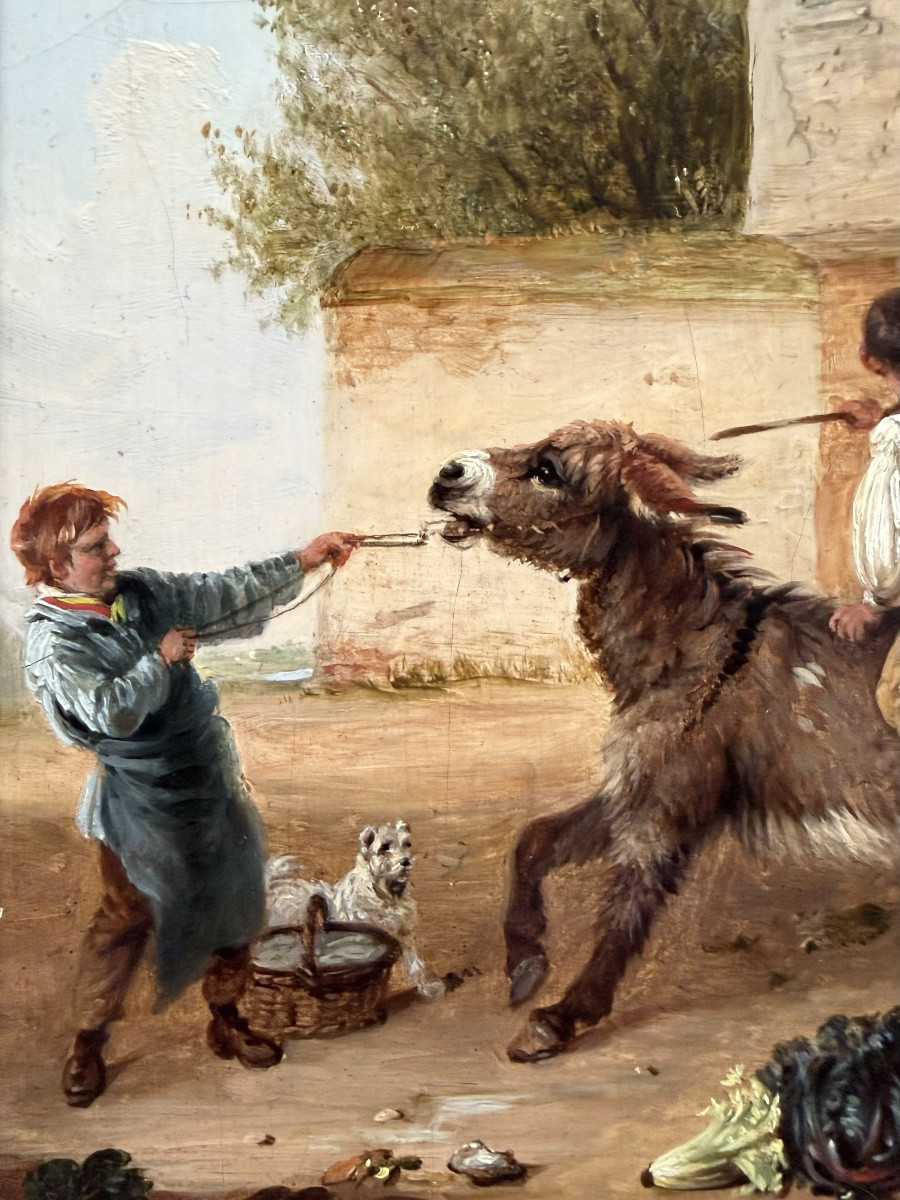
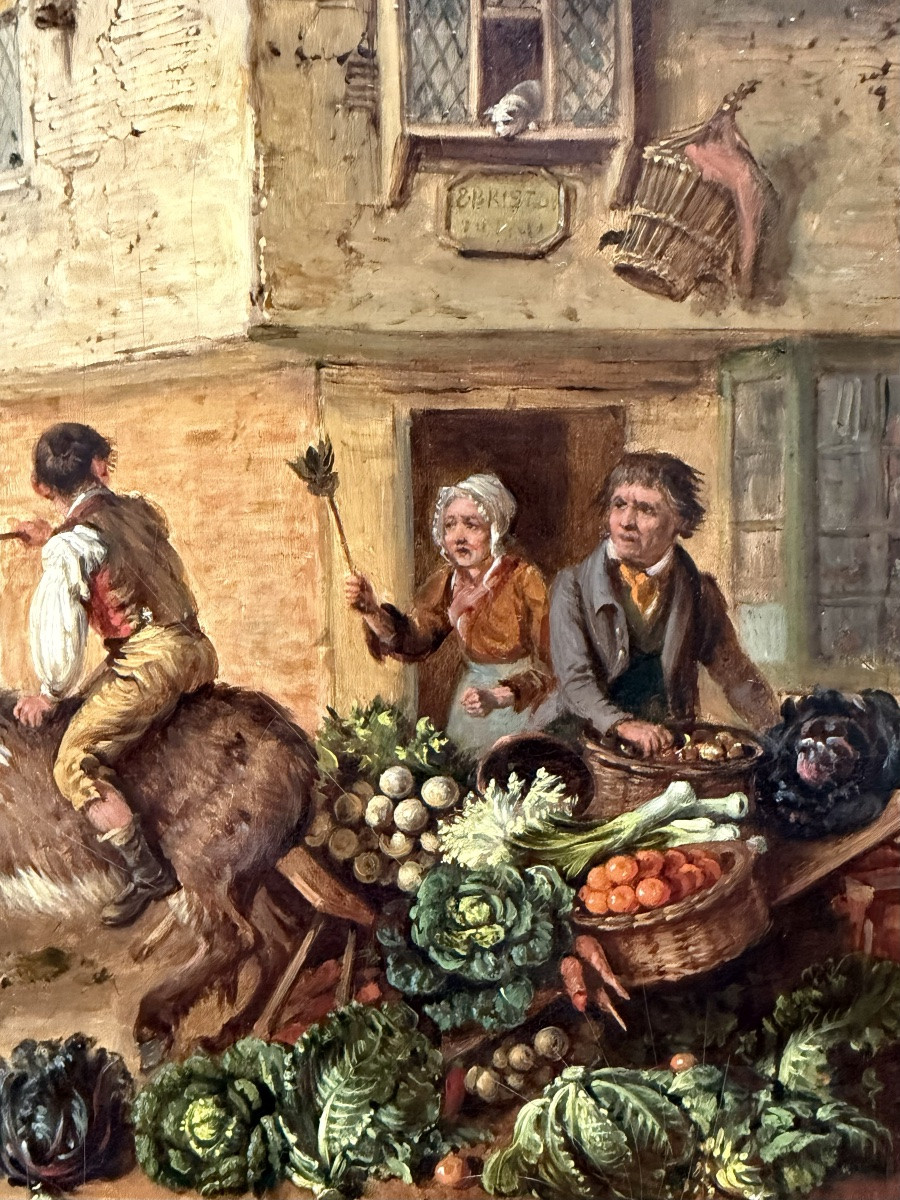
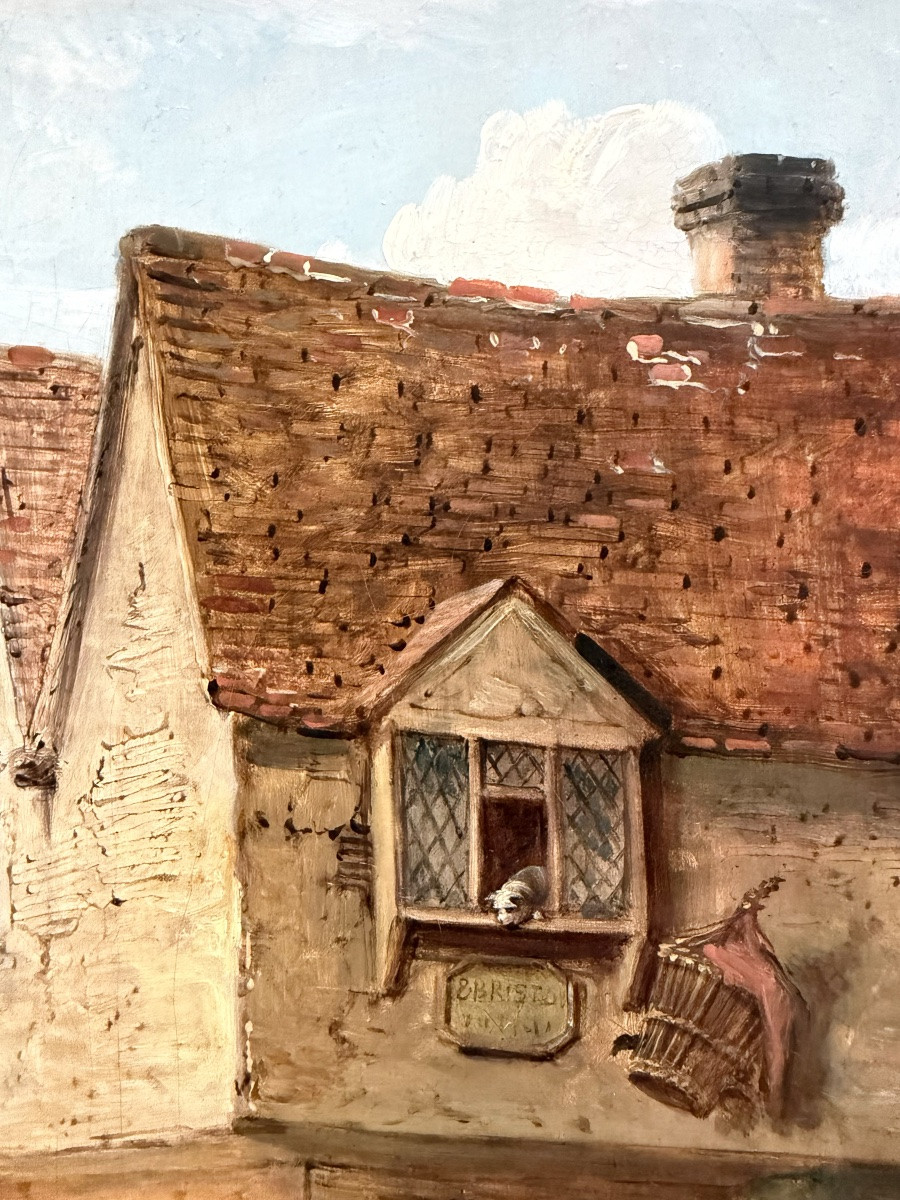
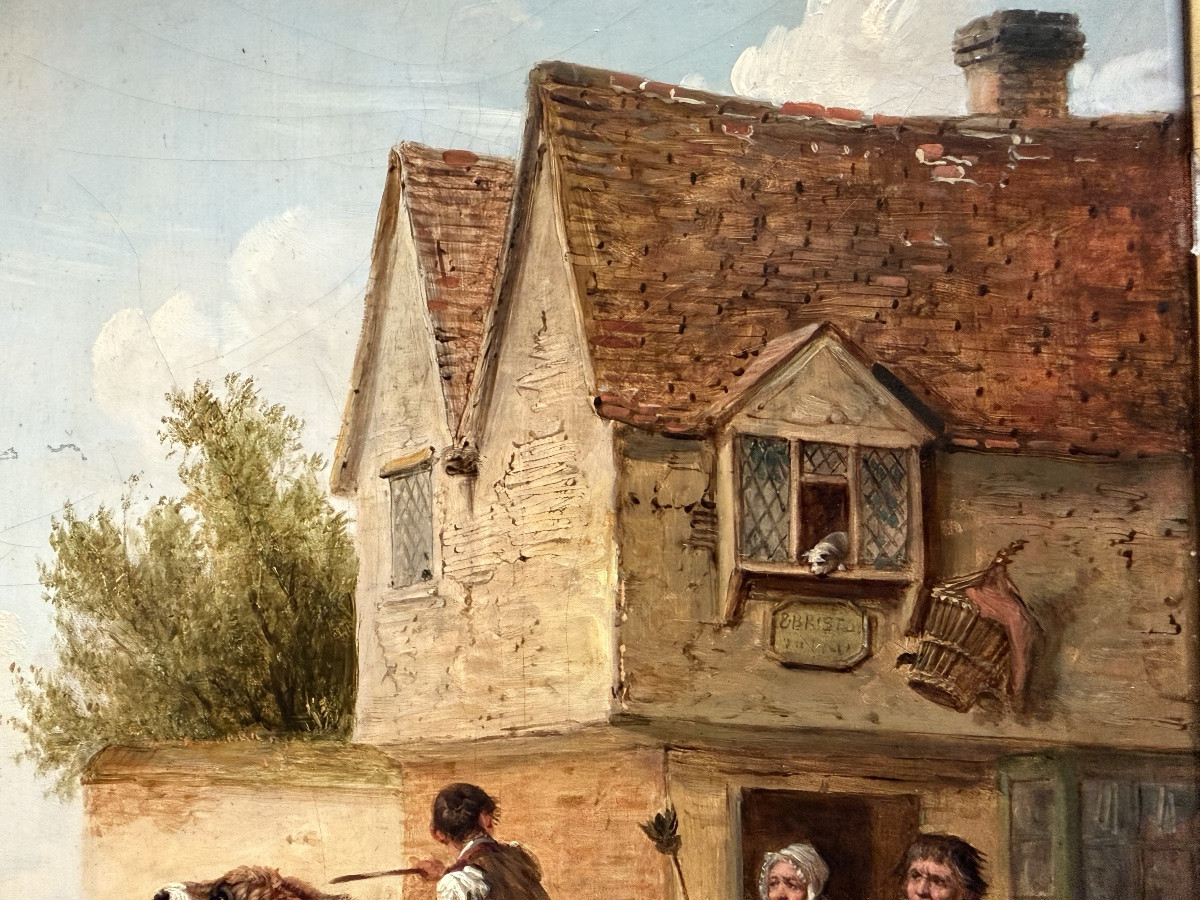
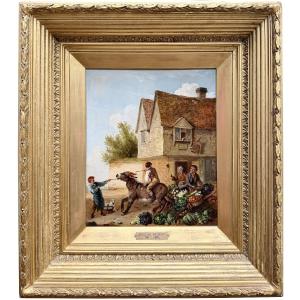


Edmund Bristow (1787 - Eton - 1876) English Painter - ' The Stubborn '
Edmund Bristow
1787 – Eton – 1876
English Painter
'The Stubborn'
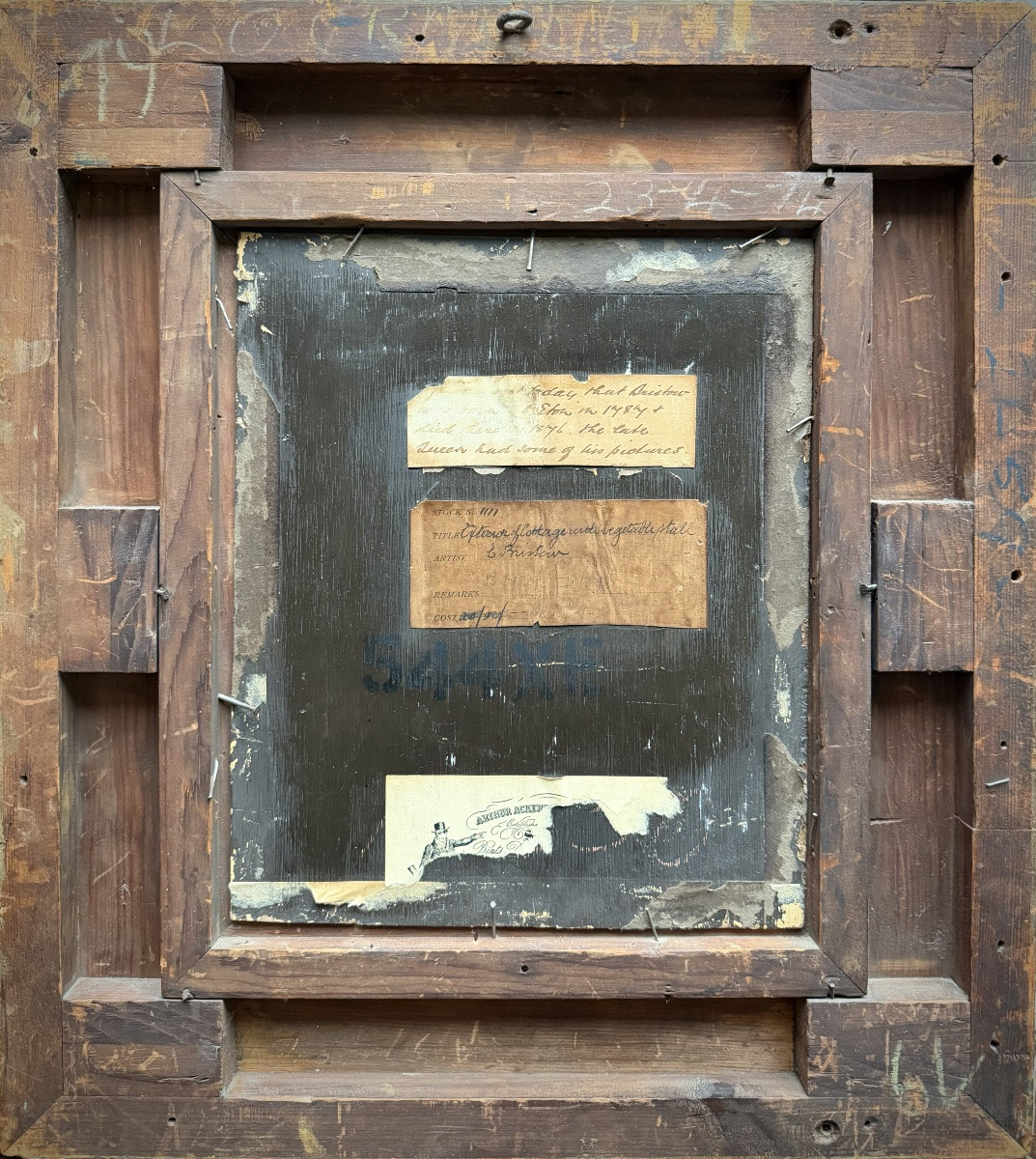
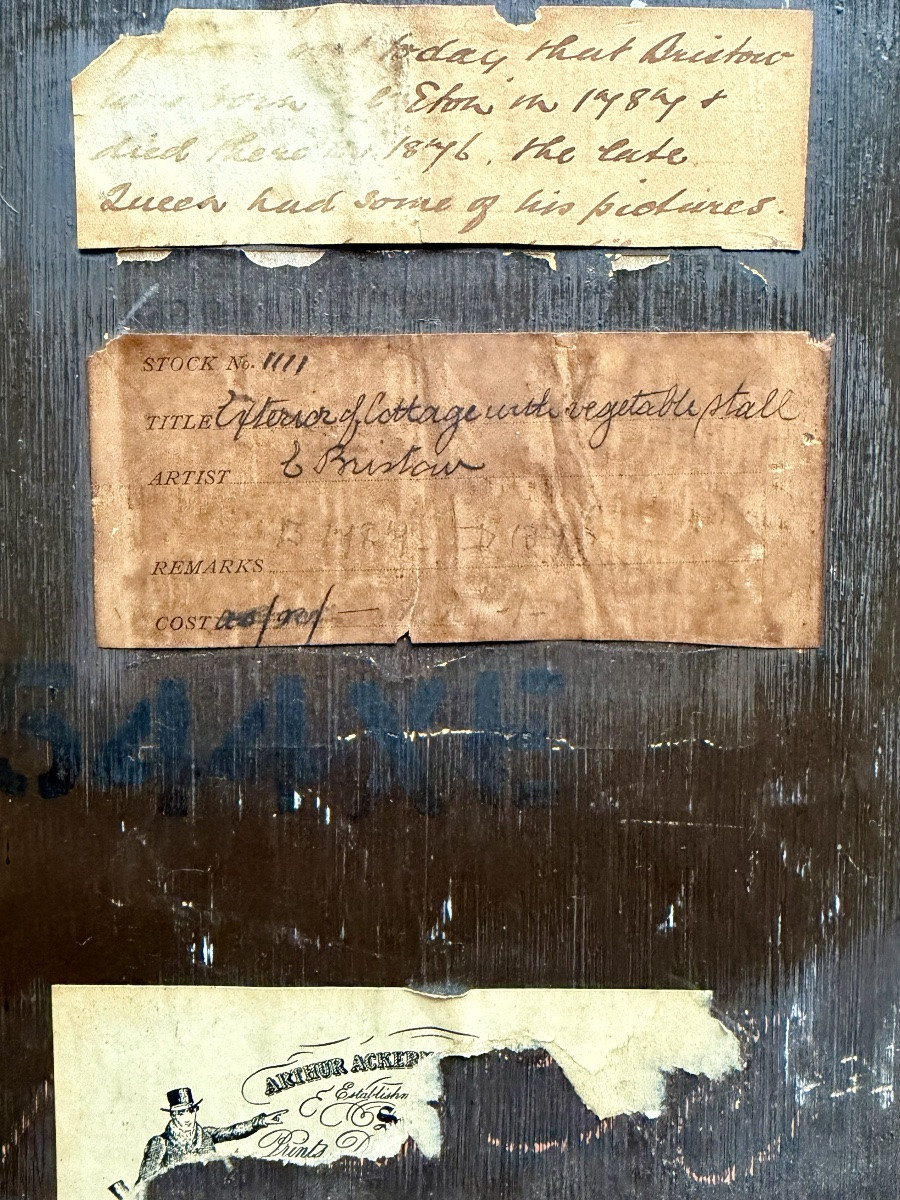
Signature: signed on the nameplate of the cottage 'E. BRISTOW'; titled on the reverse 'Interior of a Cottage with Vegetable Stall; reverse further inscribed with a note stating that Bristow was born in Eton in 1787 and died there in 1876, and that the late Queen owned several of his paintings
Medium: oil on panel
Dimensions: image size 30,5 x 25,5 cm, frame size 51 x 45,5 cm
Biography: Edmund Bristow (1 April 1787 – 12 February 1876) was an English painter known for his highly original depictions of animals, still life compositions, and genre scenes. He was born in Eton, Berkshire, the son of an heraldic painter, and grew up in an environment closely connected to visual craftsmanship and decorative arts.
From an early age, Bristow received patronage from distinguished figures including Princess Elizabeth and the Duke of Clarence (later King William IV). This early support allowed him to develop his artistic practice independently, outside strict academic constraints. He became particularly known for sketching local personalities in Eton and Windsor, as well as for his carefully observed still lifes, interiors, and scenes of everyday domestic and sporting life.
Bristow is especially admired for his exceptional sensitivity toward animals. His works demonstrate a rare ability to capture movement, personality, and expression, particularly in subjects such as horses, cats, monkeys, and donkeys. His close observation of animal behaviour and character earned him a reputation that places him in close artistic proximity to Sir Edwin Landseer, with whom he is said to have shared a friendship and exchange of ideas.
He first exhibited at the Royal Academy in 1809 with Smith shoeing a Horse, and continued to show works intermittently at the Royal Academy, the British Institution, and the Society of British Artists until 1838, when he exhibited Donkey Race at Suffolk Street. His works were also reproduced in engravings published in The Sporting Magazine and other contemporary periodicals.
Among his best-known compositions are Monkey Pugilists, Cat’s Paw, Law and Justice, Incredulity, The Rehearsal, and Pros and Cons of Life, all of which reflect his wit, narrative imagination, and keen observational skill. His paintings are typically small in scale, meticulously detailed, and highly individual in character.
Bristow was known for his independent and somewhat eccentric personality. He worked only when inspired and famously refused commissions or even declined to sell certain finished works. This independence contributed to his relatively limited output, particularly during the last fifteen years of his life.
Today, his works are represented in important public collections, including the Victoria and Albert Museum (V&A), London, and the Tate Britain collection, as well as in several historic British private collections and regional museum holdings connected to Eton and Windsor heritage.
Edmund Bristow died in Eton on 12 February 1876 at the age of 89. His work remains valued for its originality, humour, and highly perceptive study of animal life within the tradition of early 19th-century British painting.
1787 – Eton – 1876
English Painter
'The Stubborn'
Signature: signed on the nameplate of the cottage 'E. BRISTOW'; titled on the reverse 'Interior of a Cottage with Vegetable Stall; reverse further inscribed with a note stating that Bristow was born in Eton in 1787 and died there in 1876, and that the late Queen owned several of his paintings
Medium: oil on panel
Dimensions: image size 30,5 x 25,5 cm, frame size 51 x 45,5 cm
Biography: Edmund Bristow (1 April 1787 – 12 February 1876) was an English painter known for his highly original depictions of animals, still life compositions, and genre scenes. He was born in Eton, Berkshire, the son of an heraldic painter, and grew up in an environment closely connected to visual craftsmanship and decorative arts.
From an early age, Bristow received patronage from distinguished figures including Princess Elizabeth and the Duke of Clarence (later King William IV). This early support allowed him to develop his artistic practice independently, outside strict academic constraints. He became particularly known for sketching local personalities in Eton and Windsor, as well as for his carefully observed still lifes, interiors, and scenes of everyday domestic and sporting life.
Bristow is especially admired for his exceptional sensitivity toward animals. His works demonstrate a rare ability to capture movement, personality, and expression, particularly in subjects such as horses, cats, monkeys, and donkeys. His close observation of animal behaviour and character earned him a reputation that places him in close artistic proximity to Sir Edwin Landseer, with whom he is said to have shared a friendship and exchange of ideas.
He first exhibited at the Royal Academy in 1809 with Smith shoeing a Horse, and continued to show works intermittently at the Royal Academy, the British Institution, and the Society of British Artists until 1838, when he exhibited Donkey Race at Suffolk Street. His works were also reproduced in engravings published in The Sporting Magazine and other contemporary periodicals.
Among his best-known compositions are Monkey Pugilists, Cat’s Paw, Law and Justice, Incredulity, The Rehearsal, and Pros and Cons of Life, all of which reflect his wit, narrative imagination, and keen observational skill. His paintings are typically small in scale, meticulously detailed, and highly individual in character.
Bristow was known for his independent and somewhat eccentric personality. He worked only when inspired and famously refused commissions or even declined to sell certain finished works. This independence contributed to his relatively limited output, particularly during the last fifteen years of his life.
Today, his works are represented in important public collections, including the Victoria and Albert Museum (V&A), London, and the Tate Britain collection, as well as in several historic British private collections and regional museum holdings connected to Eton and Windsor heritage.
Edmund Bristow died in Eton on 12 February 1876 at the age of 89. His work remains valued for its originality, humour, and highly perceptive study of animal life within the tradition of early 19th-century British painting.
2 100 €
Period: 19th century
Style: Other Style
Condition: Excellent condition
Material: Oil painting on wood
Width: 45,5 cm
Height: 51 cm
Depth: 12 cm
Reference (ID): 1758429
Availability: In stock
Print