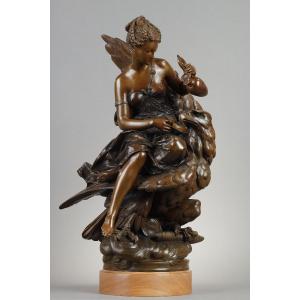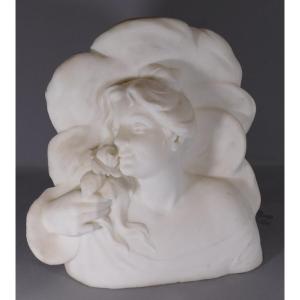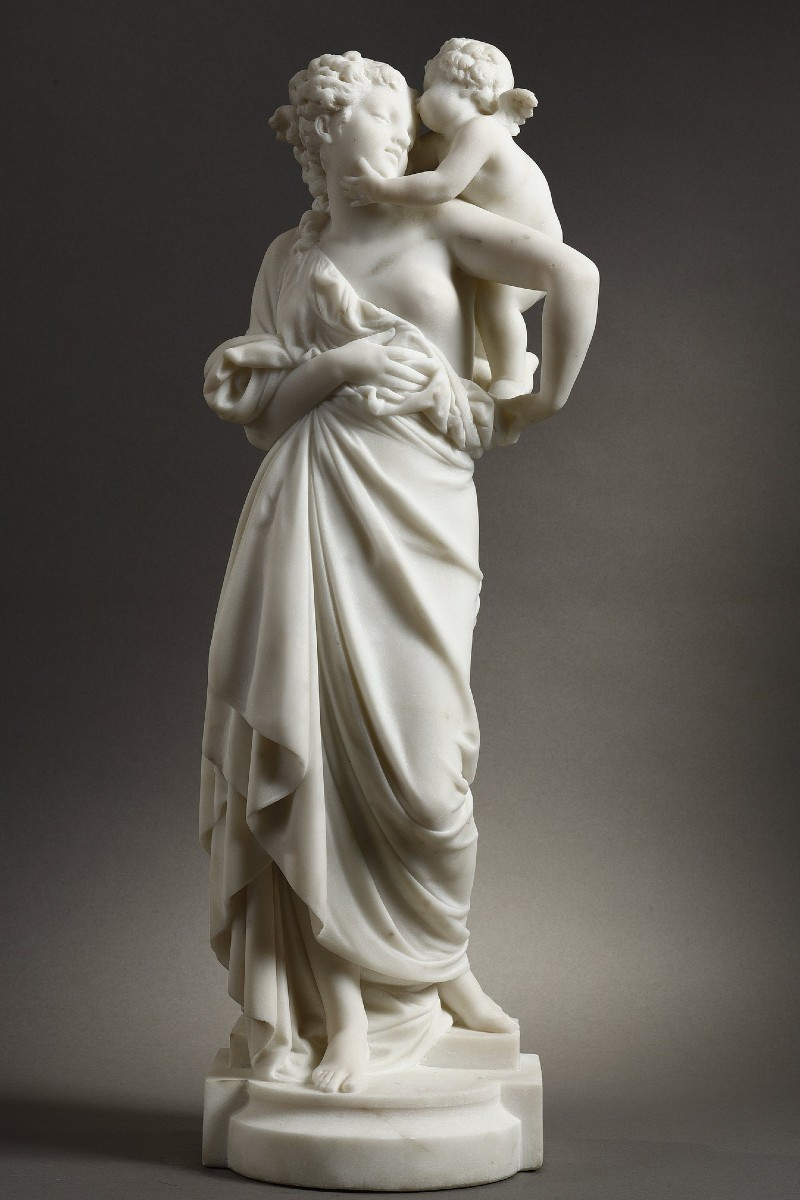
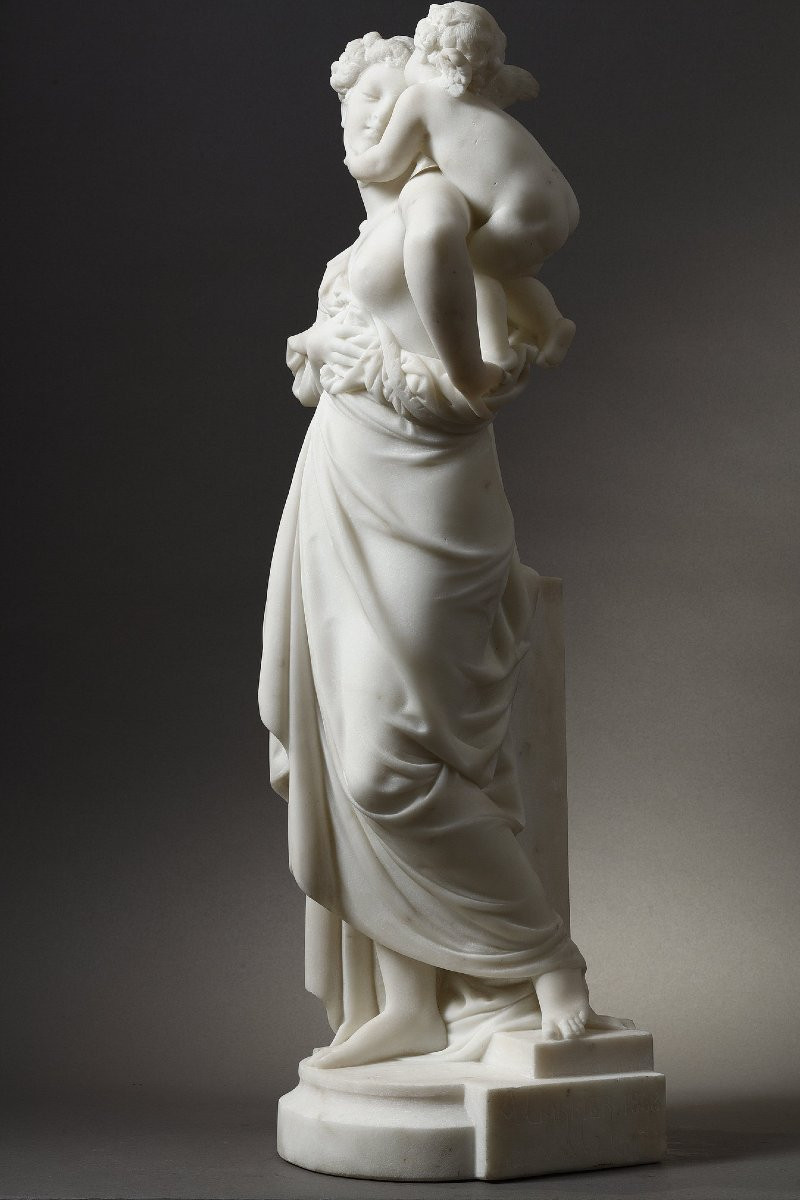
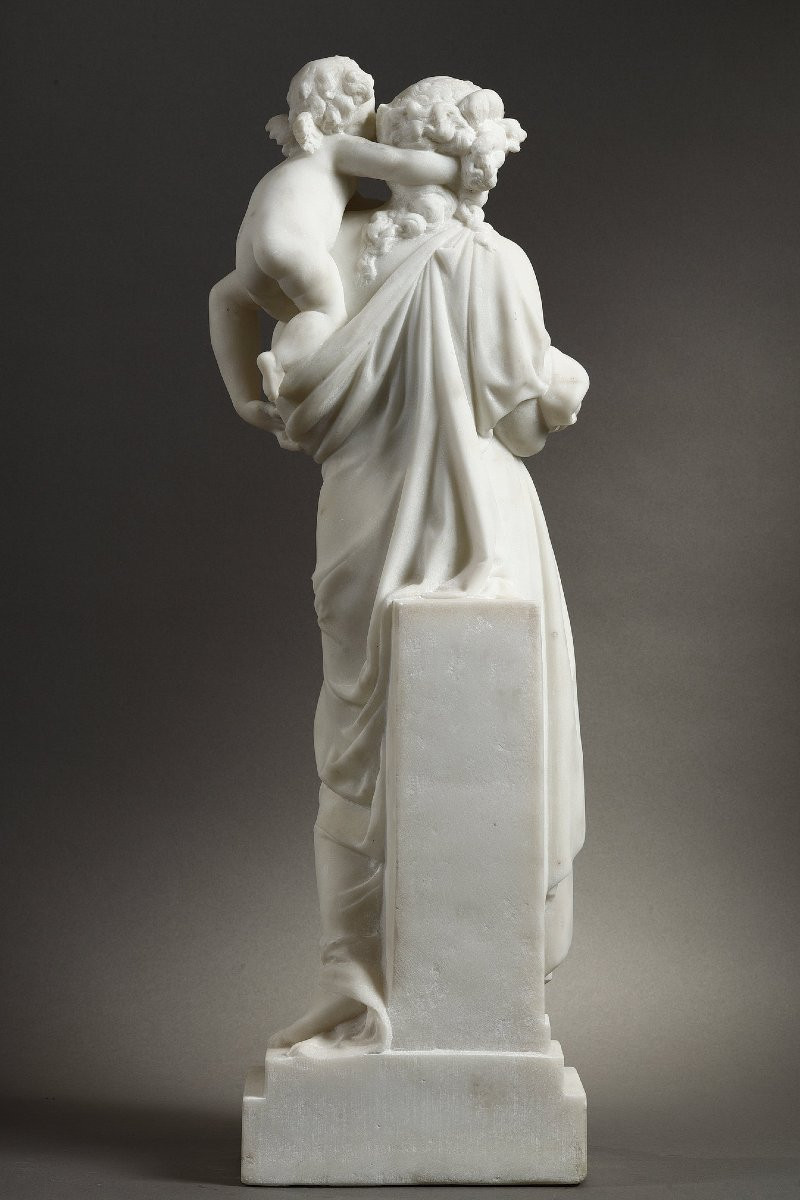
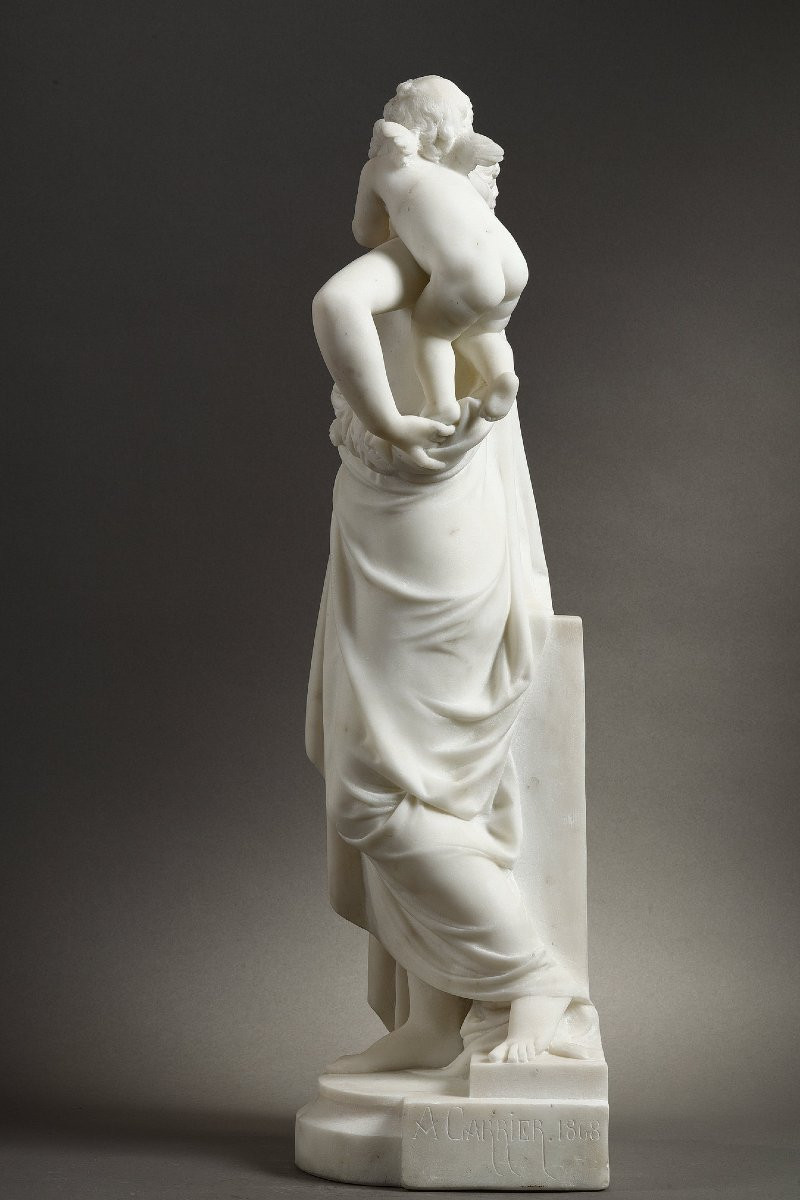
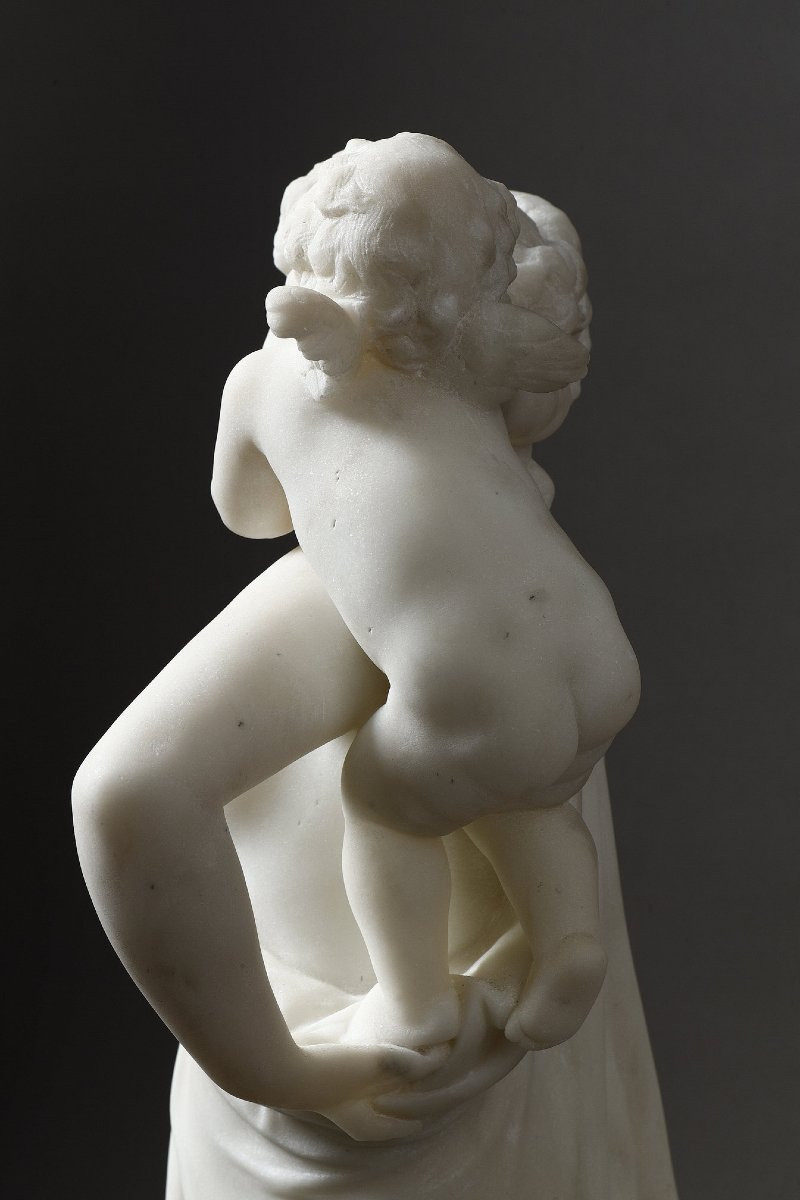
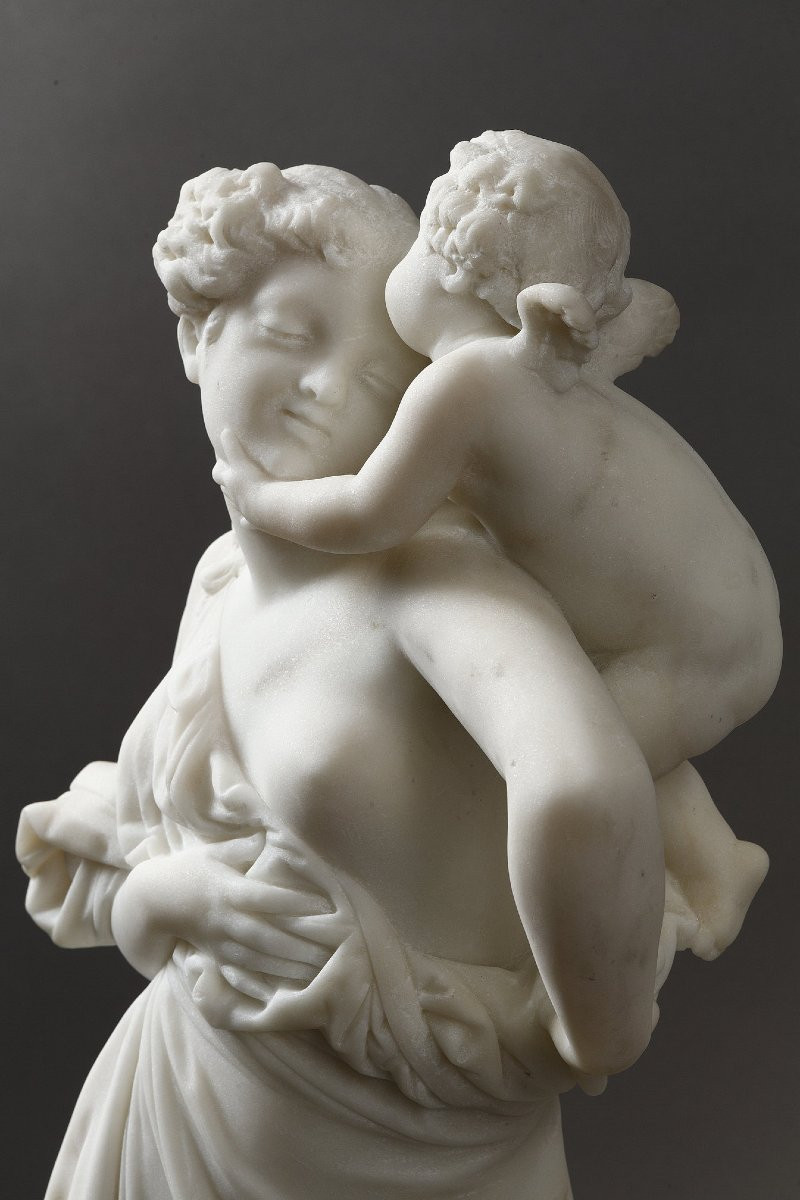
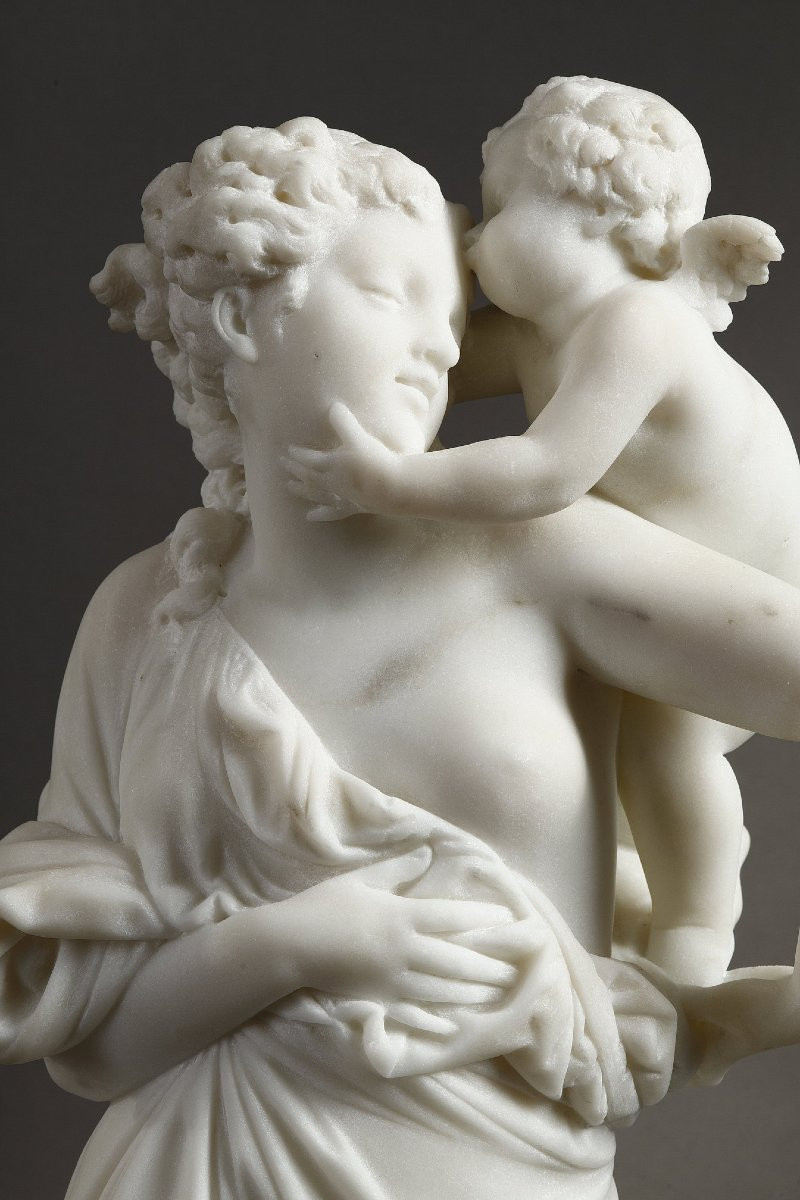
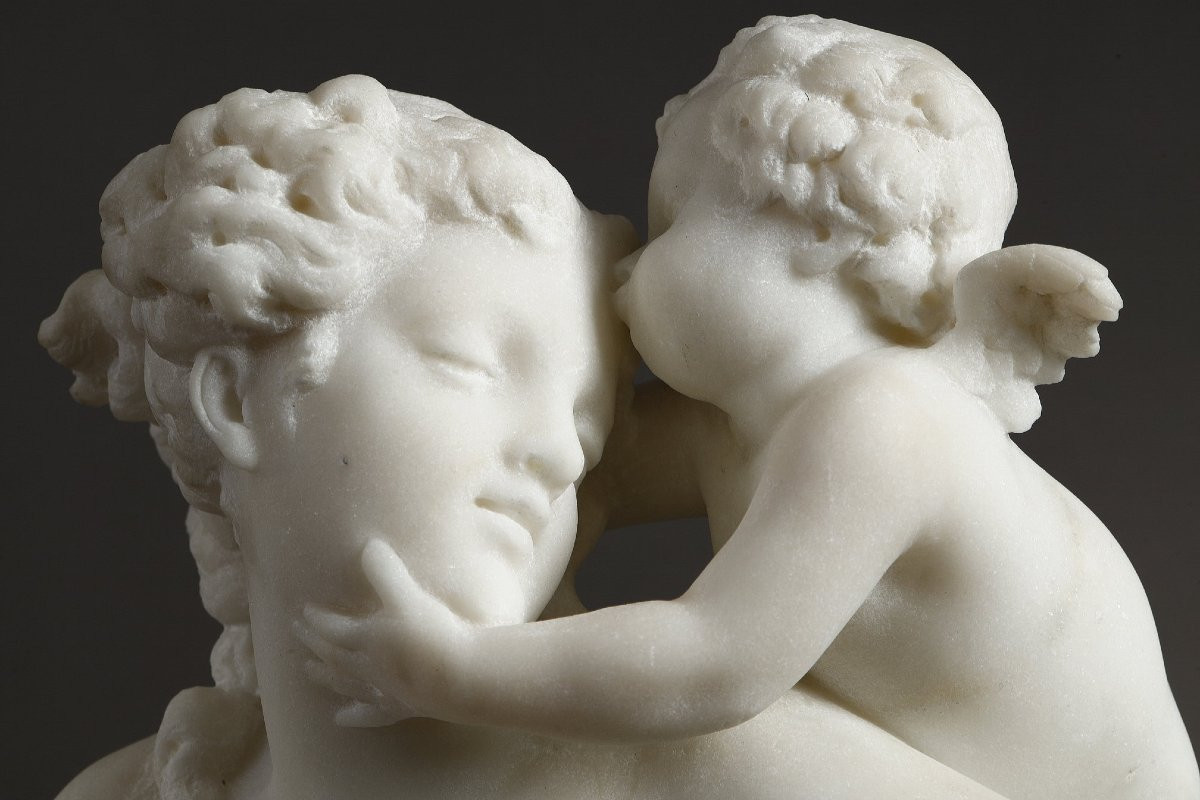
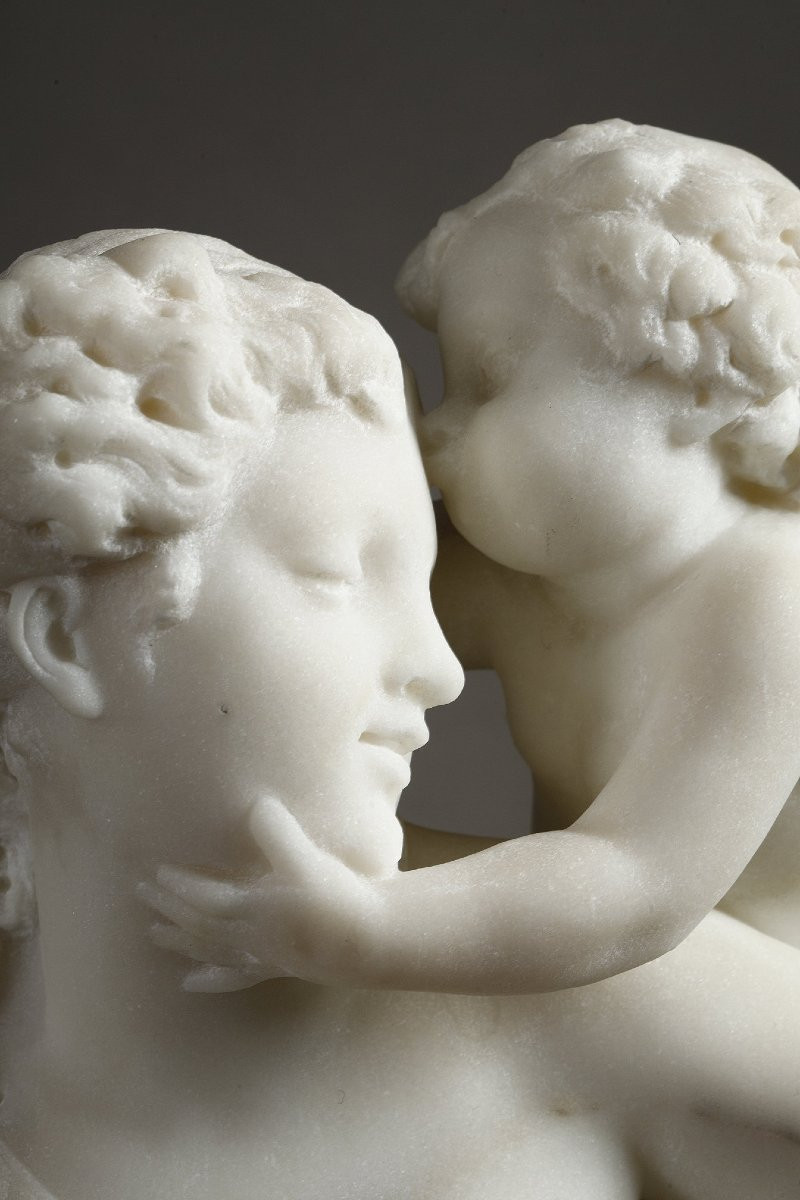
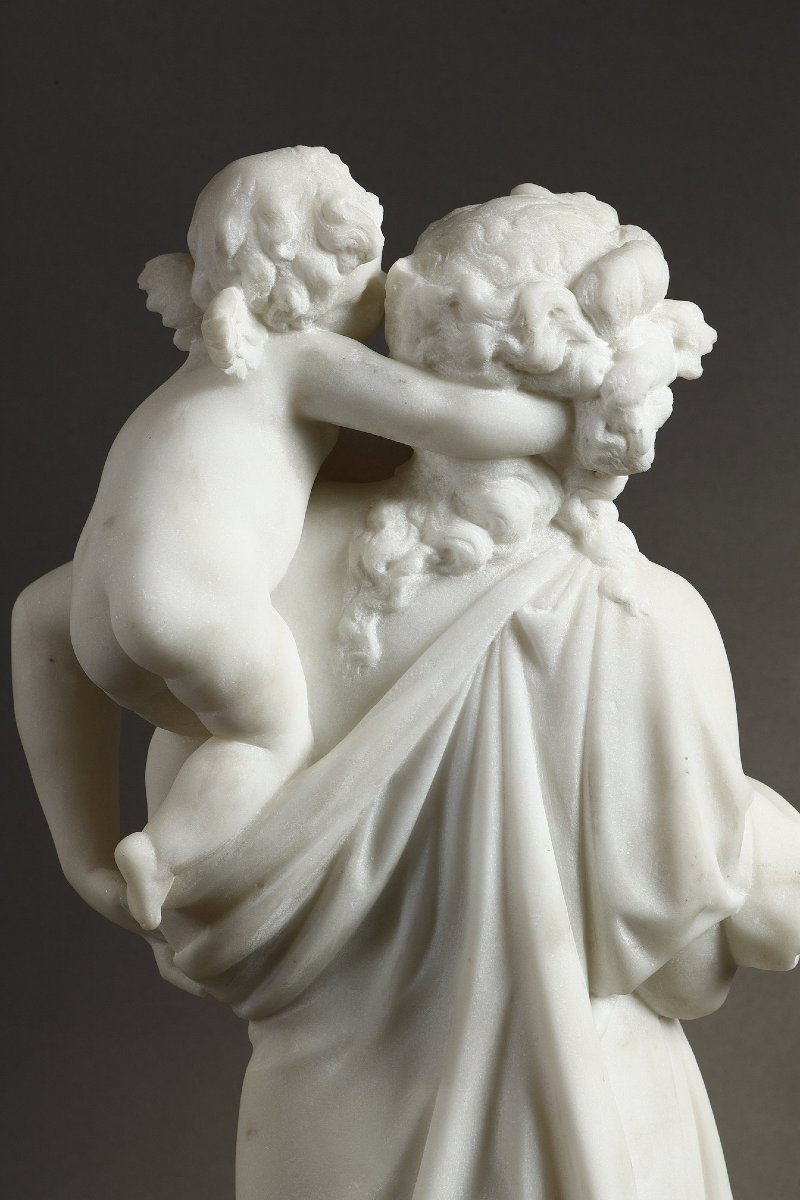


Allegory Of Love - Albert-ernest Carrier-belleuse (1824-1887)
Artist: Carrier-belleuse
Carved group in white Carrara marble
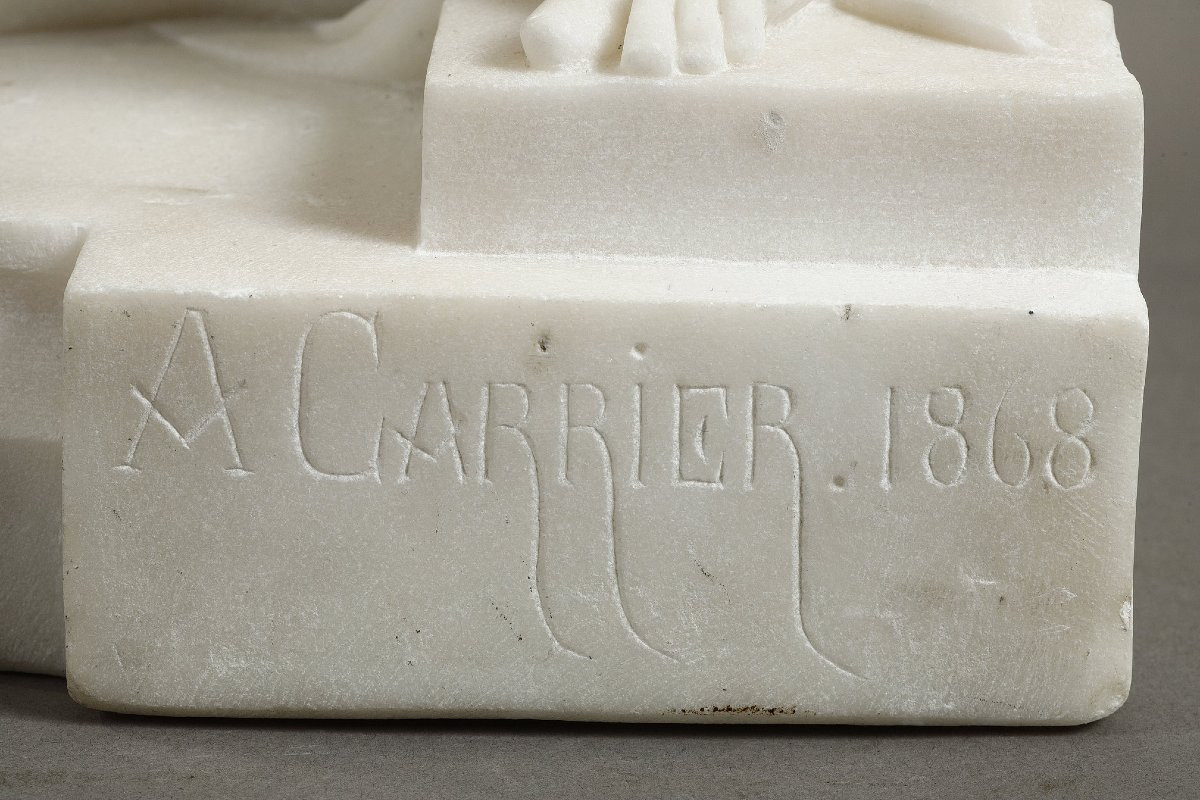
signed "A. Carrier"
and dated "1868"
France
1868
height 68.5 cm
width 25 cm
prof. 19 cm
link to our web catalog:
https://galerietourbillon.com/carrier-belleuse-albert-ernest-allegorie-de-lamour/
Galerie Tourbillon : Free appraisals - Buying - Selling
Biography:
Albert-Ernest Carrier de Belleuse dit Carrier-Belleuse (1824-1887)was one of the century's most prolific artists and enjoyed great successunder the Second Empire, enjoying the personal support of Napoleon III.His work was greatly influenced by the styles of the Italian Renaissanceand eighteenth-century styles, which he helped to bring up to date.In 1837, the young Carrier-Belleuse began an apprenticeshipworkshop of the chisel-maker Bauchery, and soon afterwards was accepted by the goldsmith JacquesHenri Fauconnier. Through François Arago, he met the sculptor David d'Angers.the sculptor David d'Angers, who facilitated his admission to the École des Beaux-Arts.Carrier-Belleuse entered in 1840. Noted for his skill by the great bronzebronze houses such as Barbedienne and Denière, he soon received numerousreceive numerous orders for models of candelabras, clocks, fireplacefireplace ornaments, etc. In 1848, probably at the instigation ofFrançois Arago, who had become head of state, he received his first public commissionfor a small statue of Mademoiselle Rachel singing La Marseillaise.In 1851, he appeared for the first time at the Salon des artistes français, where hetwo bronze medallions. From 1851 to 1855, Carrier-Belleuse spent timein England, in Stoke-on-Trent, where he was director of theschool of modeling and drawing at Mintons, a major porcelain manufacturer.porcelain factory.On his return to France, Carrier-Belleuse settled in Parisa vast studio at 15 rue de la Tour d'Auvergne. From 1857, he made regularregular entries to the Salon, and gained notoriety with the success of majormarbles, such as the Bacchante, exhibited at the 1863 Salon andacquired by Napoleon III, Angelica (1866) and Hébéendormie (1869). At the 1867 Salon, his group entitled LeMessiah won him the medal of honor for sculpture. It was acquiredto decorate the chapel of the Virgin in the church ofSaint-Vincent-de-Paul church.At the same time, Carrier-Belleuse became renowned for his terracotta bustswhich, in many respects, are reminiscent of the work of 18th-centuryeighteenth-century artists. He painted portraits of many of the celebrities of his time.of his time. He produced busts of Napoleon III, Renan,Thiers, Grévy, Arago, Marguerite Bellanger, Théophile Gautier, Honoré Daumier,Delacroix, Hortense Schneider, Réjane... He also modeled numerous busts of mythologicalof mythological inspiration and a series of historical and artistic portraitssuch as Mary Stuart, Shakespeare and Mozart.Carrier-Belleuse employed and trained many young artists in his rue de la Tourmany talented young artists, including Alexandre Falguière, Jules DeschampsAlexandre Falguière, Jules Desbois, Eugène Delaplanche, Jules Dalou and evenJoseph Chéret; but he is best known for having been the master of AugusteRodin, who joined his studio as a practitioner in 1864.Carrier-Belleuse devoted much of his time to decorative sculpture.He contributed to the decoration of many important buildings. He was notably responsible forthe caryatids of the Renaissance theater, the pediment of the main entranceof the Banque de France, the stucco ceilings of the Lesdiguières and La TrémoïlleTrémoïlle pavilions at the Palais du Louvre, the frieze at the Palais de la Bourse in Brussels, and theand the decoration of the Hôtel de la Païva on the Champs-Elysées in Paris. Healso received state commissions for monuments: that of Jean-JacquesRousseau in Montmorency, Alexandre Dumas in Villers-Cotterêts and Masséna in Nice.Nice. Abroad, he created the equestrian statue of Michel le brave in Bucharestand the tomb of José de San Martín in Buenos Aires.In 1873, Carrier-Belleuse took part in the Paris Opera projectdirected by his friend Charles Garnier. He created the two monumentalflanking the grand staircase in the main hall, and the caryatidsand the caryatids on the chimney of the grand foyer. In 1875, he was appointed director of worksof the Manufacture de Sèvres. He gave the factory a thoroughly modern impetusthe creation of a complete range of vases.
signed "A. Carrier"
and dated "1868"
France
1868
height 68.5 cm
width 25 cm
prof. 19 cm
link to our web catalog:
https://galerietourbillon.com/carrier-belleuse-albert-ernest-allegorie-de-lamour/
Galerie Tourbillon : Free appraisals - Buying - Selling
Biography:
Albert-Ernest Carrier de Belleuse dit Carrier-Belleuse (1824-1887)was one of the century's most prolific artists and enjoyed great successunder the Second Empire, enjoying the personal support of Napoleon III.His work was greatly influenced by the styles of the Italian Renaissanceand eighteenth-century styles, which he helped to bring up to date.In 1837, the young Carrier-Belleuse began an apprenticeshipworkshop of the chisel-maker Bauchery, and soon afterwards was accepted by the goldsmith JacquesHenri Fauconnier. Through François Arago, he met the sculptor David d'Angers.the sculptor David d'Angers, who facilitated his admission to the École des Beaux-Arts.Carrier-Belleuse entered in 1840. Noted for his skill by the great bronzebronze houses such as Barbedienne and Denière, he soon received numerousreceive numerous orders for models of candelabras, clocks, fireplacefireplace ornaments, etc. In 1848, probably at the instigation ofFrançois Arago, who had become head of state, he received his first public commissionfor a small statue of Mademoiselle Rachel singing La Marseillaise.In 1851, he appeared for the first time at the Salon des artistes français, where hetwo bronze medallions. From 1851 to 1855, Carrier-Belleuse spent timein England, in Stoke-on-Trent, where he was director of theschool of modeling and drawing at Mintons, a major porcelain manufacturer.porcelain factory.On his return to France, Carrier-Belleuse settled in Parisa vast studio at 15 rue de la Tour d'Auvergne. From 1857, he made regularregular entries to the Salon, and gained notoriety with the success of majormarbles, such as the Bacchante, exhibited at the 1863 Salon andacquired by Napoleon III, Angelica (1866) and Hébéendormie (1869). At the 1867 Salon, his group entitled LeMessiah won him the medal of honor for sculpture. It was acquiredto decorate the chapel of the Virgin in the church ofSaint-Vincent-de-Paul church.At the same time, Carrier-Belleuse became renowned for his terracotta bustswhich, in many respects, are reminiscent of the work of 18th-centuryeighteenth-century artists. He painted portraits of many of the celebrities of his time.of his time. He produced busts of Napoleon III, Renan,Thiers, Grévy, Arago, Marguerite Bellanger, Théophile Gautier, Honoré Daumier,Delacroix, Hortense Schneider, Réjane... He also modeled numerous busts of mythologicalof mythological inspiration and a series of historical and artistic portraitssuch as Mary Stuart, Shakespeare and Mozart.Carrier-Belleuse employed and trained many young artists in his rue de la Tourmany talented young artists, including Alexandre Falguière, Jules DeschampsAlexandre Falguière, Jules Desbois, Eugène Delaplanche, Jules Dalou and evenJoseph Chéret; but he is best known for having been the master of AugusteRodin, who joined his studio as a practitioner in 1864.Carrier-Belleuse devoted much of his time to decorative sculpture.He contributed to the decoration of many important buildings. He was notably responsible forthe caryatids of the Renaissance theater, the pediment of the main entranceof the Banque de France, the stucco ceilings of the Lesdiguières and La TrémoïlleTrémoïlle pavilions at the Palais du Louvre, the frieze at the Palais de la Bourse in Brussels, and theand the decoration of the Hôtel de la Païva on the Champs-Elysées in Paris. Healso received state commissions for monuments: that of Jean-JacquesRousseau in Montmorency, Alexandre Dumas in Villers-Cotterêts and Masséna in Nice.Nice. Abroad, he created the equestrian statue of Michel le brave in Bucharestand the tomb of José de San Martín in Buenos Aires.In 1873, Carrier-Belleuse took part in the Paris Opera projectdirected by his friend Charles Garnier. He created the two monumentalflanking the grand staircase in the main hall, and the caryatidsand the caryatids on the chimney of the grand foyer. In 1875, he was appointed director of worksof the Manufacture de Sèvres. He gave the factory a thoroughly modern impetusthe creation of a complete range of vases.
9 500 €
Period: 19th century
Style: Napoleon 3rd
Condition: Excellent condition
Material: Marble
Height: 68,5 cm
Reference (ID): 1751757
Availability: In stock
Print