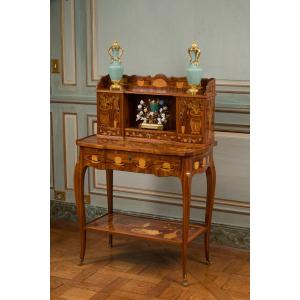


Mid-period Transitional Bonheur Du Jour Attributed To Charles Topino
Artist: Charles Topino
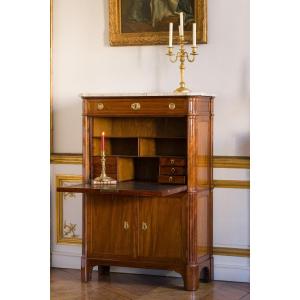
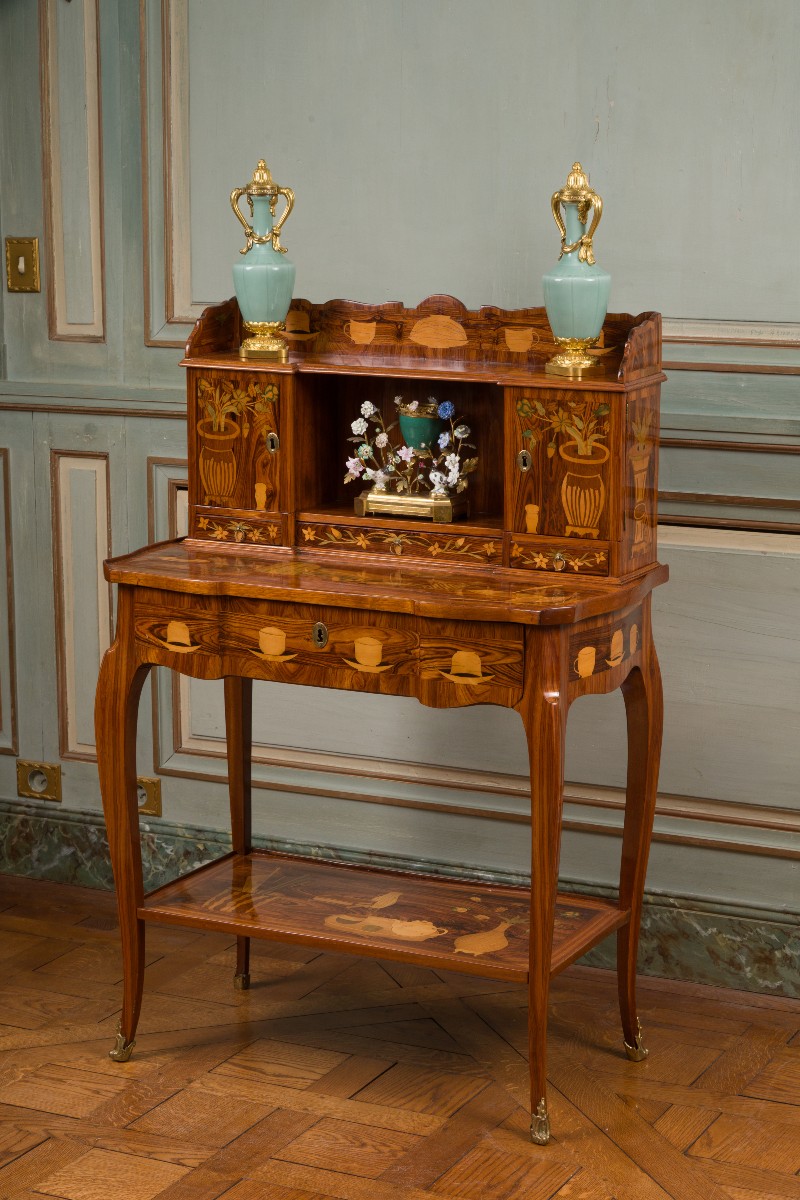
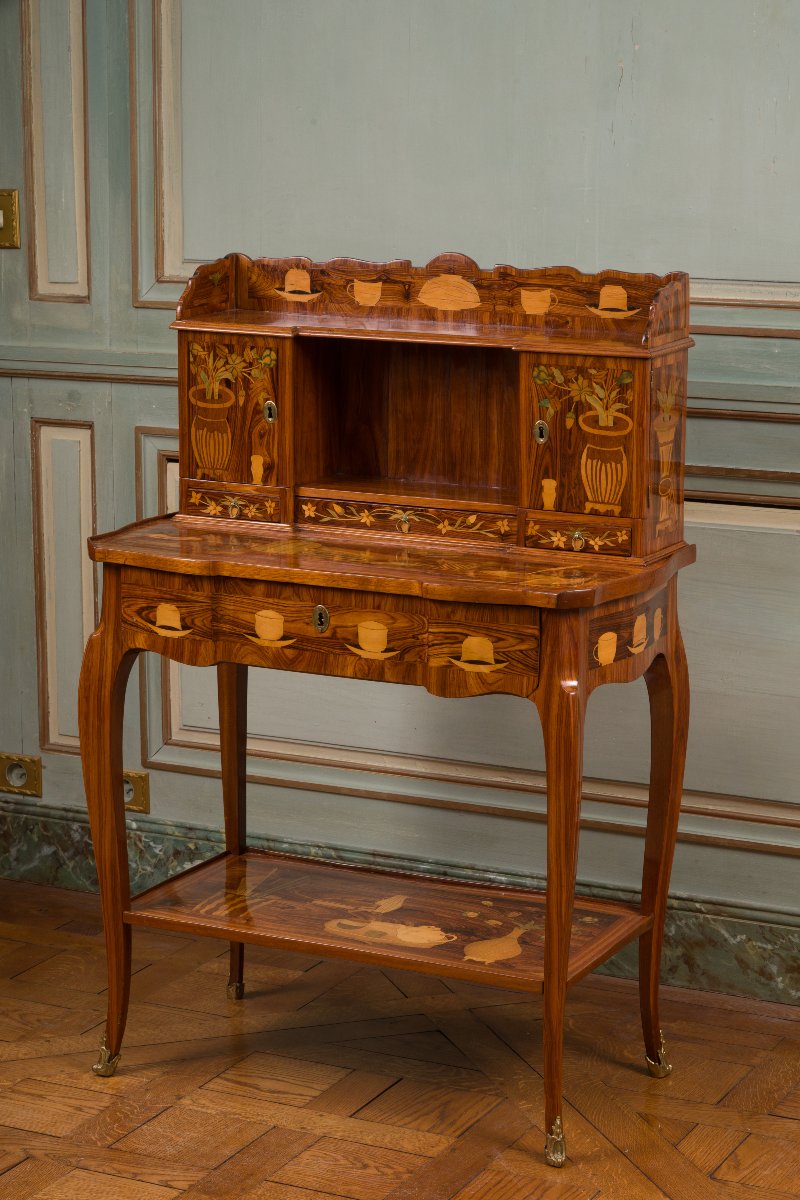
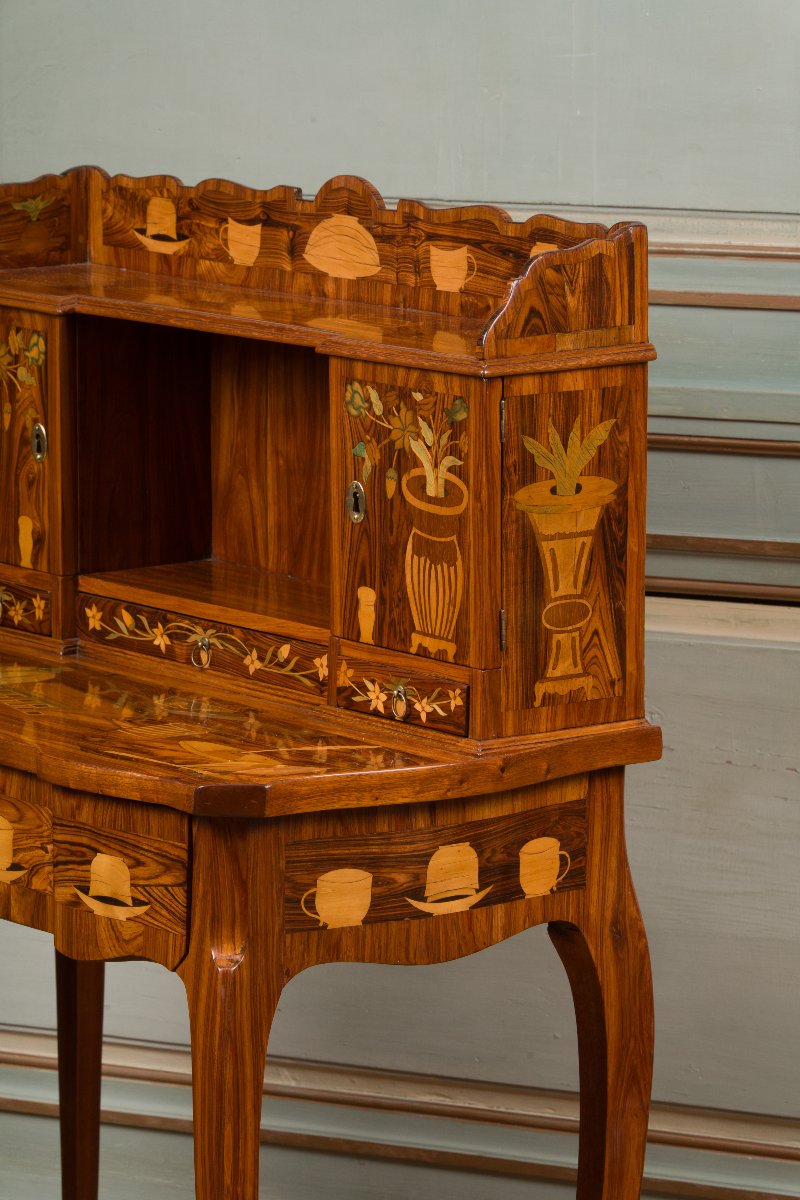
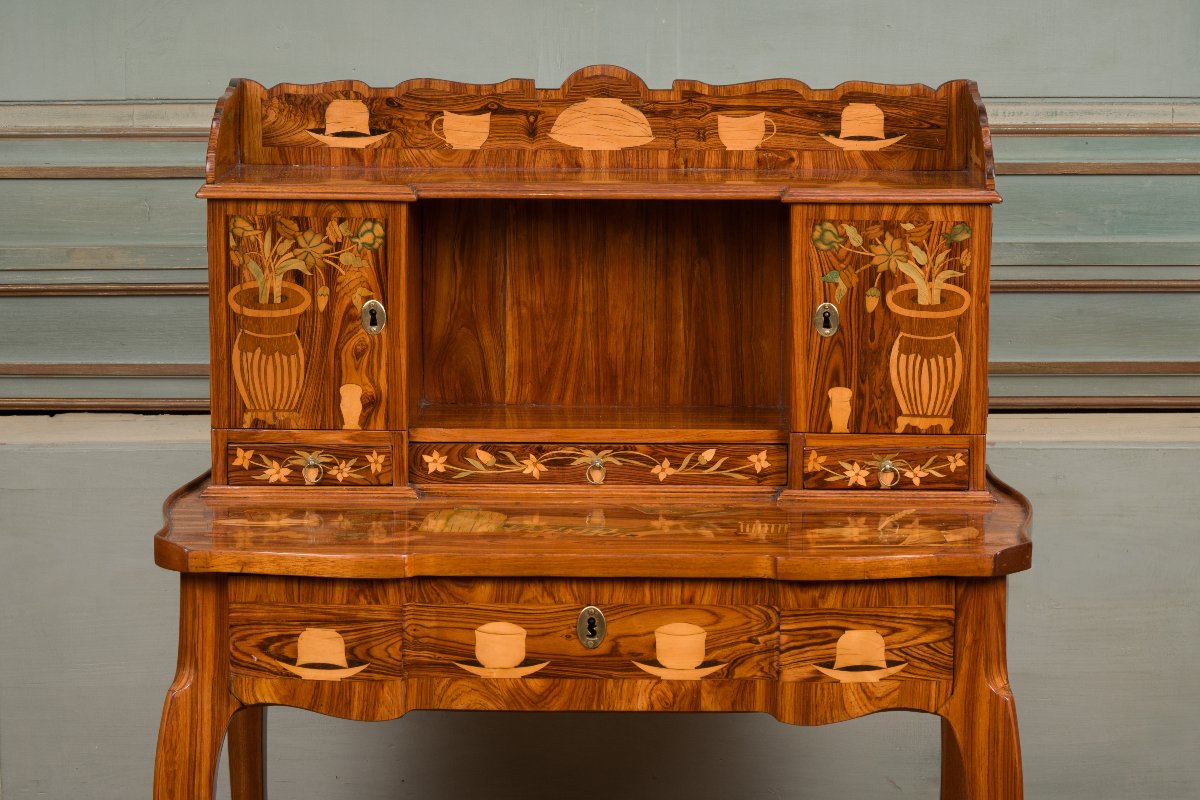
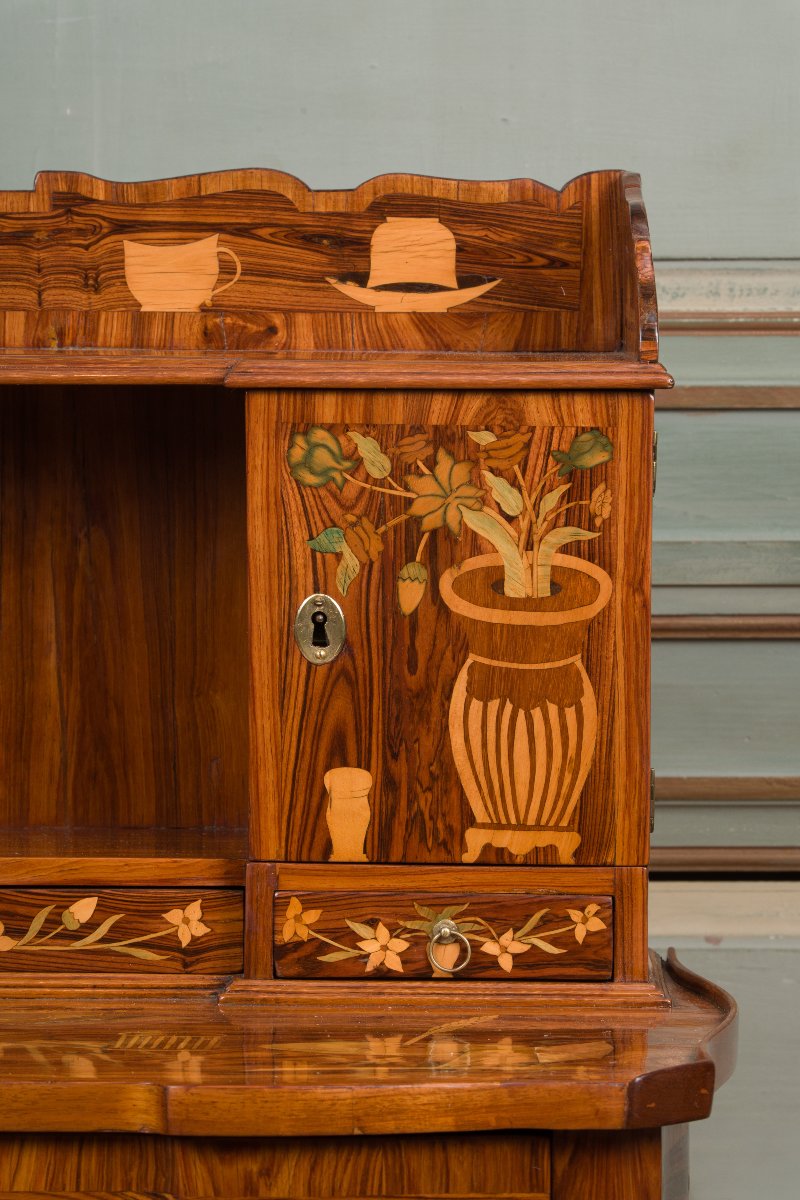
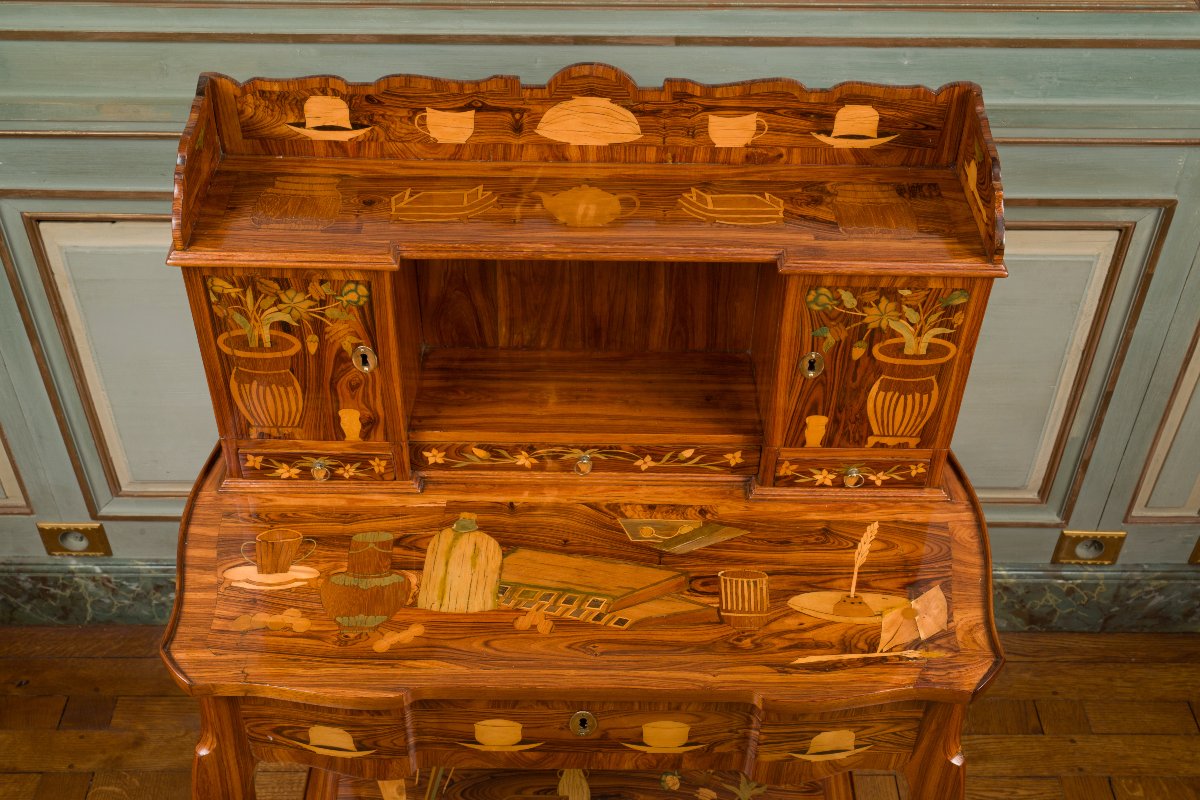
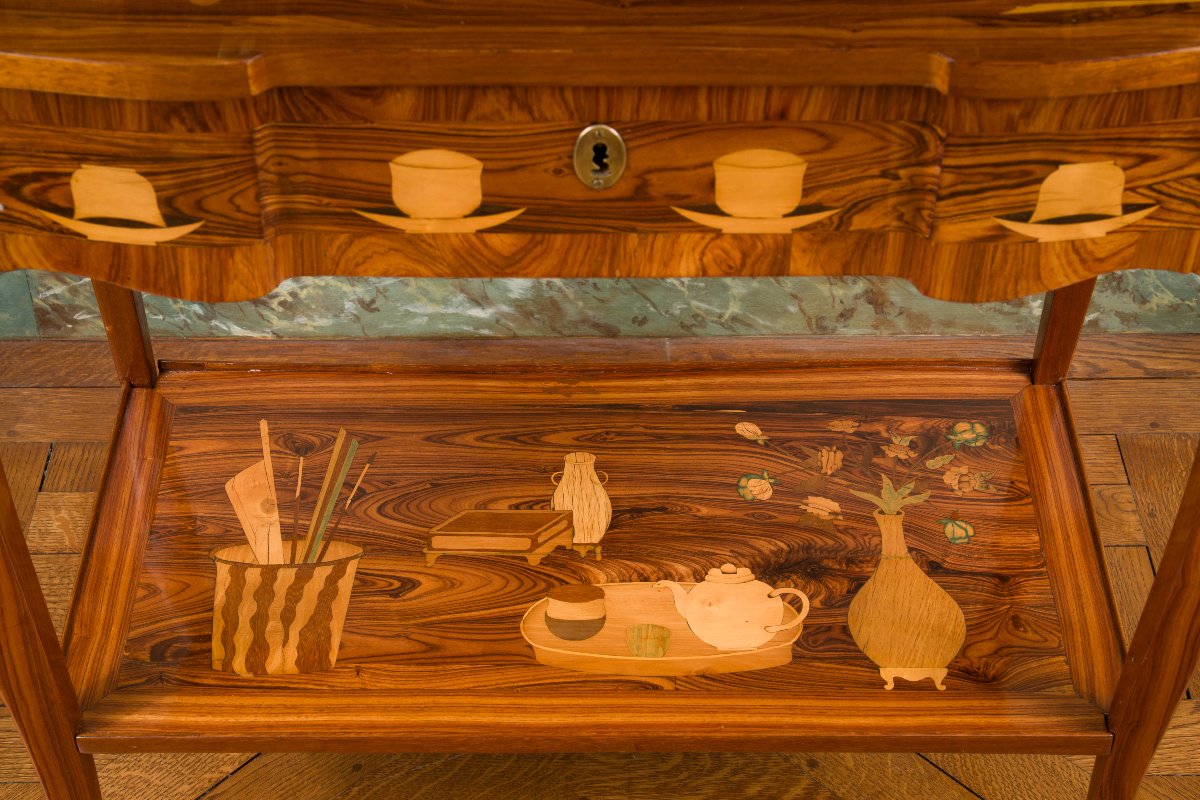
Inlaid with sycamore and rosewood on a violet wood ground. The decoration depicts garlands of flowers, vases, cups, inkwells, and other objects reminiscent of Asian art. The gallery, with its flowing cutouts, is inlaid with utensils in light woods and ebony on a violet wood ground, and bordered with a string course. The tiered section opens with two doors framing a niche and three slender drawers decorated with a garland of jasmine flowers. The lower section opens with a central drawer forming a writing surface lined with red leather. The contoured cutout top is adorned with various motifs such as playing cards, bottles, an urn, and an inkwell. The whole rests on four tall, cabriole legs joined by a stretcher shelf inlaid with paintbrushes, a vase of flowers, a cup, and a teapot. They are finished with delicate feet of chased and gilded bronze. The 18th-century craze for the Orient, as well as for fashionable new beverages such as tea, coffee, and chocolate, is reflected in the decoration of this piece of furniture. These utensils, used with marquetry of a naive style, also echo the themes of the frames found on Coromandel lacquer panels. They also evoke everyday activities, as, intended for ladies, the bonheur du jour allowed them to store papers, letters, ribbons, and jewelry.
Transitional period.
H. 109 x W. 68 x D. 40 cm.
An identical model is reproduced on page 843 of Pierre Kjellberg's book on French Furniture of the 18th Century (Éditions de l'amateur, 2002), and another is held at the Château de Champs-sur-Marne. Probably originally from Arras, Charles Topino began his career as a journeyman craftsman in the Faubourg Saint-Antoine district of Paris. He was the brother of the cabinetmaker Jean-Baptiste, known by the pseudonym Lebrund, and the nephew of the painter Topino-Lebrun.
Becoming a master craftsman in 1773, he was appointed in 1782 as a representative of the guild of joiners and cabinetmakers. Recognized both in France and abroad, Topino attracted a large clientele of merchants and fellow cabinetmakers such as Boudin, Migeon, and Delorme, as well as French noblemen like the Marquis de Graville. Among the leading minor masters of his century, his work is characterized by highly personal and easily recognizable pieces, primarily in the Transition and Louis XVI styles.
Marquetry, decorated with vases of flowers, writing desks, and various utensils such as cups, teapots, and bowls—presented in the manner of still lifes—as well as playing cards and books, are the most distinctive features of his furniture. They are most often inspired by the borders of Coromandel lacquer Chinese screens, which employ the same motifs. Gathered in oval, round, or square compartments, or arranged in a frieze, the decorations are generally viewed in profile, and their very simple cutting requires only a small number of pieces of wood, which are then chiseled for the details. They are found on small Transition-style furniture, for which Charles Topino showed a clear preference, primarily on bonheur-du-jour tables and small side tables. Among the bonheur-du-jour tables, he mainly created his models in a classic rectangular shape, but also some oval models, a novelty of the style he particularly favored. Also frequently oval, the marquetry tables depicting everyday objects typically feature a drawer in the center of the apron and two small, pivoting drawers on either side.
Transitional period.
H. 109 x W. 68 x D. 40 cm.
An identical model is reproduced on page 843 of Pierre Kjellberg's book on French Furniture of the 18th Century (Éditions de l'amateur, 2002), and another is held at the Château de Champs-sur-Marne. Probably originally from Arras, Charles Topino began his career as a journeyman craftsman in the Faubourg Saint-Antoine district of Paris. He was the brother of the cabinetmaker Jean-Baptiste, known by the pseudonym Lebrund, and the nephew of the painter Topino-Lebrun.
Becoming a master craftsman in 1773, he was appointed in 1782 as a representative of the guild of joiners and cabinetmakers. Recognized both in France and abroad, Topino attracted a large clientele of merchants and fellow cabinetmakers such as Boudin, Migeon, and Delorme, as well as French noblemen like the Marquis de Graville. Among the leading minor masters of his century, his work is characterized by highly personal and easily recognizable pieces, primarily in the Transition and Louis XVI styles.
Marquetry, decorated with vases of flowers, writing desks, and various utensils such as cups, teapots, and bowls—presented in the manner of still lifes—as well as playing cards and books, are the most distinctive features of his furniture. They are most often inspired by the borders of Coromandel lacquer Chinese screens, which employ the same motifs. Gathered in oval, round, or square compartments, or arranged in a frieze, the decorations are generally viewed in profile, and their very simple cutting requires only a small number of pieces of wood, which are then chiseled for the details. They are found on small Transition-style furniture, for which Charles Topino showed a clear preference, primarily on bonheur-du-jour tables and small side tables. Among the bonheur-du-jour tables, he mainly created his models in a classic rectangular shape, but also some oval models, a novelty of the style he particularly favored. Also frequently oval, the marquetry tables depicting everyday objects typically feature a drawer in the center of the apron and two small, pivoting drawers on either side.
29 500 €
Period: 18th century
Style: Louis 15th - Transition
Condition: Condition of use
Material: Wood marquetry
Reference (ID): 1732356
Availability: In stock
Print