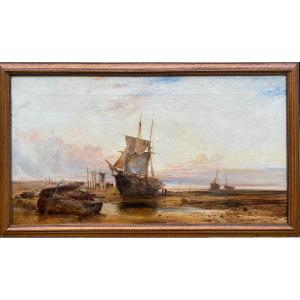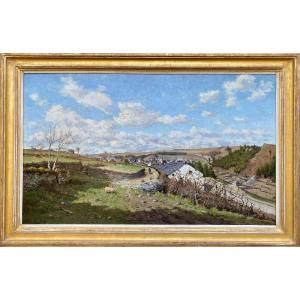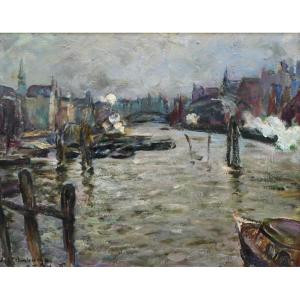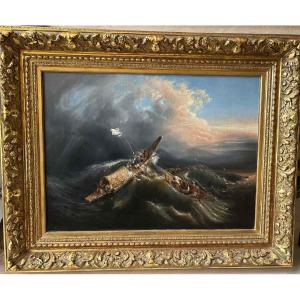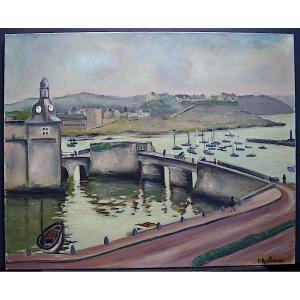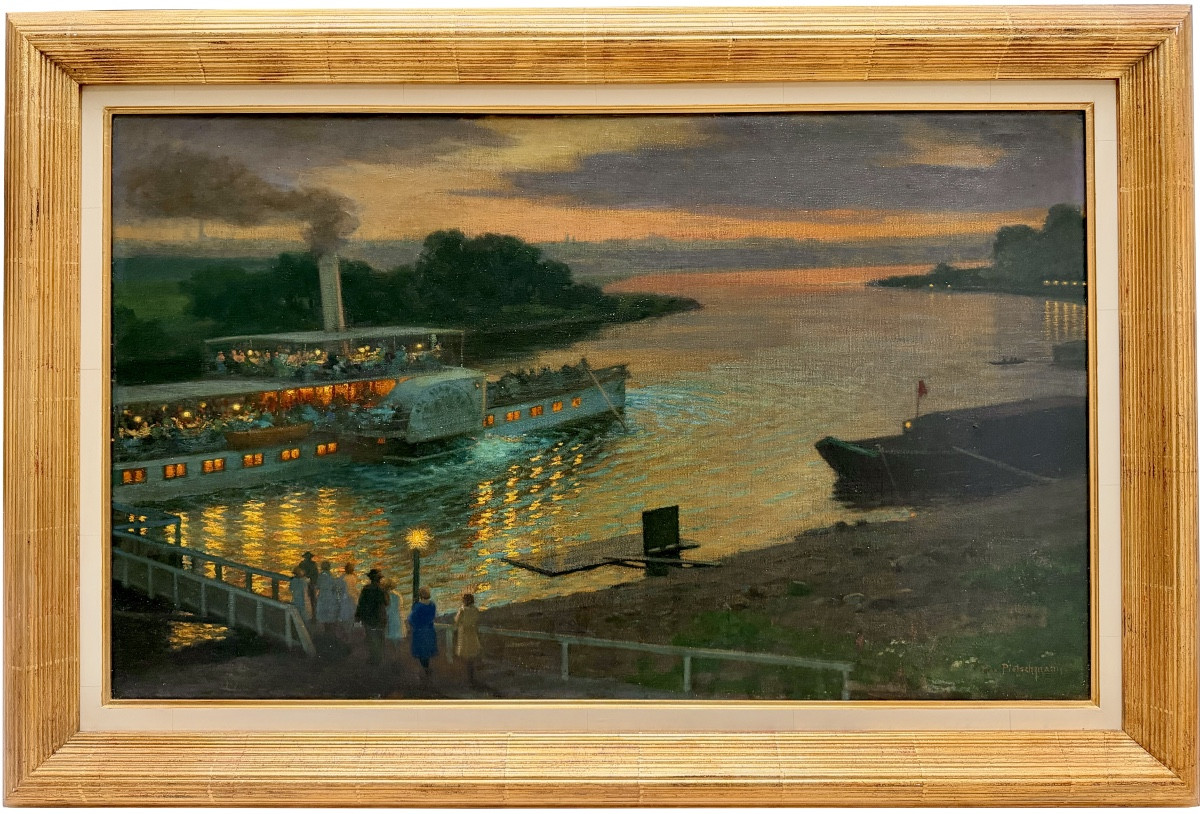
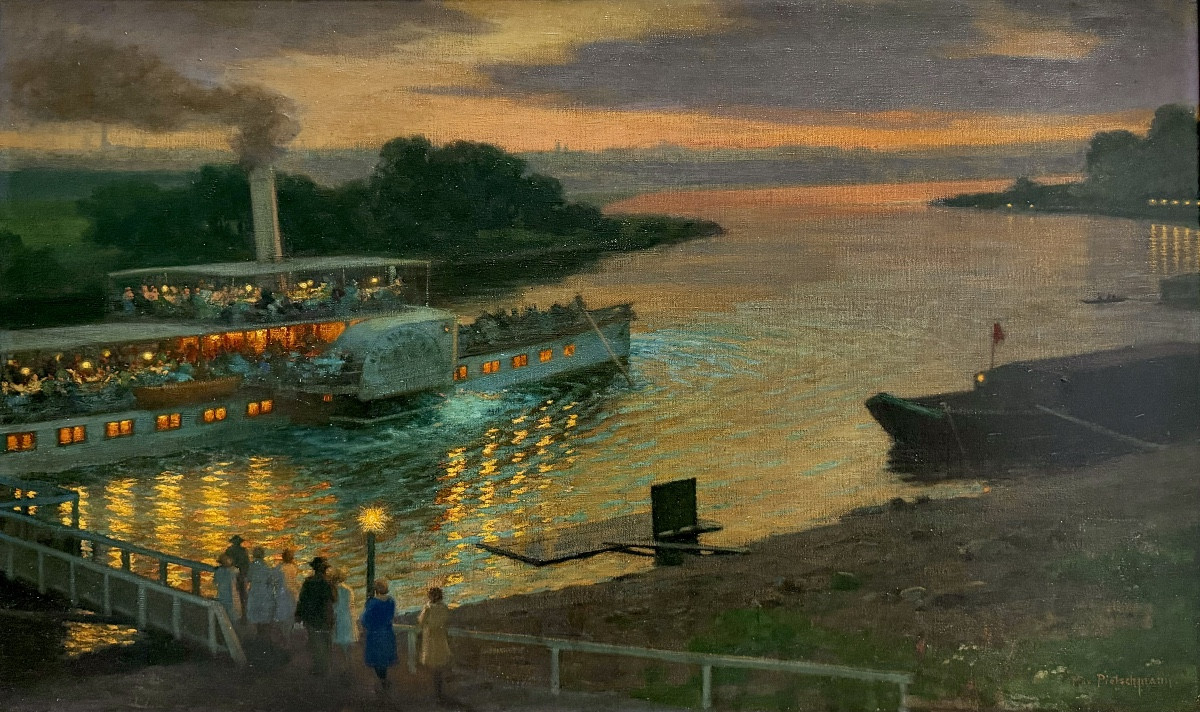

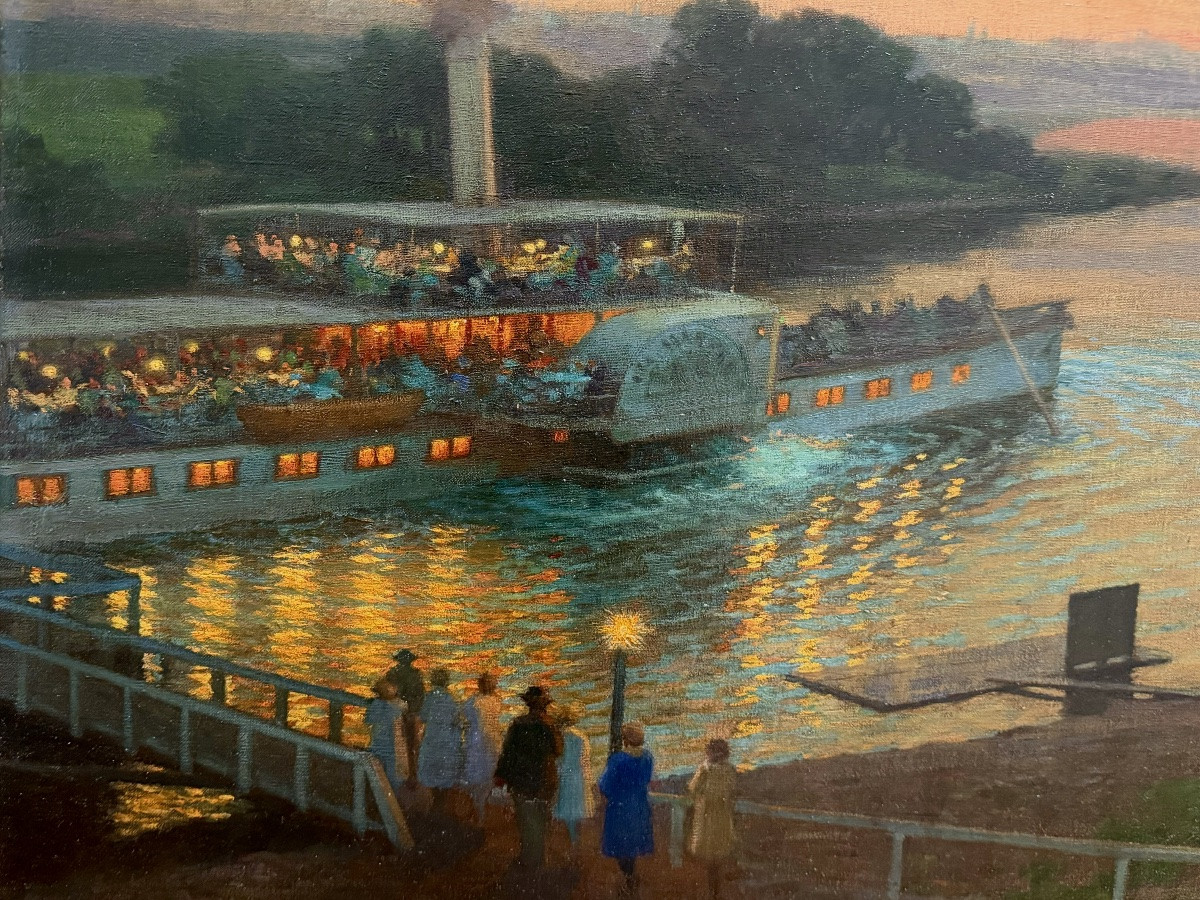
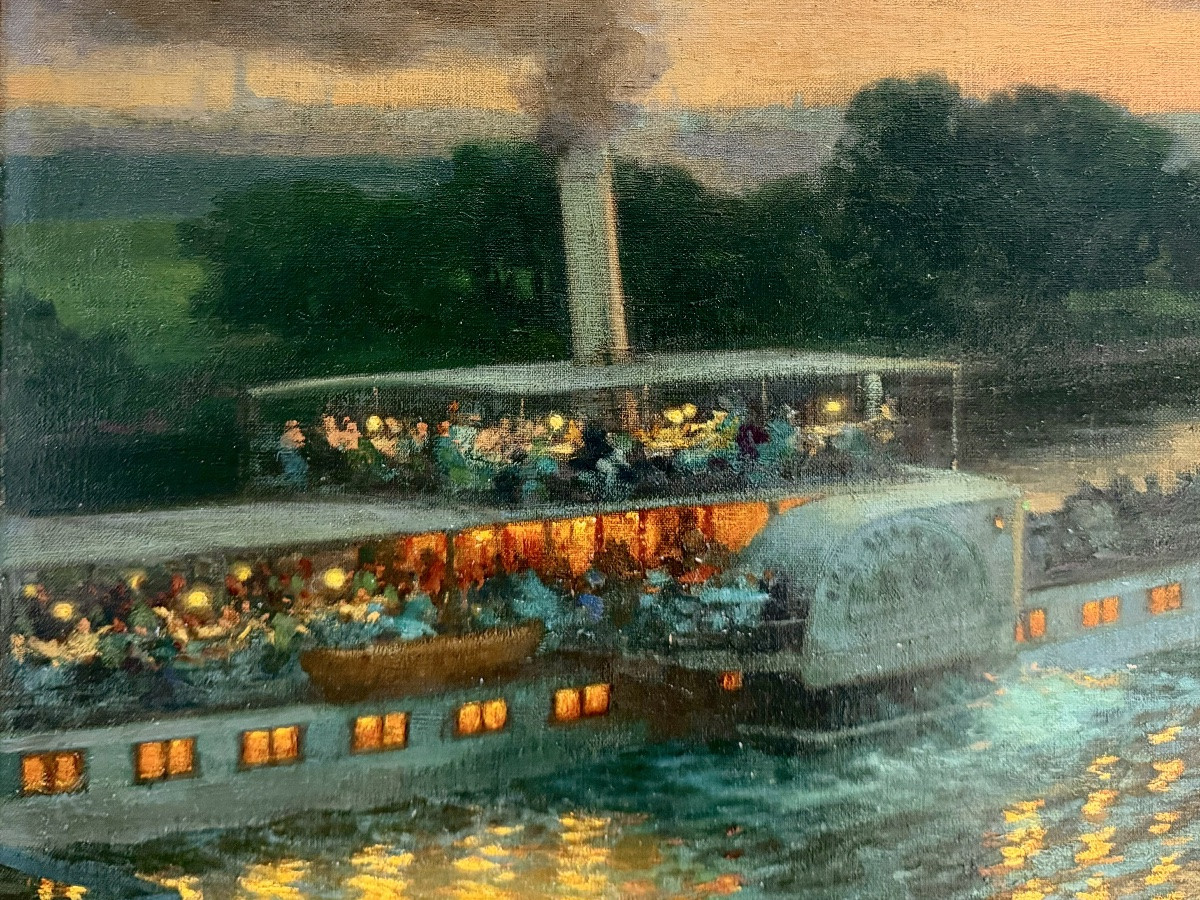

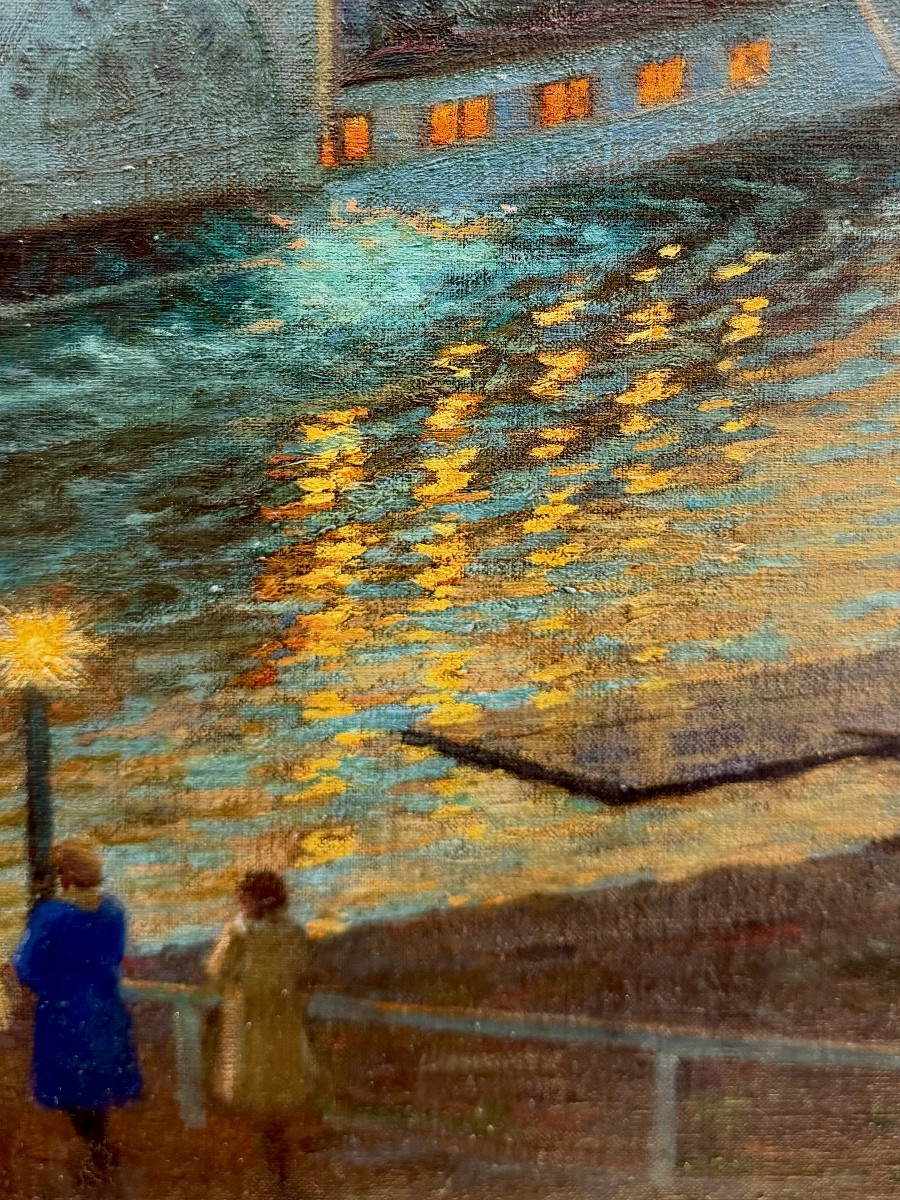
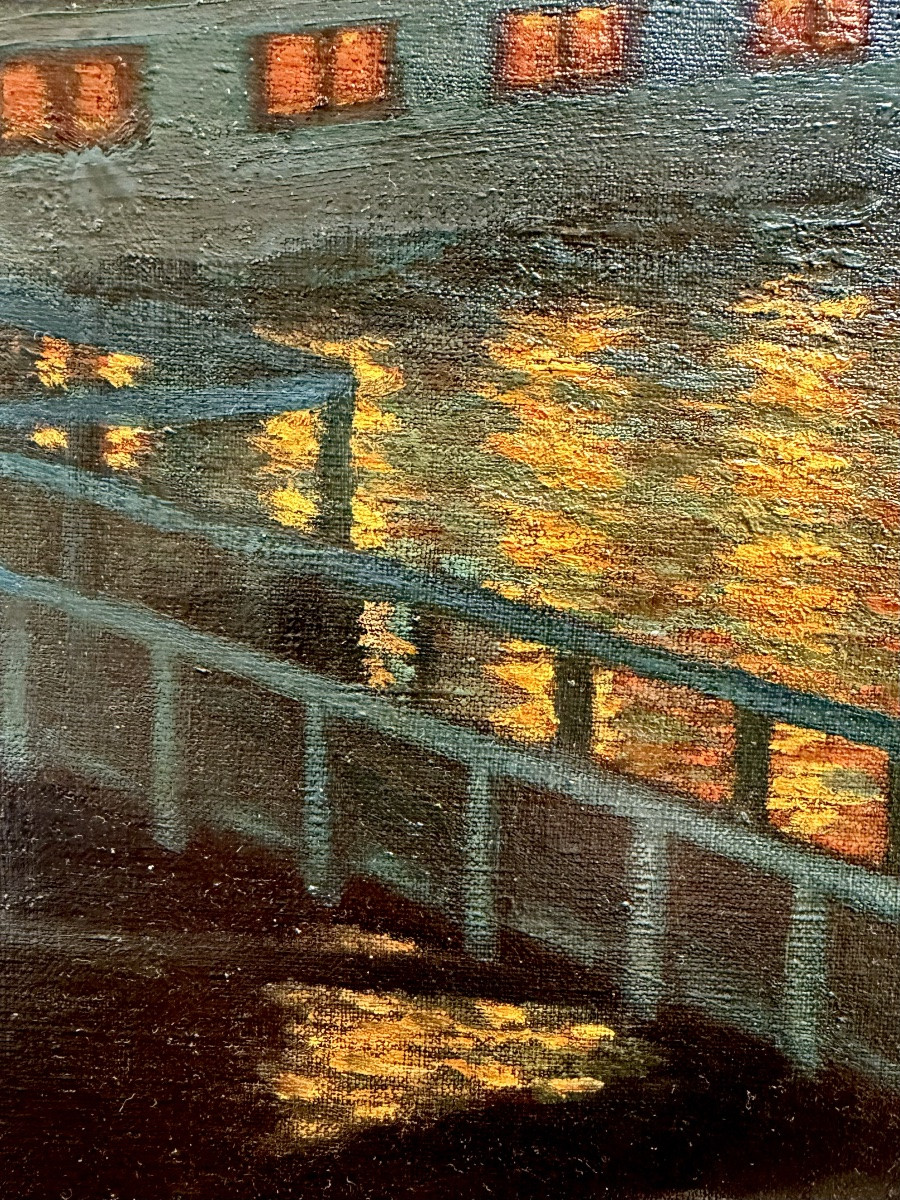
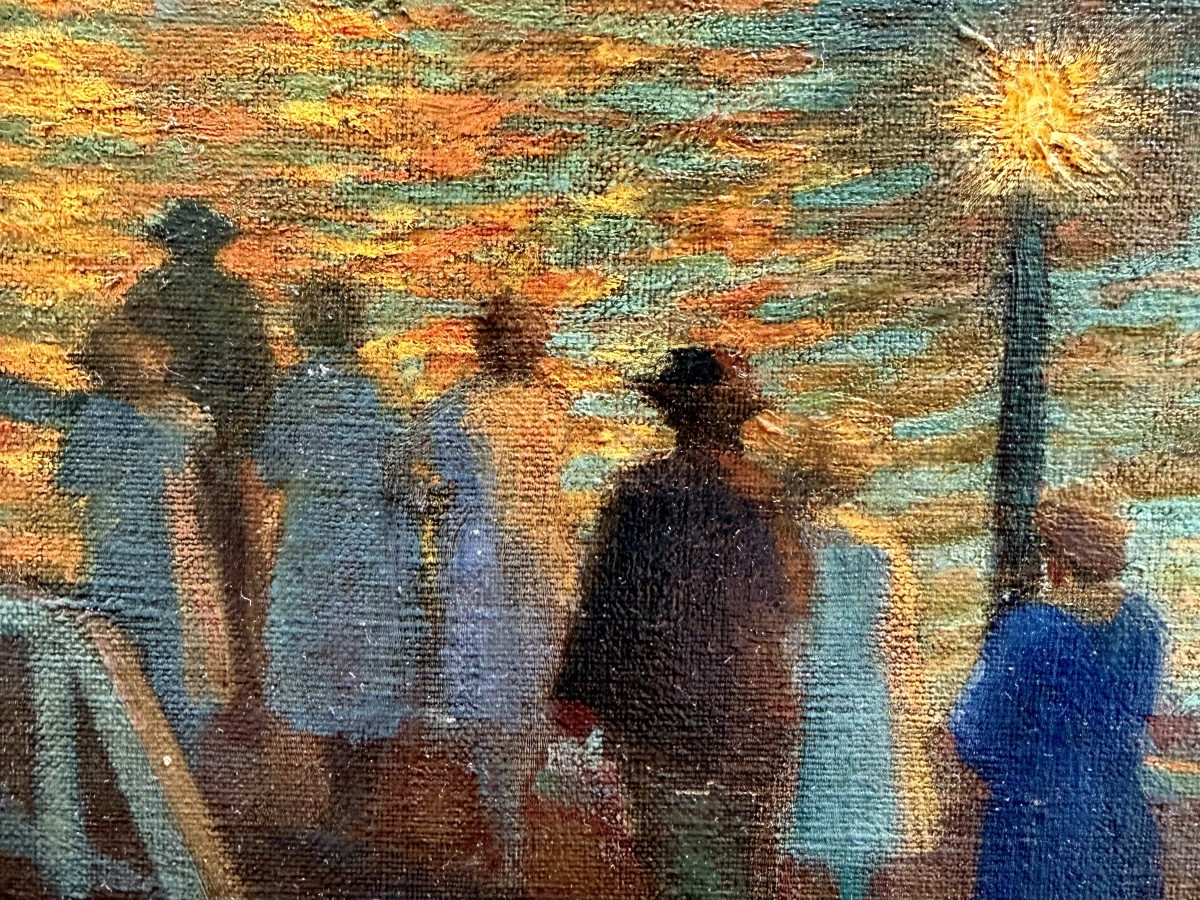
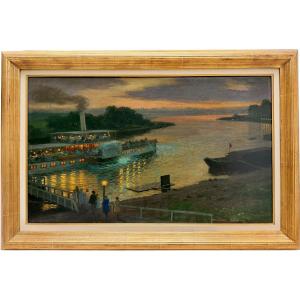


Ernst Max Pietschmann (1865 – Dresden – 1952) - Reflections In Moonlight On The Elbe At Pillnitz
Artist: Ernst Max Pietschmann, 1865 – Dresde – 1952, Peintre Allemand, Signature : Signé En Bas à Droite « Max Pietschmann »
Ernst Max Pietschmann
1865 – Dresden – 1952
German Painter
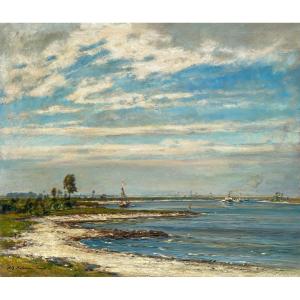
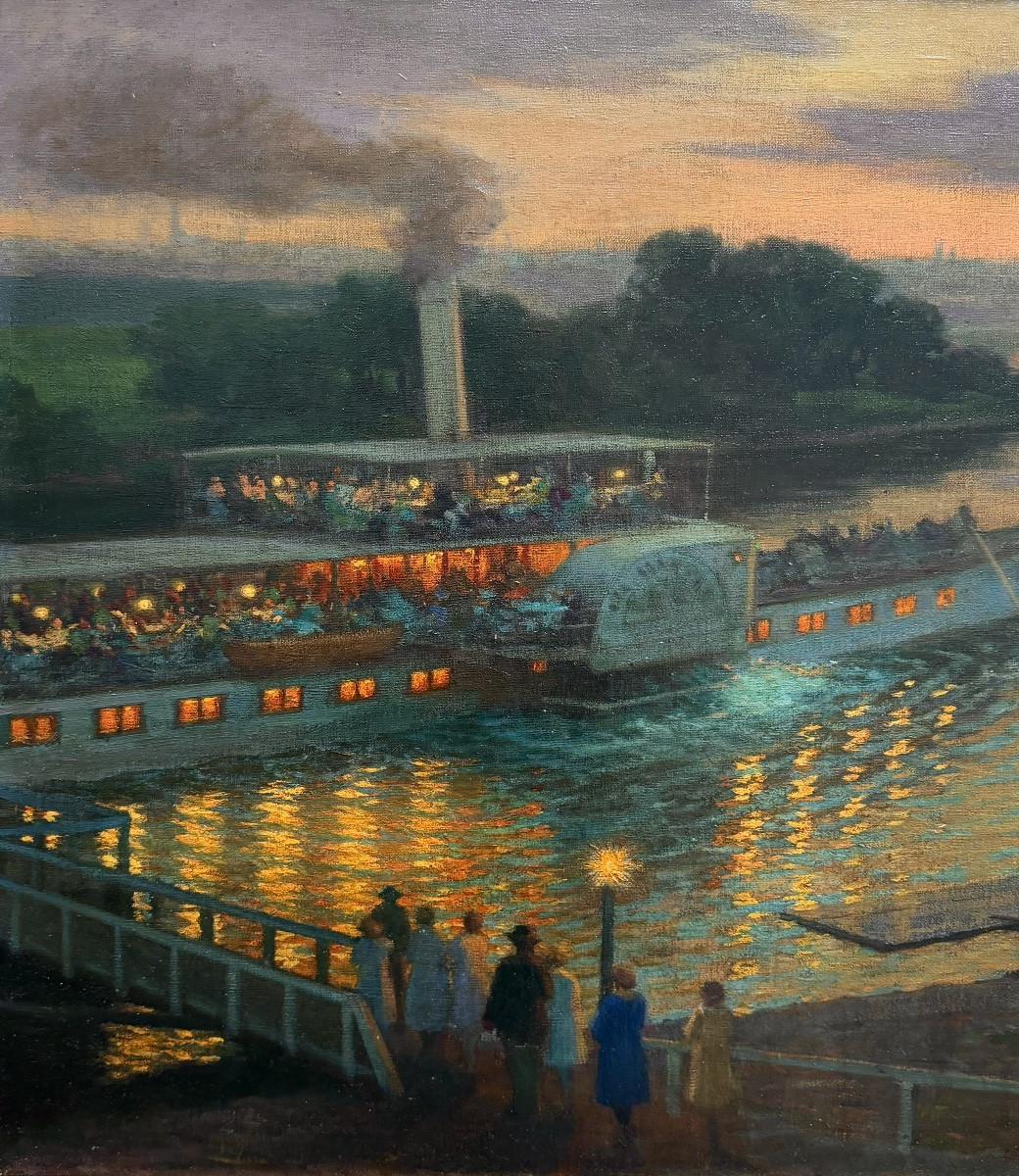
'Moonlit Reflections on the Elbe at Pillnitz'
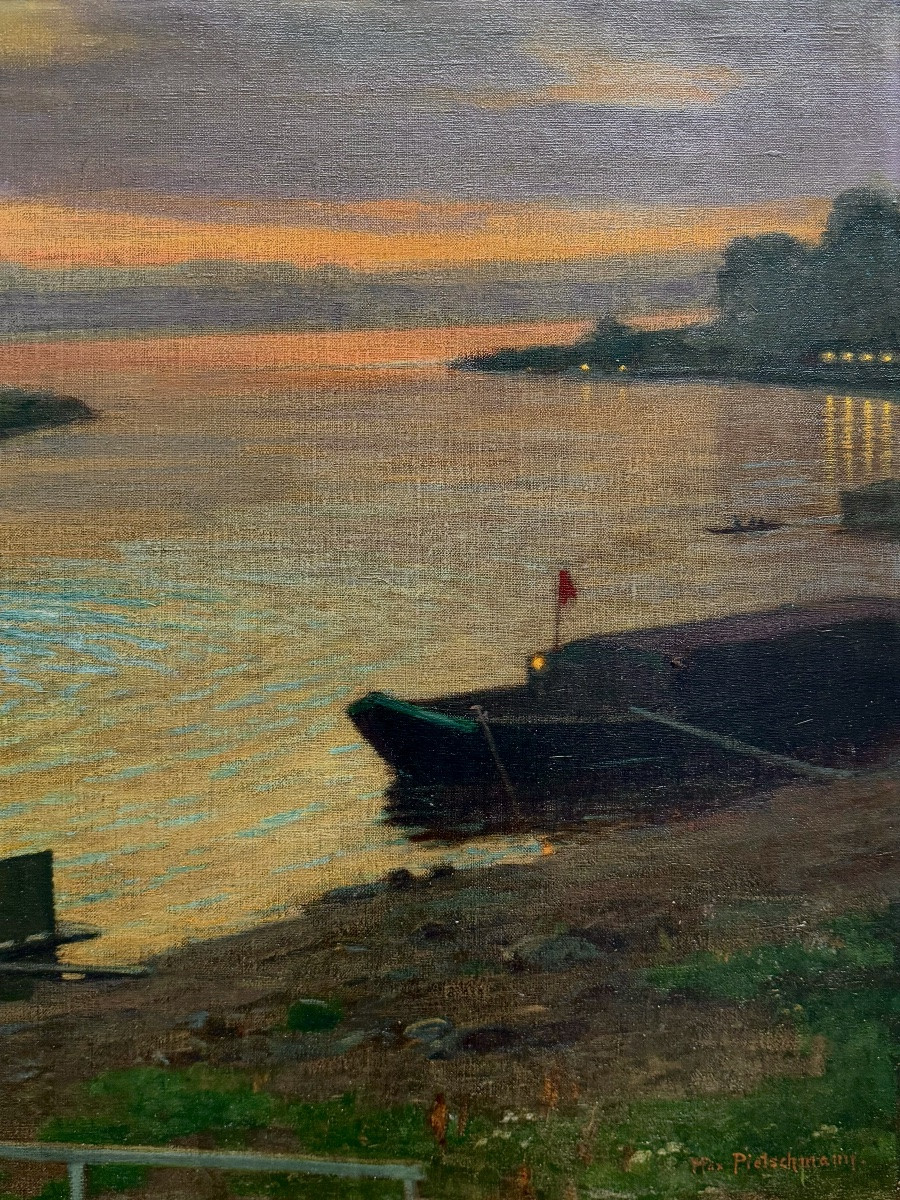
Signature: signed lower right ‘Max Pietschmann’
Medium: oil on canvas
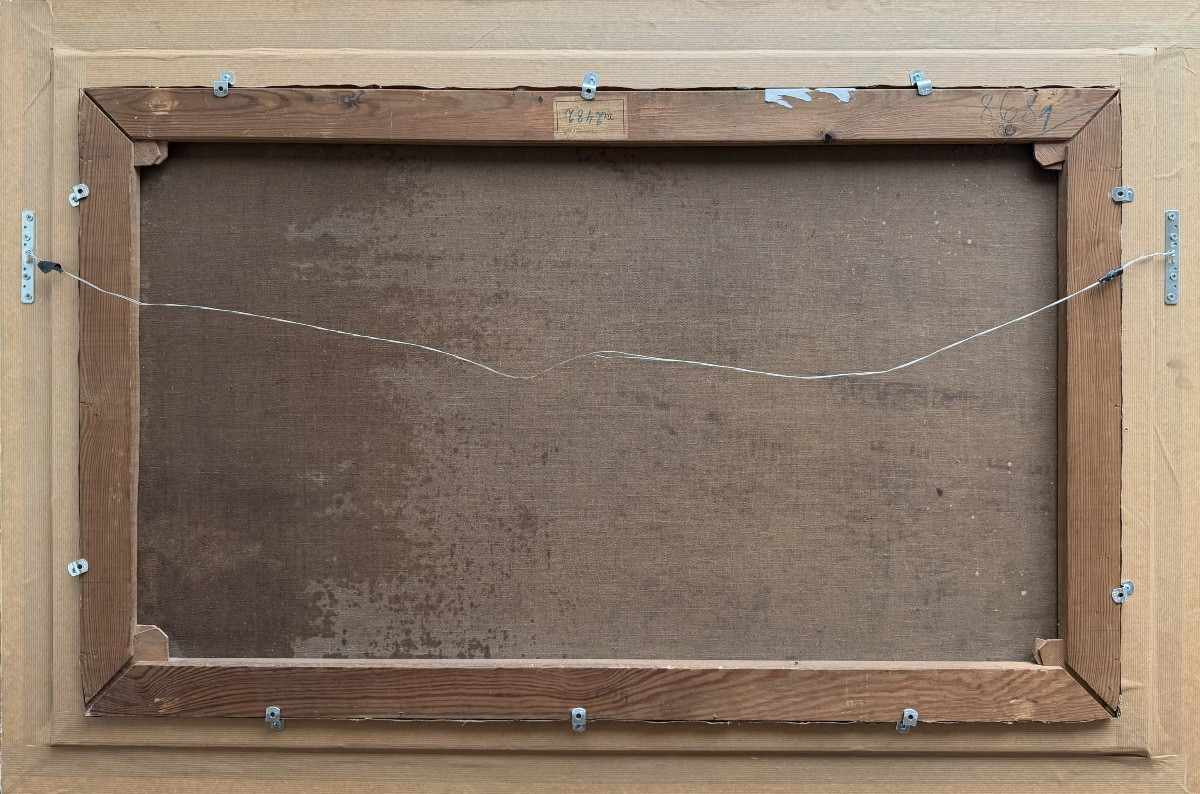
Dimensions: image size 59,5 x 98 cm; frame size 78,5 x 117 cm
Biography: Ernst Max Pietschmann (6 August 1865, Dresden – 16 April 1952, Dresden-Niederpoyritz) was a German Symbolist painter whose evocative and dreamlike compositions bridged the traditions of academic classicism with the emerging sensibilities of modern art. His work, deeply rooted in mythology and allegory, reflects a unique synthesis of rigorous academic training and a poetic, imaginative vision that aligned him with the broader currents of European Symbolism.
Pietschmann received his artistic education at the Dresden Academy of Fine Arts, where he studied under the history painter Leon Pohle and the Belgian-born artist Ferdinand Pauwels. Seeking to expand his horizons, he later traveled to Paris to attend the Académie Julian, a renowned center for progressive artistic training, where he refined his skills in figure drawing and developed his bold Symbolist style.
Upon returning to Saxony, Pietschmann became associated with the artists’ colony of Goppeln near Bannewitz and engaged in plein air painting. His early success came with the monumental Polyphemus’ Fish Catch (1892), which was later awarded at the World’s Columbian Exposition in Chicago, marking his international breakthrough. Further recognition followed at the Exposition Universelle. Around this period, he also produced important works such as Prince Bismarck in Dresden on June 18, 1892 (1895), depicting Otto von Bismarck and now in the Dresden City Museum, the Portrait of Adolf Rothermundt (1897), and Bathers in the Forest Pond in the Evening (1898), both preserved in the Gemäldegalerie Neue Meister.
Back in Dresden, Pietschmann joined the Visual Artists’ Association Dresden and became part of the early Secession movement, a decisive phase in which he fully embraced Symbolism. In 1904, he settled in Niederpoyritz, where he created his most characteristic allegorical and mythological works, influenced by artists such as Max Klinger and Arnold Böcklin, while remaining distinct within the Dresden circle alongside Oskar Zwintscher and Sascha Schneider.
Appointed professor at the Dresden Academy in 1909, Pietschmann played an important role in shaping a new generation of artists. In addition to his paintings, he worked under the pseudonym Fr. Laubnitz, producing widely admired mural prints. He died on 16 April 1952 in Niederpoyritz, and his legacy is preserved today in the Dresden State Art Collections, confirming his lasting importance within German Symbolism.
1865 – Dresden – 1952
German Painter
'Moonlit Reflections on the Elbe at Pillnitz'
Signature: signed lower right ‘Max Pietschmann’
Medium: oil on canvas
Dimensions: image size 59,5 x 98 cm; frame size 78,5 x 117 cm
Biography: Ernst Max Pietschmann (6 August 1865, Dresden – 16 April 1952, Dresden-Niederpoyritz) was a German Symbolist painter whose evocative and dreamlike compositions bridged the traditions of academic classicism with the emerging sensibilities of modern art. His work, deeply rooted in mythology and allegory, reflects a unique synthesis of rigorous academic training and a poetic, imaginative vision that aligned him with the broader currents of European Symbolism.
Pietschmann received his artistic education at the Dresden Academy of Fine Arts, where he studied under the history painter Leon Pohle and the Belgian-born artist Ferdinand Pauwels. Seeking to expand his horizons, he later traveled to Paris to attend the Académie Julian, a renowned center for progressive artistic training, where he refined his skills in figure drawing and developed his bold Symbolist style.
Upon returning to Saxony, Pietschmann became associated with the artists’ colony of Goppeln near Bannewitz and engaged in plein air painting. His early success came with the monumental Polyphemus’ Fish Catch (1892), which was later awarded at the World’s Columbian Exposition in Chicago, marking his international breakthrough. Further recognition followed at the Exposition Universelle. Around this period, he also produced important works such as Prince Bismarck in Dresden on June 18, 1892 (1895), depicting Otto von Bismarck and now in the Dresden City Museum, the Portrait of Adolf Rothermundt (1897), and Bathers in the Forest Pond in the Evening (1898), both preserved in the Gemäldegalerie Neue Meister.
Back in Dresden, Pietschmann joined the Visual Artists’ Association Dresden and became part of the early Secession movement, a decisive phase in which he fully embraced Symbolism. In 1904, he settled in Niederpoyritz, where he created his most characteristic allegorical and mythological works, influenced by artists such as Max Klinger and Arnold Böcklin, while remaining distinct within the Dresden circle alongside Oskar Zwintscher and Sascha Schneider.
Appointed professor at the Dresden Academy in 1909, Pietschmann played an important role in shaping a new generation of artists. In addition to his paintings, he worked under the pseudonym Fr. Laubnitz, producing widely admired mural prints. He died on 16 April 1952 in Niederpoyritz, and his legacy is preserved today in the Dresden State Art Collections, confirming his lasting importance within German Symbolism.
7 500 €
Period: 19th century
Style: Other Style
Condition: Excellent condition
Material: Oil painting
Width: 117 cm
Height: 78,5 cm
Depth: 10 cm
Reference (ID): 1730797
Availability: In stock
Print