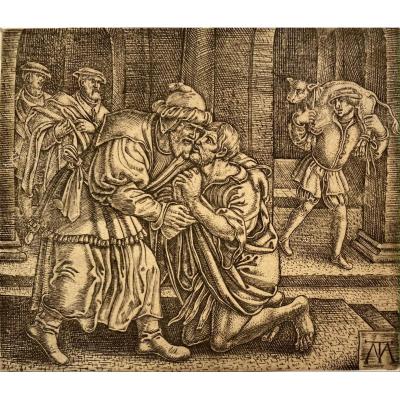
16th Century Engraving By Saenredam After Goltzius: Venus Presiding Over Love
Artist: Saenredam Jan ( 1565 – 1607 )
After Hendrick Goltzius, from the series: Seven Planets (New Hollstein: 657 to 663).
Fine impression, slight printing crease visible only on the verso.
Watermark similar to Briquet 1073 or 1075, "quartered bendwise, a lion. These arms are those of Baden-Hochberg (...) perhaps they can be attributed to Ettlingen."
STATE I/II before the second numbering below on the right.
N.H: 661.
The Seven Planets series is part of the iconographic tradition of planetary gods and children. Alongside ancient pagan stellar beliefs, elements of ancient mythology and divine iconography were transmitted throughout the Middle Ages in astrological manuscripts, calendars, and more generally in literature. From the 6th century BC onwards, the planets bore the names of ancient deities. According to astrology, children born under the influence of a planet and a constellation were characterized by specific qualities, activities, or professions. Since the end of the 15th century, particularly in the works of Marten van Heemskerck and Maarten de Vos, it was customary in series of prints to depict the deity in question in a chariot on its celestial orbit, while the children of the planets went about their business on Earth. Goltzius's fundamental iconographic innovation was to place the gods in the form of statues on pedestals, within a landscape surrounded by children of the planets dressed in the fashion of the time (cf. Ilja M. Veldman, "Antike Götter als Planeten und ihr Einfluss auf die Erdbewohner," in: catalogue Hendrick Goltzius – Mythos, Macht und Menschlichkeit, Petersberg/Dessau 2017, p. 142 et seq.).
Goltzius also established a new hierarchy in the order of the planets, which—according to the knowledge of the time—began with the planet farthest from Earth, as well as in the characterization of the planetary children. Above these terrestrial scenes, which feature Latin verses by the Haarlem humanist Cornelius Schonaeus, the constellations and planetary symbols unfold across the sky. Goltzius's planetary images possess an imposing presence, thanks to the invention of earthly statues of the gods and the spatial composition that places the observer on the same visual level as the planetary children. Saenredam's brilliant technique lends them superb harmony and elegance. "Nicolaas Teeuwisse. Berlin"
Copperplate width: 177.00
Copperplate height: 250.00
Sheet width: 208.00
Sheet height: 300.00
Fine impression, slight printing crease visible only on the verso.
Watermark similar to Briquet 1073 or 1075, "quartered bendwise, a lion. These arms are those of Baden-Hochberg (...) perhaps they can be attributed to Ettlingen."
STATE I/II before the second numbering below on the right.
N.H: 661.
The Seven Planets series is part of the iconographic tradition of planetary gods and children. Alongside ancient pagan stellar beliefs, elements of ancient mythology and divine iconography were transmitted throughout the Middle Ages in astrological manuscripts, calendars, and more generally in literature. From the 6th century BC onwards, the planets bore the names of ancient deities. According to astrology, children born under the influence of a planet and a constellation were characterized by specific qualities, activities, or professions. Since the end of the 15th century, particularly in the works of Marten van Heemskerck and Maarten de Vos, it was customary in series of prints to depict the deity in question in a chariot on its celestial orbit, while the children of the planets went about their business on Earth. Goltzius's fundamental iconographic innovation was to place the gods in the form of statues on pedestals, within a landscape surrounded by children of the planets dressed in the fashion of the time (cf. Ilja M. Veldman, "Antike Götter als Planeten und ihr Einfluss auf die Erdbewohner," in: catalogue Hendrick Goltzius – Mythos, Macht und Menschlichkeit, Petersberg/Dessau 2017, p. 142 et seq.).
Goltzius also established a new hierarchy in the order of the planets, which—according to the knowledge of the time—began with the planet farthest from Earth, as well as in the characterization of the planetary children. Above these terrestrial scenes, which feature Latin verses by the Haarlem humanist Cornelius Schonaeus, the constellations and planetary symbols unfold across the sky. Goltzius's planetary images possess an imposing presence, thanks to the invention of earthly statues of the gods and the spatial composition that places the observer on the same visual level as the planetary children. Saenredam's brilliant technique lends them superb harmony and elegance. "Nicolaas Teeuwisse. Berlin"
Copperplate width: 177.00
Copperplate height: 250.00
Sheet width: 208.00
Sheet height: 300.00
800 €
Period: 16th century
Style: Other Style
Condition: Good condition
Material: Paper
Width: 208 mm
Height: 300 mm
Reference (ID): 1725043
Availability: In stock
Print