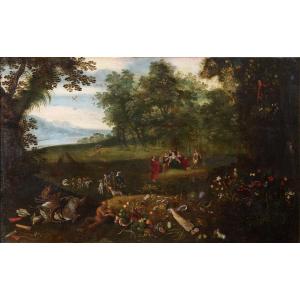

Landscape With Diana The Huntress
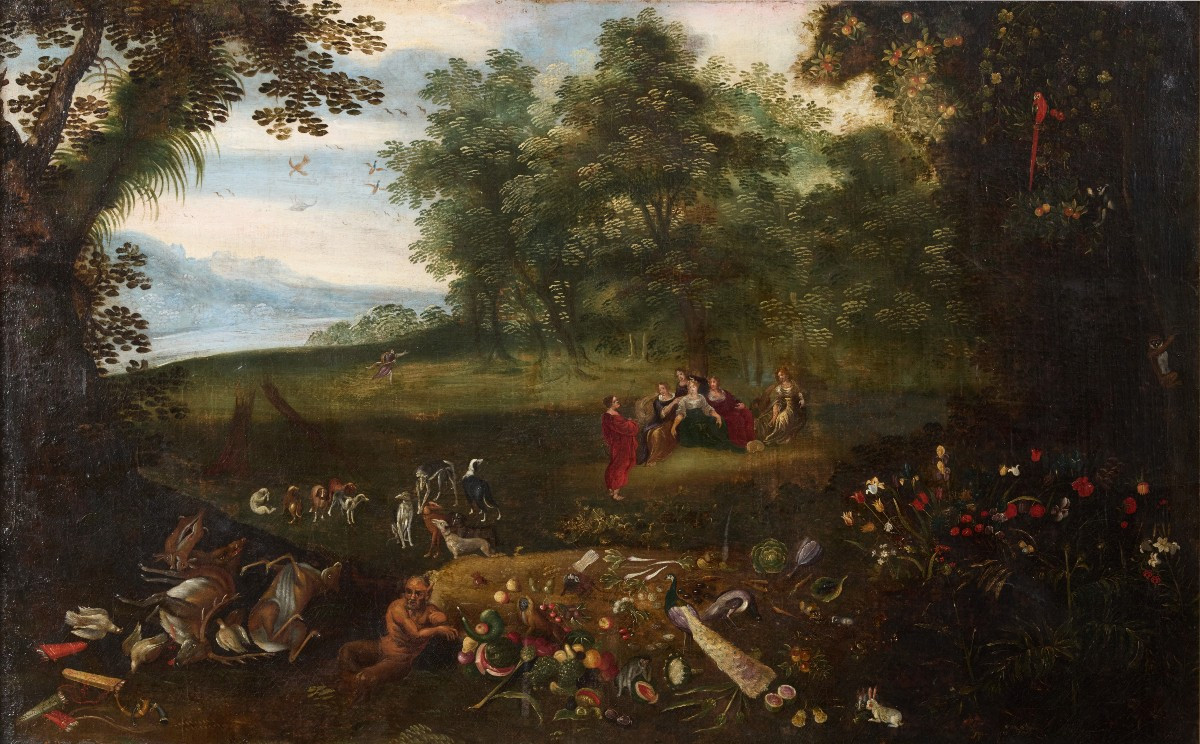
The painting depicts a vast wooded landscape bathed in soft light. The scene is arranged in depth, with a lake or body of water visible in the left background, bordered by bluish hills or mountains. The sky is clear, slightly cloudy, and a few birds fly in the distance. In the center right of the composition, in a clearing surrounded by trees, five women sit together. They wear long dresses in various colors (red, green, blue, gold). A figure dressed in red stands facing them, seemingly speaking to them or presenting something. To the left of the main group, in the background, a small human figure runs or walks in the meadow. The foreground is very rich in detail. A wide variety of animals are visible. In the center of the foreground is an abundant pile of fruit and vegetables: open watermelons, grapes, apples, pears, and other colorful fruits. Nearby, a naked or partially naked male figure, who appears elderly, is lying or crouching near this profusion of food. On the right, the vegetation becomes denser and darker. Various brightly colored flowers (red, white, yellow) are visible, as well as a red bird perched in the branches. The light gradually diminishes towards this area, creating a marked contrast between the luminous central clearing and the more shaded lateral areas. The entire composition combines human figures, animals, abundant vegetation, and a natural landscape in a detailed and teeming scene. Despite the profusion of elements that enliven the composition, the central subject of the painting is Diana the Huntress. Diana—Artemis in the Greek tradition—is recognizable by the crescent moon adorning her brow. Daughter of Jupiter and Leto, twin sister of Apollo, she is one of the twelve Olympian deities. A virgin goddess, living in the forests and keeping herself apart from the world of men, she appears here surrounded by her companions, also devoted to chastity. The group she forms with her attendants occupies the upper part of a structuring diagonal that guides the eye toward the lower left corner of the painting. Here are arranged the spoils of the hunt: the arrows and quiver, emblematic attributes of the goddess. Midway along this line of force, a group of dogs unfolds, another distinctive sign of Diana the huntress, reinforcing the iconographic coherence of the scene. In the background, a female figure in motion, preceded by a dog and moving across the landscape, seems to constitute a further evocation of the goddess in the act of hunting. A rabbit, spotted by the animal, is further concealed in the undergrowth, suggesting the ongoing chase. In the foreground, to the right of the hunting trophy, stands a satyr. This mythological figure, traditionally associated with instincts, impulses, and sensuality, establishes a symbolic contrast with the chastity and self-control embodied by Diana. Further to the right, a still life teeming with fruits and vegetables, among which exotic animals roam, develops an iconography of abundance and fertility. Finally, in the lower right corner, a profusion of flowers completes the composition, accentuating the impression of abundance and natural luxuriance that pervades the entire work. Opposite the group of female figures stands a figure dressed in red, holding a spear and an object that could be interpreted as a helmet. This figure could represent another manifestation of Diana herself, according to a technique of multiple representation found in other 17th-century compositions. This iconography of Diana draped in red and armed with a spear is notably found in the works of Rubens and Hans van Balen.
24 000 €
Period: 17th century
Style: Other Style
Condition: Excellent condition
Material: Oil painting
Length: 119
Width: 75
Reference (ID): 1724350
Availability: In stock
Print