THIS OBJECT WAS SOLD
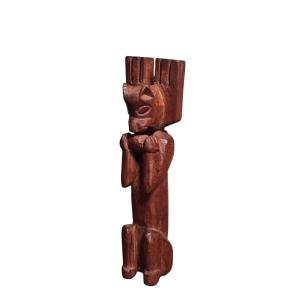
Yoruba Divination Tablet, Nigeria


An oblong divination tablet, carved in relief with a hybrid spirit combining the body of a crocodile with a human figure. The animal's paws transform into arms and legs, while the tail blends harmoniously into the composition. The reptile's belly is marked with hatched incisions evoking scales. A rectangular opening at the top allowed the object to be suspended. Wood, old brown patina, signs of wear. Yoruba, Nigeria. 52 × 14.5 cm. Sold mounted on a base, with a certificate from expert S. Reynes and an invoice from Galerie Ocarina.* Shipping costs upon request. "Among the Yoruba, divination tablets served as intermediaries between the diviner and spiritual forces, supporting dialogue with nature spirits. The crocodile, the quintessential amphibious animal, symbolizes vital power, mastery of the two worlds—aquatic and terrestrial—and the capacity to mediate between the visible and invisible. This association between human and reptilian form illustrates an ancient concept, widely shared in West Africa, according to which humankind draws its strength from the energy of totemic animals. The harmonious intertwining of the two beings expresses the unity of the cosmos, while the gesture of raised arms symbolically connects earth and sky in a call to the forces "protective." Sold to "The Yoruba are a community primarily located in Nigeria and other West African countries (Benin, Togo, Ghana), but they can also be found worldwide. Nigeria is extremely dynamic in terms of the art market, with two main cities: Ife and Benin City. The city of Ife was an important cultural center between the 9th and 17th centuries and is considered by the Yoruba to be the cradle of humanity and the very origin of their community. The ancestor of this community – Oduduwa, son of the supreme God – is said to have conquered the territory in the 11th century and organized it into several cities, including Ife. The latter housed the seat of the oni, the religious leader. This community was already organized by 1826. Indeed, by that date, there were already 55 cities, several of which had more than 20,000 inhabitants. It is also characterized by a significant political apparatus. At the head of each city was an oba – a sacred figure who only leaves his palace veiled – wielding all power. The Yoruba religion includes an impressive pantheon of numerous gods (orishas), ancestors, and spirits of nature. It continues to exist despite the steady spread of Islam. Currently, the Yoruba are still numerous in Nigeria and actively participate in the economy, administration, and culture.
Explore similar pieces and discover your ideal find:
Wood Sculptures